As firms exit an industry, the industry supply curve shifts __________ and the
equilibrium price __________ until long-run competitive equilibrium is established and
the surviving firms are earning __________ economic profits.
a. leftward; rises; zero
b. leftward; falls; positive
c. leftward; rises; positive
d. rightward; falls; negative
e. rightward; rises; positive
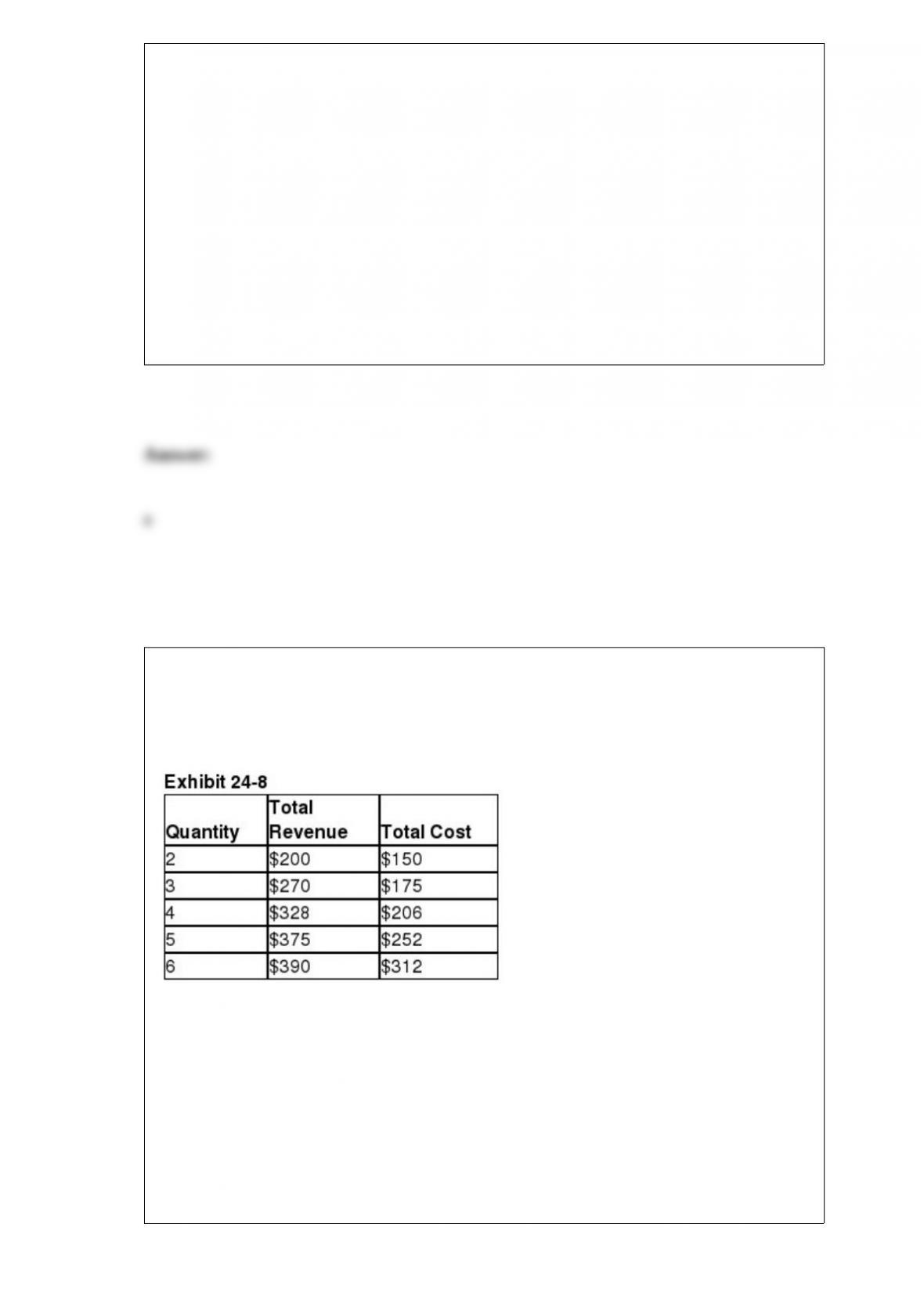
Refer to Exhibit 24-8. A profit-maximizing single-price monopolist will produce which
quantity of output?
a. 3 units
b. 4 units
c. 5 units
d. 6 units
e. There is not enough information given to answer this question.

Samantha is given a flu shot by her doctor. This reduces the probability that she will get
the flu and it also reduces the probability that others will get the flu, too. The latter is an
example of a
a. negative externality.
b. positive externality.
c. substitute good.
d. complementary good.
If a person is receiving greater marginal utility per dollar from consuming one good
than another, it follows that he or she is
a. maximizing disutility.
b. not maximizing utility.
c. maximizing utility.
d. There is not enough information to answer the question.

Which of the following statements is false?
a. If a negative externality exists, the market output is greater than the socially optimal
output.
b. If a positive externality exists, the market output is less than the socially optimal
output.
c. If there are no external costs or benefits, then it follows that marginal private costs
equal marginal social costs and marginal private benefits equal marginal social benefits.
d. When a positive externality exists, marginal social benefits are greater than marginal
private benefits.
e. none of the above
Switching costs make it less likely that the consumer of a network good will shift to a
different company’s product. This is called the __________ effect.
a. lock-in
b. system
c. Internet
d. compression
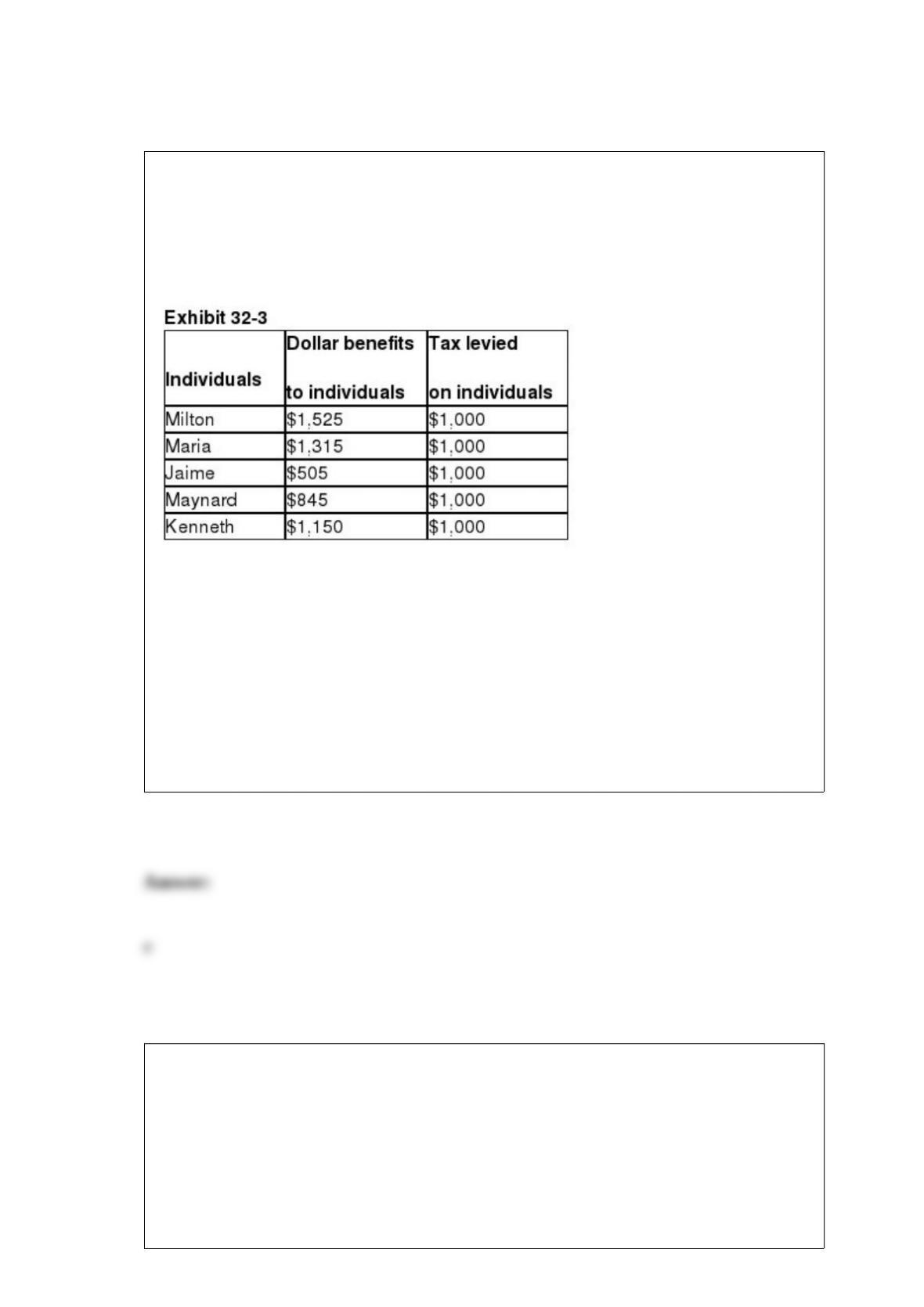
Refer to Exhibit 32-3. The exhibit shows the breakdown of benefits and costs for a
five-person community considering whether to purchase a $5,000 statue of Adam Smith
to put in the center of the public square. How will each of the five persons (from Milton
to Kenneth, in order) vote?
a. against; against; against; for; for
b. against; against; for; for; against
c. against; for; for; for; for
d. for; for; for; against; against
e. for; for; against; against; for
Which of the following statements is true?
a. The monopolist can sell all it can produce at the market price.
b. The marginal revenue curve of the single-price monopolist lies above its demand
curve.
c. The marginal revenue curve of the single-price monopolist is the same as its demand
curve.
d. The marginal revenue curve of the single-price monopolist lies below its demand
curve.
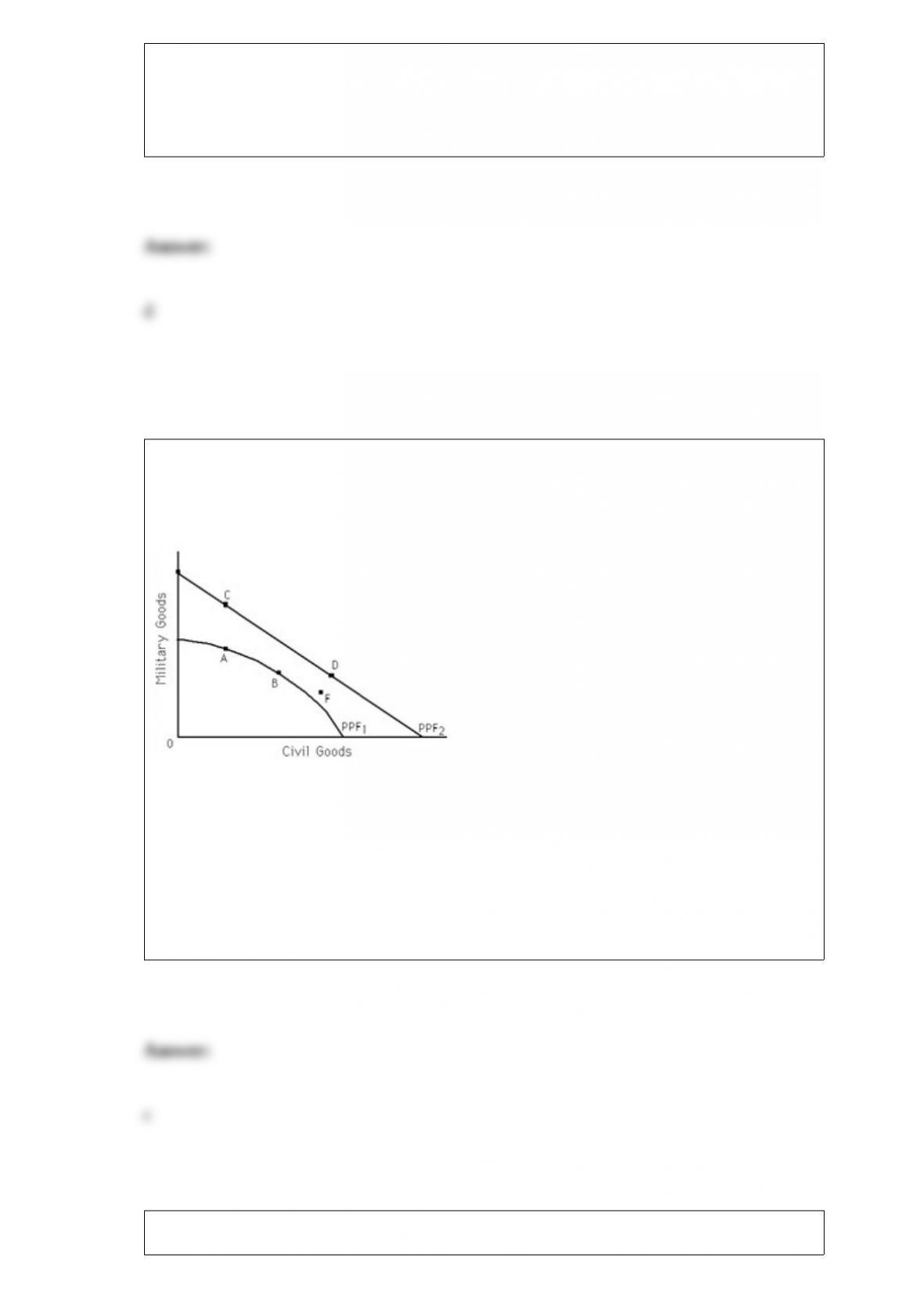
Refer to Exhibit 2-7. For which of the following is the statement “In order to get more
civilian goods, we have to forfeit some military goods” true?
Exhibit 2-7
a. a movement from A to C
b. a movement from B to D
c. a movement from C to D
d. a movement from F to D
e. none of the above
A tax placed on a good can make that good relatively more expensive and its substitutes

relatively less expensive.
a. True
b. False
If the law of increasing opportunity costs is operable, and currently the opportunity cost
of producing the 1,000th unit of good X is 0.5Y, then the opportunity cost of producing
the 2,001st unit of good is X is most likely to be
a. less than 0.5Y.
b. more than 0.5Y but less than 2Y.
c. more than 0.5Y
d. less than 0.5Y but more than zero.
e. none of the above
Refer to Exhibit 26-3. The Herfindahl Index for this industry is currently

a. 996.
b. 1,062.
c. 1,800.
d. 1,980.
e. 10,000.
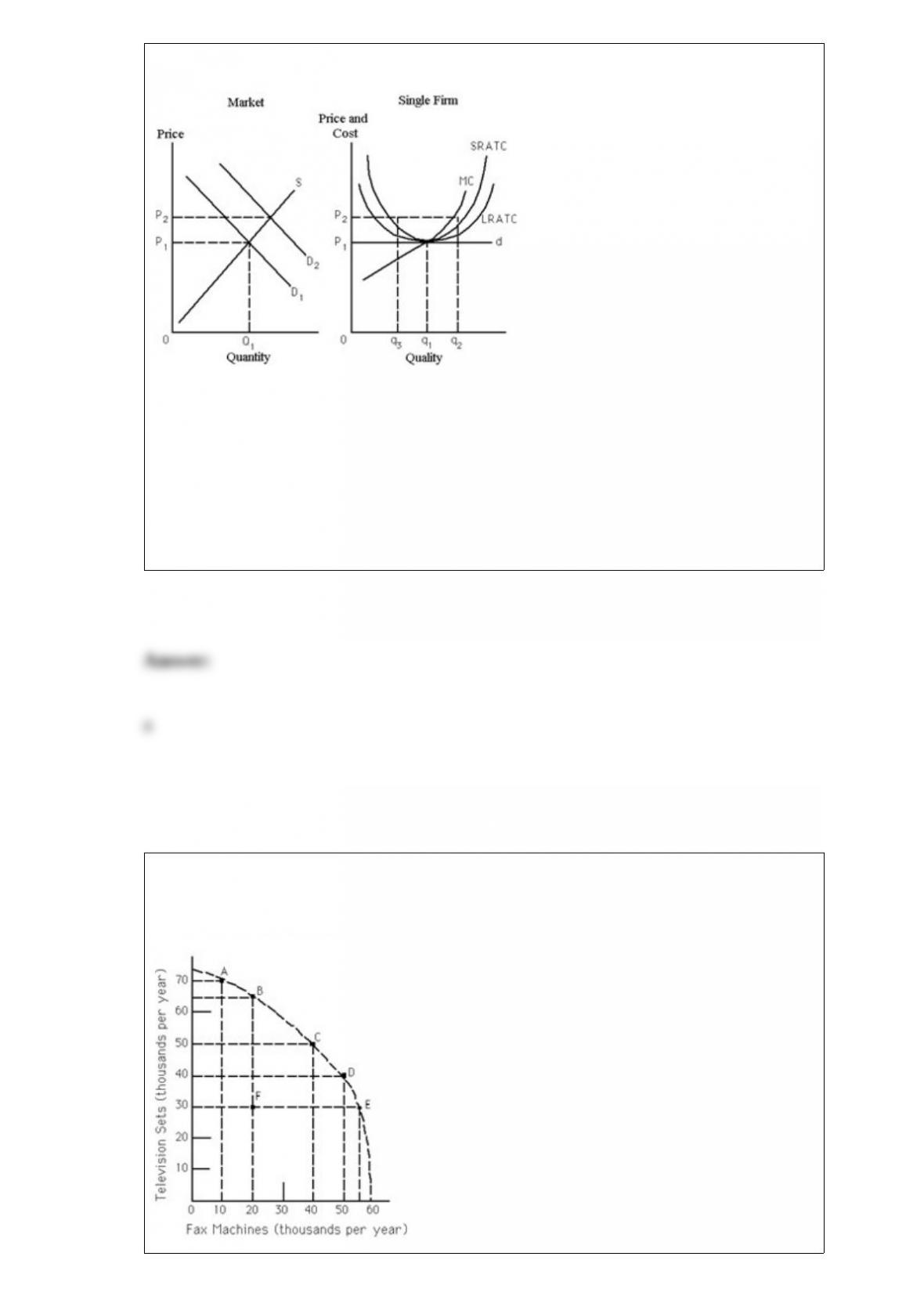
Refer to Exhibit 23-9. Suppose that the market starts out at long-run competitive
equilibrium with price equal to P1and producing Q1output, and then demand increases
from D1 to D2. As a consequence, the typical profit-maximizing firm will
Exhibit 23-9
a. increase quantity produced by (q2 –
q1).
b. decrease quantity produced by (q2 – q1).
c. decrease quantity produced by (q1 – q3).
d. not change its output level because the demand curve it is facing did not change.
Refer to Exhibit 2-5. Which of the following labeled points are productive efficient?
Exhibit 2-5
a. A, B, C, D, and E

b. B, C and D only
c. C only
d. All of the points are productive efficient.
e. None of the points are productive efficient.
Suppose the socially optimal output is 134 units of a good and the market output is 95
units of the good. A possible reason the market produces “too little” is that
a. marginal private benefits are less than marginal social benefits.
b. marginal private benefits are greater than marginal private costs.
c. marginal private benefits are greater than marginal social benefits.
d. marginal private costs are greater than marginal private benefits.
e. b and c
Another term for a stockbroker is an account representative.
a. True
b. False
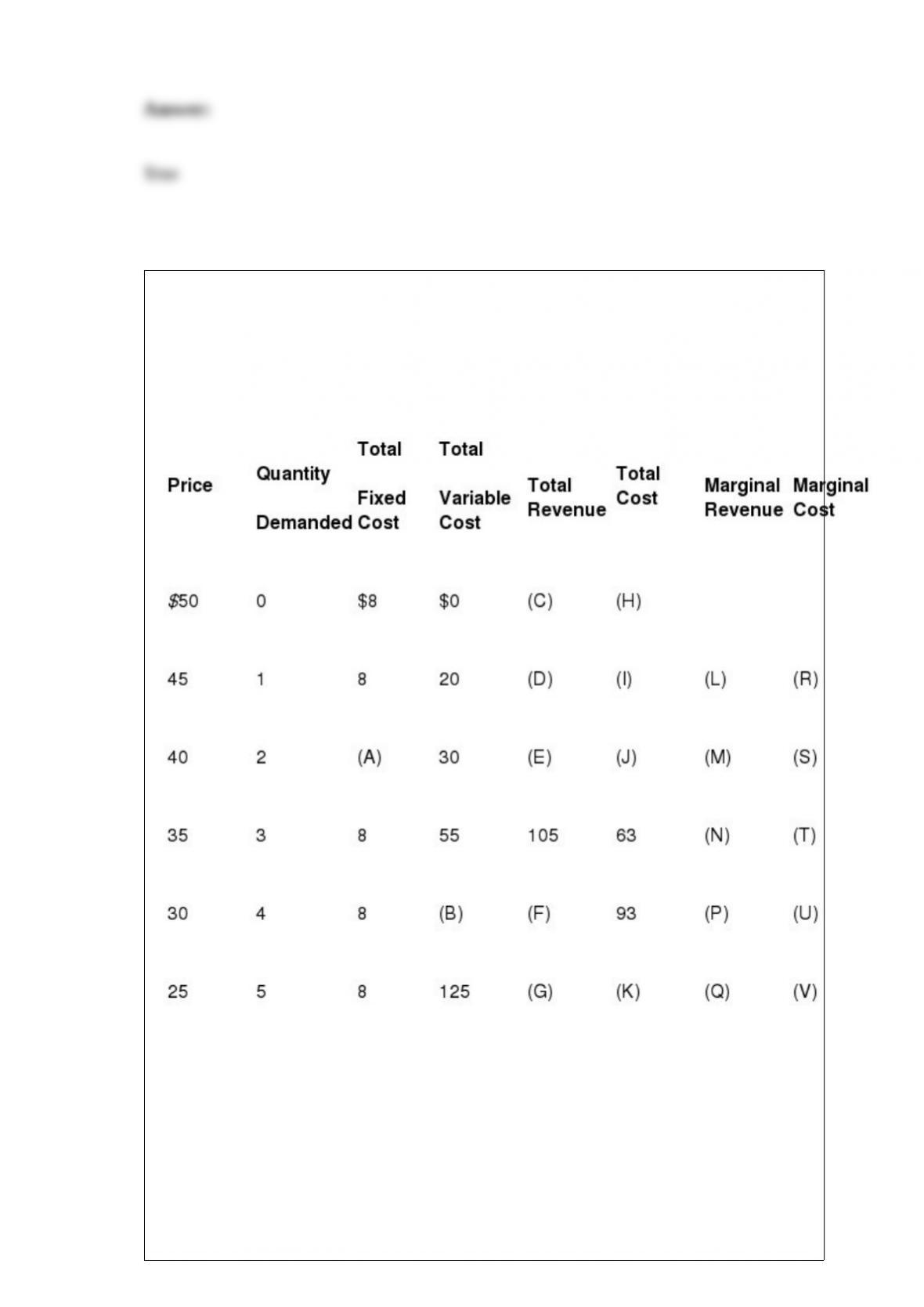
Refer to Exhibit 24-4. The profit-maximizing single-price monopolist’s maximum profit
is
Exhibit 24-4
a. $22.
b. $42.
c. $82.
d. $130.

e. $140.
In an oligopolistic market, the product being produced can be either homogeneous or
differentiated.
a. True
b. False
Which is the following is most likely to be a derived demand?
a. the demand for new clothes to wear to a party
b. the demand for a house to live in
c. the demand for oranges that will be used to produce and sell orange juice
d. the demand for oranges to eat

Refer to Situation 22-l. What will Diane’s average total costs be if she sells 2,500
donuts in her first week and then goes out of business?
a. $8.30
b. $1.81
c. $1.08
d. $9.71
There are ten firms in an industry. Five of the firms each have a market share of 12
percent and five of the firms each have a market share of 8 percent. The Herfindahl
index is
a. 1,000.
b. 1,040.
c. 100.
d. 920.
e. none of the above

Suppose that prices in France increase by 8 percent while prices in the United States
remain relatively stable. We would expect that (on the foreign exchange market) the
demand for U.S. dollars will __________ and the supply of U.S. dollars will
__________.
a. increase; decrease
b. increase; increase
c. decrease; decrease
d. decrease; increase
Good Y is an inferior good. If the average income of those who buy good Y rises, the
_____________ curve for good Y will shift ____________ resulting in a(n)
_____________ in the equilibrium price of Y and a(n) ____________ in the
equilibrium quantity of Y.
a. supply; rightward; decrease; increase.
b. demand; leftward; decrease; decrease
c. demand; rightward; increase; increase
d. supply; leftward; increase; decrease
e. supply; leftward; increase; increase
If MPPX/PX < MPPY/PY, the firm should buy
a. more of factor X and less of factor Y.
b. less of factor X and more of factor Y.
c. more of factor Y and the same amount of factor X.
d. less of factor X and factor Y.
e. more of factor X and factor Y.
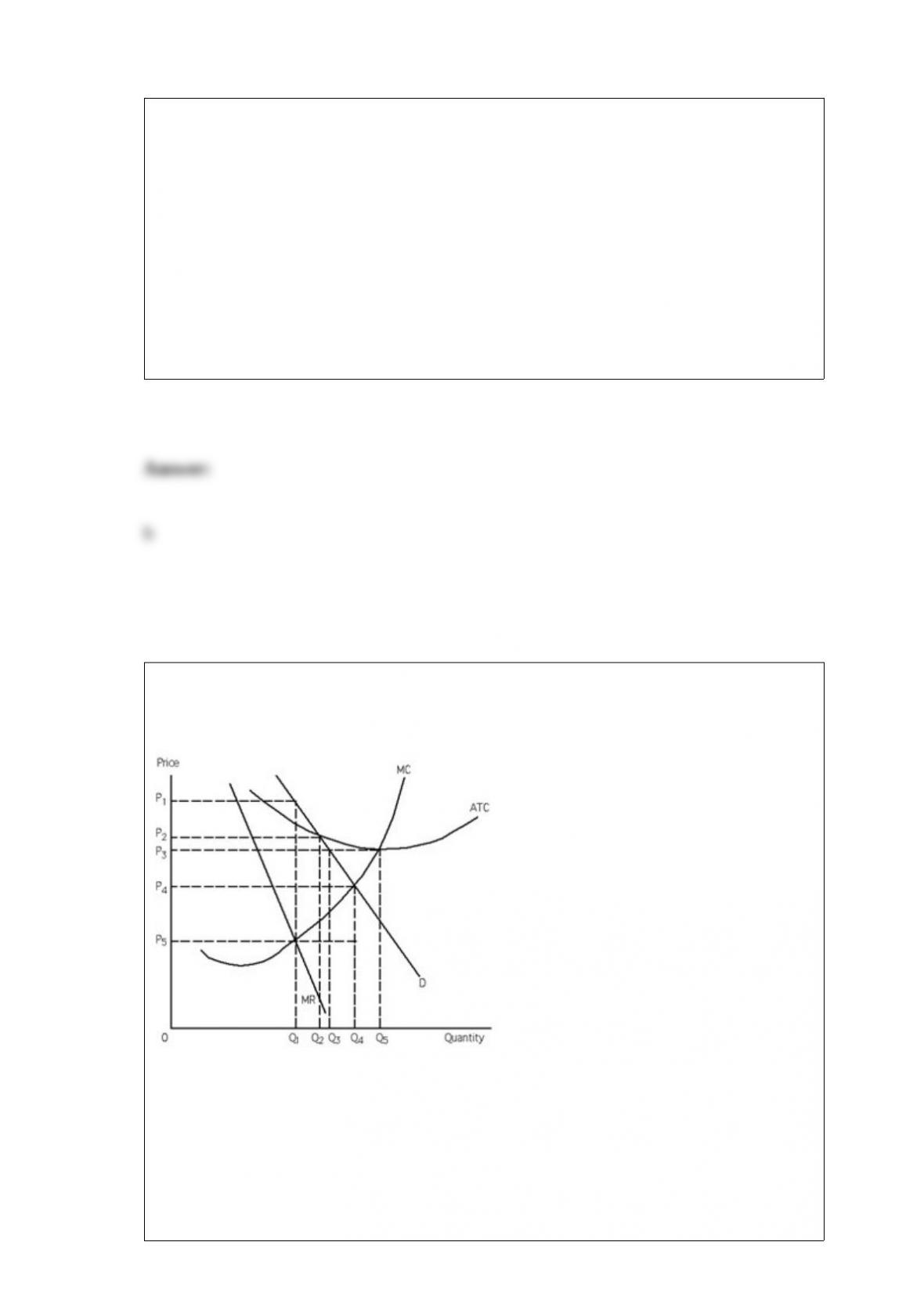
Refer to Exhibit 26-4. The resource-allocative efficient level of output is
Exhibit 26-40
a. Q1.
b. Q2.
c. Q3.

d. Q4.
e. Q5.