
Entrepreneurs
a. operate within markets.
b. increase trade by satisfying an unmet demand for a good or service.
c. increase trade by increasing the transaction costs of making trades.
d. a and b
e. a, b and c
The economy can produce 15X and 15Y, 10X and 20Y, 5X and 25Y, or 0X and 30Y. It
follows that opportunity cost of 1X is ___Y.
a. 4.0
b. 5.0
c. 2.5
d. 1.0
e. none of the above
Exhibit 22-3
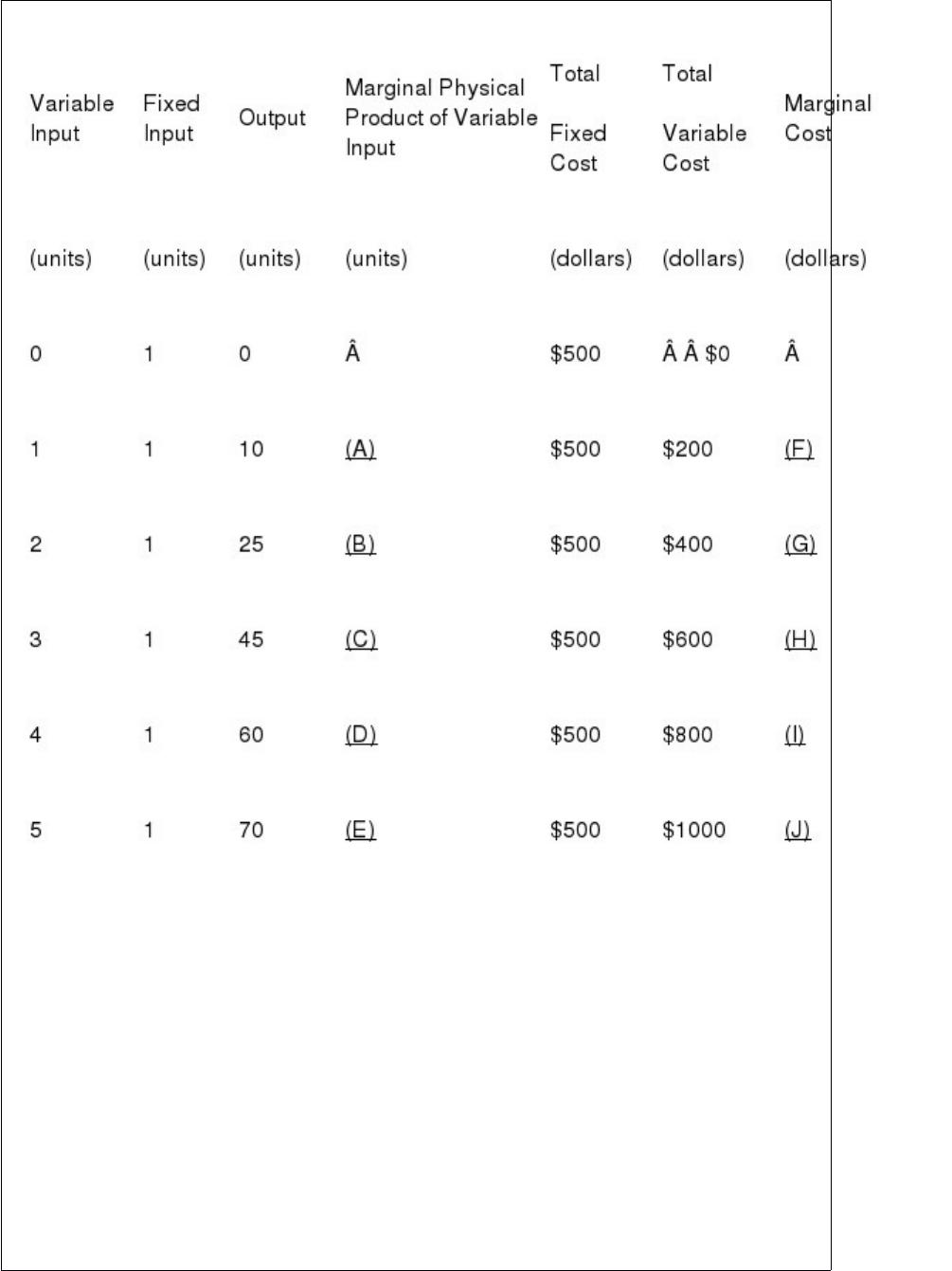
Diminishing marginal returns set in with the addition of the __________ unit of the
variable input.
a. first
b. second
c. third
d. fourth
e. fifth

Suppose the government provides peanut butter to everyone free of charge and
everyone consumes it to the point at which he receives no additional satisfaction from
another spoonful. Is this necessarily good?
a. Yes, because everyone is satisfied.
b. No, because there might be some cases where the resources used to produce peanut
butter could have been better used to produce more of other products.
c. Yes, because the law of diminishing marginal utility indicates that in order to get the
greatest amount of satisfaction from the use of resources, people should consume as
much of every good as they can.
d. none of the above
Suppose the current exchange rate between the U.S. dollar and the Mexican peso is
$0.10 = 1 peso. Furthermore, suppose the price level in the United States rises 15
percent at a time when the Mexican price level is stable. According to the purchasing
power parity theory, what will be the new equilibrium exchange rate?
a. $0.085 = 1 peso
b. $0.13 = 1 peso
c. $0.15 = 1 peso
d. $0.115 = 1 peso
e. none of the above

The diamond-water paradox is illustrated by which of the following statements?
a. Water, a necessity, has a relatively low price whereas diamonds, usually a luxury,
have a relatively high price.
b. Although water appears to have a relatively low price when compared to diamonds,
in reality, it has a relatively higher price.
c. Although water appears to have a relatively low price when compared to diamonds,
in reality, the prices are equal.
d. Although water appears to have a relatively low price when compared to diamonds,
at the margin, water has the relatively higher price.
e. Although water appears to have a relatively low price when compared to diamonds,
at the margin, the prices are equal.
Within the perfectly competitive market structure, consider a labor union that manages
to obtain higher wages for its members. At the time the union obtains higher wages, the
perfectly competitive firms are earning positive economic profits. It follows that
a. initially higher wages will reduce profits.
b. in the long run product prices will be higher because of higher wages.
c. in the long run the firms in the industry will earn below normal profits.
d. in the short run the firms in the industry will necessarily earn below normal profits.
e. a and b
An externality is internalized if

a. the person(s) or group that generated the externality incorporate into their own
private cost-benefit calculations the external benefits (in the case of a positive
externality) or the external costs (in the case of a negative externality) that third parties
bear.
b. people are made aware of it and realize that social benefits are less than private
benefits (in the case of a positive externality) and that social costs are less than private
costs (in the case of a negative externality).
c. the person(s) or group that generated the externality do not incorporate into their own
private cost-benefit calculations the external benefits (in the case of a positive
externality) or the external costs (in the case of a negative externality) that third parties
bear.
d. b and c
e. none of the above
The ticket price of zero for the viewing of a television show taping often results in a
shortage of tickets which are frequently rationed on a first-come-first-served basis.
a. True
b. False
Why would a candidate for political office speak in general instead of specific terms?
a. Because he or she believes voters want to hear generalities, not specifics.
b. Because he or she believes voters are too busy to listen to specifics.
c. Because he or she believes that specifics are too likely to label him or her as a
member of an extreme-wing, and politically this would be undesirable.
d. Because it is cheaper to get the message out if it is worded in general instead of
specific terms.

How is scarcity related to competition?
a. Competition is an effect of scarcity.
b. Scarcity is an effect of competition.
c. Both scarcity and competition are effects of a rationing device.
d. Both scarcity and competition are effects of opportunity cost.
e. Scarcity produces disutility and competition produces utility.
Logrolling consists of
a. exchanging votes to gain support for legislation.
b. spreading the costs of a piece of special interest legislation over many millions of
people.
c. attempts directed at slowing down the growth of rational ignorance.
d. increasing taxes on some people and lowering taxes on other people.
e. none of the above
For a straight-line downward-sloping demand curve, price elasticity of demand
a. increases as we move down along the demand curve from higher to lower prices.
b. decreases as we move down along the demand curve from higher to lower prices.

c. remains constant along the entire demand curve.
d. a or b depending on the actual slope of the demand curve
Some racing horse breeders keep a few of their foals and sell the others. Generally, they
put the poorest quality foals up for sale early in the season. Buyers have limited
information about the foals up for sale, but they know that the first foals from some
breeders will not be good racers. Other breeders sell all their foals. Since buyers cannot
know which breeders are keeping back their good foals, they are suspicious of all foals
offered for sale early in the season, lowering the sale prices. Breeders who sell all their
foals are therefore forced to hold back their better foals until later in the season, to get
true market prices for them. The market for foals is therefore subject to the
a. adverse selection problem.
b. moral hazard problem.
c. free-rider effect.
d. none of the above
If inflation in the United States rises relative to the inflation rate in Mexico, the dollar
will __________ in terms of the peso and the peso will __________ in terms of the
dollar.
a. remain unaffected; appreciate
b. remain unaffected; depreciate
c. depreciate; remain unaffected
d. depreciate; appreciate
e. remain unaffected; remain unaffected
The statement, “Every person who shall monopolize, or attempt to monopolize, or
combine or conspire with any other person or persons to monopolize any part of the
trade or commerce…shall be guilty of a misdemeanor” is a part of the
a. Clayton Act.
b. Robinson-Patman Act.
c. Sherman Act.
d. Wheeler-Lea Act.
e. none of the above
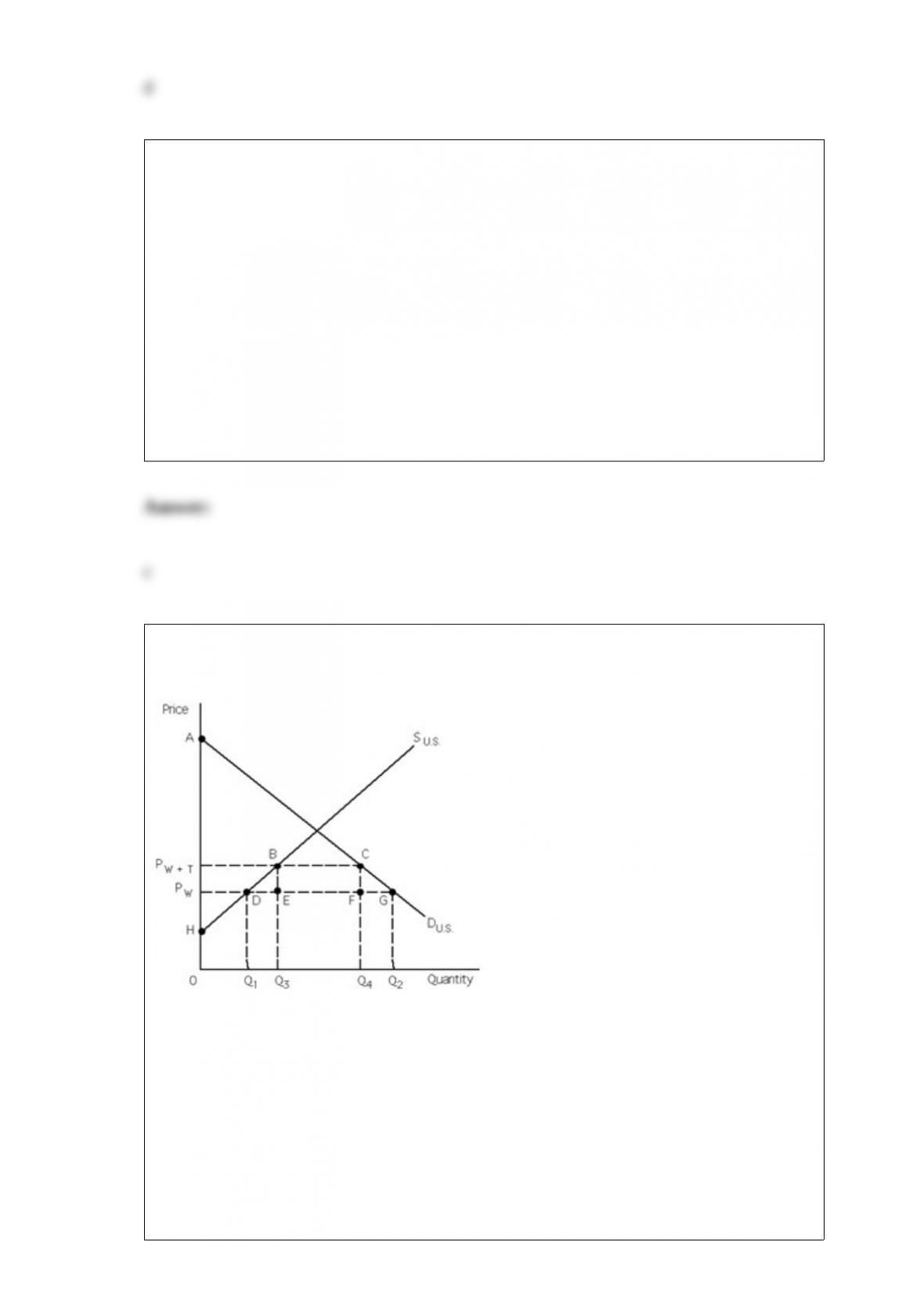
Exhibit 34-11
PW is the price that exists in the market before a tariff is imposed and PW + T is the price
that exists in the market after a tariff is imposed. Because of the tariff, consumers’
surplus falls and producers’ surplus rises by the area
a. BCFE.
b. BCGE.
c. DBCG.

d. DBCF.
e. none of the above
If Jack bought 21 DVDs last year when his income was $30,000 and he buys 23 DVDs
this year when his income is $35,000, then his income elasticity of demand is
______________ which means that DVDs are a(n) ______________ good for Jack.
a. +1.69; normal
b. -1.69; inferior
c. +0.59; normal
d. +0.59; inferior
e. -0.44; inferior