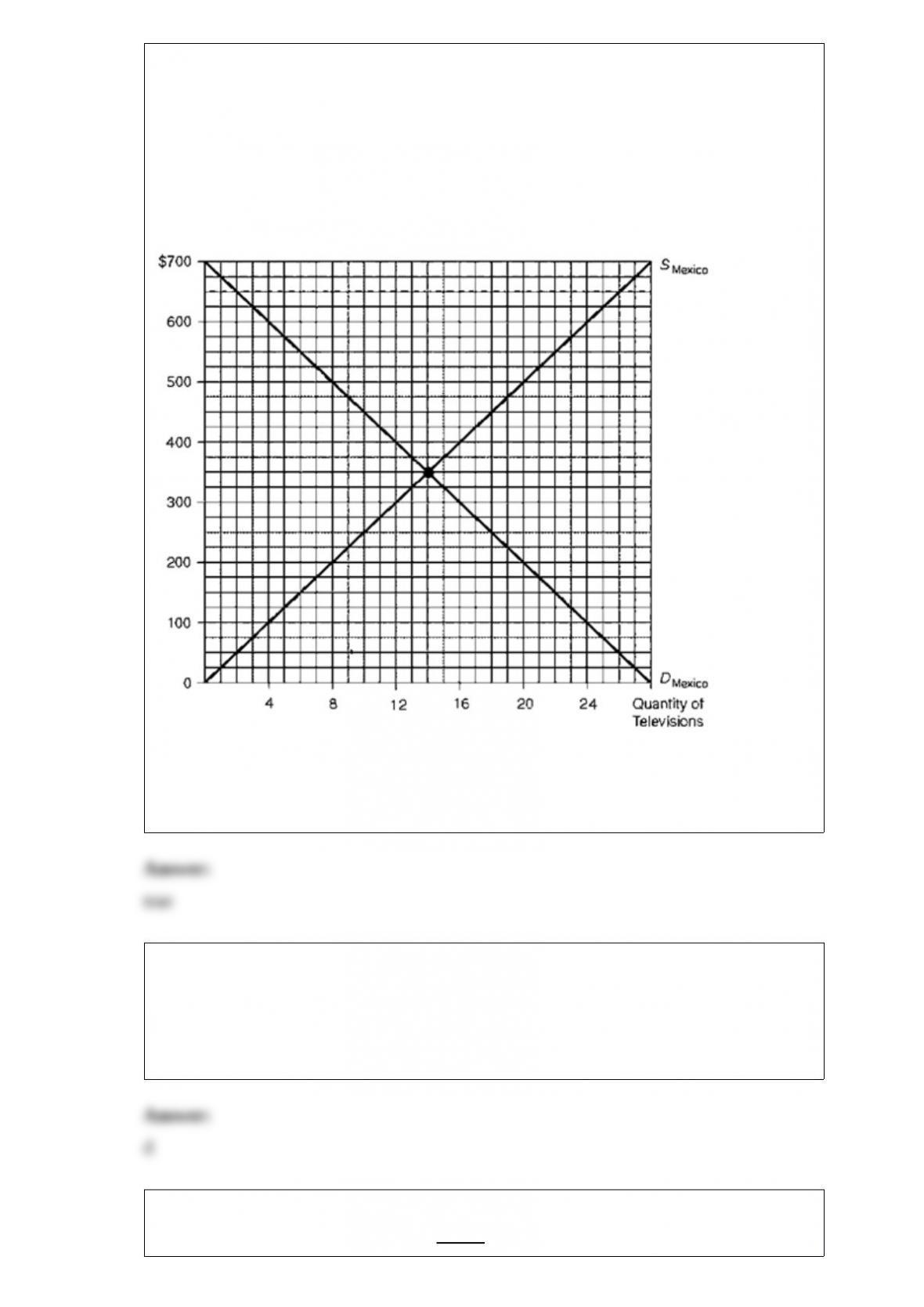
1) figure 5.5 illustrates the television market for mexico, assumed to be a small country
that is unable to affect the world price. smexico is the domestic supply schedule and
dmexico is the domestic demand schedule. suppose that japan can supply televisions to
mexico at a price of $100 per set.
figure 5.5. mexico’s television market
consider figure 5.5. with free trade, mexicans produce 4 tvs, consume 24 tvs, and
import 20 tvs.
a.true
b.false
2) open economies have more:
a.competition
b.firm turnover
c.new firms entering the market
d.all of these
3) all of the following exchange-rate systems require international reserves to finance
balance-of-payments disequilibriums except:

a.pegged or fixed exchange rates
b.managed floating exchange rates
c.adjustable pegged exchange rates
d.freely floating exchange rates
4) critics of u.s. trade and immigration policy maintain that
a.it has depressed wages for many americans
b.it has increased the supply of less educated workers in the united states
c.it has an adverse impact on the employment opportunities of less-skilled, american
workers
d.all of the above
5) the balance of payments refers to the stock of trade and investment transactions that
exists at a particular point in time.
a.true
b.false
6) swap arrangements are bilateral agreements between central banks to allow countries
to temporarily borrow funds to ease current-account deficits and discourage speculative
capital flows.
a.true
b.false
7) the principle of absolute advantage asserts that mutually beneficial trade can occur
even if one nation is absolutely more efficient in the production of all goods.
a.true
b.false

8) high real interest rates in the united states tend to:
a.decrease the demand for dollars, causing the dollar to depreciate
b.decrease the demand for dollars, causing the dollar to appreciate
c.increase the demand for dollars, causing the dollar to depreciate
d.increase the demand for dollars, causing the dollar to appreciate
9) under managed floating exchange rates, a central bank would initiate:
a.contractionary monetary policy to offset a depreciation of its currency
b.contractionary monetary policy to offset an appreciation of its currency
c.expansionary monetary policy to offset a depreciation of its currency
d.none of the above
10) concerning exchange-rate determination, “market fundamentals” include all of the
following except:
a.monetary policy and fiscal policy
b.profitability and riskiness of investments
c.speculative opinion about future exchange rates
d.productivity changes affecting production costs
11) negotiating the north american free trade agreement was relatively easy since it
involved meshing two large industrial countries with a developing country.
a.true
b.false
12) according to the absorption approach, the economic circumstances that best warrant
a currency devaluation is where the domestic economy faces:
a.unemployment coupled with a payments deficit

b.unemployment coupled with a payments surplus
c.full employment coupled with a payments deficit
d.full employment coupled with a payments surplus
13) adjustment assistance is sometimes used to assist:
a.in retraining workers displaced by imports
b.in retraining workers displaced by exports
c.foreign firms injured by our quotas
d.foreign firms injured by our tariffs
14) ____ is the ability of a firm/industry, under free and fair market conditions, to
design, produce, and market goods and services that are better and/or cheaper than
those of other firms/industries.
a.competitiveness
b.protectionism
c.comparative advantage
d.absolute advantage
15) economists agree that wages of unskilled workers are being held down by
a.international trade
b.technology improvements
c.lack of education
d.a combination of a, b, and c
16) concerning international debt, ____ refers to a negotiated reduction in the
contractual obligations of the debtor country and includes schemes such as markdowns
and write-offs of debt.
a.debt/equity swap

b.debt-for-debt swap
c.debt forgiveness
d.debt sales