1) for the united states, suppose the annual interest rate on government securities equals
8 percent while the annual inflation rate equals 4 percent. for japan, suppose the annual
interest rate on government securities equals 10 percent while the annual inflation rate
equals 7 percent. these variables would cause investment funds to flow from:
a.the united states to japan, causing the dollar to depreciate
b.the united states to japan, causing the dollar to appreciate
c.japan to the united states, causing the yen to depreciate
d.japan to the united states, causing the yen to appreciate
2) over time, a depreciation in the value of a nation’s currency in the foreign exchange
market will result in:
a.exports rising and imports falling
b.imports rising and exports falling
c.both imports and exports rising
d.both imports and exports falling
3) an import quota tends to reduce the overall welfare of the importing nation by an
amount equal to the protective effect, consumption effect, and the portion of the
revenue effect that is captured by the domestic government.
a.true
b.false
4) long-run determinants of the dollar’s exchange value include all of the following
except:
a.preferences of americans for foreign produced goods
b.u.s. tariffs placed on imports of foreign produced goods
c.productivity of the american worker
d.interest rates in u.s. financial markets
5) that the balance of payments could be adjusted by prices and interest rates, under a
fixed exchange rate system, originated with keynesian theory during the 1930s.
a.true
b.false
6) foreign ownership of u.s. financial assets
a.has decreased since the 1960’s
b.has increased since the 1960’s
c.has made the u.s. a net borrower since the late 1980’s
d.both a and c
7) when a tariff on imported inputs exceeds that on the finished good,
a.the nominal tariff rate on the finished product would tend to overstate its protective
effect
b.the nominal tariff rate would tend to understate it’s protective effect
c.it is impossible to determine the protective effect of a tariff
d.tariff escalation occurs
8) figure 5.5 illustrates the television market for mexico, assumed to be a small country
that is unable to affect the world price. smexico is the domestic supply schedule and
dmexico is the domestic demand schedule. suppose that japan can supply televisions to
mexico at a price of $100 per set.
figure 5.5. mexico’s television market
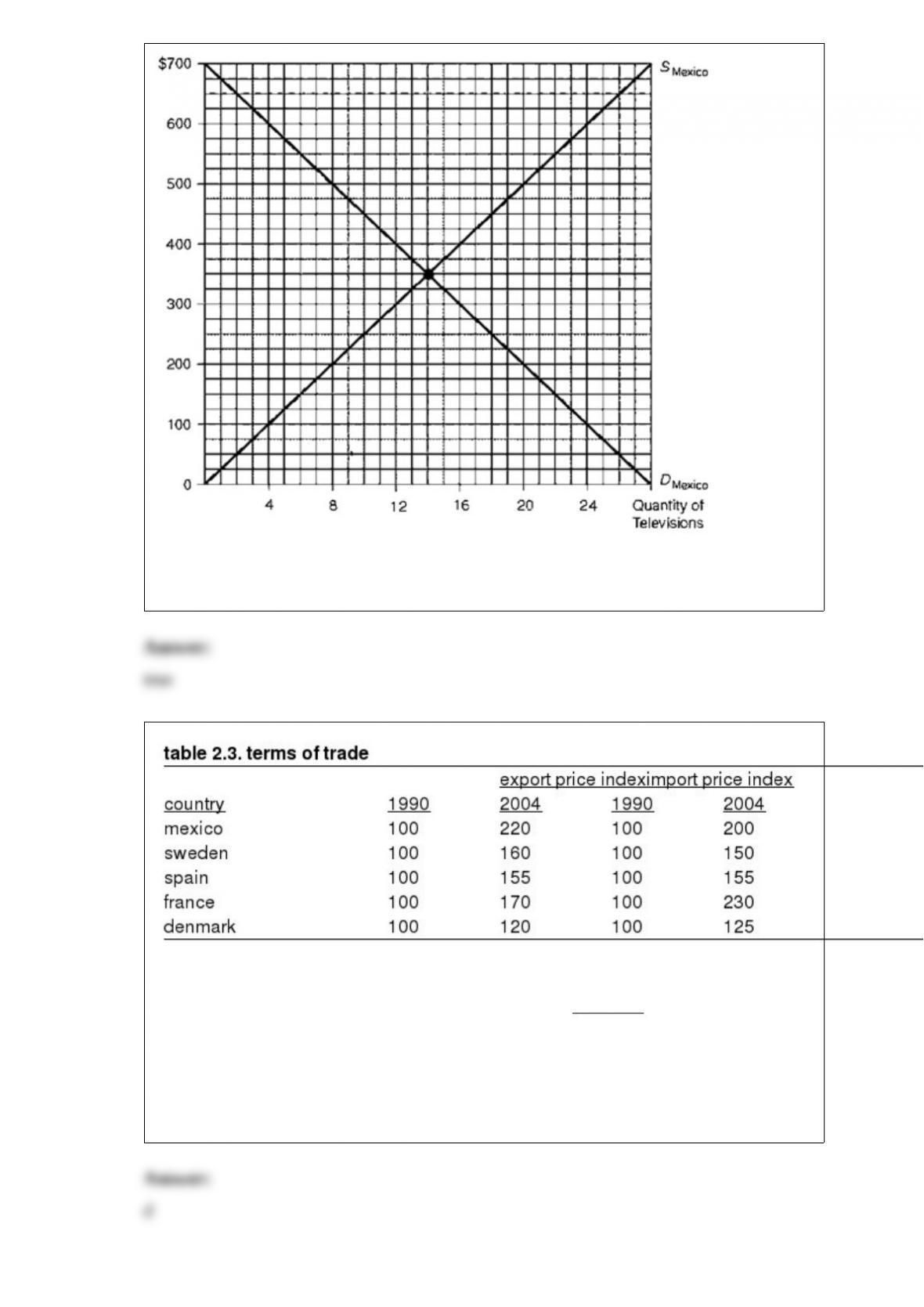
consider figure 5.5. the japanese export quota’s revenue effect totals $1200.
a.true
b.false
9) referring to table 2.3, which countries’ terms of trade improved between 1990 and
2004?
a.mexico and denmark
b.sweden and denmark
c.sweden and spain
d.mexico and sweden
10) import tariffs and import quotas yield identical protection effects, consumption
effects, redistribution effects, and revenue effects.
a.true
b.false
11) industrial policy attempts to foster the development of industries that offer long-run
comparative disadvantages and which are insulated from other sectors of the economy.
a.true
b.false
12) arguments for u.s. trade restrictions include all of the following except
a.job protection
b.infant industry support
c.maintenance of domestic living standard
d.improving incomes for developing countries
13) in recent years, the largest amount of u.s. direct investment abroad has occurred in:
a.central america
b.south america
c.europe
d.japan