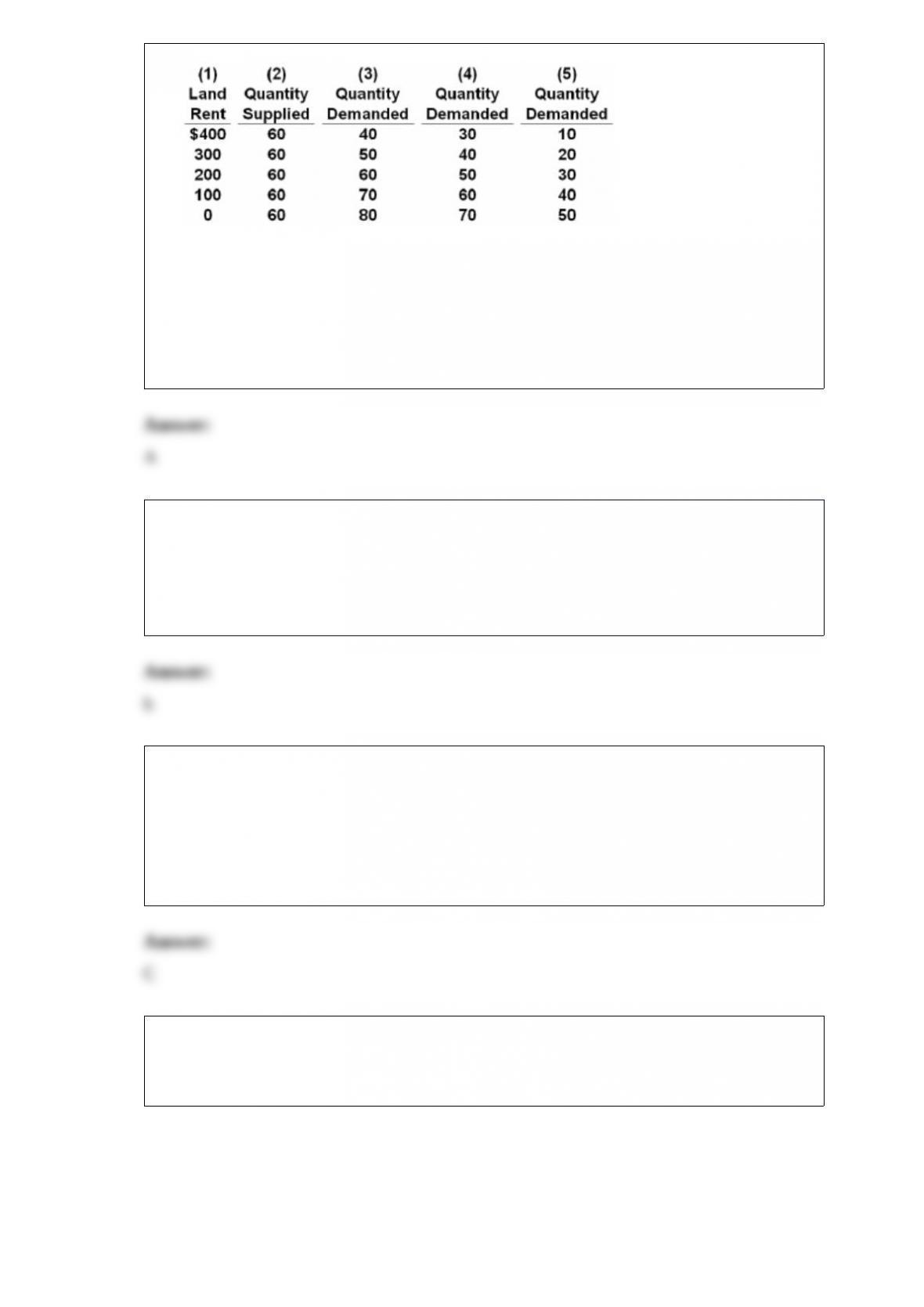
1)
Refer to the above table, in which the values for columns (2) through (5) are in acres. If
the relevant columns are (1), (2), and (5), land rent will be:
A.$0 per acre.
B.$100 per acre.
C.$200 per acre.
D.$300 per acre.
2) if the u.s. unemployment rate is 9 percent, we can infer that:
a.the economy is in the expansion phase of the business cycle.
b.potential gdp is in excess of actual gdp.
c.actual gdp is in excess of potential gdp.
d.actual gdp is equal to potential gdp.
3) Which of the following laws prohibited mergers by stock acquisition if the effect was
to lessen competition?
A.Celler-Kefauver Act of 1950
B.Wheeler-Lea Act of 1938
C.Clayton Act of 1914
D.Sherman Act of 1890
4) The following information: The Fed is going to auction $30 billion in reserves using
the term auction facility. It receives the following bids:
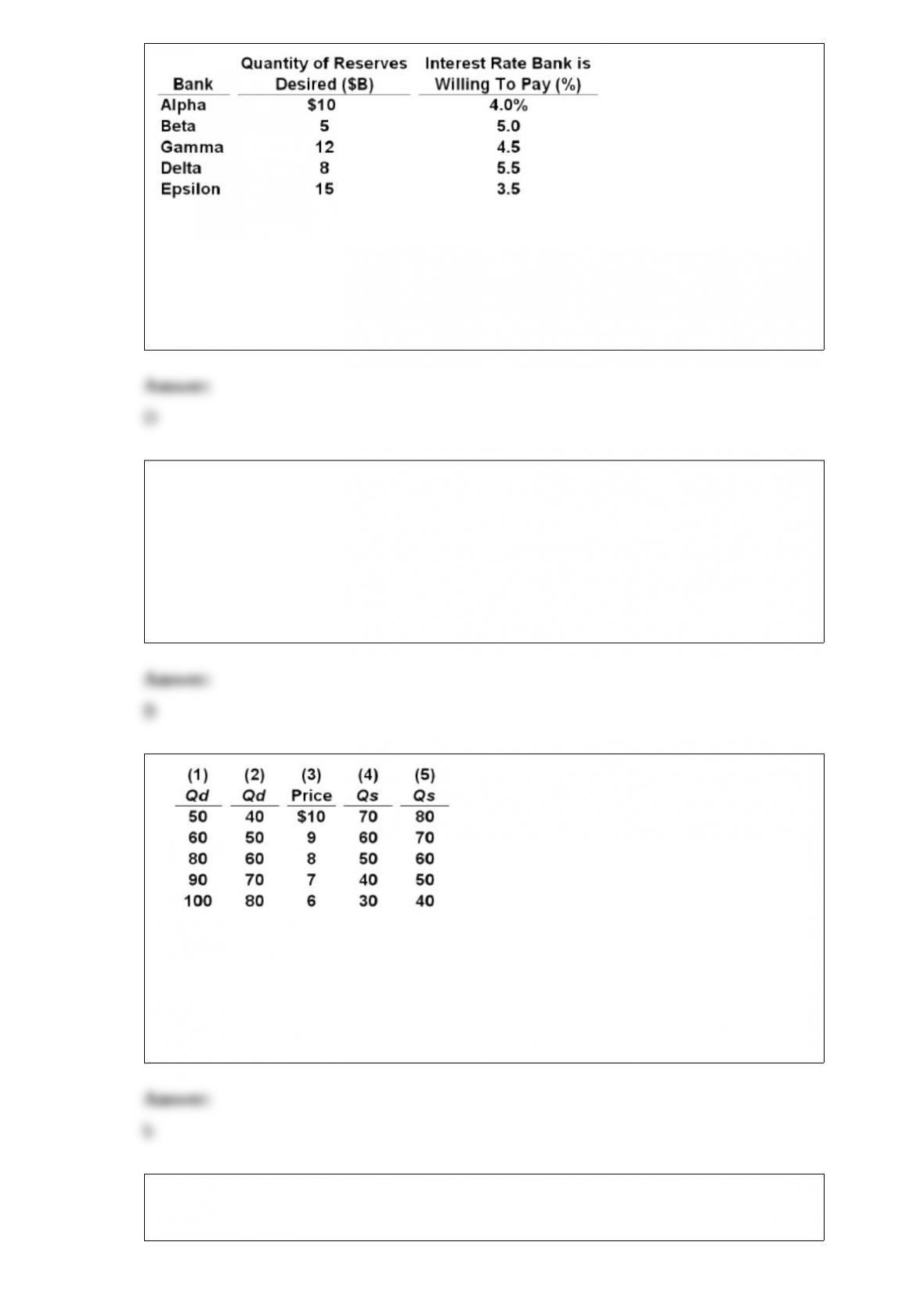
Refer to the above information. As a result of the auction, how much and at what
interest rate will Gamma bank borrow?
A.$7 billion; 4.5 percent
B.$5 billion; 4.5 percent
C.$12 billion; 4.5 percent
D.$12 billion; 4 percent
5) The Fed is like a sponge in that it can:
A.clean up economic problems just as one would wash dirt of a car.
B.squeeze new reserves into the banking system, or soak up reserves if the banking
reserve “bowl” is too full.
C.wipe away inflation when used with the ‘soap” of fiscal policy.
D.wash the “windows” of the banking system so that monetary policy is more
transparent.
6)
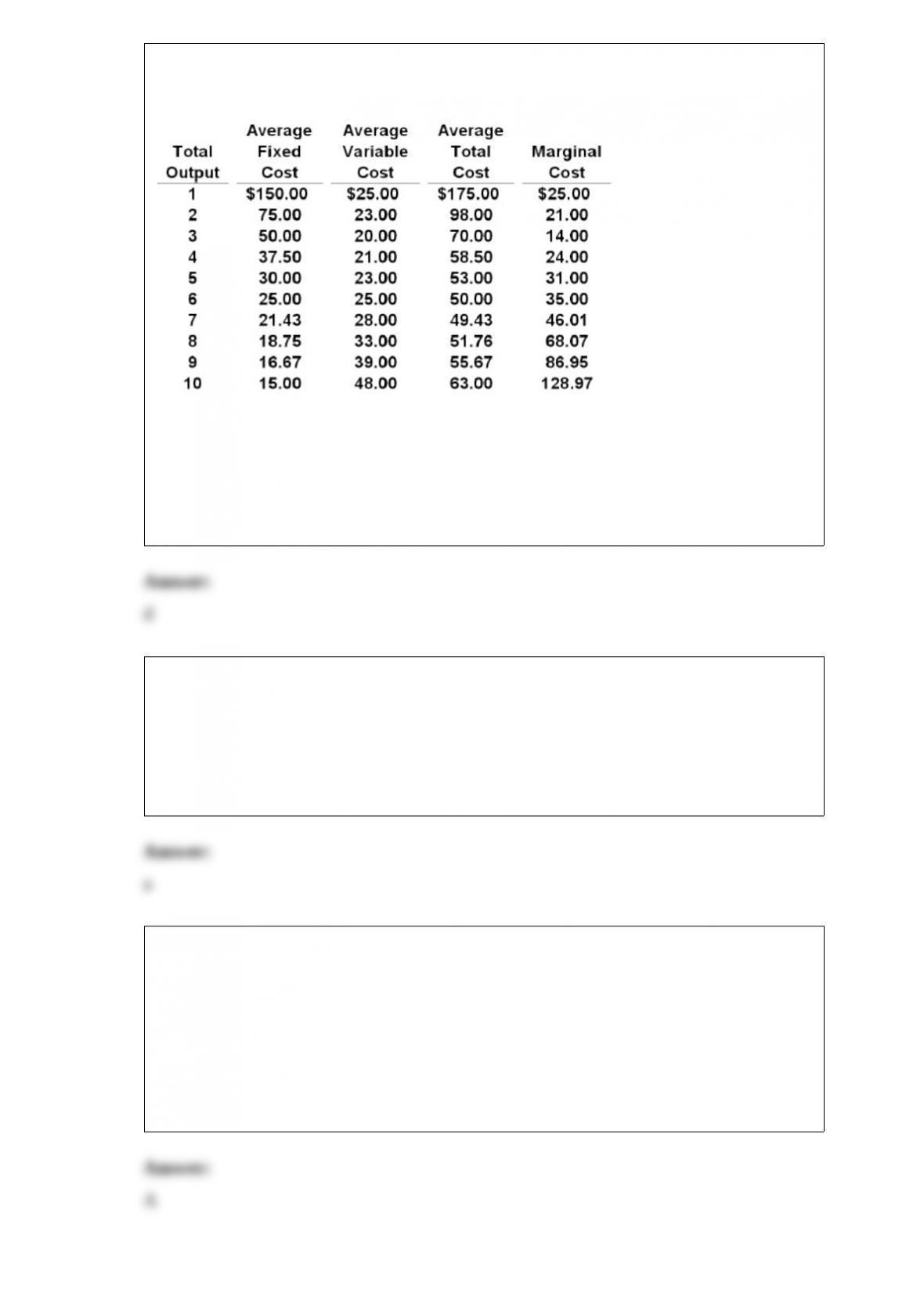
refer to the above table. if demand is represented by columns (3) and (1) and supply is
represented by columns (3) and (4), equilibrium price and quantity will be:
a.$10 and 60 units.
b.$9 and 60 units.
c.$8 and 80 units.
d.$7 and 30 units.
7) which of the following is most likely to be a variable cost?
a.fuel and power payments

b.interest on business loans
c.rental payments on ibm equipment
d.real estate taxes
8) The public debt is the amount of money that:
A.state and local governments owe to the Federal government.
B.Americans owe to foreigners.
C.the Federal government owes to holders of U.S. securities.
D.the Federal government owes to taxpayers.
9) In making an investment decision a business firm is most interested in the:
A.nominal interest rate.
B.real interest rate.
C.nominal interest rate minus the real interest rate.
D.the future supply of loanable funds.
10) a public good:
a.can be produced profitably by private firms.
b.is available to all and cannot be denied to anyone.
c.is characterized by rivalry and excludability.
d.produces no externalities.
11) Suppose a firm offers its workers a cafeteria plan in which it allows workers to
allocate a set amount of fringe benefit money toward specific insurance. Mary, who has
five kids needing braces, selects the family dental coverage. This is an example of the:
A.free-rider problem.
B.principal-agent problem.
C.adverse selection problem.
D.moral hazard problem.
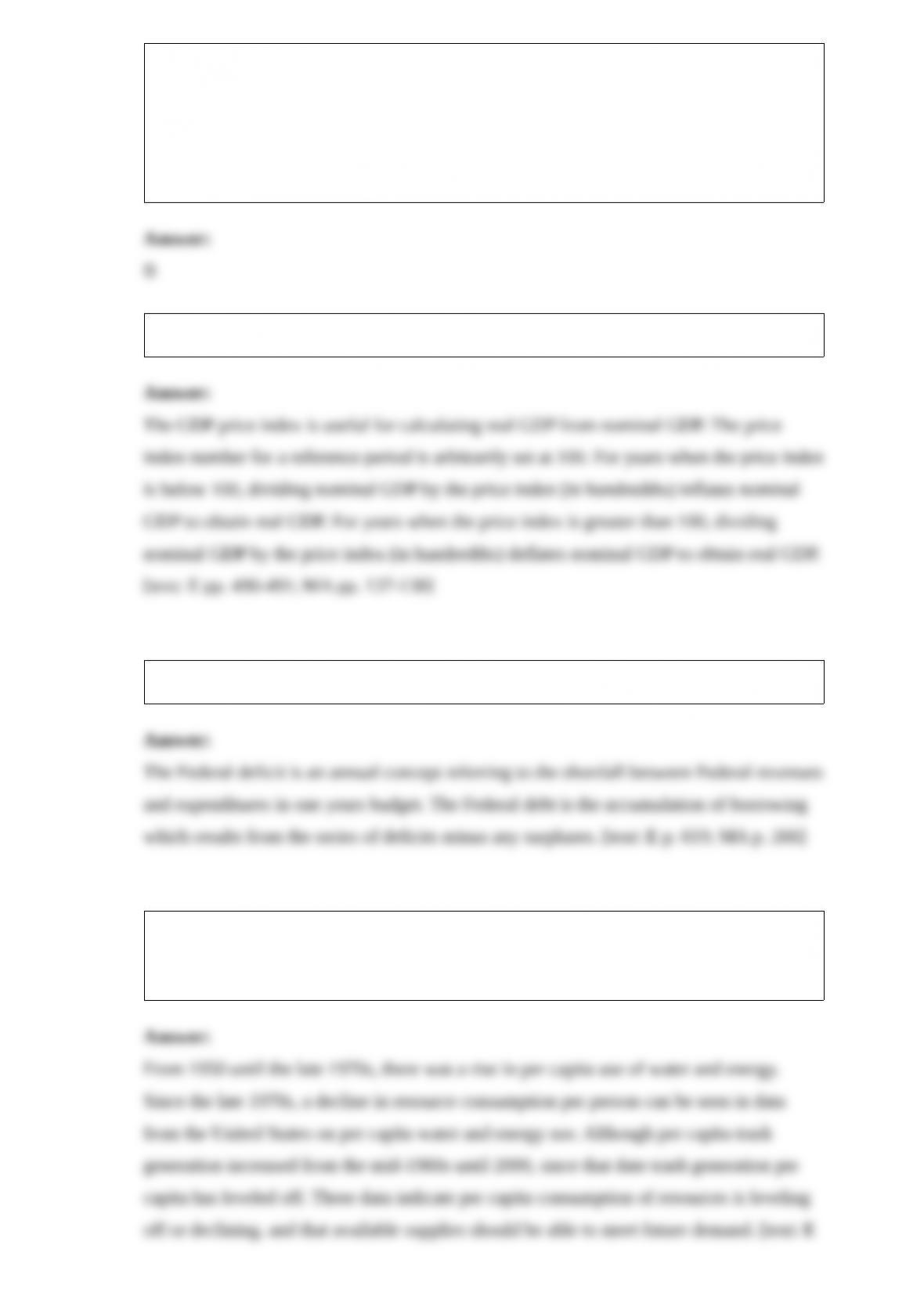
12) the following cost data for a firm that is selling in a purely competitive market.
refer to the above data. we can infer that, at zero output, this firm’s total fixed, total
variable, and total costs are:
a.zero, zero, and zero, respectively.
b.zero, $25, and $175, respectively.
c.$150, $25, and $175, respectively.
d.$150, zero, and $150, respectively.
13) the fact that the major indicator of enterprise success in the soviet union and
pre-reform china was the quantity of output implied that:
a.product quality was neglected.
b.production costs were minimized.
c.product-mix met consumer needs.
d.technological advance was too rapid.
14) The problem of cyclical asymmetry refers to the idea that:
A.a restrictive monetary policy can force a contraction of the money supply, but an
expansionary monetary policy may not achieve an increase in the money supply.
B.the monetary authorities have been less willing to use an expansionary monetary
policy than they have a restrictive monetary policy.
C.cyclical downswings are typically of longer duration than cyclical upswings.
D.an expansionary monetary policy can force an expansion of the money supply, but a
restrictive monetary policy may not achieve a contraction of the money supply.
15) Suppose firm X implements a new method for extracting copper from
copper-bearing ore. This is an example of:
A.product innovation.
B.process innovation.
C.economics of scale.
D.the inverted-U theory.
16) What is the relationship between real GDP, nominal GDP, and the price index?
17) Differentiate between the Federal deficit and the Federal debt.
18) Describe the trends in total and per capita water use, energy consumption, and trash
generation in the United States from 1950 to 2000. What do they indicate about
resource use?
19) What are the two reasons that people want to hold money? In other words, what are
the two types of demand for money?
20) Explain the difference between nominal and real interest rates.
21) What is an individual transferable quota (ITQ)? How can it be used with the total
allowable catch (TAC) for making fishing more efficient and sustainable?