1) Consider the two diagrams below. Diagram A represents a typical firm in a purely
competitive industry. Diagram B represents the supply and demand conditions in that
industry.
(a)Describe the price, output, and profit situation for the individual firm in the short run.
(b)Describe what will happen to the individual firm and the industry in the long run.
Show the changes on diagrams A and B.
2)
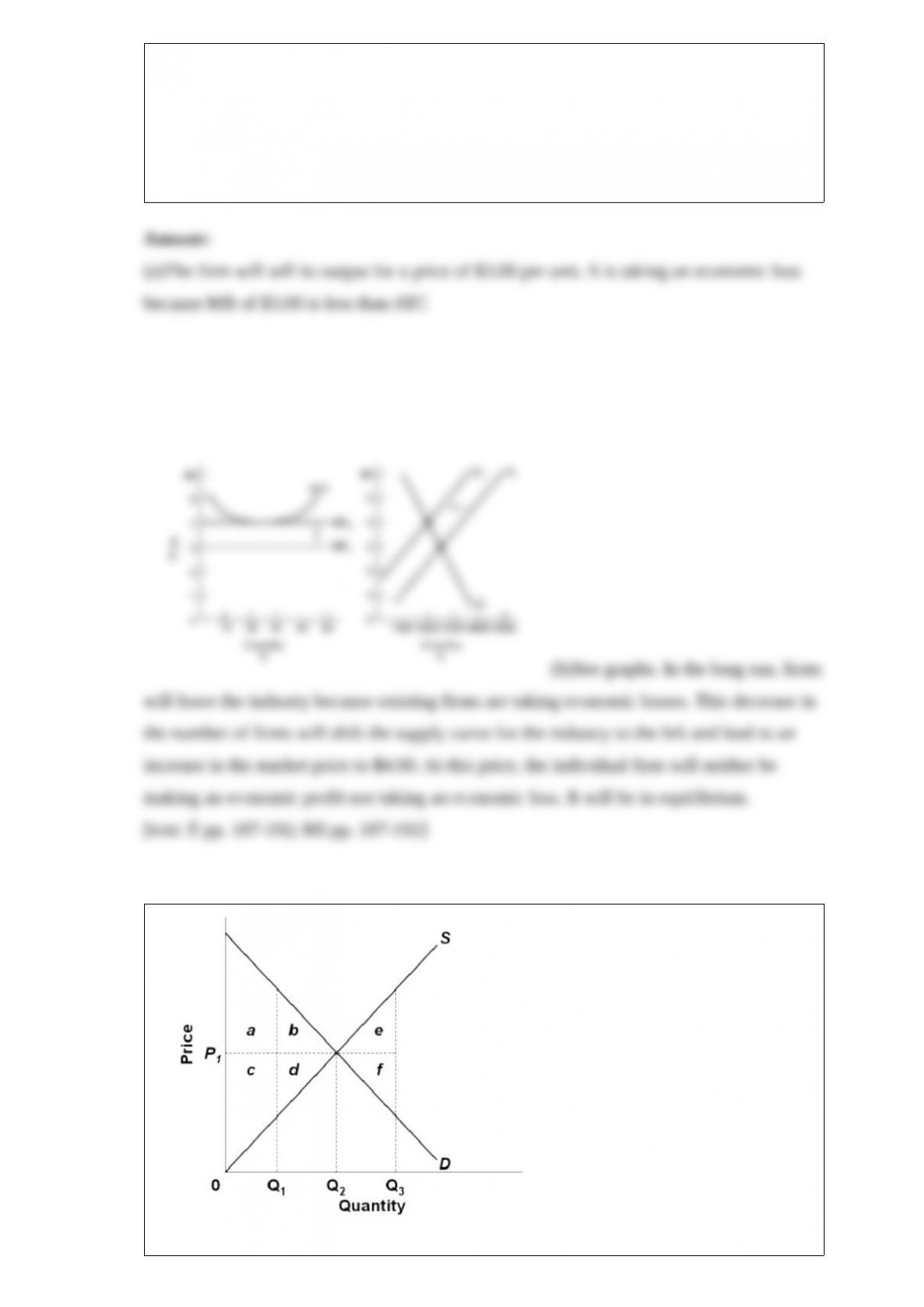
refer to the above diagram. assuming equilibrium price p1, producer surplus is
represented by areas:
a.a + b.
b.a + b + c + d.
c.c + d.
d.a + c.
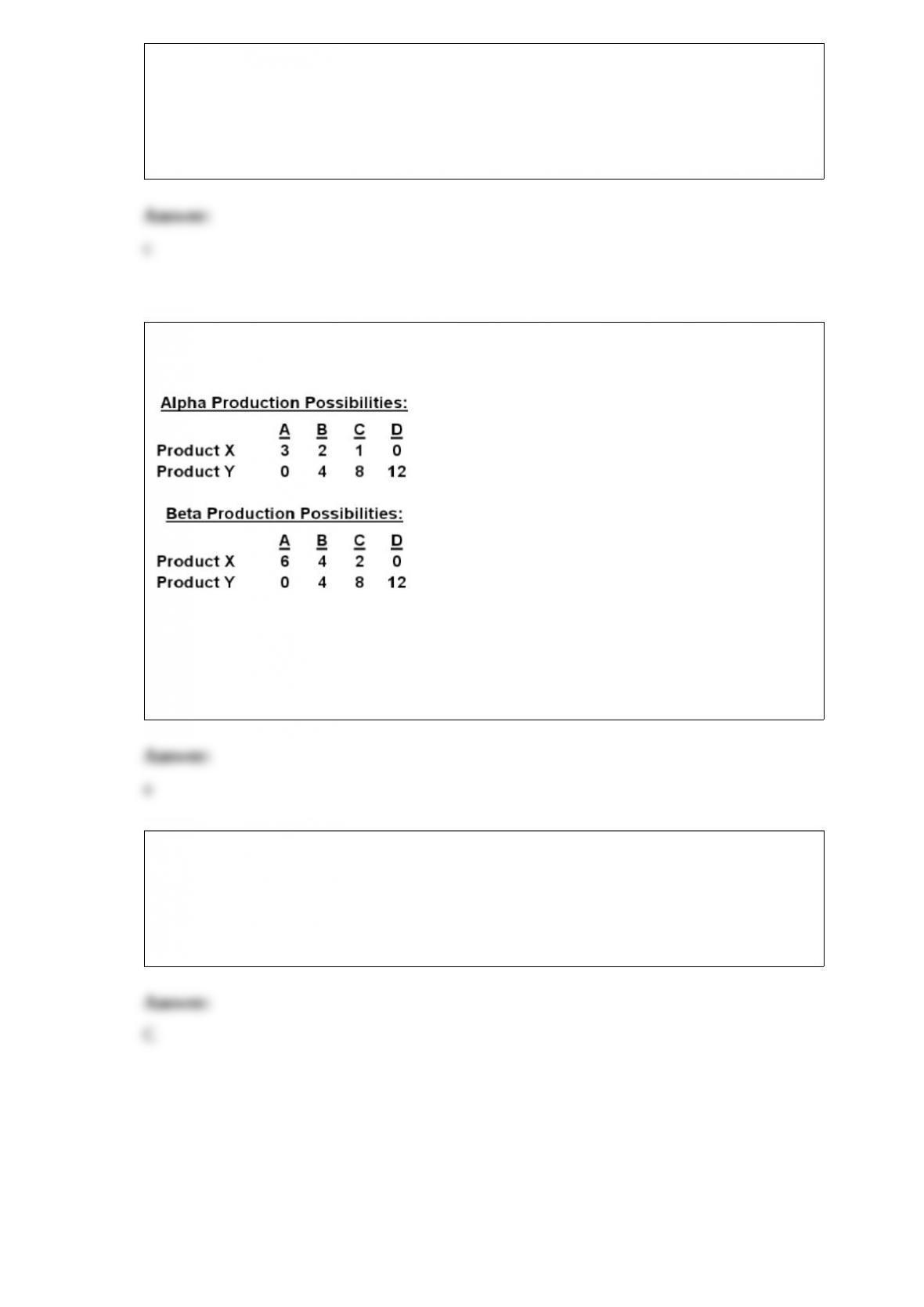
3) the following production possibilities tables for countries alpha and beta:
refer to the above tables. the domestic opportunity cost of one unit of x in beta is:
a.2 units of y
b.4 units of y
c.1 unit of y
d.3 units of y
4) Collective bargaining occurs under a framework of rules established in the:
A.Sherman Act.
B.Clayton Act.
C.National Labor Relations Act.
D.Employer-Employee Dispute Act.
5)
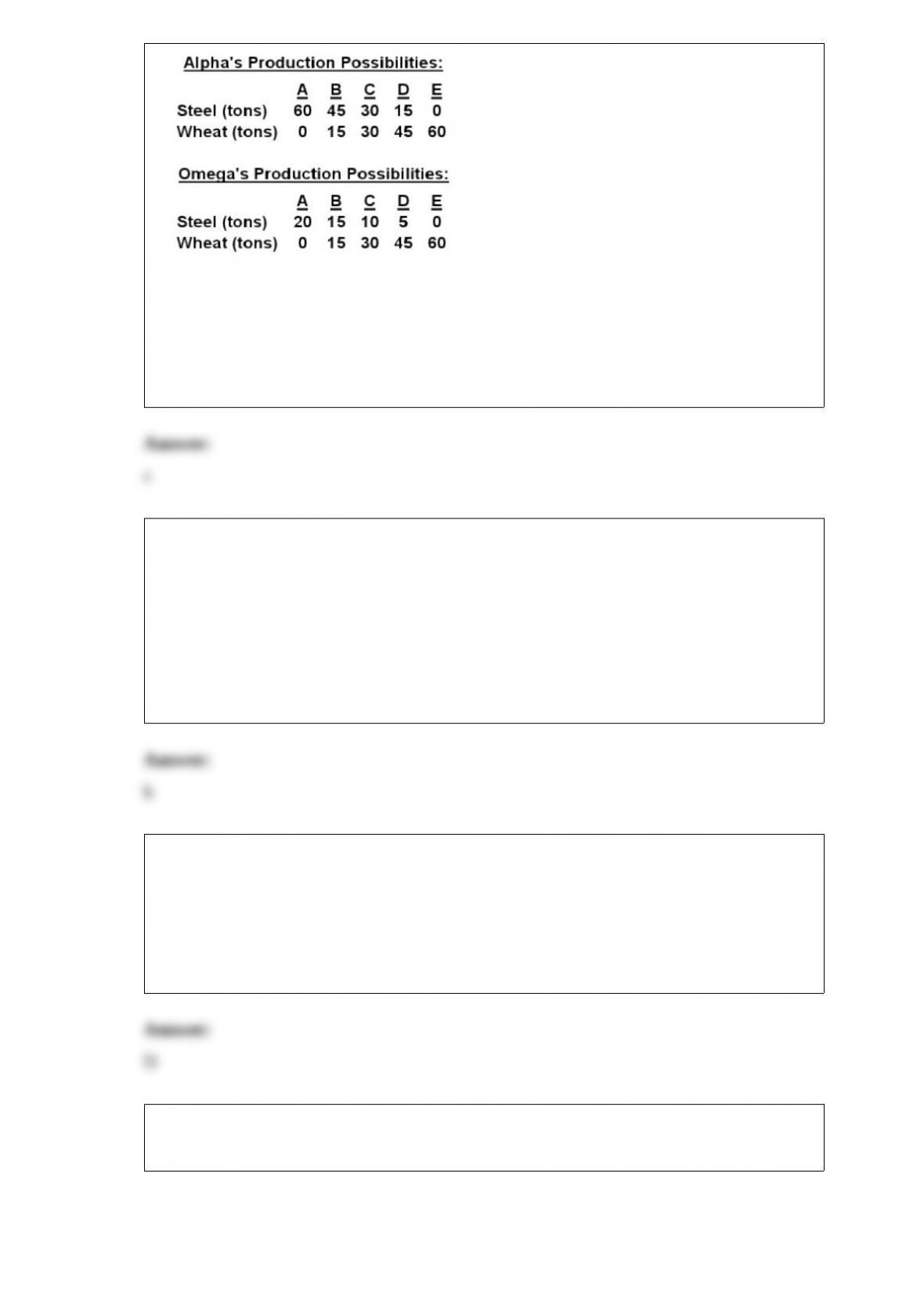
refer to the above data. if alpha was producing at alternative b and omega was at
alternative c before trade, the gain from specialization and trade would be:
a.30 tons of wheat.
b.5 tons of steel.
c.5 tons of steel and 15 tons of wheat.
d.15 tons of steel and 5 tons of wheat.
6) economic growth rates in follower countries:
a.tend to be lower than in leader countries because labor forces in follower countries are
too small.
b.tend to exceed those in leader countries because followers can cheaply adopt the new
technologies that leaders developed at relatively high costs.
c.will never bring real gdp per capita up to the same levels as in leader countries, even
if follower growth rates are greater than those in leader countries.
d.typically average about 2 percent per year.
7) Which of the following countries has the smallest percentage of its labor force
employed in agriculture?
A.China
B.Japan
C.Brazil
D.U.S.
8) the following cost data for a firm that is selling in a purely competitive market.
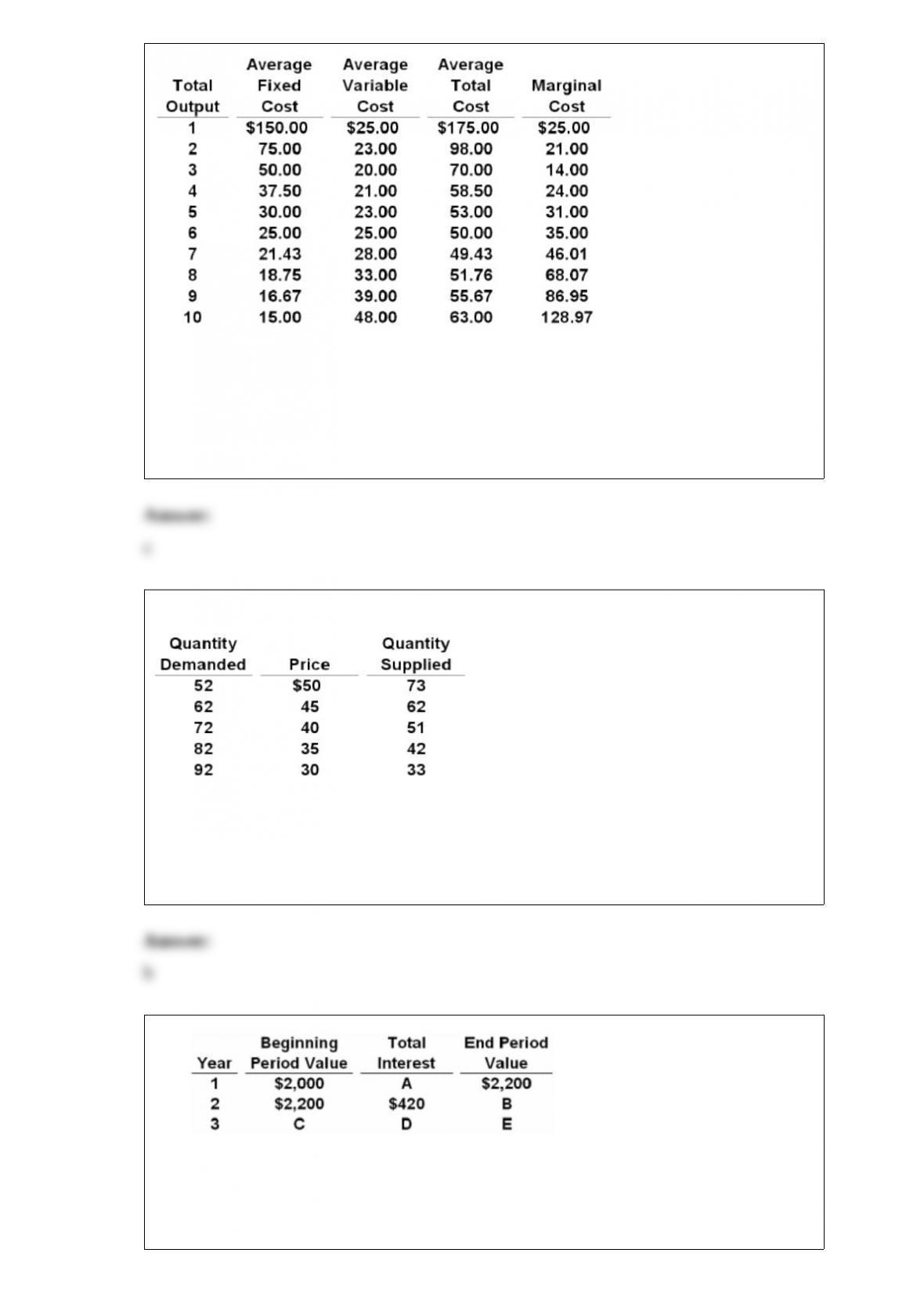
refer to the above data. if the market price for this firm’s product is $86.95, it will
produce:
a.9 units at an economic profit of zero.
b.6 units at a loss of $90.
c.9 units at an economic profit of $281.52.
d.8 units at an economic profit of $130.48.
9) government-set prices
in the above market, economists would call a government-set minimum price of $50 a:
a.price ceiling.
b.price floor.
c.equilibrium price.
d.fair price.
10)
Refer to the above table representing Kara’s bank account. Assuming that $2000 was
deposited into her account at the beginning of year 1, and no further deposits or
withdrawals were made, the interest rate Kara is receiving on her account:
A.is 5 percent.

B.is 10 percent.
C.is 20 percent.
D.cannot be determined.
11) which of the following is correct?
a.if demand is elastic, an increase in price will increase total revenue.
b.if demand is elastic, a decrease in price will decrease total revenue.
c.if demand is elastic, a decrease in price will increase total revenue.
d.if demand is inelastic, an increase in price will decrease total revenue.
12) a budget line shows the:
a.alternative combinations of two goods that a consumer can purchase with a given
money income.
b.alternative combinations of two goods that will yield the same level of total utility to
a consumer.
c.quantities of a particular good that a consumer will buy at various prices.
d.ratio of money income to product price.
13) if nominal gdp rises:
a.real gdp may either rise or fall.
b.we can be certain that the price level has risen.
c.real gdp must fall.
d.real gdp must also rise.
14) The transactions demand for money is most closely related to money functioning as
a:
A.unit of account.
B.medium of exchange.
C.store of value.
D.measure of value.

15) rising per-unit production costs are most directly associated with:
a.frictional unemployment.
b.structural unemployment.
c.demand-pull inflation.
d.cost-push inflation.