1) the present choice of position on the production possibilities curve will not influence
the future location of the curve.
2) price discrimination is illegal in the united states under antitrust regulations.
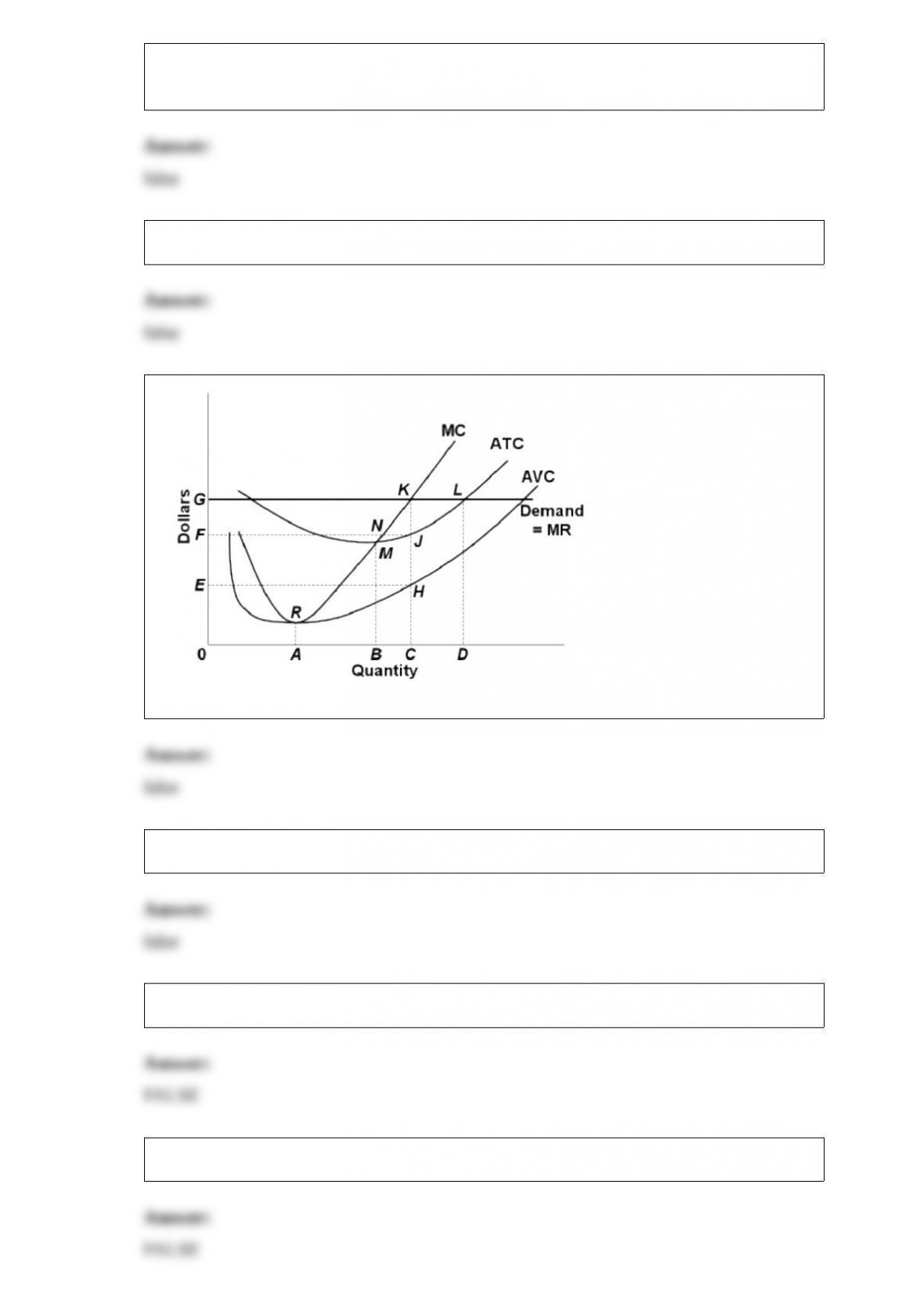
3)
refer to the above diagram. at output c total variable cost is fgkj.
4) surpluses drive market prices up; shortages drive them down.
5) The interest-rate effect is one of the determinants of aggregate demand.
6) Excess reserves are the amount by which required reserves exceed actual reserves.

7) illegal immigration always has a negative impact on the wages of domestic-born
workers.
8) The public debt is held as Treasury bills, Treasury notes, Treasury bonds, and U.S.
savings bonds.
9) the concept of opportunity cost:
a.is irrelevant in socialistic economies because of central planning.
b.suggests that the use of resources in any particular line of production means that
alternative outputs must be forgone.
c.is irrelevant if the production possibilities curve is shifting to the right.
d.suggests that insatiable wants can be fulfilled.
10) a firm’s supply curve is upsloping because:
a.the expansion of production necessitates the use of qualitatively inferior inputs.
b.mass production economies are associated with larger levels of output.
c.consumers envision a positive relationship between price and quality.
d.beyond some point the production costs of additional units of output will rise.
11) Which of the following generalizations is correct?
A.the more elastic the supply of a product, the larger the portion of an excise tax that is
borne by buyers
B.the more elastic the demand for a product, the larger the portion of an excise tax that
is borne by buyers
C.the more inelastic the supply of a product, the larger the portion of an excise tax that
is borne by buyers
D.the more inelastic the demand for a product, the larger the portion of an excise tax
that is borne by sellers
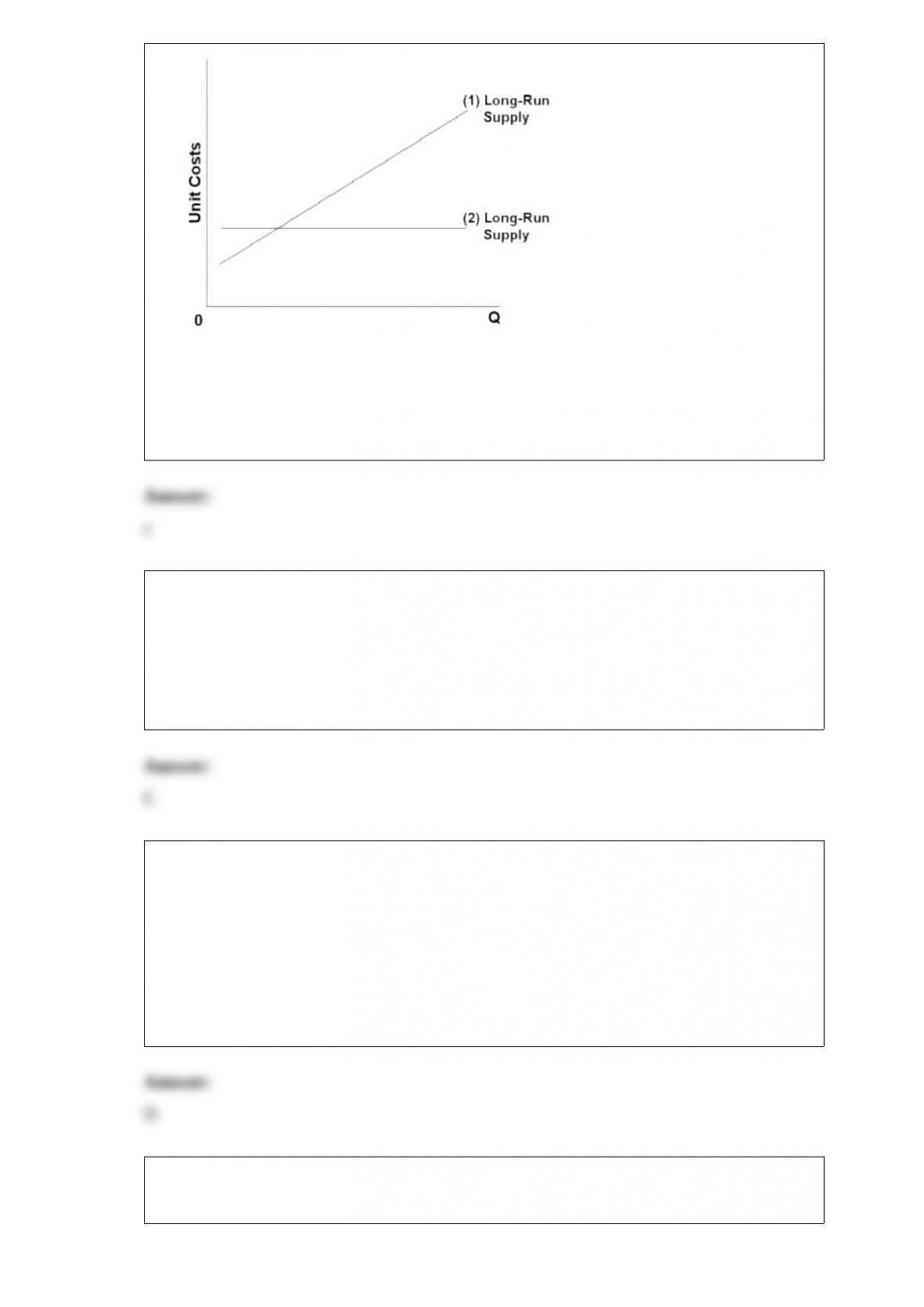
12)
refer to the above diagram. line (1) reflects the long-run supply curve for:
a.a constant-cost industry.
b.a decreasing-cost industry.
c.an increasing-cost industry.
d.a technologically progressive industry.
13) When aggregate demand declines, wage rates may be inflexible downward, at least
for a time, because of:
A.the foreign purchases effect.
B.inflexible product prices.
C.wage contracts.
D.the wealth effect.
14) Suppose that real domestic output in an economy is 20 units, the quantity of inputs
is 10, and the price of each input is $4. Answer the following question(s) on the basis of
this information.
Refer to the above information. The level of productivity is:
A.20.
B.10.
C.5.
D.2.
15) the following information for a pure monopolist:
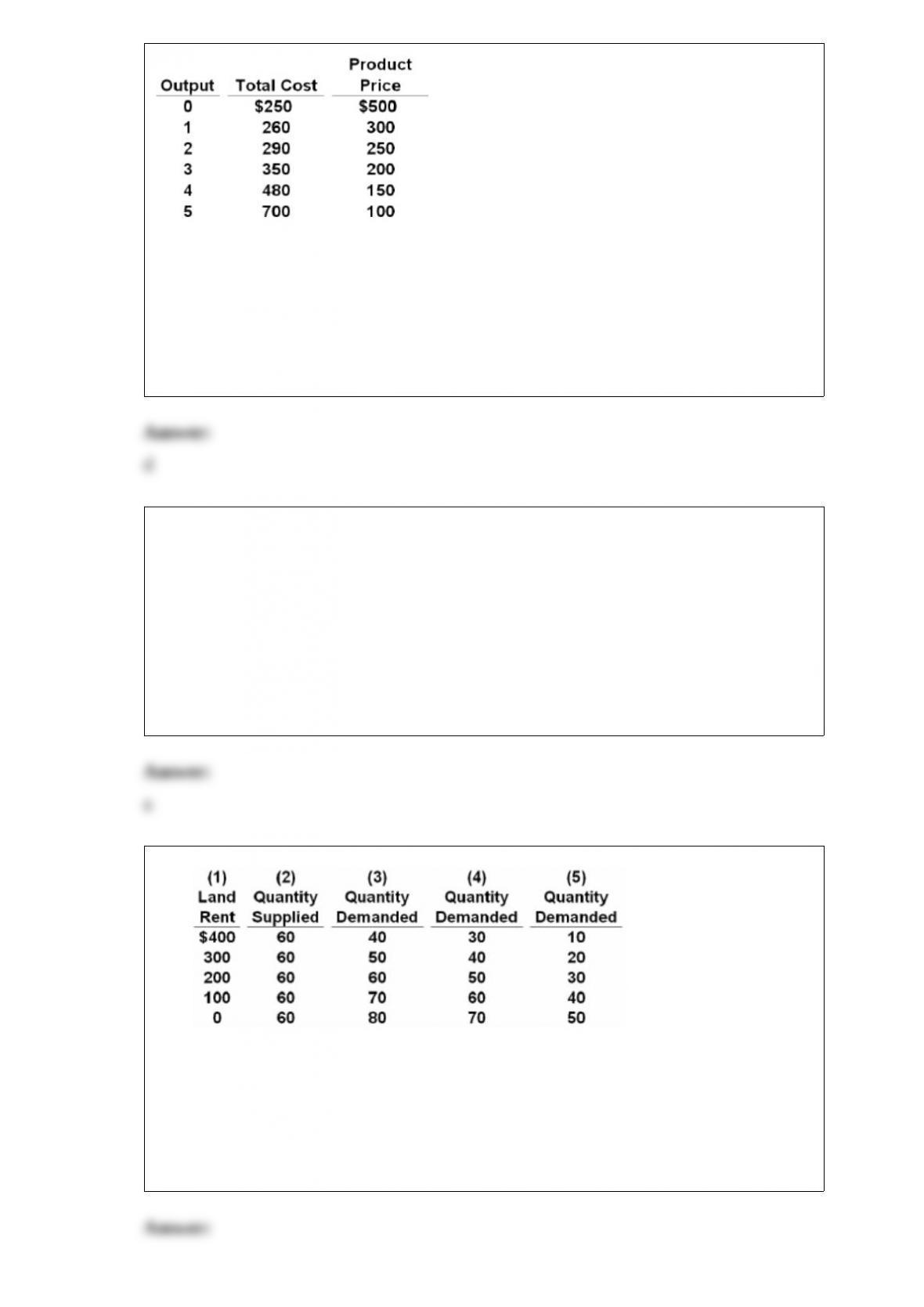
if the above profit-maximizing monopolist is able to price discriminate, charging each
customer the price associated with each given level of output, how much profit will the
firm earn?
a.$120
b.$250
c.$300
d.$420
16) which of the following statements is correct?
a.the long-run supply curve for a purely competitive increasing-cost industry will be
upsloping.
b.the long-run supply curve for a purely competitive increasing-cost industry will be
perfectly elastic.
c.the long-run supply curve for a purely competitive industry will be less elastic than
the industry’s short-run supply curve.
d.the long-run supply curve for a purely competitive decreasing-cost industry will be
upsloping.
17)
Refer to the above table, in which the values for columns (2) through (5) are in acres. If
the relevant columns are (1), (2), and (4), land rent will be:
A.$100 per acre.
B.$200 per acre.
C.$300 per acre.
D.$400 per acre.

18) Broadly defined, technological advance:
A.can occur in the short run, long run, or very long run.
B.comprises new and improved goods and services and new and improved ways of
producing or distributing them.
C.includes invention, but not innovation or diffusion.
D.includes product innovation, but not process innovation.
19) Differences in the amounts and quality of education and training:
A.combine with differences in mental, physical, and aesthetic talents to produce income
inequality.
B.explain none of the income inequality in the United States.
C.explain nearly all the income inequality in the United States.
D.have lessened in the United States in the past decade, sharply reducing income
inequality.
20) If two countries are growing at the same rate, the income gap between the two
countries should remain the same. Evaluate this statement.
21) Give a brief definition of fiscal policy? What are its economic goals?
22) Summarize the main research conclusions found by prominent economists on the
economic effects of immigration.
23) Explain the economic rationale for Henry Georges proposal for a single tax on land.
24) Is it possible to impose a burden on future generations by increasing the public
debt?
25) If the public debt is a debt that we owe to ourselves, then there are obviously no
problems connected with such a debt. Critically evaluate.
26) Why might trade barriers be a highly ineffective technique for increasing domestic
employment?

27) Suppose Jackie is considering purchasing an asset that will have a future value of
$650 in 4 years. The interest rate is 8% and the price of the asset is $500. Should Jackie
buy the asset? Why or why not?
28) If a nations balance of payments is always in balance, why isnt it also always in
equilibrium?