
Sven likes to water ski, but can only water ski during the one week each year when he
is on vacation. Therefore, he plans to ski every day, for eight hours a day. The first day,
Sven skied for eight hours and enjoyed every hour. The second day, Sven slept in and
then skied for seven hours, which was fun but not as much fun as the first day. The third
day, Sven skied for six hours, but was starting to get a bit bored by the end. The fourth
day, Sven skied for four hours and then took a nap. On the fifth day of Sven’s vacation,
Sven went blueberry picking all day. Sven’s total utility ______ with each hour that he
skied.
A. increased
B. decreased
C. remained constant
D. first increased than decreased
Refer to the figure below. This graph describes a good that:
A. generates positive externalities.
B. should be banned.
C. generates negative externalities.
D. the government should tax.
National defense is an example of a good that is:
A. neither nonrival nor nonexcludable.
B. largely nonrival and nonexcludable.
C. only nonexcludable.
D. only nonrival
In 1929, the CPI equaled 0.171 and in 1930, the CPI equaled 0.167. These data provide
evidence of a period of:
A. inflation.
B. deflation.
C. trade deficit.
D. expansion.
Compared to a fixed percentage reduction regulation, a tax on pollution encourages:
A. firms to reduce pollution by the same percent.
B. firms to use the same technology to reduce pollution.
C. firms that can more cheaply reduce pollution to make larger reductions.
D. big firms to make larger reductions because they can more easily afford it.
Factories and machines are examples of:
A. consumption goods.
B. non-market goods.
C. value-added goods.
D. capital goods.
The Boskin Commission found that the CPI ______ the true inflation rate.
A. is independent of
B. understates
C. precisely measures
D. overstates
Changes in government purchases affect planned spending:
A. only when there is an expansionary gap.
B. autonomously.
C. directly, by changing autonomous expenditures.
D. indirectly, by changing induced expenditures.
Everyone in the neighborhood has been complaining about the deteriorating condition
of the park, but nobody has cleaned it up. Why not?
A. There is an excess demand for parks in the neighborhood.
B. There is an excess supply of parks in the neighborhood.
C. The reservation price for a clean park exceeds the cost of cleaning it.
D. No single person’s reservation price to clean the park makes it worth cleaning it.
Bank depositors will not lose their deposits in a banking panic if:
A. there is fractional reserve banking.
B. there is 100% reserve banking.
C. there is a central bank.
D. the actual reserve/deposit ratio equals the desired reserve/deposit ratio.
For a given inflation rate, if concerns about future weakness in the economy cause
businesses to reduce their spending on new capital, then the ______ shifts _____.
A. aggregate demand curve; right
B. aggregate demand curve; left
C. aggregate supply curve; left
D. aggregate supply curve; right
The free-rider problem occurs when:
A. buyers pay less than their reservation price.
B. sellers receive more than their reservation price.
C. people who do not pay for a good or service cannot be excluded from enjoying it.
D. people who pay for a good or service cannot be excluded from enjoying it.
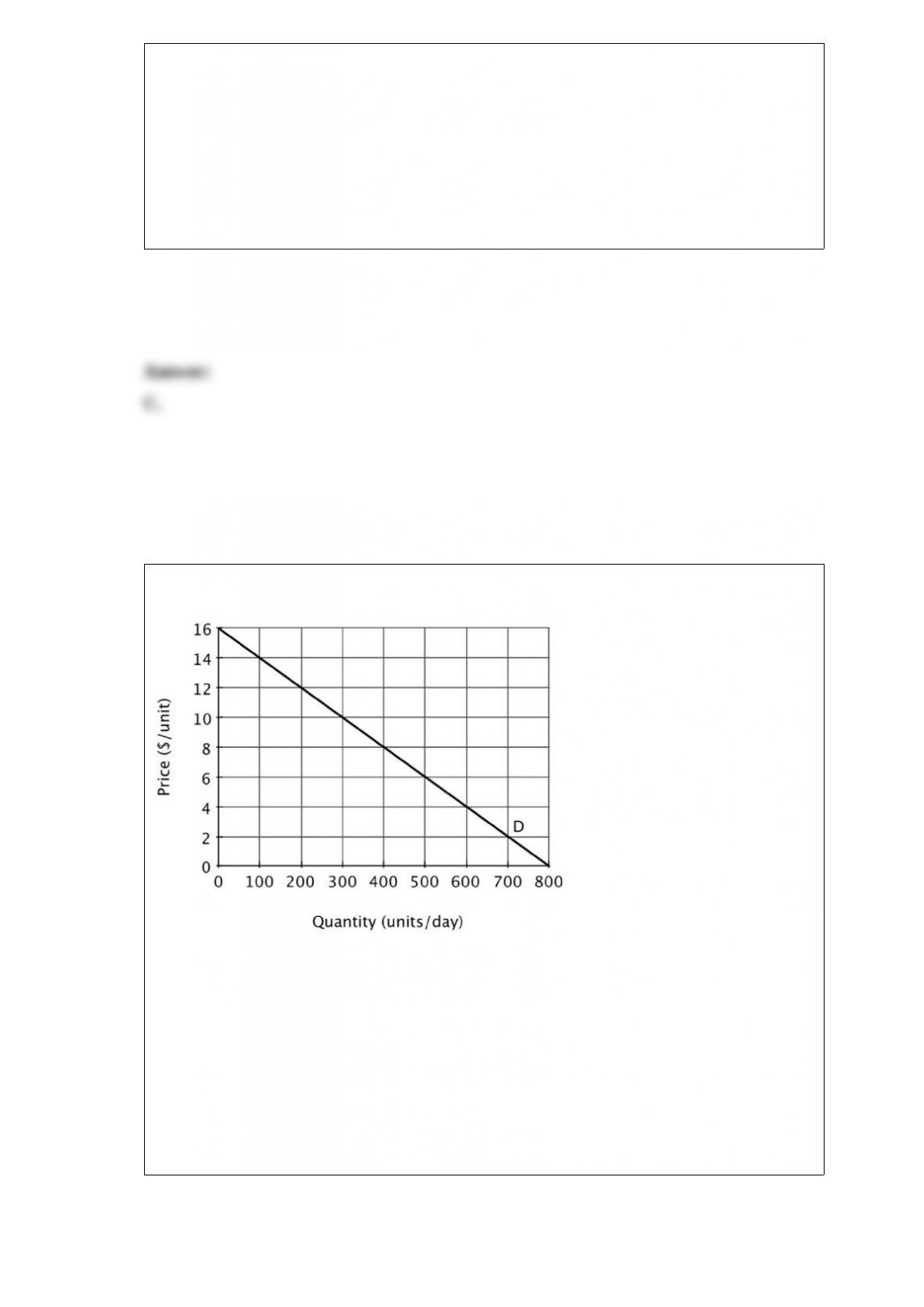
Suppose the figure below illustrates the demand curve facing a monopolist.
At a price of $8 per unit, the total revenue for this monopolist is ______ per day, and
the marginal revenue earned from the last unit sold is ______.
A. $8; $8
B. $3,200; $8
C. $3,200; $4
D. $3,200; $0
The equilibrium price and quantity of any good or service is established by:
A. only demanders.
B. only suppliers.
C. government regulations.
D. both demanders and suppliers.
If a gamble has an expected value of $10, then one can predict that:
A. only risk-averse people will take the gamble.
B. no risk-averse person will take the gamble.
C. all risk-neutral people will take the gamble.
D. the gamble never pays out more than $10.
Refer to the figure below. What is the equilibrium price of bananas in this market?
A. $0/pound
B. $1/pound
C. $4/pound
D. $5/pound
The aggregate demand curve shows the relationship between planned spending and the:
A. nominal interest rate.
B. real interest rate.
C. unemployment rate.
D. inflation rate.

Suppose that the salary range for recent college graduates with a bachelor’s degree in
economics is $30,000 to $50,000, with 25 percent of jobs offering $30,000 per year, 50
percent offering $40,000 per year and 25 percent offering $50,000 per year and that in
all other respects, the jobs are equally satisfying. Assume that in this market, a job offer
remains open for only a short time so that continuing to search requires an applicant to
reject any current job offer. Moe has just received a job offer that pays $40,000 per
year. Moe should:
A. reject the offer regardless of his preference for risk.
B. accept the offer if he is risk averse.
C. reject the offer if he is risk averse.
D. only accept the offer if he is risk-neutral.
If government spending increases by $1 million while net taxes are unchanged, then:
A. public saving increases.
B. public saving decreases.
C. public saving does not change.
D. private saving increases.
Suppose a firm uses workers and office space to produce output. The firm is locked into
a year-long lease on its office space, but it can easily vary the number of
employee-hours it uses each day. The table below describes the relationship between
the number of employee-hours the firm uses each day and the firm’s daily output. Each
unit of output sells for $2, the hourly wage rate is $14, and the rent on the office space
is $50 per day.
When the firm uses 9 employee-hours, it earns a daily ______ of ______.
A. loss; $64
B. profit; $64
C. loss; $114
D. profit; $114
In an open economy with flexible exchange rates, monetary policy affects consumption
and investment by changing the ______ and affects net exports by changing the _____.
A. inflation rate; unemployment rate
B. exchange rate; real interest rate
C. growth of domestic real GDP; growth of foreign real GDP
D. real interest rate; exchange rate
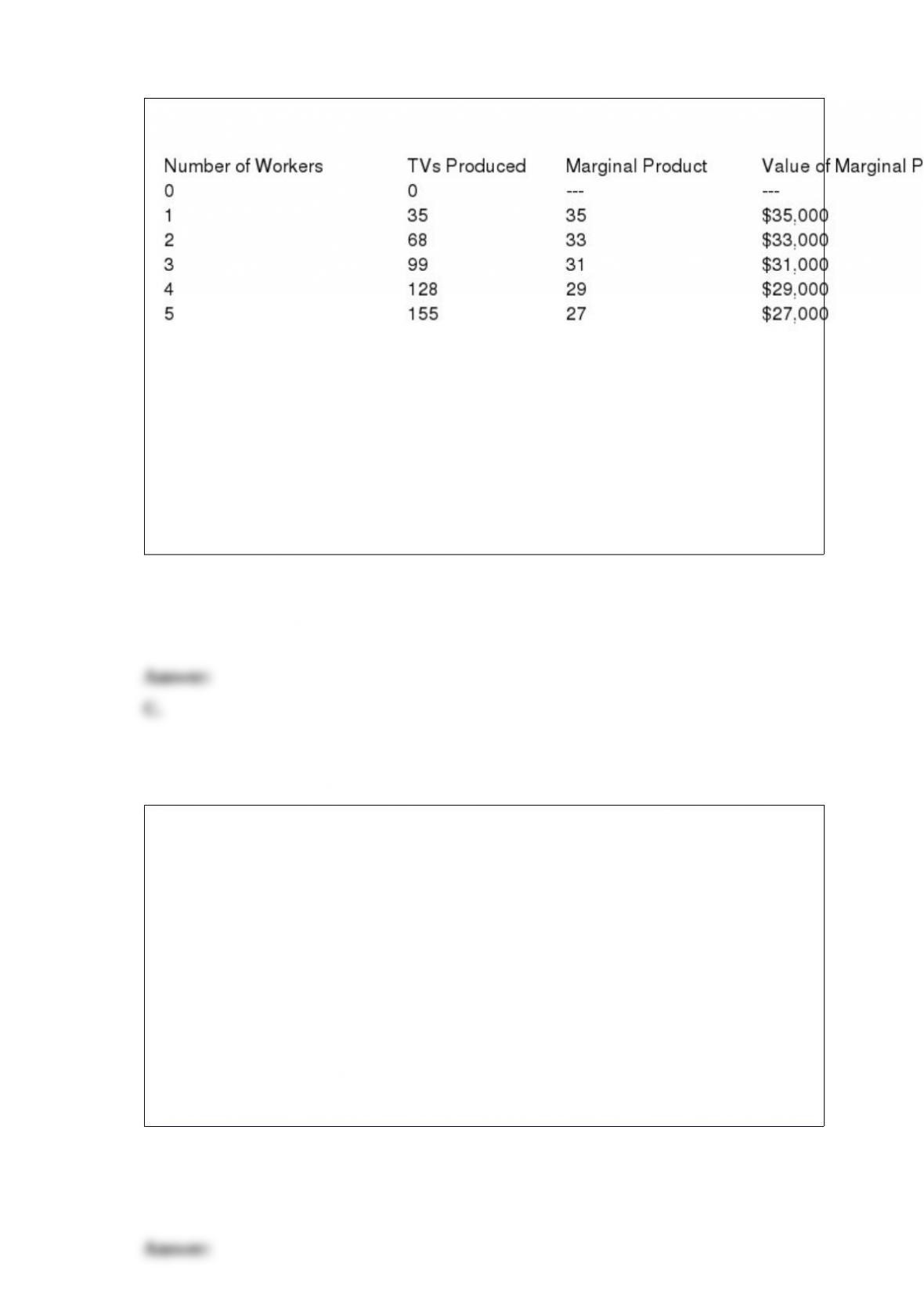
The following table provides information about production at the XYZ-TV Company.
How many workers will XYZ-TV Company hire if the going wage for TV production
workers is $32,000?
A. 0
B. 1
C. 2
D. 3
Joe is shopping for a new computer. A computer can be delivered to Joe’s home for
$1,200. Alternatively, Joe can pick up the same computer at the warehouse for $1,000.
How should Joe buy the computer?
A. Joe should drive to the warehouse because $1,000 is less than $1,200.
B. Joe should drive to the warehouse if his cost of driving to the warehouse is less than
$200.
C. Joe should drive to the warehouse if his cost of driving to the warehouse is greater
than $200.
D. Joe should drive to the warehouse because the $200 he would save by driving to the
warehouse is more than 10% of the purchase price.
Where Y is GDP, C is consumption, I is investment, G is government spending, and
there is no international trade, national saving equals:
A. C + I + G.
B. Y – C – G.
C. Y + C + G.
D. Y – C – I.
You have found data that indicates that the income elasticity of demand for generic
(unbranded) shampoo is -0.7. You should conclude that generic shampoo:
A. is a normal good.
B. has inelastic demand.
C. is below its equilibrium price.
D. is an inferior good.
Which of the following statements about implicit costs is true?
A. They are always fixed.
B. They measure the forgone opportunities of the firm’s owners.
C. They exceed explicit costs.
D. They do not enter into the calculation of economic profit.
If short-run equilibrium output equals 10,000, the income-expenditure multiplier equals
5, potential output (Y*) equals 11,000, then government purchases must ______ to
eliminate any output gap.
A. increase by 200
B. increase by 1,000
C. increase by 5,000
D. decrease by 200
To the extent that households are target savers who save to reach a specific goal, an
increase in the interest rate ______ household saving and a decrease in the interest rate
______ household saving.
A. increases; decreases
B. decreases; increases
C. does not affect; increases
D. increases; does not affect
Refer to the figure below. Long-run equilibrium in this economy:
A. will be impossible to achieve.
B. could occur if AD shifts upward to the right.
C. could occur if AS shifts upward and to the left.
D. will occur only if AD shifts downward to the left.
If the rate of inflation equals zero, then the real rate of interest:
A. equals zero.
B. equals the nominal rate of interest.
C. can be negative.
D. equals the target real interest rate.
Private saving is positive when:
A. there is a government budget surplus.
B. there is a government budget deficit.
C. the government’s budget is balanced.
D. after-tax income of households and businesses is greater than consumption
expenditures.
If real GDP is less than potential GDP, then:
A. the actual unemployment rate is greater than the natural rate of unemployment.
B. the actual unemployment rate equals zero.
C. the output gap is positive.
D. the actual unemployment rate is less than the natural rate of unemployment.
It takes many years to train to become an orthopedic surgeon. This suggests that, in the
short run, a sudden increase in the demand for orthopedic surgeons will:
A. not affect the salaries of orthopedic surgeons.
B. have no impact on the number of people who decide to become orthopedic surgeons.
C. lead to a large increase in the number of orthopedic surgeons.
D. have little effect on the number of trained orthopedic surgeons.