
The Federal Trade Commission Act of 1914
a. made interlocking directorates illegal.
b. set up the Federal Trade Commission (FTC) to deal with “unfair methods of
competition.”
c. made monopolization of trade a misdemeanor.
d. prohibited suppliers from offering special discounts to large chain stores without
offering them to everyone else.
e. empowered the FTC to deal with false and deceptive acts or practices.
For a perfectly competitive firm,
a. marginal revenue is equal to price.
b. price is equal to marginal cost at the output level that maximizes profit.
c. selling an additional unit of the good it produces increases total revenue by the price
of the good.
d. a and b
e. a, b, and c

According to the data provided in this table, what is the slope of the line between points
C and D (if these data were graphed with X on the horizontal axis and Y on the vertical
axis)?
a. -0.40
b. -2.50
c. 0.40
d. 2.50
e. none of the above
Total industry sales are $90 million. The top four firms (A, B, C, and D) account for
sales of $15 million, $3.5 million, $1.3 million and $0.8 million, respectively. What is
the four-firm concentration ratio?
a. 9.40
b. 0.23
c. 0.77
d. 0.40
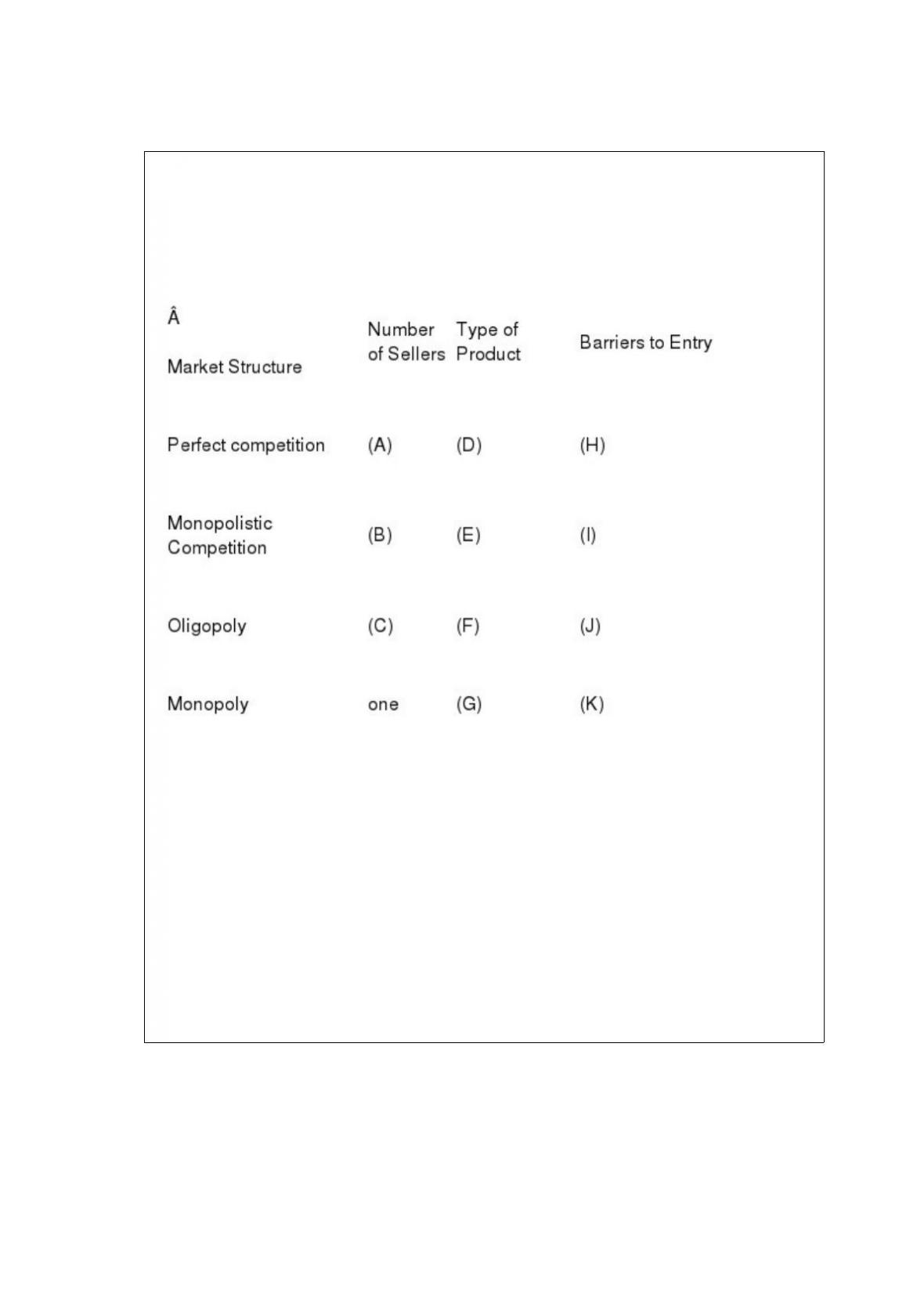
Exhibit 25-9
There ___________ barriers to entry in a perfectly competitive market.There
____________barriers to entry in monopolistic competition.There
____________barriers to entry in oligopoly. There ____________ barriers to entry in
monopoly.[Your answers should fill in blanks (H), (I), (J) and (K), respectively.]
a. are; are; are no; are no
b. are no; are; are; are no
c. are no; are no; are; are
d. are no; are; are; are

Suppose health-care reform Y makes it unlawful for insurance companies to deny
insurance to persons with a preexisting disease and sets a fine for those people who do
not buy insurance.It follows that if the fine is
a. larger than the benefits derived from not buying insurance right away, then people
will not buy the insurance and pay the fine.
b. smaller than the benefits derived from not buying the insurance right away, then
people will not buy the insurance and pay the fine.
c. larger than the benefits derived from not buying insurance right away, then people
will buy the insurance right away and not pay the fine.
d. b and c
e. none of the above
Jimmy borrowed $30,000 to add a room to his house. He financed the loan over 3 years
at 8 percent per year. He expects a 2 percent inflation rate each year for the next 3
years. It follows that he expects to pay an annual real interest rate of
a. 8 percent.
b. 9 percent.
c. 11 percent.
d. 6 percent.

The demand curve facing a monopolistic competitive firm will be __________ than the
demand curve facing a perfectly competitive firm because the price elasticity of
demand for the monopolistic competitive firm’s product is __________ than that for the
perfectly competitive firm.
a. steeper; higher
b. flatter; higher
c. steeper; lower
d. flatter; lower
A profit maximizing firm that is a price taker in both product and factor markets will
hire a factor up to the point at which
a. the last unit of the factor hired adds as much to costs as it does to revenues.
b. the value of marginal product equals the wage rate.
c. the marginal revenue product equals the wage rate.
d. all of the above
e. a and b
Suppose the government decides that every family should own its own home. To bring
this about, the government decides to subsidize the home-construction industry by
giving the home-construction companies $10,000 for every house that they build. As a
result of this,
a. the supply curve of new houses would shift leftward, since it now costs $10,000 more
for builders to produce a house.
b. the demand curve for new houses would shift rightward, since now every family

would want to buy a house.
c. the demand curve for new houses would shift leftward.
d. the supply curve of new houses would shift rightward, since builders would be
willing to produce and sell more houses at each given price.
e. c and d
Which of the following was declared illegal by the Sherman Act of 1890?
a. a conspiracy in restraint of trade
b. price discrimination
c. tying contracts
d. interlocking directorates