1) an advantage of international reserves is that they allow countries to sustain
temporary balance-of-payments deficits until acceptable adjustment measures can
operate to correct the disequilibrium.
a.true
b.false
2) foreign-exchange brokers help commercial banks carry out foreign exchange trading
and maintain desired balances of foreign exchange.
a.true
b.false
3) exhibit 4.2
in the absence of international trade, assume that the equilibrium price and quantity of
motorcycles in canada is $14,000 and 10 units respectively. assuming that canada is a
small country that is unable to affect the world price of motorcycles, suppose its market
is opened to international trade. as a result, the price of motorcycles falls to $12,000 and
the total quantity demanded rises to 14 units; out of this total, 6 units are produced in
canada while 8 units are imported. now assume that the canadian government levies an
import tariff of $1,000 on motorcycles.
refer to exhibit 4.2. the tariff’s redistribution effect equals $7,000.
a.true
b.false
4) stabilizing speculation reinforces market forces by intensifying an appreciation or a
depreciation in a currency’s exchange value.
a.true
b.false
5) under a floating exchange-rate system, which of the following best leads to a
depreciation in the value of the canadian dollar?
a.a decrease in the canadian money supply
b.a fall in the canadian interest rate
c.an increase in national income overseas
d.rising inflation overseas
6) ricardo’s theory of comparative advantage does not take into account demand
conditions when determining relative commodity prices.
a.true
b.false
7) given floating exchange rates, assume that the swiss decrease their import purchases
from italy while at the same time the italians increase their purchases of swiss
government securities. the first action by itself would lead to a (an) ____ of the franc
against the lira while the second action by itself would lead to a (an) ____ of the franc
against the lira.
a.appreciation, appreciation
b.depreciation, depreciation
c.appreciation, depreciation
d.depreciation, appreciation
8) the effect of currency depreciation on the purchasing power of money balances and
the resulting impact on domestic expenditures is emphasized by the:
a.absorption approach
b.monetary approach
c.fiscal approach
d.elasticity approach
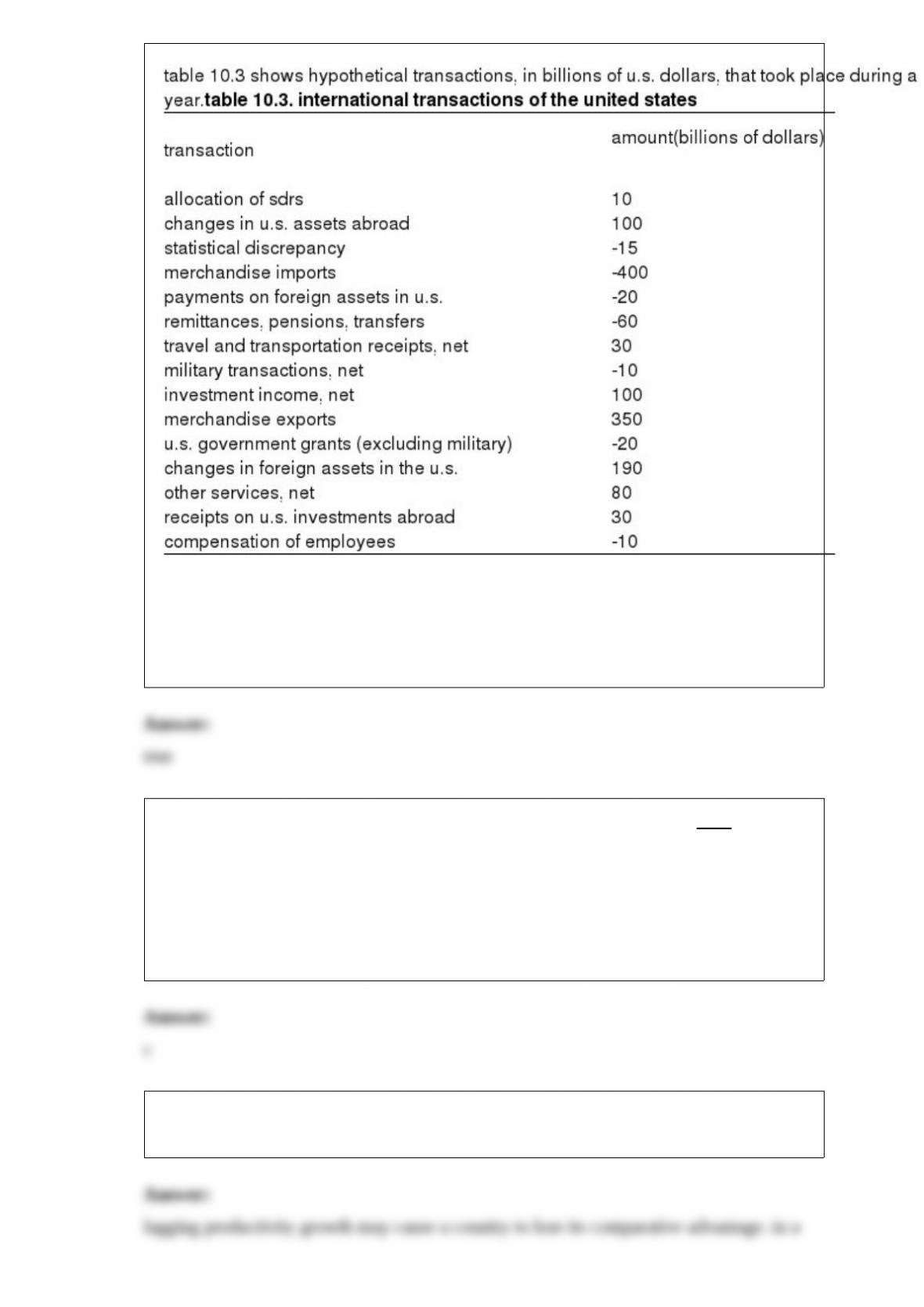
9) refer to table 10.3. the merchandise-trade balance registered a deficit of $50 billion.
a.true
b.false
10) concerning international trade restrictions, which of the following is false? trade
restrictions:
a.limit specialization and the division of labor
b.reduce the volume of trade and the gains from trade
c.cause nations to produce inside their production possibilities curves
d.may result in a country producing some of the product of its comparative
disadvantage
11) is it possible for comparative advantage to change, thus changing the direction of
trade?
12) what is the most important factor which contributes to competitiveness?
13) explain how advocates of strategic trade policy differ from the classical free traders
in their treatment of externalities?
14) does exposure to competition with the world leader in a particular industry improve
a firm’s productivity?
15) what is the foreign repercussion effect?
16) explain the law of comparative advantage.
17) what are the essential arguments in favor of free trade?
18) how can tariffs be justified?
19) what are the challenges of the international trading system?