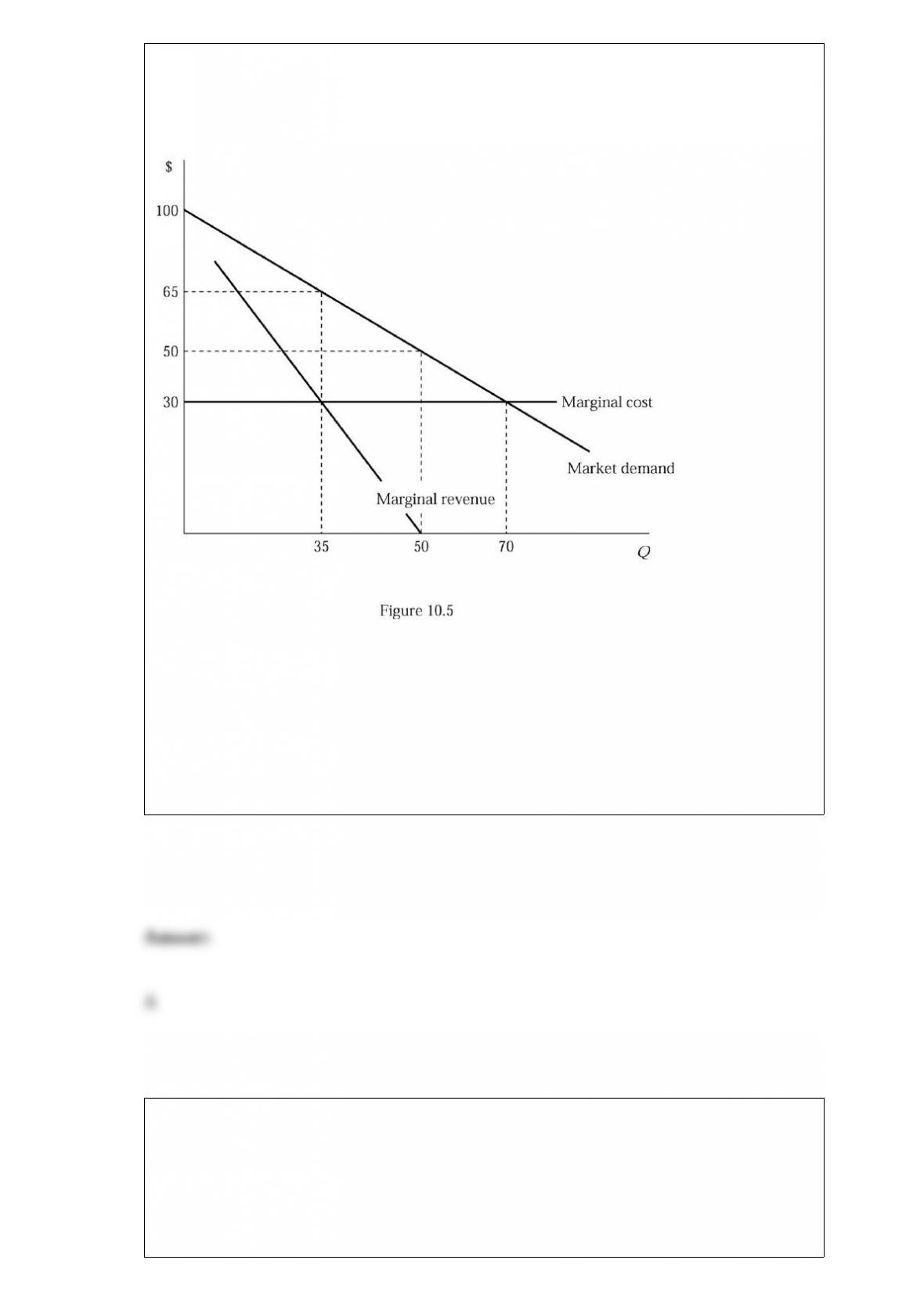
Suppose that Figure 10.5 shows a monopolist’s demand curve, marginal revenue, and its
cost. The monopolist would maximize its profit by producing a quantity of ________
and by charging a price of ________.
A) 35; $65
B) 50; $50
C) 70; $30
D) There is not sufficient information.
Which of the following is NOT a macroeconomic question?
A) Should we have a constitutional amendment to balance the federal budget?
B) Do employers discriminate against women by paying them lower wages?

C) How does a political candidate’s economic reform package affect the inflation rate?
D) All of the above are macroeconomic questions.
Toby sells wheat in a perfectly competitive market. This month Toby receives a higher
price for a bushel of wheat than he did last month. Which of the following might
explain this?
A) The market demand for wheat increased.
B) The market demand for wheat decreased.
C) Firms entered the market.
D) Toby’s costs have decreased.
In monopolistic competition, firms can have some market power based on the fact that:
A) they are large in size.
B) there are barriers to entry.
C) there is only one firm in the industry.
D) they produce differentiated goods.
According to this Application, the Commerce Department typically uses ________ to
determine of foreign companies are selling products at lower prices in the United States
than in their own domestic markets.
A) price information supplied by the foreign manufacturing company
B) actual prices charged in home markets compared to foreign markets
C) value-added price estimates supplied by the World Trade Organization (WTO)
D) a constructed value method where it estimates prices charged in an exporter’s home
market
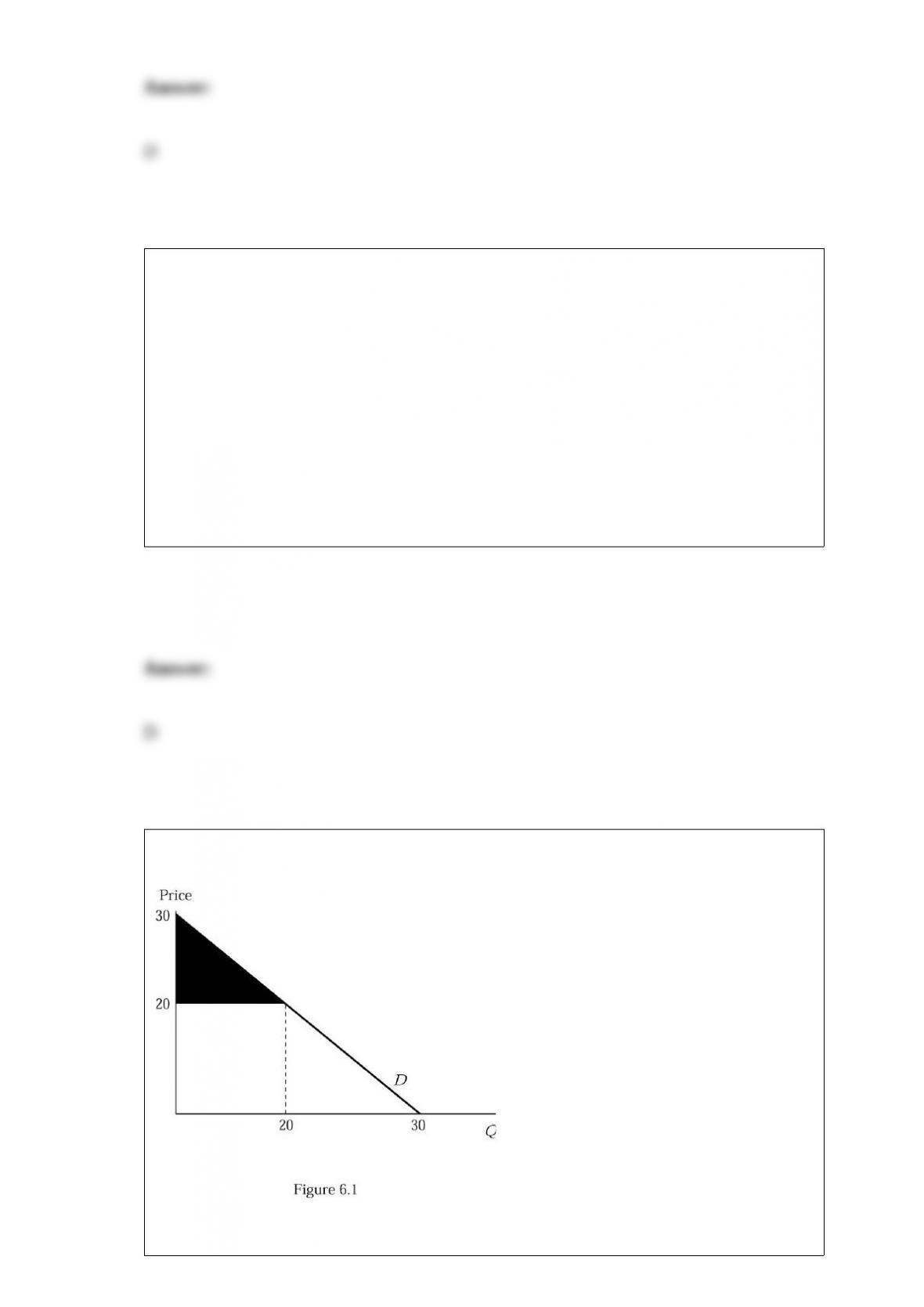
In Figure 6.1, the price of the good is $20 and the shaded area represents:
A) producer surplus.

B) consumer surplus.
C) market equilibrium.
D) a price ceiling.
As long as two firms have different abatement costs, they:
A) can benefit under a system of marketable pollution permits by trading the right to
pollute.
B) will prefer a pollution tax to a system of marketable pollution permits.
C) will decrease the price of their product if taxed on the amount of pollution they emit.
D) will not be able to benefit from trading the right to pollute under a system of
marketable pollution permits.
In Figure 5.3 the most elastic supply curve:
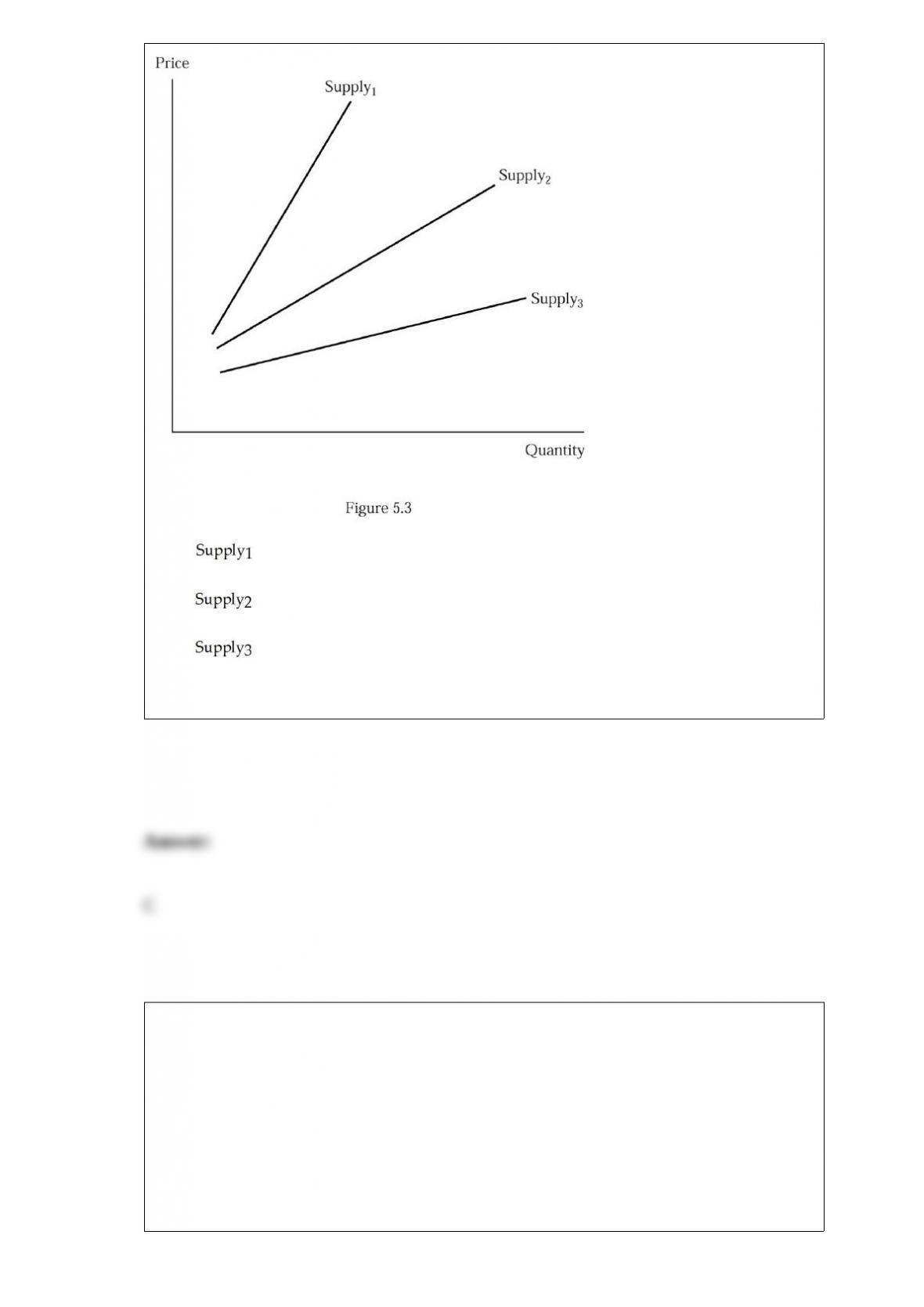
A) is .
B) is .
C) is .
D) Cannot be determined.
The law of demand states that the quantity demanded of a product increases as:
A) consumer income rises.
B) the prices of other products fall.
C) the price of the product rises.
D) the price of the product falls.

Recall the application about positive and negative effects from immigration of
low-skilled workers. Which groups below benefit from immigration of low-skill
workers?
A) firms and high school dropouts
B) consumers and low-skill workers
C) firms and low-skill workers
D) firms and consumers
The health insurance premiums for Firm A’s employees are based on an experience
rating. Which of the following is correct?
A) Firm A will be more likely to screen job applicants for health problems in order to
keep its premiums low.
B) Firm A will be more likely to offer safety and health programs for its employees.
C) Firm A will be less likely to consider the health of job applicants when hiring new
employees.
D) both A and B

In general the entry-deterrence game will generate a market price:
A) higher than the monopoly price.
B) lower than the monopoly price but higher than the duopoly price.
C) the same as the monopoly price.
D) the same as the duopoly price.
Suppose that Gigantic Company is increasing in size. As Gigantic Company grows,
demand for inputs causes input prices to rise. It is likely that continued growth will
result in:
A) economies of scale.
B) reduced fixed costs.
C) diseconomies of scale.
D) increasing marginal returns.
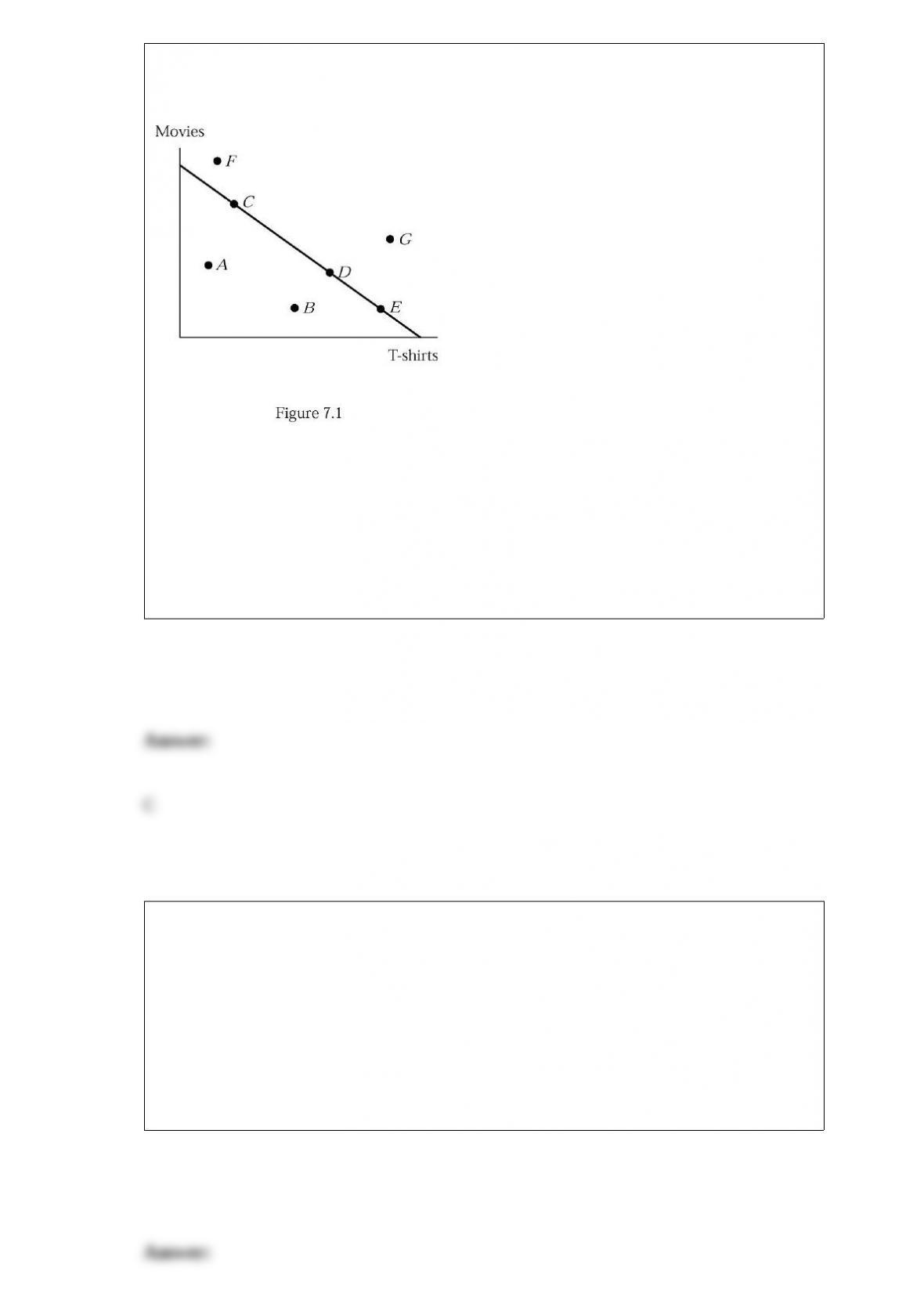
Refer to Figure 7.1. Which of the following includes an unaffordable combination(s) of
movies and T-shirts?
A) A, B and C
B) B, C and D
C) C, D and G
D) A, C and E
The absolute value of the slope of the budget line is:
A) the ratio of the marginal utility of one good to the marginal utility of the other good.
B) the ratio of the marginal utility of one good to the price of the other good.
C) the ratio of the price of one good to the price of the other good.
D) dependent on consumer income.
The government is likely to block a merger if:
A) the firms remaining would all earn economic profit.
B) it can be established that the merger would substantially reduce competition.
C) the firms remaining would be able to charge a price above marginal cost.
D) the firms that are merging are producing different products.
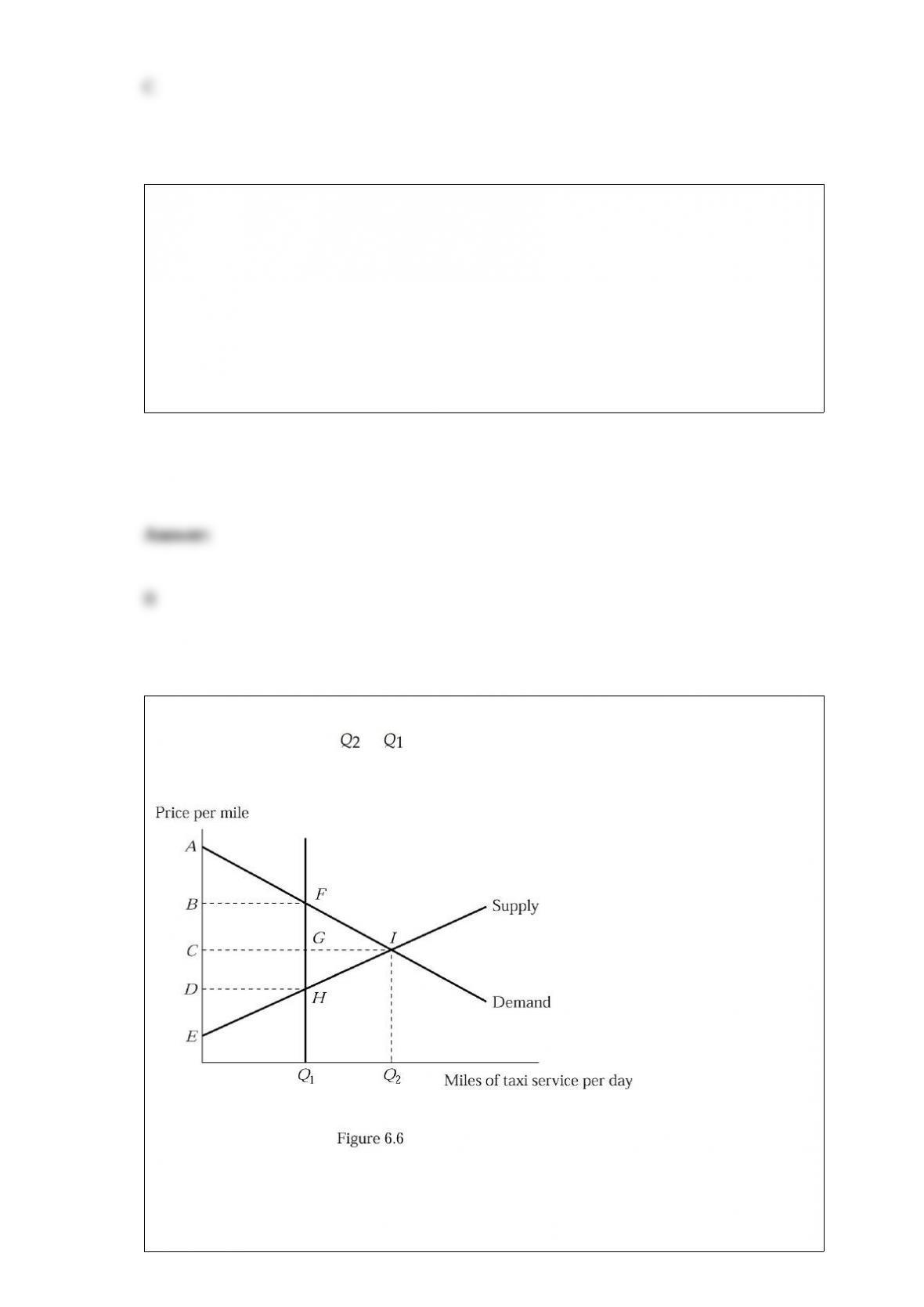
Refer to Figure 6.6, which shows a market for taxi medallions. If the number of taxi
licenses is reduced from to , the consumer surplus from consuming taxicab
services is represented by:
A) area ABF.
B) area ACFG.
C) area DEH.
D) area BEFH.
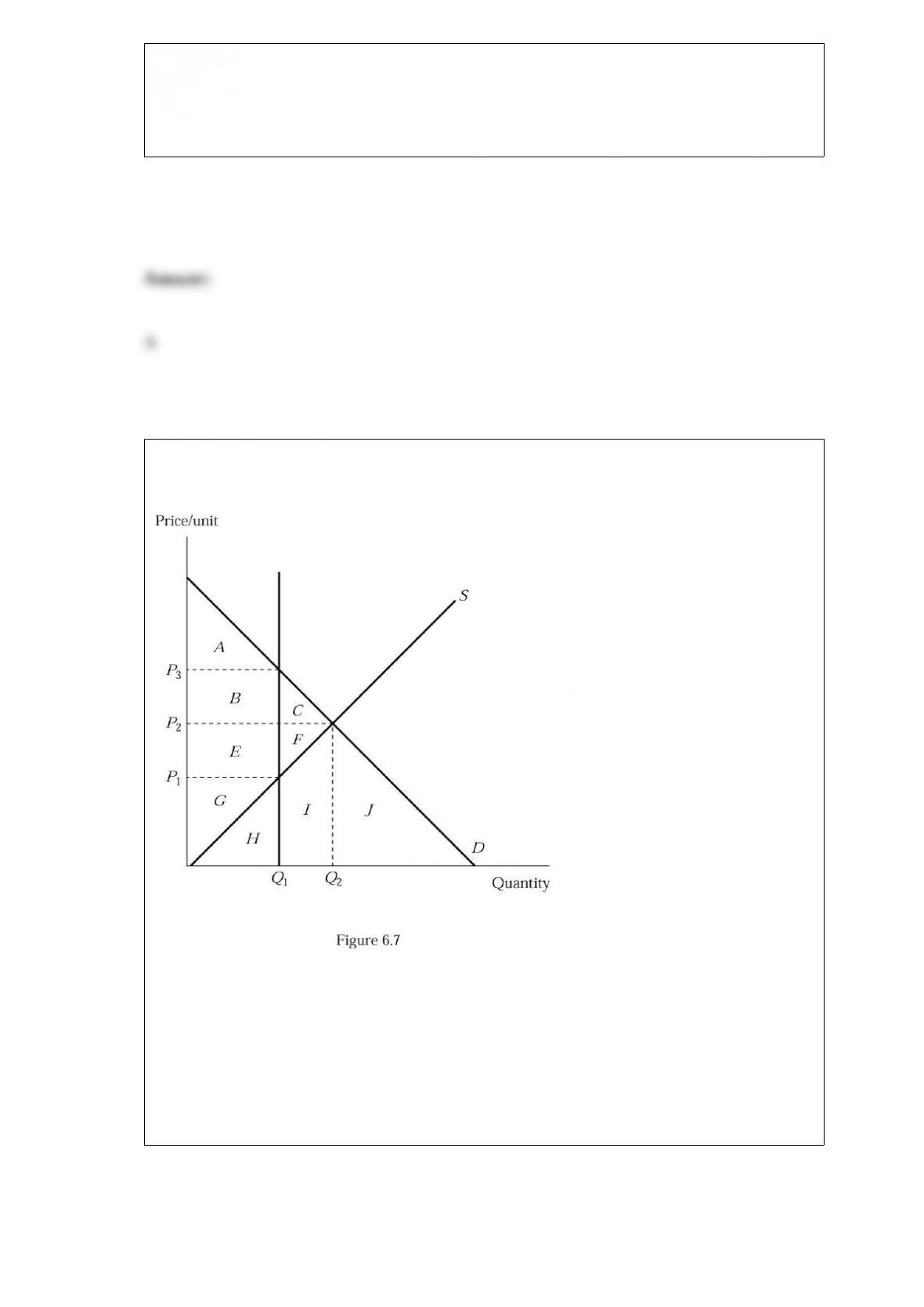
In Figure 6.7 with a quantity constraint of Q1, consumer surplus is area:
A) A.
B) A + B + C.
C) E + F + G.
D) G.
If a monopolist charges the same price for all of the units of the good that it sells, then
beyond the first unit sold:
A) P = MR because the firm maximizes profit.
B) P = MR because the monopolist holds price constant.
C) P < MR because the monopolist must decrease price on all units in order to sell
another unit.
D) P > MR because the monopolist must decrease price on all units in order to sell
another unit.
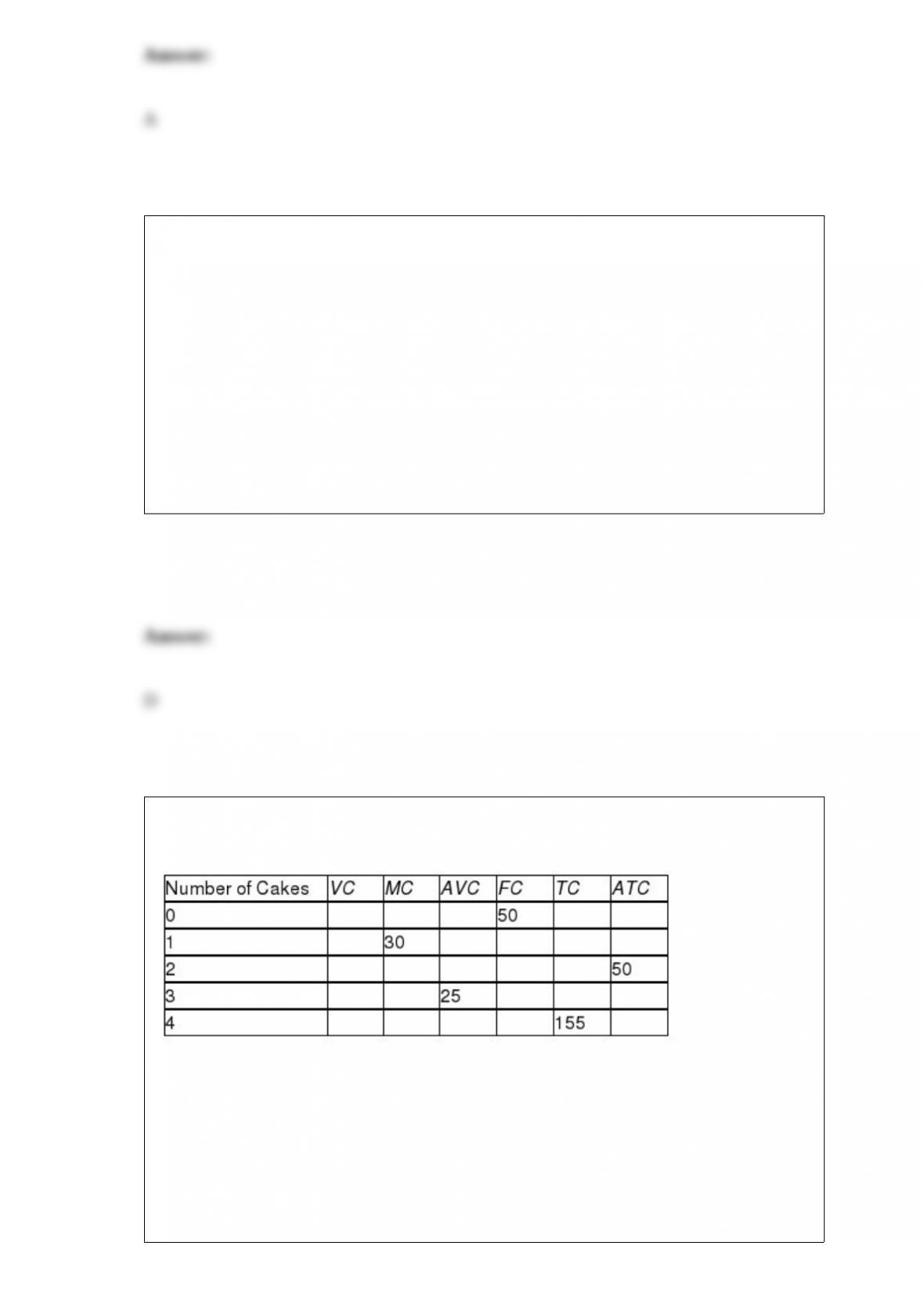
Table 8.3 presents the cost schedule for Candy’s Cakes. If Candy produces two cakes,
Candy’s marginal cost is:
Table 8.3
A) $0.
B) $20.
C) $25.

D) $50.
A good for which demand decreases when income increases is known as a(n) ________
good.
A) normal
B) inferior
C) complementary
D) substitute
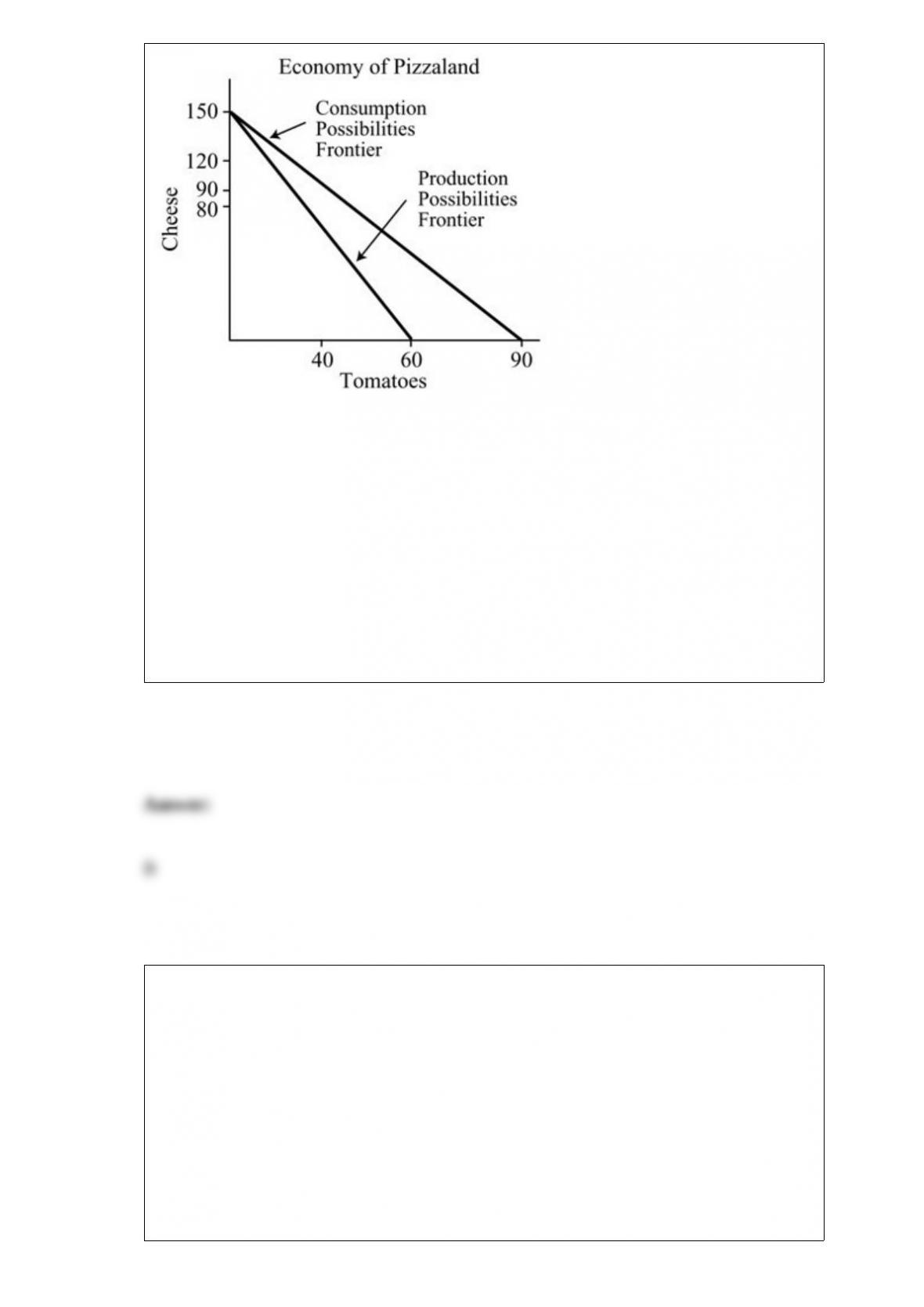
Figure 18.2
Refer to Figure 18.2. After trade and specialization begin, the maximum amount of
tomatoes that Pizzaland can consume is:
A) 120.
B) 90.
C) 80.
D) 60.
In the mid 1990s, Coke introduced a new soda in the soft drink market. Coke then used
a new advertising campaign to associate the new soda with youth and strength. Coke
was trying to:
A) shift the demand curve for competing soft drinks to the left.
B) create a perfectly competitive market for soft drinks.
C) maximize its per unit costs through advertising.
D) lower the market price of soft drinks.

The face value of money or income is called its ________ value.
A) real
B) marginal
C) nominal
D) external
For public goods, an external benefit occurs because:
A) the goods are overvalued by society.
B) they provide total benefits that are greater than their costs, but smaller than the
personal benefit of each individual.
C) they are rival.
D) none of the above

Suppose nation A produces only two goods, apples and oranges. If nation A produces
only apples, it can make 12 apples per day. If nation A produces only oranges, it can
make 36 oranges per day. If the country has a constant production trade-off between
apples and oranges, then the opportunity cost of one apple in nation A is:
A) 36 oranges.
B) 3 oranges.
C) 12 oranges.
D) .33 oranges.
Suppose that a market for a product is in equilibrium at a price of $5 per unit. At any
price below $5 per unit:
A) there will be an excess demand for the product.
B) there will be an excess supply of the product.
C) the quantity supplied of the product will be greater than the quantity demanded of
that product.
D) both B and C.

On a linear demand curve, demand is ________ at the middle of the demand curve than
it is at small quantities.
A) more elastic
B) less elastic
C) equally elastic
D) impossible to tell
The cross-price elasticity between good X and good Y is positive. Other things being
equal, if the price of X rises:
A) quantity of Y demanded decreases.
B) quantity of Y demanded increases.
C) a consumer spends more on good Y than on good X.
D) a consumer spends more on good X than on good Y.
A reservation price is:
A) the lowest price found so far in a search process.
B) a negotiated price for a product or service.

C) the price at which a consumer is indifferent about additional search for a lower price.
D) a retail price listed on a product.