
1) Scenario 15-3
A monopoly firm maximizes its profit by producing Q = 500 units of output. At that
level of output, its marginal revenue is $30, its average revenue is $60, and its average
total cost is $34.
At Q = 500, the firm’s marginal cost is
a. less than $30.
b. $30.
c.$34.
d.greater than $34.
2) Miguel is a 20 year old college student who works part-time and earns an annual
income of $12,000. To smooth out his life cycle changes in income, Miguel can
a.save his earnings to use when he is middle-aged.
b.lend money to a friend to purchase a new car.
c.borrow money to pay for college, which he will later repay when his income rises.
d.attempt to pay for college from his current earnings.
3) Scenario 20-3
Suppose that a society is made up of five families whose incomes are as follows:
$120,000; $90,000; $30,000; $30,000; and $18,000.
The federal government is considering two potential income tax plans:
Plan A is a negative income tax plan where the taxes owed equal 1/3 of income minus
$20,000.
Plan B is a two-tiered plan where families earning less than $35,000 pay no income tax
and families earning more than $35,000 pay 10% of their income in taxes. The income
tax revenue collected from those families earning over
$35,000 is then redistributed equally to those families earning less than $35,000.
Refer to Scenario 20-3. Assuming that utility is directly proportional to the cash value
of after-tax income, which government policy would an advocate of liberalism prefer?
a.Plan A
b.Plan B
c.either Plan A or Plan B
d.neither Plan A nor Plan B because any plan that forcibly redistributes income is
against the philosophy

4) Studies of human decision-making show that
a.firms are less likely to maximize profits than consumers are to maximize utility.
b.firms are more likely to maximize profits than consumers are to maximize utility.
c.people are irrational more often than they are rational.
d.people are reluctant to change their minds.
5) In a market economy, prices are the signals that guide the allocation of scarce
resources.
a.True
b.False
6) Which of the following is not correct?
a.Evaluating statements about how the world should be involves values as well as facts.
b.Positive statements can, in principle, be confirmed or refuted by examining evidence.
c.Normative statements can be judged using data alone.
d.Deciding what is good or bad policy is not just a matter of science.
7) Public schools, parks, libraries, and roads are paid for largely through tax revenue
because
a.society finds them so valuable that citizens are happy to pay for their full cost.
b.these goods create a free-rider problem.
c.if they were funded privately, too many of these goods would be produced.
d.All of the above are correct.
8) What would happen to the equilibrium price and quantity of latt©s if consumers’
incomes rise and latt©s are a normal good?
a.Both the equilibrium price and quantity would increase.
b.Both the equilibrium price and quantity would decrease.
c.The equilibrium price would increase, and the equilibrium quantity would decrease.
d.The equilibrium price would decrease, and the equilibrium quantity would increase.

9) In the United States, the payroll tax is also called a
a.dividend income tax.
b.social insurance tax.
c.value added tax.
d.capital gains tax.
10) What causes the Tragedy of the Commons?
(i)Social and private incentives differ.
(ii)Common resources are not rival in consumption and are not excludable.
(iii)Common resources are not excludable but are rival in consumption.
a.(i) only
b.(ii) only
c.(i) and (ii) only
d.(i) and (iii) only
11) When all firms and potential firms in a market have the same cost curves, the
long-run equilibrium of a competitive market with free entry and exit will be
characterized by firms
a.earning small but positive economic profits.
b.facing the prospect of future losses.
c.operating at the efficient scale.
d.that work together to raise market prices.
12) The essence of science is
a.the laboratory experiment.
b.the scientific method.
c.the study of nature, but not the study of society.
d.All of the above are correct.
13) Factor markets are different from product markets in an important way because

a.equilibrium is the exception, and not the rule, in factor markets.
b.the demand for a factor of production is a derived demand.
c.the demand for a factor of production is likely to be upward sloping, in violation of
the law of demand.
d.All of the above are correct.
14) A cost-benefit analysis of a highway is difficult to conduct because analysts
a.cannot estimate the explicit cost of a project that has not been completed.
b.are unlikely to have access to costs on similar projects.
c.are not able to consider the opportunity cost of resources.
d.will have difficulty estimating the value of the highway.
15) Arrow’s impossibility theorem illustrates the difficulties in creating the perfect
voting system.
a.True
b.False
16) Suppose the world price of a television is $300. Before Paraguay allowed trade in
televisions, the price of a television there was $350. Once Paraguay began allowing
trade in televisions with other countries, Paraguay began
a.importing televisions and the price of a television in Paraguay decreased to $300.
b.importing televisions and the price of a television in Paraguay remained at $350.
c.exporting televisions and the price of a television in Paraguay decreased to $300.
d.exporting televisions and the price of a television in Paraguay remained at $350.
17) In a market economy, supply and demand are important because they
a.play a critical role in the allocation of the economy’s scarce resources.
b.determine how much of each good gets produced.
c.can be used to predict the impact on the economy of various events and policies.
d.All of the above are correct.

18) measures how
a.the price of one good changes in response to a change in the price of another good.
b.the quantity demanded of one good changes in response to a change in the quantity
demanded of another good.
c.the quantity demanded of one good changes in response to a change in the price of
another good.
d.strongly normal or inferior a good is.
19) Suppose three firms form a cartel and agree to charge a specific price for their
output. Each individual firm has an incentive to maintain the agreement because the
firm’s individual profits will be the greatest under the cartel arrangement.
a.True
b.False
20) Table 22-13
A high school Spanish class and their teacher are planning to take a Spring Break trip
abroad but they have to decide where to go. They have narrowed the options to: Spain,
Mexico, Ecuador, and Costa Rica. The voters’ preferences are shown in the table below.
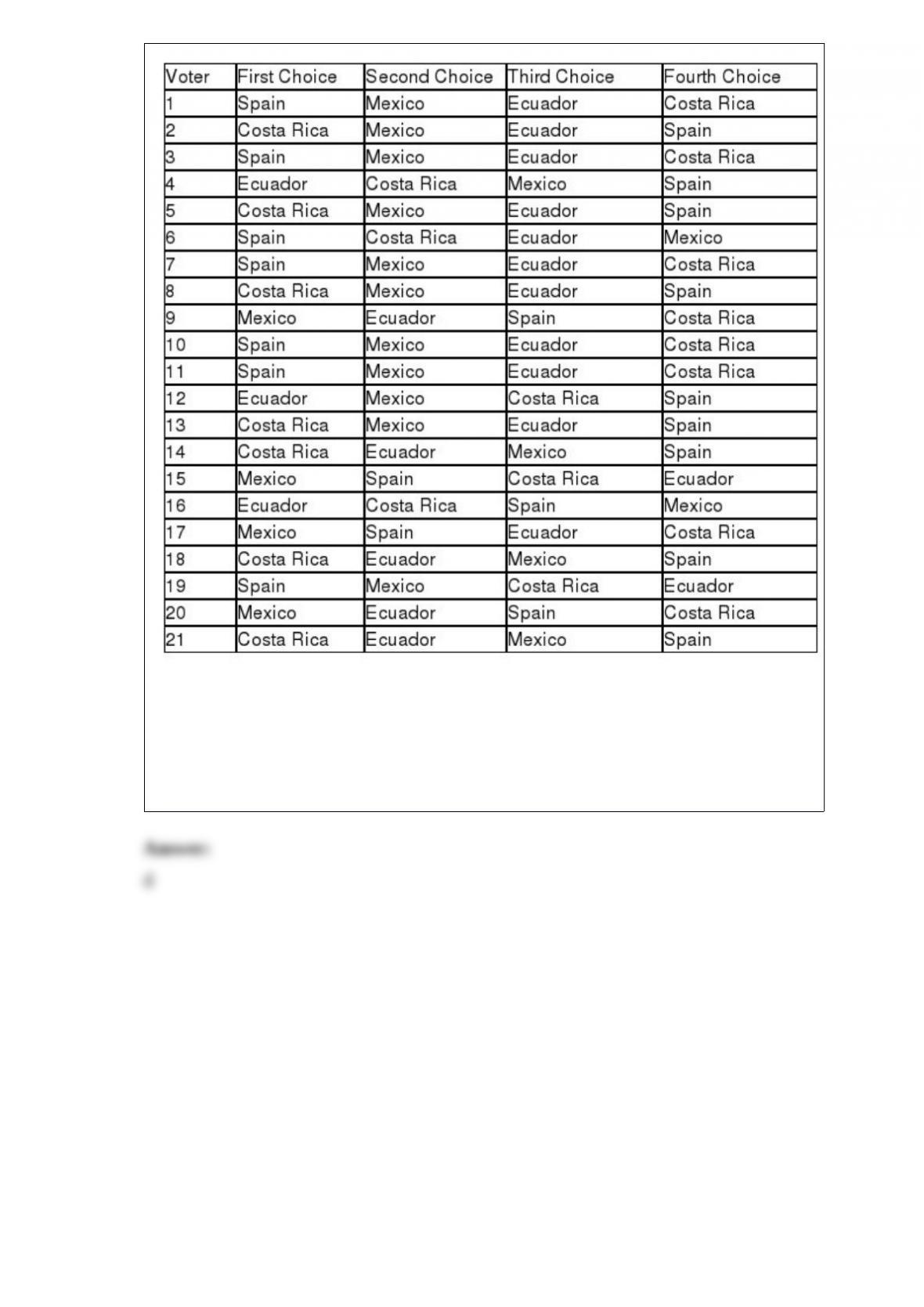
Refer to Table 22-13. In a pairwise election between Costa Rica and Ecuador and then a
second election between the winner and Mexico, which countries are chosen?
a.Costa Rica is chosen in the in the first and second elections.
b.Costa Rica is chosen in the first election and Mexico is chosen in the second.
c.Ecuador is chosen in the first and second elections.
d.Ecuador is chosen in the first election and Mexico is chosen in the second.