
Deciding how products of a society are distributed among the citizens in an economy
answers the economic question of:
A) Who consumes the products produced?
B) What will be produced?
C) Where will the products produced be consumed?
D) How will we produce it?
Which of the following statements about featherbedding is correct?
A) It may or may not increase the demand for labor.
B) It may or may not increase wages.
C) It forces a firm to hire more workers than it needs.
D) all of the above
The effort used to coordinate the factors of production is a description of:
A) physical capital.
B) human capital.

C) labor.
D) entrepreneurship.
When a demand curve is drawn, which of the following is held constant?
A) people’s income
B) people’s preferences
C) prices of related goods
D) All of the above are held constant when constructing a demand curve.
Suppose that your tuition to attend college is $5,000 per year and you spend $5,000 per
year on room and board. If you were working full time, you could earn $22,000 per
year. What is your opportunity cost of attending college?
A) $13,000
B) $27,000
C) $30,000
D) $35,000

The reason that the local telephone company is able to engage in price discrimination
between business and residential customers in providing local phone service is that:
A) it is the only provider of local (landline) telephone service.
B) it must be extremely difficult, if not impossible, for one consumer to resell phone
service to another.
C) business and residential customers differ in their willingness to pay for phone
service.
D) All of the above are correct.
________ is a simplified representation of an economic environment.
A) An economic model
B) Microeconomics
C) Scarcity
D) Normative analysis
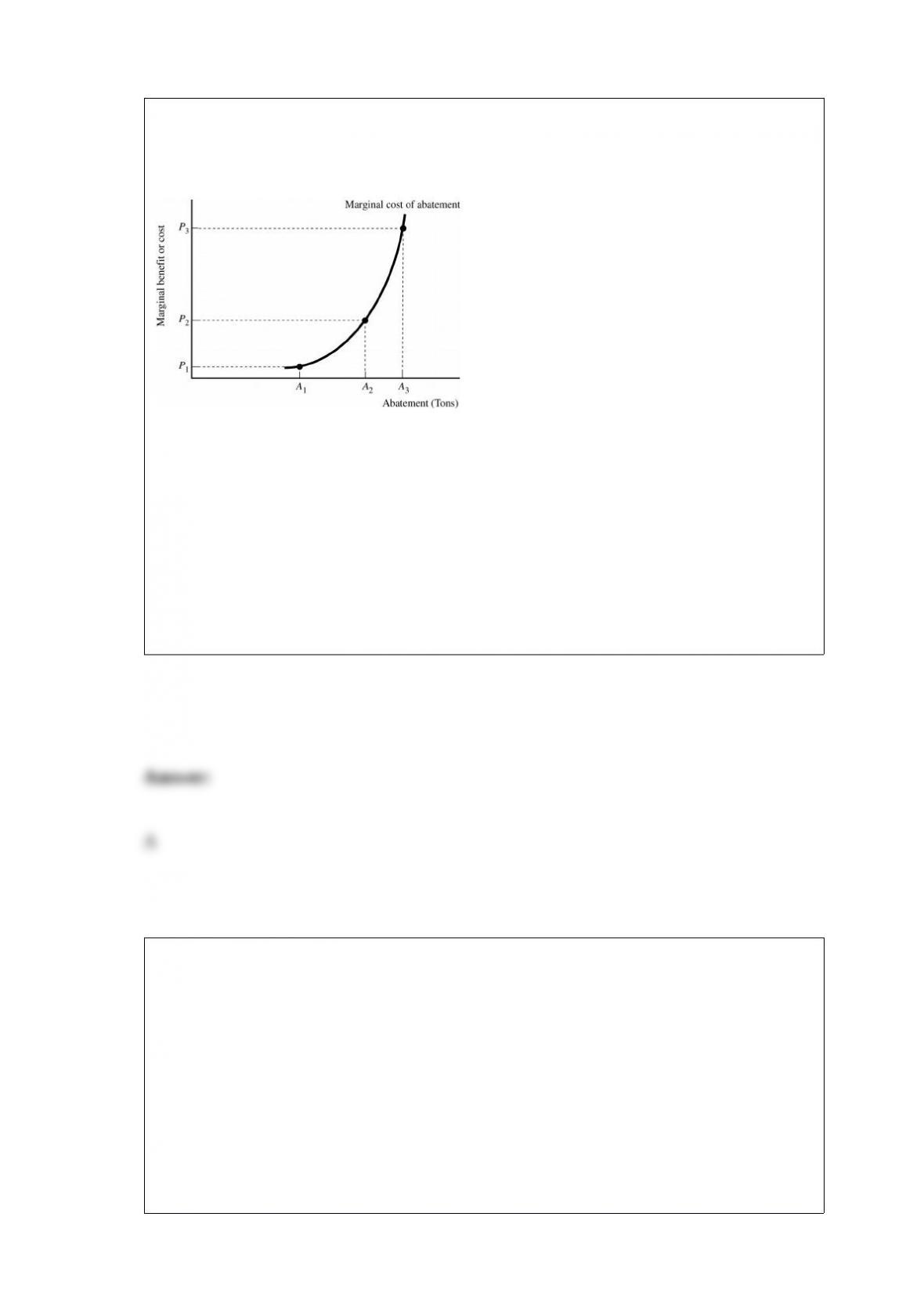
A firm that generates pollution is illustrated in Figure 16.1. If the government would
like to induce this firm to abate, or reduce, its pollution by A1 tons, it will impose a
pollution tax equal to:
Figure 16.1
A) P3.
B) P1 minus P3.
C) P2.
D) P2 minus P3.
If a firm that makes $100 profit per pair of shoes pays LeBron James $2,000,000 to
endorse their basketball shoes, then to make the endorsement pay off they must sell at
least:
A) $2,000,000 more in shoes.
B) $20,000 more in shoes.
C) 20,000 more pairs of shoes.
D) 200,000 more pairs of shoes.

In monopolistic competition, the presence of free entry suggests that:
A) some firms will earn economic profits in the long run.
B) some firms will be forced to incur losses in the long run.
C) all firms will earn zero economic profit in the long run.
D) all firms will earn zero economic profit in both the short run and the long run.
When after seeing the current mortgage interest rates and immediately deciding to start
the search for a new house, you are using:
A) microeconomics to evaluate the merits of public policies.
B) microeconomics to understand markets and predict changes.
C) microeconomics to understand marginal changes in the macroeconomy.
D) microeconomics to make managerial and personal decisions.

If a profit-maximizing firm in a perfectly competitive market is currently producing the
output where (price – average variable cost) < average fixed cost, the firm is:
A) making a positive economic profit.
B) making a zero economic profit.
C) suffering an economic loss.
D) none of the above
Which of the following is a criticism that economists have against regional free trade
areas?
A) Regional trade areas promote trade within the trade area, but they do little to
promote trade across the globe.
B) Regional trade areas have been more successful in promoting worldwide trade than
the WTO.
C) Some countries have abandoned the WTO to join the regional trade areas.
D) Regional trade areas require that member countries first withdraw membership from
the WTO.
A duopoly is an industry with:

A) one firm.
B) two firms.
C) many firms that sell slightly differentiated products.
D) many firms that sell identical products.
When detailing the cost of producing electricity with turbines of different sizes. The
concept of scale economies is realized when:
A) the average cost tend to decrease as the size of the turbine decreases.
B) the average cost tend to increase as the size of the turbine decreases.
C) the average cost tend to decrease as the size of the turbine increases.
D) the average cost tend to increase as the size of the turbine increases.
Quantity demanded is defined as the:
A) quantity of a product that consumers are willing and able to buy at a given price.
B) quantity of a product that sellers are willing and able to buy at a given level of
income.
C) quantity of a product that consumers and producers are willing and able to buy,

given their level of preference.
D) quantity of a product that consumers are willing and able to sell at a given price.
Decreases in the demand for products can be caused by which of the following?
A) decreases in income
B) decreases in population
C) decreases in the prices of substitute goods
D) all of the above
Which one of the following is good example of a natural monopoly?
A) electricity
B) cable TV service
C) water systems
D) all of the above

A single variable can be illustrated as:
A) a bar graph.
B) a pie chart.
C) a time-series graph.
D) all of the above.
Price discrimination is best described as a situation where a firm:
A) charges buyers an excessive price for its product.
B) charges different prices to different groups of buyers.
C) sells the same product for different prices from one year to another.
D) acts as a price taker.

Why is the market supply curve positively sloped?
A) At a higher price, more firms enter the market willing to sell the product or service.
B) At a higher price, fewer firms enter the market willing to sell the product or service.
C) At a higher price, the firms already in the market and are willing to sell a larger
quantity of the product or service.
D) Both A and C are correct.
Under average-cost pricing, an increase in the monopolist’s production cost will:
A) decrease its profit because its profit per unit decreases.
B) not affect its profit because the government adjusts the regulated price equal to the
average cost.
C) increase its profit because the monopolist can reduce the average cost at a greater
output level.
D) none of the above
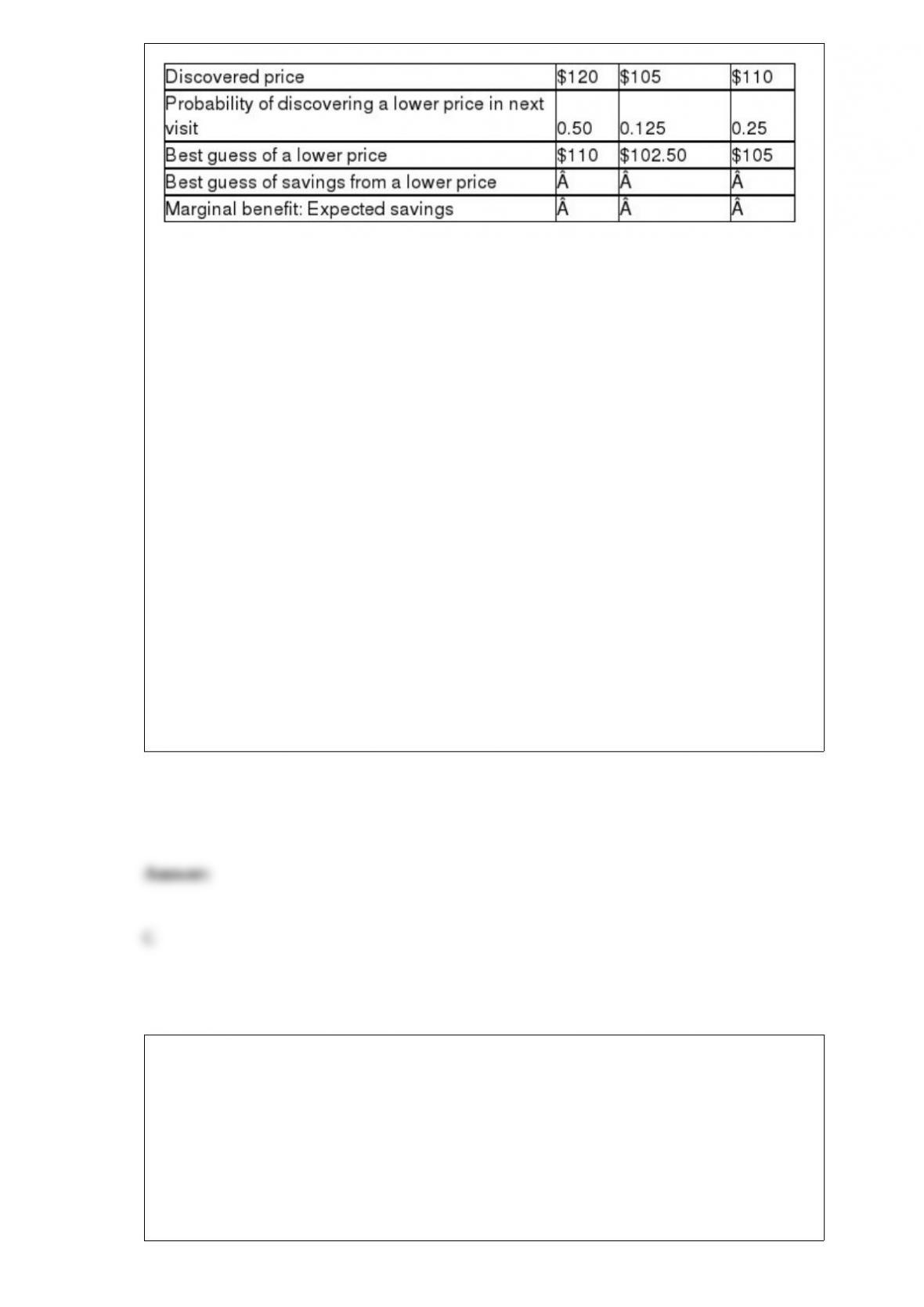
Table 14.5
Table 14.5 contains data on the marginal benefit of searching for a lower price for a
digital camera.
The price of the camera ranges from $100 at the lowest price store to $140 at the
highest price store.
For any randomly selected store, any price from the low price to the high price is
equally likely.
The marginal cost of visiting each store is constant at $1.50 per visit.
Refer to Table 14.5. At the discovered price of $110, the best guess of savings from a
lower price is:
A) $1.25.
B) $2.50.
C) $5.
D) $10.
Accountants include ________ costs as part of a firm’s costs, while economists include
________ costs.
A) explicit; no explicit
B) implicit; no implicit
C) explicit and implicit; implicit

D) explicit; explicit and implicit
Many hotel chains offer senior citizen discounts to members of AARP. This suggests
that the hotels believe that senior citizens have a ________ demand for hotel rooms
than non-seniors.
A) smaller
B) greater
C) more elastic
D) less elastic
Scientific research is subsidized by the government because:
A) it yields benefits to consumers and producers who did not participate in the research.
B) researchers are under-paid by private firms, so the government must make up the
difference.
C) much scientific research takes place at state-funded universities.
D) scientific research has no market value so would not be undertaken without
government intervention.
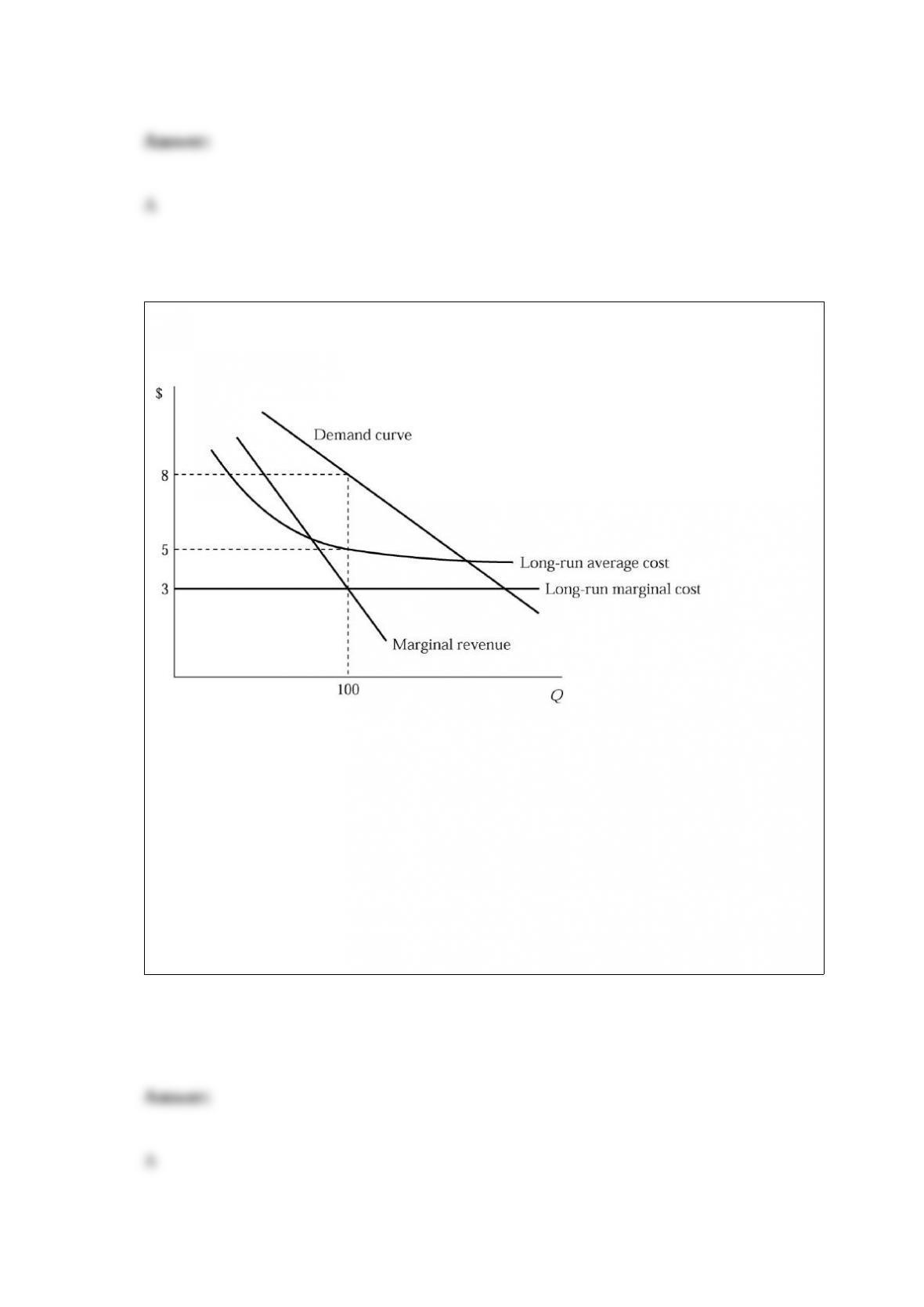
Figure 11.4 depicts demand and costs for a monopolistically competitive firm. If the
firm’s demand curve shifts to the left as more firms enter the market:
Figure 11.4
A) the firm’s average cost will be higher at the new profit maximizing output level.
B) the firm’s average cost will be lower at the new profit maximizing output level.
C) the firm’s average cost will remain the same at the new profit maximizing output
level.
D) There is not sufficient information.

Table 16.3 shows the production cost for two utilities at different levels of sulfur
dioxide emissions. Assume that the government issued 8 marketable pollution permits
to each firm. If the two firms were to voluntarily trade pollution permits, how many
permits would be swapped?
Table 16.3
A) 1
B) 2
C) 3
D) 4
Assume that Bright Lights Inc. is part of a perfectly competitive market. If Bright
Lights Inc. decides to raise their prices for the vanity light fixtures by 20%, which of
the following is most likely to result?
A) Bright Lights Inc.’s supply curve will shift to the left and they will produce less
output.
B) Bright Lights Inc. will increase the price of their output to compensate for the rise in
their rent.
C) Bright Lights Inc. will earn less profit but will produce the same amount of output.
D) Bright Lights Inc. will shut down immediately.

If a firm uses the marginal principle, then the firm picks the quantity of workers:
A) at which the marginal benefit equals the marginal cost.
B) at a point where the firms earns an additional profit by employing one additional unit
of labor.
C) equal the total product of labor times the price of labor.
D) is the same as the marginal product of labor.
Claudia spends her income on two goods, DVD rentals and chewing gum. She
considers both goods to be normal goods. If Claudia’s income stays constant and the
relative price of DVD rentals increases, she will:
A) rent more DVDs and purchase less chewing gum.
B) rent more DVDs and purchase more chewing gum.
C) rent fewer DVDs and purchase more chewing gum.
D) rent fewer DVDs and purchase less chewing gum.