
According to economists, one of the signs of an unhealthy economy is a(n)
a. rising labor productivity.
b. increasing real GDP.
c. declining real GDP.
d. declining unemployment.
What involves taking the risks that are necessary to seek out business opportunities?
a. Invention
b. Benchmarking
c. Averaging
d. Entrepreneurship
An increase in the number of nursing homes and community health centers and the
expansion of home care has led to an increase in the demand for nurses. At the same
time, improving opportunities for women in business have reduced the supply of
nurses. Hospitals, the major employers of nurses, have resisted wage increases. The
resulting situation could be described as
a. the cost disease of the service sector.

b. a shortage of nurses.
c. the problem of auxiliary restrictions.
d. the wage floor problem.
The aggregate supply curve slopes upward because firms
a. seek to maximize profits and output.
b. normally can purchase inputs at fixed prices.
c. employ technology, which is always fixed.
d. purchase inputs whose prices rise as output rises.
Firms violating antitrust laws are likely to be sued by the federal government, but not
by rival firms.
a. True
b. False

If an economist wants to make a prediction about the effects of a change in disposable
income on the change in consumption spending based on historical data, she must
assume that
a. the future will closely resemble the past.
b. consumption and disposable income will be negatively related.
c. the consumption function will have a downward slope.
d. as disposable income increases, consumer spending will remain constant.
Rent controls and controls on other prices often aggravate the very problem they are
intended to solve.
a. True
b. False
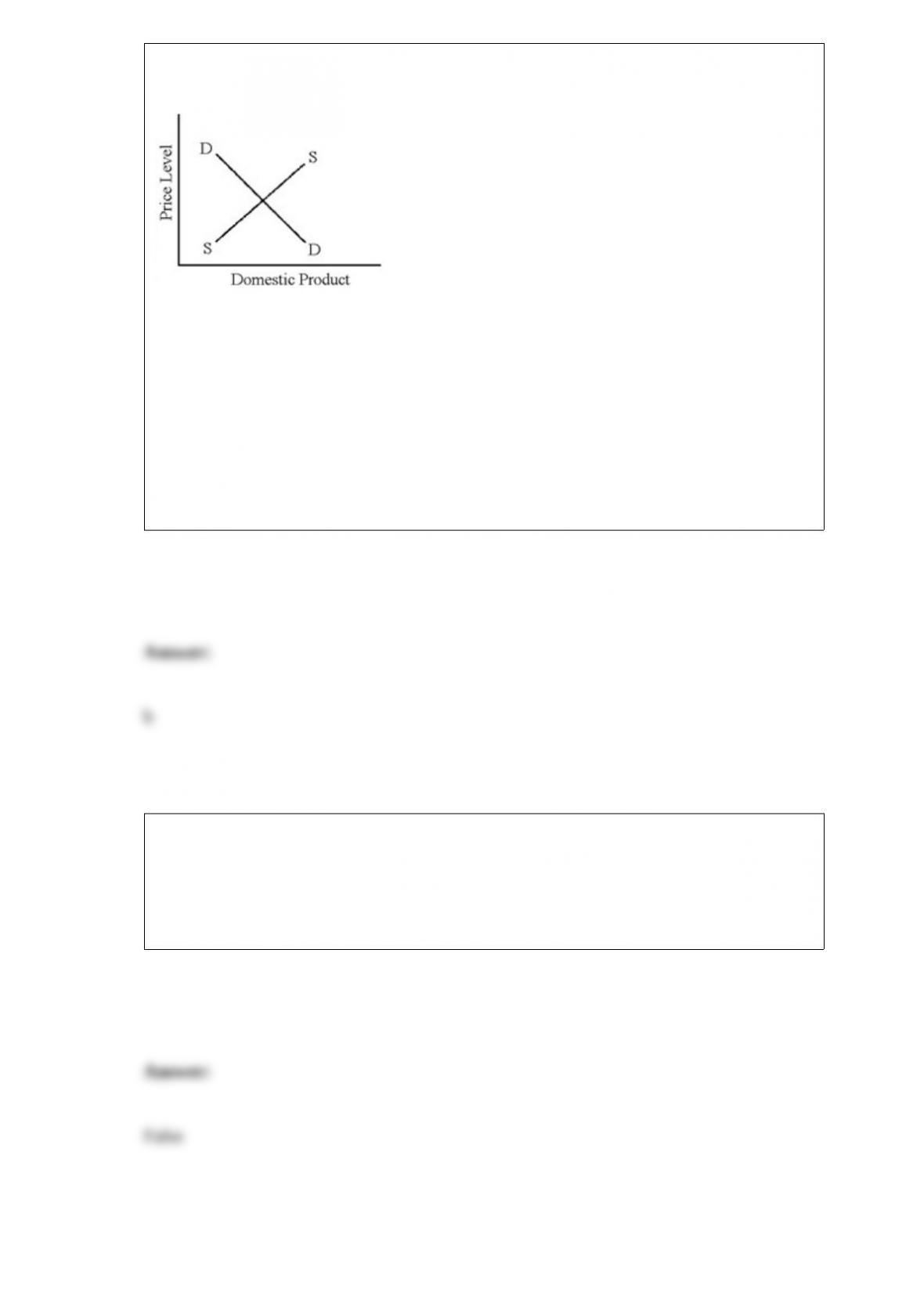
Figure 5-2
In Figure 5-2, an increase in government spending would cause
a. an outward shift in the aggregate supply curve and an increase in the price level.
b. an outward shift in the aggregate demand curve and an increase in the price level.
c. an inward shift of the aggregate demand curve and an increase in the price level.
d. an inward shift of the aggregate demand curve and a decrease in the price level.
Prosperity in the United States is evenly distributed across the fifty states.
a. True
b. False

Because the Soviet Union educated more scientists and engineers than the United
States, their level of economic growth was higher.
a. True
b. False
If fears of a terrorist attack are widespread and people lose faith in money, the economy
could revert to a system of
a. cash and checks.
b. double-entry bookkeeping.
c. barter.
d. financial intermediaries.
Which of the following was not a factor that contributed to the subprime mortgage
crisis?
a. false security derived from FDIC insurance on mortgage loans
b. lower down payments
c. households devoting 25% or more of their income to mortgage payments

d. lending to households with adverse credit ratings
The rational expectations hypothesis is impeccably logical, but inconsistent with the
facts.
a. True
b. False
On the Micronesian island of Yap, it is easier to make purchases with stone wheel
currency than it is to make purchases with paper currency including the U.S. dollar.
a. True
b. False

Both President Bush and President Obama wanted tax cuts to stimulate consumer
spending during the 2007-2009 recession.
a. True
b. False
A computer manufacturer sells 1,000 units per month at $500 each. A price cut to $400
is being considered. His marginal cost is constant at $300 per unit. To maintain profits,
quantity sold must increase to at least
a. 1,500.
b. 2,000.
c. 2,500.
d. 3,000.
Firms that set prices equal to marginal costs will usually recover all of their R&D costs.
a. True
b. False

If AD and AS increase at exactly the same rate, the result will be
a. demand-side inflation.
b. supply-side inflation.
c. falling prices.
d. stable prices.
An economic boom that creates an inflationary gap is usually followed later by
a. falling prices.
b. a period of stagflation.
c. an increase of potential GDP.
d. an increase in aggregate supply.

Injections include saving and taxes.
a. True
b. False
The socialist countries of Eastern Europe have
a. fewer environmental problems than capitalist countries.
b. improved their environment more than the capitalist countries.
c. worse environmental problems than capitalist countries.
d. worsened since the collapse of communism there.
If wages rise by 12 percent at the same time prices rise by 3 percent, then the increase
in real wages is equal to
a. 12 percent.
b. 9 percent.
c. 6 percent.
d. 3 percent.

If actual inflation is less than the expected rate of inflation, then probably
a. the borrower gains at the expense of the lender.
b. neither the borrower nor the lender gains.
c. the lender gains at the expense of the borrower.
d. the purchasing power of the borrower is increased.
On a graph with time on the horizontal axis and real GDP per capita on the vertical axis,
the income levels of poorer countries are
a. diverging more from the incomes of rich countries.
b. maintaining a constant gap with the incomes of richer countries.
c. crossing the line representing richer countries.
d. coming closer to the line representing richer countries.

The maximum increase in the money supply possible from a deposit of $D into the
banking system where R is the reserve requirement is
a. (1/R)(D − R).
b. R D.
c. (1/R)(1 − R)D.
d. (1/R)D.
Piketty’s analysis concludes that unequal ownership of capital, rather than unequal pay,
is responsible for notably high levels of inequality in the decades since the 1980s.
a. True
b. False
An industry can be defined as
a. the group of all firms that sell a product.
b. any company that produces and sells something.
c. the set of buyers of a particular good or service.

d. the top companies that sell something.
For which of the following time periods did the U.S. have a budget surplus?
a. 1990-1993
b. 1998-2001
c. 2003-2006
d. The U.S. did not have a surplus in any of these time periods.
Figure 10-7
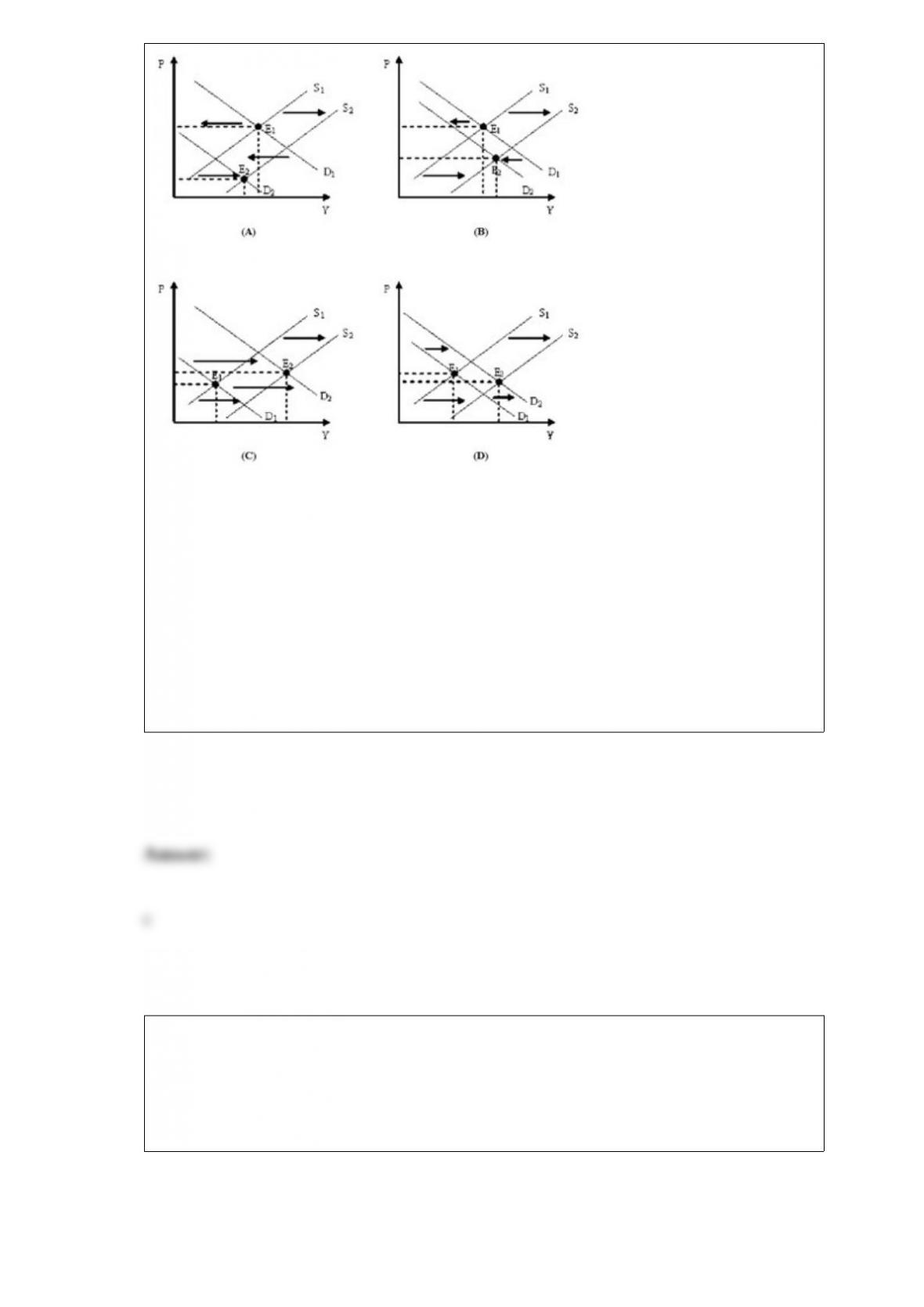
Which of the panels in Figure 10-7 shows an economic expansion caused primarily by a
change in aggregate demand?
a. Panel (A)
b. Panel (B)
c. Panel (C)
d. Panel (D)
If investment spending depends on GDP, this is called induced investment.
a. True
b. False

Perfectly competitive markets are not the most efficient type.
a. True
b. False
The tendency of opportunity cost to increase as production increases
a. is an example of theory that has not been proven by facts.
b. is a general principle, but not a universal fact.
c. is a universal fact, with no known exceptions.
d. rarely holds in reality, but is a useful theory.
e. cannot be tested with standard economic tools.
Suppose demand can be described with the equation Q = 900 − 5P and supply with the
equation Q = 100 + 5P.
a. Determine the equilibrium price and quantity.
b. Determine the surplus or shortage if the price were $100.
Changes in the rate charged by electric power companies are subject to government
control because
a. the electric power companies are government enterprises.
b. consumer ignorance makes it impossible to know what rates are fair.

c. the electric power companies are monopolies of a service that is important to buyers.
d. cutthroat competition would probably occur if the government did not intervene.
In December of 2007, with an unemployment rate of 5.0 percent, most economists
believed this was above the natural rate.
a. True
b. False