
1) When the Fed auctions reserves through the term auction facility, the interest rate is
set by the rate offered by the highest bidder.
2) A side benefit of international trade is that it links national interests and increases the
opportunity costs of war.
3) The actual budget may be in deficit while the standardized budget is in surplus.
4) certain inherently desirable products such as education and health care should be
produced so long as resources are available.
5) About one-half of U.S. electricity is generated using petroleum.
6) In the theory of coordination failures, shifts of the nation’s long-run aggregate supply
curve are the main cause of business cycles.
7) TAC policies help reduce overfishing and reduce costs for fishers.
8) a price floor in a competitive market will result in persistent shortages of a product.

9) an economy will always operate at some point on its production possibilities curve.
10) Different rents on land reflect differences in the marginal revenue productivity of
land.
11) Logrolling can either increase or diminish economic efficiency.
12) during recent years the u.s. unemployment rate has been substantially higher than
the rate in most of the other major industrial nations.
13) in drawing a particular budget line, money income and the prices of the two
products are fixed.
14) Suppose that the labor cost-total cost ratio in industry A is 82 percent while in
industry B it is 21 percent. Other things equal, labor demand will be:
A.more elastic in industry A than in B.
B.unit elastic in both industry A and B.
C.more elastic in industry B than in A.
D.relatively elastic in both industry A and B.
15)
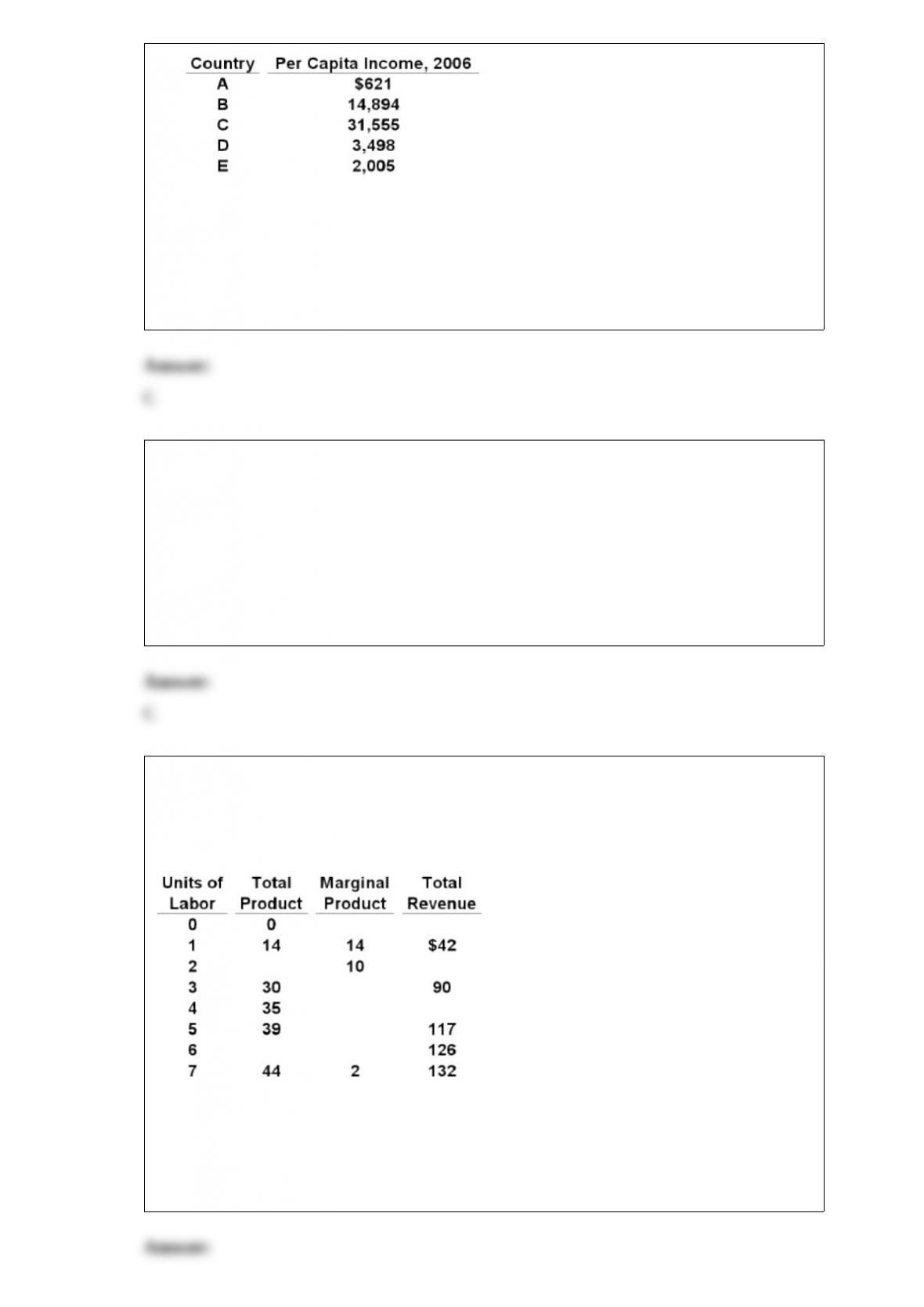
Which of the above nations would be middle-income developing countries (DVCs),
according to the World Bank?
A.country E only
B.countries A, D, and E
C.countries D and E
D.countries D only
16) The capricious universe view indicates that:
A.in the long run “acts of God” have contained population growth and thus contributed
to economic development.
B.DVCs will obtain biological and chemical weapons and force the redistribution of
world wealth.
C.there is little or no correlation between one’s efforts and the rewards he or she
receives.
D.international and civil wars have been the primary impediment to growth.
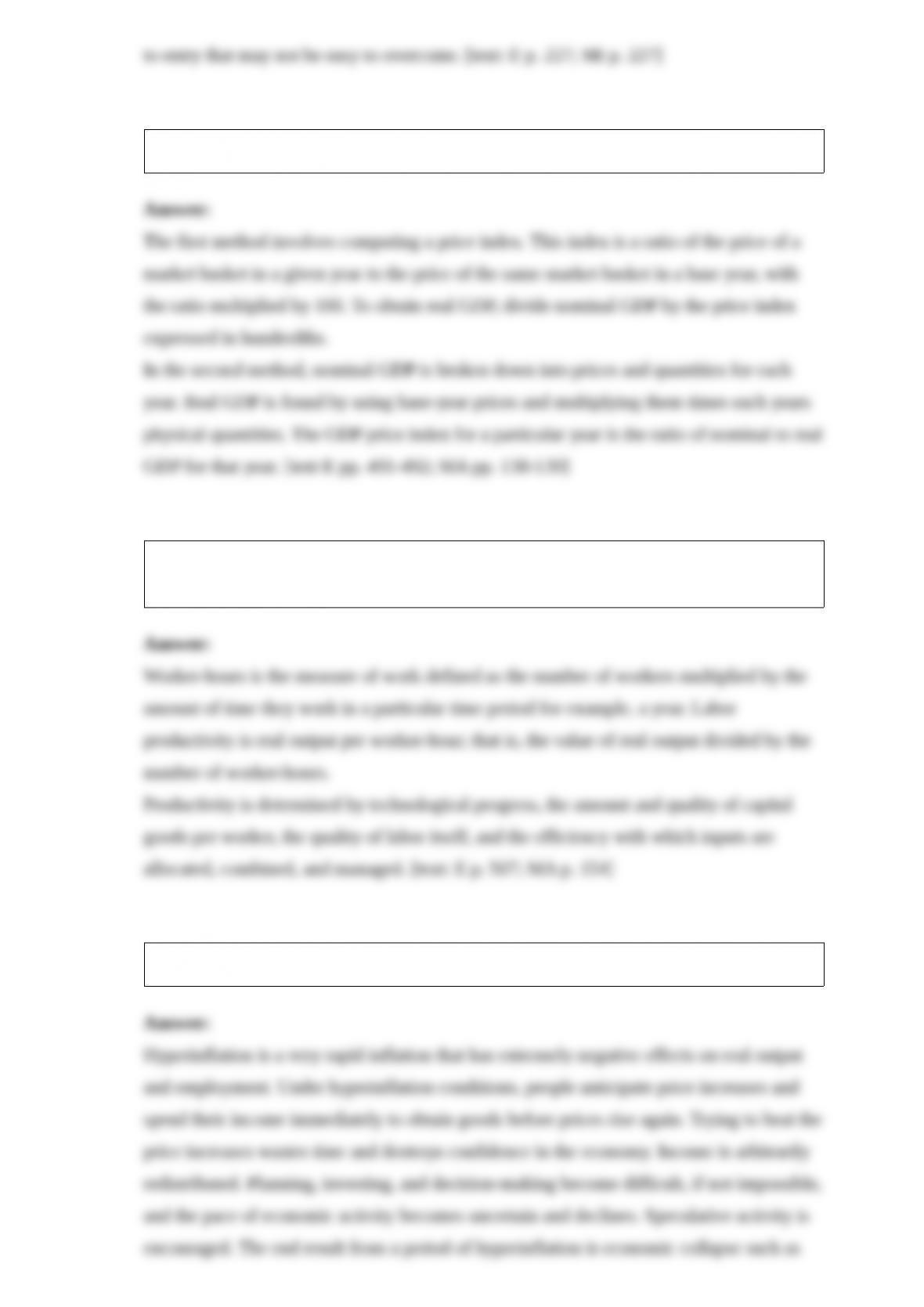
17) Below is the information for Manfred’s Shoe Shine Parlor. Assume Manfred hires
labor, its only variable input, under purely competitive conditions. Shoe shines are also
sold competitively.
Refer to the above data. What is the marginal product of the sixth worker?
A.2 units
B.3 units
C.4 units
D.5 units

18) the major source of tax revenue for the federal government is:
a.personal income taxes.
b.property taxes.
c.corporate income taxes.
d.sales and excise taxes.
19) Assume labor is the only variable input and that an additional input of labor
increases total output from 72 to 78 units. If the product sells for $6 per unit in a purely
competitive market, the MRP of this additional worker is:
A.$6.
B.$12.
C.$36.
D.$72.
20) resources are efficiently allocated when production occurs where:
a.marginal cost equals average variable cost.
b.price is equal to average revenue.
c.price is equal to marginal cost.
d.price is equal to average variable cost.
21) (Consider This) The story about economist Irving Fisher’s conversation with his
masseuse illustrates that:
A.other things equal, interest rates are higher on smaller loans than on larger loans.
B.interest is a payment required for someone to give up the present use of their money.
C.other things equal, longer term loans have lower interest rates than shorter-term
loans.
D.real interest rates differ from nominal interest rates.
22) An increasing share of the private capital flows to DVCs since 1990 have been in
the form of:

A.interest-free government loans.
B.educational and training assistance.
C.direct foreign investment.
D.bank loans.
23) Which of the following is considered a renewable natural resource?
A.natural gas.
B.copper.
C.solar power.
D.coal.
24) Suppose American winemakers convince the Federal government to issue a
directive to serve only domestically produced wine at government functions. This
would be an example of:
A.nonselectivity.
B.the Coase theorem.
C.logrolling.
D.rent-seeking behavior.
25) The bank panics of 1930-1933 and the resulting failures of many banks were caused
by:
A.the widespread conversion of checkable deposits to cash by the public.
B.the raising of the reserve requirement by the Board of Governors.
C.a massive inflow of gold bullion to the United States.
D.a massive inflow of cash into bank deposits by citizens who feared their money was
losing its value.
26) Which of the following provides public assistance to those who are blind and
otherwise disabled?
A.Medicare
B.Supplemental Security Income (SSI)
C.Medicaid
D.TANF

27) The U.S. public debt:
A.refers to the debts of all units of governmentFederal, state, and local.
B.consists of the total debt of U.S. households, businesses, and government.
C.refers to the collective amount that U.S. citizens and businesses owe to foreigners.
D.consists of the historical accumulation of all Federal government deficits less
surpluses.
28) for most nations, per capita spending on health care tends to:
a.remain constant as per capita income increases.
b.rise much faster than per capita income.
c.rise proportionately with per capita income.
d.fall as per capita income increases.
29) (Consider This) How did economist Abba Lerner use the analogy of a car on a
highway to depict his view of macroeconomic stability? How did economist Milton
Friedman modify this depiction?
30) What is the imitation problem resulting from technological advance? How might a
dominant firm respond to the threat from product innovation by a smaller firm?
31) What is the supply-side cause of instability according to the mainstream view?
32) Describe the relationship shown by the investment demand curve.
33) What are two real-world complications with the long-run conclusion about the
representative firm in the model of monopolistic competition?
34) What are the two basic ways of deriving real GDP from nominal GDP?
35) Define worker-hours and labor productivity. What factors are behind labor
productivity?
36) What is hyperinflation and what are its effects?