A decrease in the price of pizza will cause a(n):
A. increase in demand.
B. increase in quantity demanded.
C. decrease in quantity demanded.
D. decrease in the number of consumers.
Beyond the provision of public goods, government exists to address:
A. national defense.
B. the problem of declining moral values.
C. limiting personal freedom.
D. externalities and property rights.
When someone buys a movie on DVD, the DVD is a ______ good.
A. public
B. private

C. collective
D. commons
Frank owns an apple farm and plans to spend 4 hours today picking apples. The number
of apples he can pick per hour depends on the total number of hours he spends working
in either the east orchard or the west orchard in the manner shown in the table below.
What is the opportunity cost to Frank of spending an additional hour picking apples in
the East orchard?
A. 10 apples
B. 20 apples
C. 30 apples
D. 40 apples
In the short-run Keynesian model, if the mpc equals 0.8, then to decrease planned
aggregate spending by $30 billion at any output level, government spending must be
decreased by ______ or net taxes must be increased by _____.
A. $30 billion; $30 billion
B. more than $30 billion; more than $30 billion
C. less than $30 billion; less than $30 billion
D. $30 billion; more than $30 billion
Suppose that the production of oranges reduces global warming. The equilibrium price
of oranges is _______ because not all of the _________ are accounted for in the
marketplace.
A. too high; benefits
B. too low; benefits
C. too low; costs
D. optimal; costs
The figure below shows Avery’s weekly production possibilities curve for scarves.
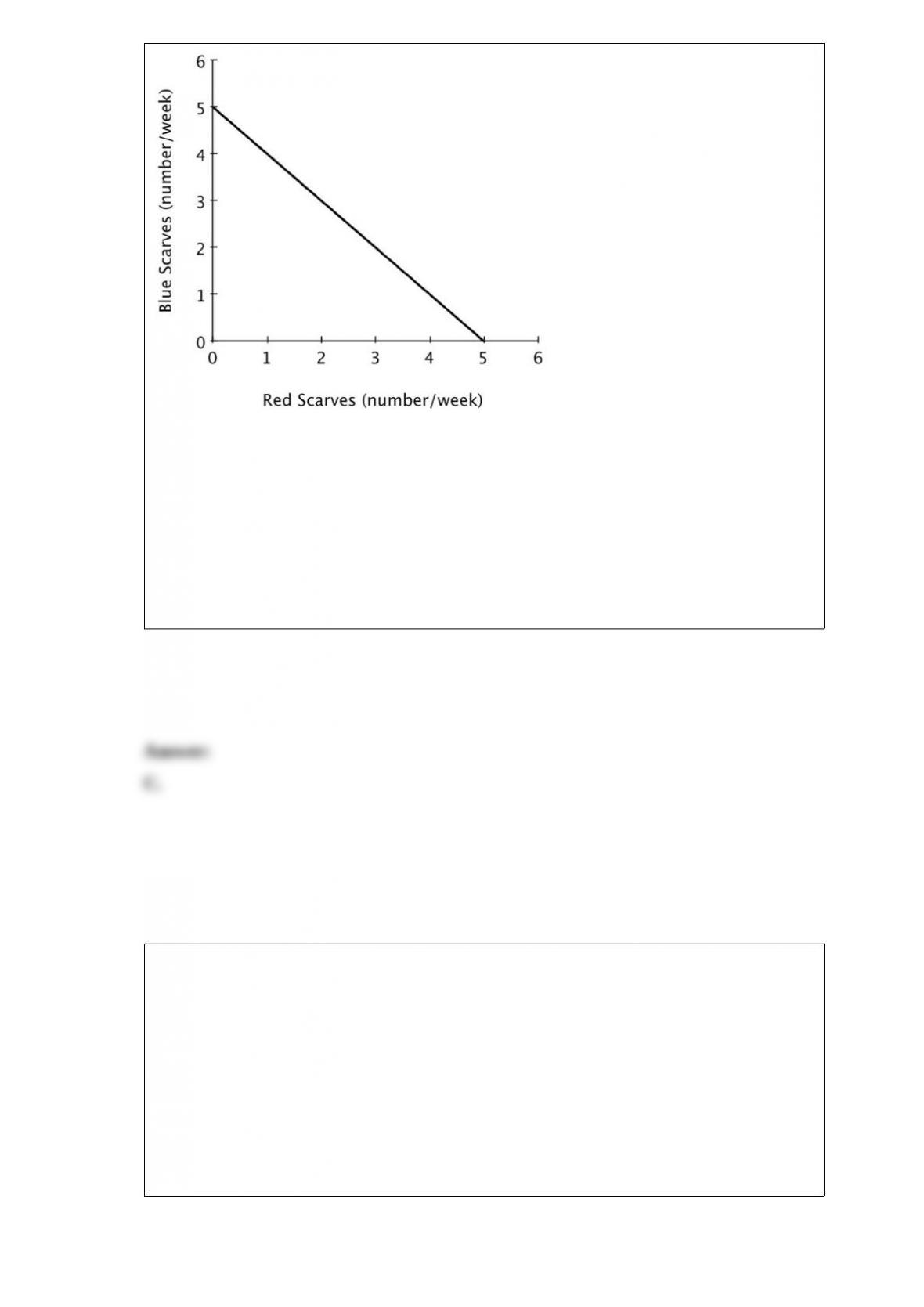
Avery’s PPC would shift outward if she:
A. knits more red scarves and fewer blue scarves each week.
B. devotes less time to knitting each week.
C. devotes more time to knitting each week.
D. knits fewer red scarves and more blue scarves each week.
Suppose it takes Dan 5 minutes to make a sandwich and 15 minutes to make a
smoothie, and it takes Tracy 6 minutes to make a sandwich and 12 minutes to make a
smoothie. Which of the following statements is correct?
A. Tracy should specialize in sandwiches and smoothies.
B. Dan should specialize in smoothies, and Tracy should specialize in sandwiches.
C. Dan should specialize in sandwiches, and Tracy should specialize in smoothies.
D. Dan should specialize in both sandwiches and smoothies.

An example of a government policy to provide a framework within which the private
sector can operate productively is:
A. the taxation of savings.
B. the suppression of political dissent.
C. maintaining a well-functioning legal system.
D. government ownership of capital.
Slower real wage growth in the U.S. since the 1970s accompanied by rapid job growth,
can be explained by:
A. skill-biased technological change.
B. globalization.
C. a productivity slowdown accompanied by an increase in the labor supply.
D. a productivity slowdown accompanied by a decrease in the labor supply.

Starting from potential output, if firms become less optimistic about the future and
decide to decrease their investment in new capital, then this will generate a(n) _____
gap and inflation will _____.
A. recessionary; increase
B. recessionary; decrease
C. expansionary; decrease
D. expansionary; increase
An economic expansion in the United States ______ the demand for exports from
Mexico resulting in an increase in Mexican autonomous expenditures and a(n) ______
output gap in Mexico.
A. reduces; expansionary
B. increases; expansionary
C. reduces; recessionary
D. increases; recessionary

To accommodate an adverse inflation shock the Fed must ____, while to offset the
effect of an increase in aggregate demand the Fed must _____.
A. reduce the inflation rate target; adjust the real interest rate target to the level at which
saving equals investment in the long run
B. increase the inflation rate target; adjust the real interest rate target to the level at
which saving equals investment in the long run
C. maintain the inflation rate target; maintain the real interest rate target
D. adjust the real interest rate target to the level at which saving equals investment in
the long run; reduce the inflation rate target
The following table shows the relationship between the speed of a computer’s CPU and
its benefits and costs. Assume that all other features of the computer are the same (that
is, CPU speed is the only source of variation), and only the CPU speeds listed below are
available for purchase.
The marginal benefit of upgrading from a 2.0GHz computer to a 2.5GHz computer is:
A. $1,400.
B. $1,000.
C. $400.
D. $100.

During recessions, the change in real GDP is:
A. always positive.
B. always negative.
C. most often positive, but occasionally negative.
D. most often negative, but occasionally positive.
If a country pegs its currency to a foreign currency, it no longer has the ability to use
monetary policy to stabilize the economy because:
A. it no longer has a central bank.
B. monetary policy must be used to keep the exchange rate’s market equilibrium value
at its official value.
C. banks will begin to hold 100% of their deposits in reserves.
D. it must eliminate its currency from circulation and replace it with the foreign
currency.
Suppose you own a small business. Last month, your total revenue was $6,000. In
addition, you paid:
$1,000 in monthly rent for office space.
$200 in monthly rent for equipment.
$3,000 to your workers in wages for the month.
$1,000 for the supplies you used that month.
If you correctly determine that your economic profit last month was negative $200, then
it must be true that:
A. you do not have any implicit costs.
B. your implicit costs are $200 per month.
C. your implicit costs are $1,000 per month.
D. the rent you pay on your equipment is an implicit cost.
The price equals marginal cost rule for profit maximization is a specific example of
which core principle?
A. The Scarcity Principle.
B. The Cost-Benefit Principle.
C. The Principle of Comparative Advantage.
D. The Efficiency Principle.
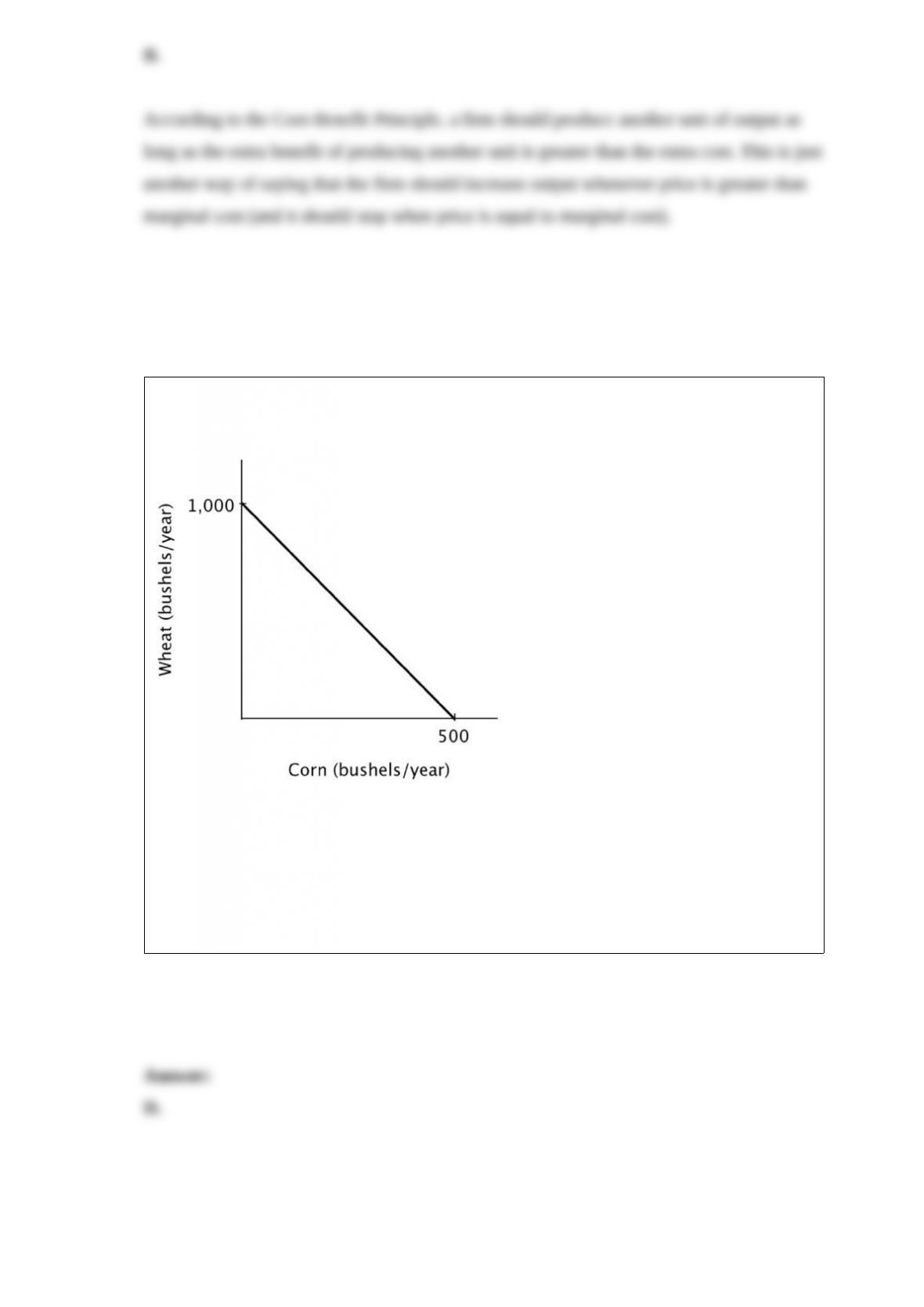
Refer to the figure below. Growing 1,000 bushels of wheat and no bushels of corn each
year is:
A. inefficient and unattainable.
B. inefficient but attainable.
C. efficient but unattainable.
D. efficient and attainable.

John is trying to decide how to divide his time between his job as a stocker in the local
grocery store, which pays $7 per hour for as many hours as he chooses to work, and
cleaning windows for the businesses downtown. He makes $2 for every window he
cleans. John is indifferent between the two tasks, and the number of windows he can
clean depends on how many hours he spends cleaning in a day, as shown in the table
below:
Should John spend a third hour cleaning windows?
A. Yes, because he would earn $28.
B. Yes, because the additional amount he would earn is $14, which is greater than his
opportunity cost of $7.
C. No, because the additional amount he would earn is $6, which is less than his
opportunity cost of $7.
D. Yes, because the additional amount he would earn is $6, which is better than earning
nothing.
The law of demand indicates that as the cost of an activity:
A. falls, less of the activity will occur.
B. rises, more of the activity will occur.
C. rises, the level of the activity may or may not increase depending on the individual.
D. rises, less of the activity will occur.

The equilibrium quantity of money in circulation is determined by:
A. the interaction of an upward-sloping money supply curve and a downward-sloping
money demand curve.
B. the nominal interest rate, real income, and the price level.
C. the Federal Reserve.
D. the decentralized interactions between households and businesses.
Your state department of transportation is considering installing toll booths with gates
on a quiet section of highway. If this is done, a good that is currently a:
A. public good will become a private good.
B. nonrival good will become a rival good.
C. nonexcludable good will become an excludable good.
D. rival good will become an excludable good.
There are ten states in the democratic nation of Fatlandia, and each state has ten
thousand residents. Although incomes vary, each Fatlandian pays a tax equal to the total
cost of all government projects divided by the number of residents in the country.
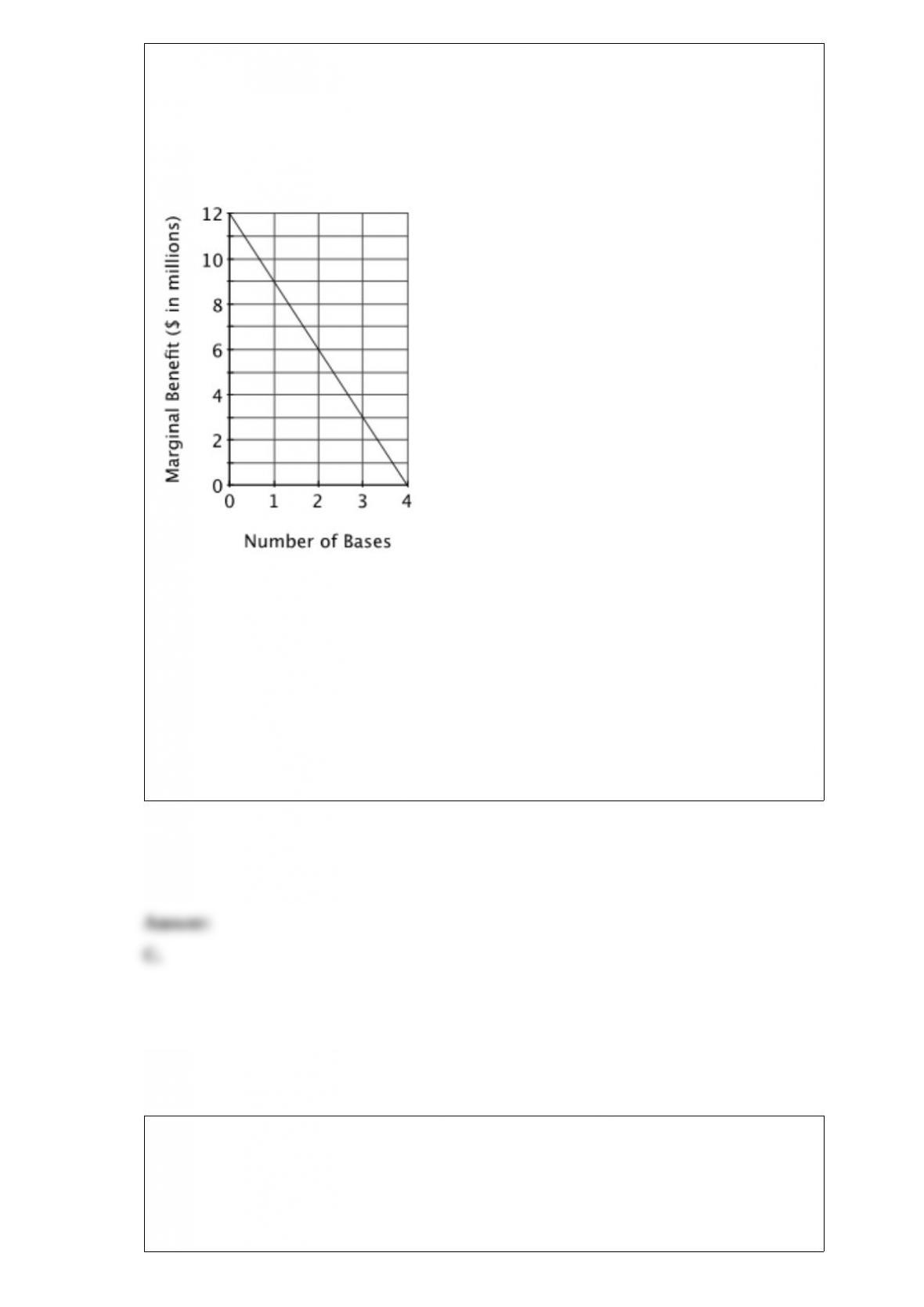
Currently, two states each have one army base. An army base adds $2 million to a
state’s local economy each year. In addition, in terms of increased security, the annual
marginal benefit to Fatlandia of having an additional army base is shown below. The
total cost of an army base is $8 million per year.
The marginal benefit of adding a third army base equals the local marginal benefit of $2
million plus the marginal benefit to Fatlandia of ______.
A. $0
B. $1 million
C. $3 million
D. $22.5 million
The money demand curve will shift to the left if:
A. the nominal interest rate increases.
B. the nominal interest rate decreases.

C. the price level increases.
D. the price level decreases.
When actual output is greater than potential output there is a(n):
A. budget deficit.
B. budget surplus.
C. expansionary gap.
D. recessionary gap.
In a two-person, two-good economy, the gains to specialization will be larger when:
A. one person has an absolute advantage in both goods.
B. neither person has an absolute advantage.
C. there are small differences between the individuals in their opportunity costs of
producing the two goods.
D. there are large differences between the individuals in their opportunity costs of
producing the two goods.
The reason economists consider monopoly to be socially undesirable is that
monopolists:
A. earn too much economic profit.
B. can charge any price they want.
C. exploit the inelastic nature of demand.
D. produce less than the socially optimal level of output.
Two types of bias that tend to cause the CPI to overstate the “true” rate of inflation are
the ______ bias and the ______ bias.
A. substitution; quality adjustment
B. price; quantity
C. aggregation; price
D. quality adjustment; price adjustment
In a market where government has set the maximum price below the equilibrium price,
one might expect:
A. quantity demanded to equal quantity supplied.
B. excess supply.
C. a black market to develop as individuals try to take advantage of unexploited
opportunities.
D. quantity supplied to surpass quantity demanded.
If taxpayers pay a smaller fraction of their income in taxes as their incomes rise, the tax
is ______ and if taxpayers pay a larger fraction of their income in taxes as their income
rise, the tax is ______.
A. regressive; progressive
B. progressive; regressive

C. proportional; progressive
D. regressive; proportional