
1) In the prisoners’ dilemma game, one prisoner is always better off confessing, no
matter what the other prisoner does.
a.True
b.False
2) Bill is restoring a car and has already spent $4,000 on the restoration. He expects to
be able to sell the car for $6,200. Bill discovers that he needs to do an additional $2,400
of work to make the car worth $6,200 to potential buyers. He could also sell the car
now, without completing the additional work, for $3,800. What should he do?
a.He should sell the car now for $3,800.
b.He should keep the car since it wouldn’t be rational to spend $6,400 restoring a car
and then sell it for only $6,200.
c.He should complete the additional work and sell the car for $6,200.
d.It does not matter if Bill sells the car now or completes the work and then sells it at
the higher price because the outcome will be the same either way.
3) A monopolistically competitive market
a.usually has too many firms, reducing the economic profit of each firm to zero.
b.usually has too few firms, reducing the product variety for consumers.
c.may have too many or too few firms, and the government can intervene to achieve the
optimal number of firms.
d.may have too many or too few firms, but the government can do little to rectify the
situation.
4) If New York City imposed a 50 cent tax on soft-drink beverages that contain sugar or
high-fructose corn syrup, it would
a.be an excise tax.
b.be an income tax.
c.reduce tax revenue.
d.cause the supply of corn to rise.
5) Price discrimination explains why Ivy League universities often base tuition costs on
students’
a.age.
b.financial resources.
c.high school GPA.
d.gender.
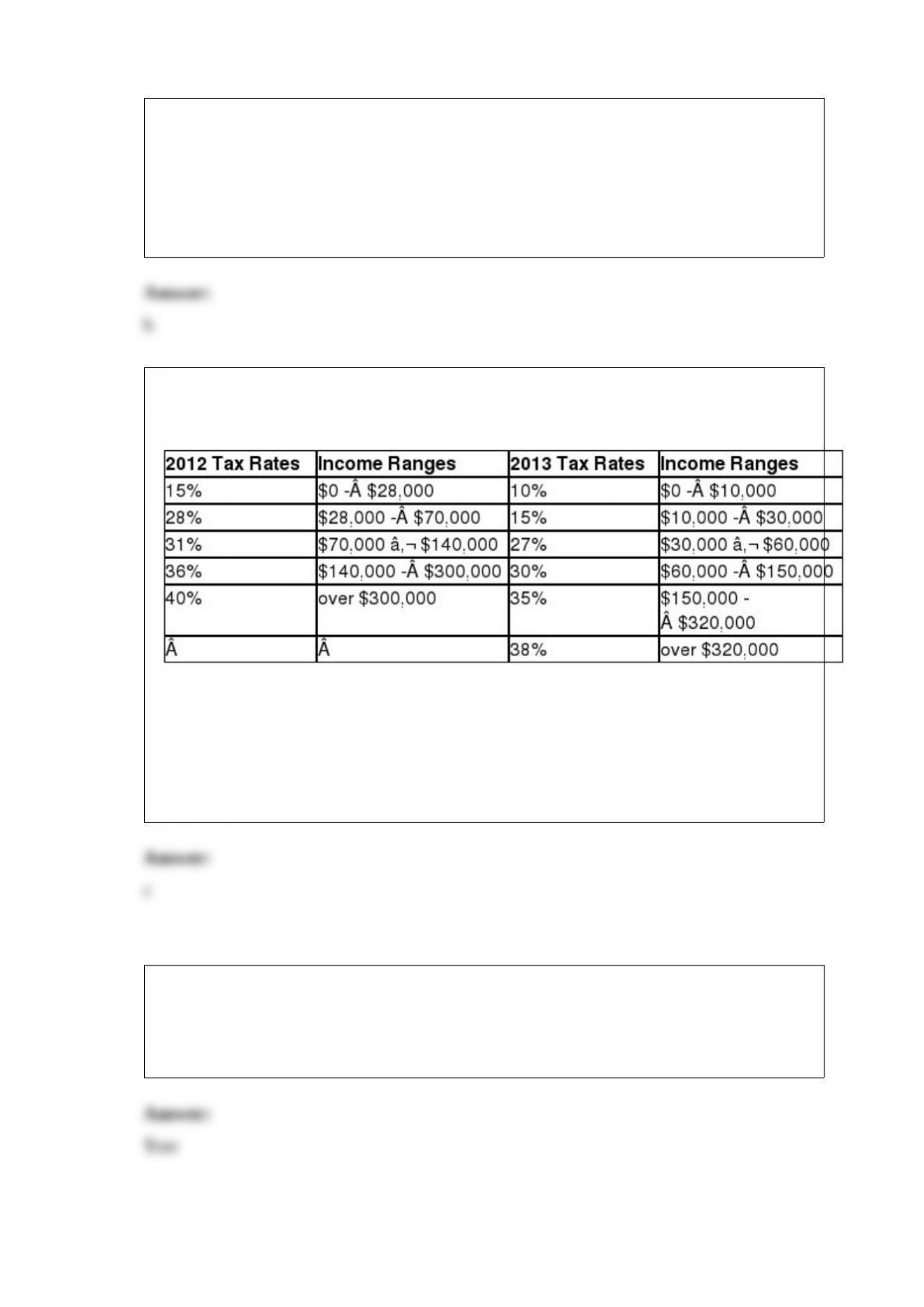
6) Table 12-9
United States Income Tax Rates for a Single Individual, 2012 and 2013.
Ruby Sue is a single person whose taxable income is $100,000 a year. What is her
marginal tax rate in 2012?
a.15%
b.28%
c.31%
d.36%
7) If a tax generates a reduction in surplus that is exactly offset by the tax revenue
collected by the government, the tax does not have a deadweight loss.
a.True
b.False

8) Suppose the average value of in-kind transfers increases by $2,000 from 2013 to
2014 . The poverty rate
a.is more likely to understate the true level of poverty.
b.is more likely to overstate the true level of poverty.
c.will increase by $2,000 divided by the poverty level.
d.Both b and c are correct.
9) Which of the following events could increase the demand for labor?
a.A decrease in output price
b.A decrease in the amount of capital available for workers to use
c.An increase in the marginal productivity of workers
d.A decrease in the wage paid to workers
10) The most likely explanation for economies of scale is
a.coordination problems.
b.specialization of labor.
c.increasing marginal cost.
d.decreasing marginal cost.
11) If a line passes through the points (20,5) and (10,10), then the slope of the line is
1/2.
a.True
b.False