
The benefits principle states that those who
a. pay the taxes should reap the benefits.
b. reap the benefits from government should pay the taxes.
c. are best able to pay should pay for what they receive.
d. pay taxes get the benefits they deserve.
One of the clear effects of deregulation was
a. lower prices of many services.
b. increased entry of new firms into regulated industries.
c. lower income to unions working in regulated industries.
d. all of the above.
If consumers’ expectations about future income are very optimistic, then we should
expect
a. the consumption function to shift downward.
b. consumers to move up along the consumption function.
c. the consumption function to shift upward.
d. consumers to move down along the consumption function.
When a firm’s fixed costs increase it should raise its prices in order to maximize profits.
a. True
b. False
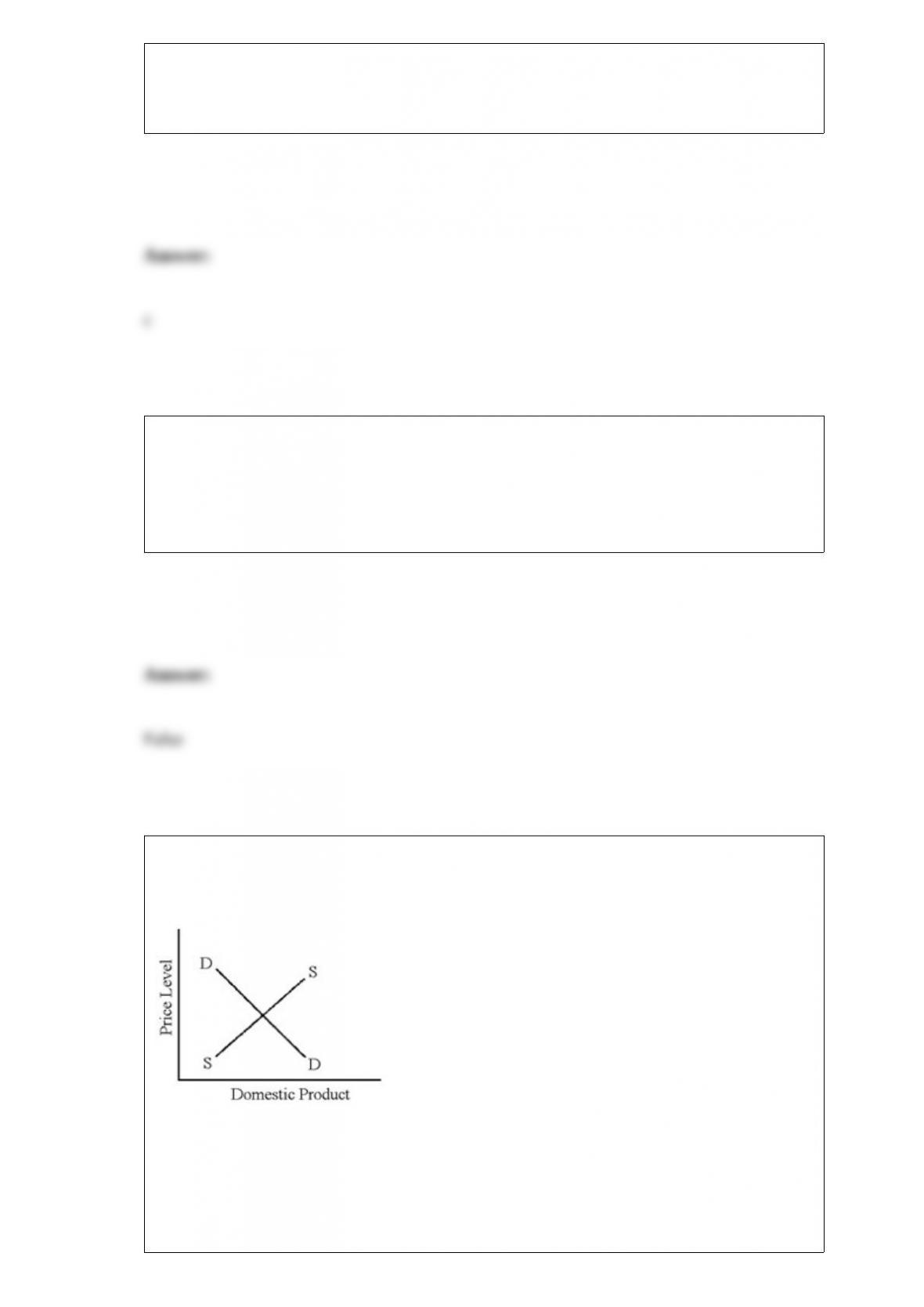
Figure 5-2
In Figure 5-2, if the aggregate demand curve moves to the right less rapidly than the
aggregate supply curve, then
a. the price level should decline over time.

b. the price level should remain stable.
c. the price level will tend to increase.
d. the level of real GDP should decrease.
Compared to perfect competition, monopoly in the long run
a. restricts output.
b. charges a higher price.
c. produces at less than minimum average cost.
d. All of the above are correct.
If, at the full employment level of income, the amount that businesses plan to invest is
greater than the amount that consumers plan to save, then
a. there will be an inflationary gap.
b. there will be a deflationary gap.
c. total demand will fall short of potential GDP.
d. the economy will suffer from increasing unemployment.

If the expenditure schedule lies above the level of potential GDP, then there is a(n)
a. recessionary gap.
b. precautionary gap.
c. deflationary gap.
d. inflationary gap.
If a country produces a commodity in the range of decreasing returns to scale, and the
country begins to export more in a pure free trade system, the domestic price of the
commodity will
a. fall.
b. rise.
c. exceed the price in foreign countries.
d. be below the price in foreign countries.
e. One cannot predict the impact on the price of the commodity.

The use of spending and taxes by the government to influence aggregate demand is
known as
a. monetary policy.
b. governmental policy.
c. administrative policy.
d. fiscal policy.
e. federal policy.
Usury laws tend to hurt whom?
a. suppliers of loans
b. consumers who cannot get credit
c. bank stockholders
d. All of the above are correct.

By changing the amount of income a consumer has to spend, a change in the price of
one good may affect the quantity demanded of another good.
a. True
b. False
Where marginal cost is less than average cost,
a. opportunity cost must have been excluded from the calculation of marginal cost.
b. marginal cost must be falling.
c. marginal cost must be rising.
d. marginal cost may be rising, falling, or constant.
If the short-run Phillips curve is steep, the inflationary costs of using expansionary
policy to reduce unemployment would be substantial.
a. True
b. False

The economic impact of a change in spending, working through the multiplier, takes
effect
a. immediately.
b. very quickly, with a small number of rounds of spending.
c. after a very long period of time.
d. after multiple rounds of spending occur.
A graph with a positive slope indicates that the variables depicted on the axes move in
the same directions.
a. True
b. False

One of the strongest arguments against active stabilization policy is
a. that recognition lags make timely intervention very difficult.
b. the economy corrects itself very slowly.
c. the inability of economic theory to suggest appropriate policy.
d. the difficulty of obtaining agreement on monetary policy.
What would happen to the budget line if income as well as prices of both goods
increase by the same percentage?
a. A rightward parallel shift in the budget line.
b. A leftward parallel shift in the budget line.
c. A rightward shift in the budget line.
d. No shift in the budget line.
How the price of a depletable resource changes over time depends on
a. how the technology of resource extraction changes.
b. the interest rate.

c. how the technologies of production change in firms that use the resource.
d. All of the above are correct.
As price increases, additional suppliers are willing to produce a commodity.
a. True
b. False
How are money cost and opportunity cost related to each other?
a. If markets function well, they are closely related.
b. They are always identical in any economic system.
c. Opportunity cost always exceeds money cost.
d. Money cost is less than or equal to opportunity cost.
e. In a market economy, they are always equal to each other.

Because a monopolist must cut its price to increase its sales by one unit,
a. MR > P at every output level.
b. MC > MR at every output level.
c. P > MR at every output level.
d. MC > P at every output level.
In the United States, price-fixing arrangements among firms are
a. legal.
b. illegal only if a court decides that the prices fixed are unreasonable.
c. illegal only if a court has concrete evidence that the firms explicitly colluded.
d. illegal.
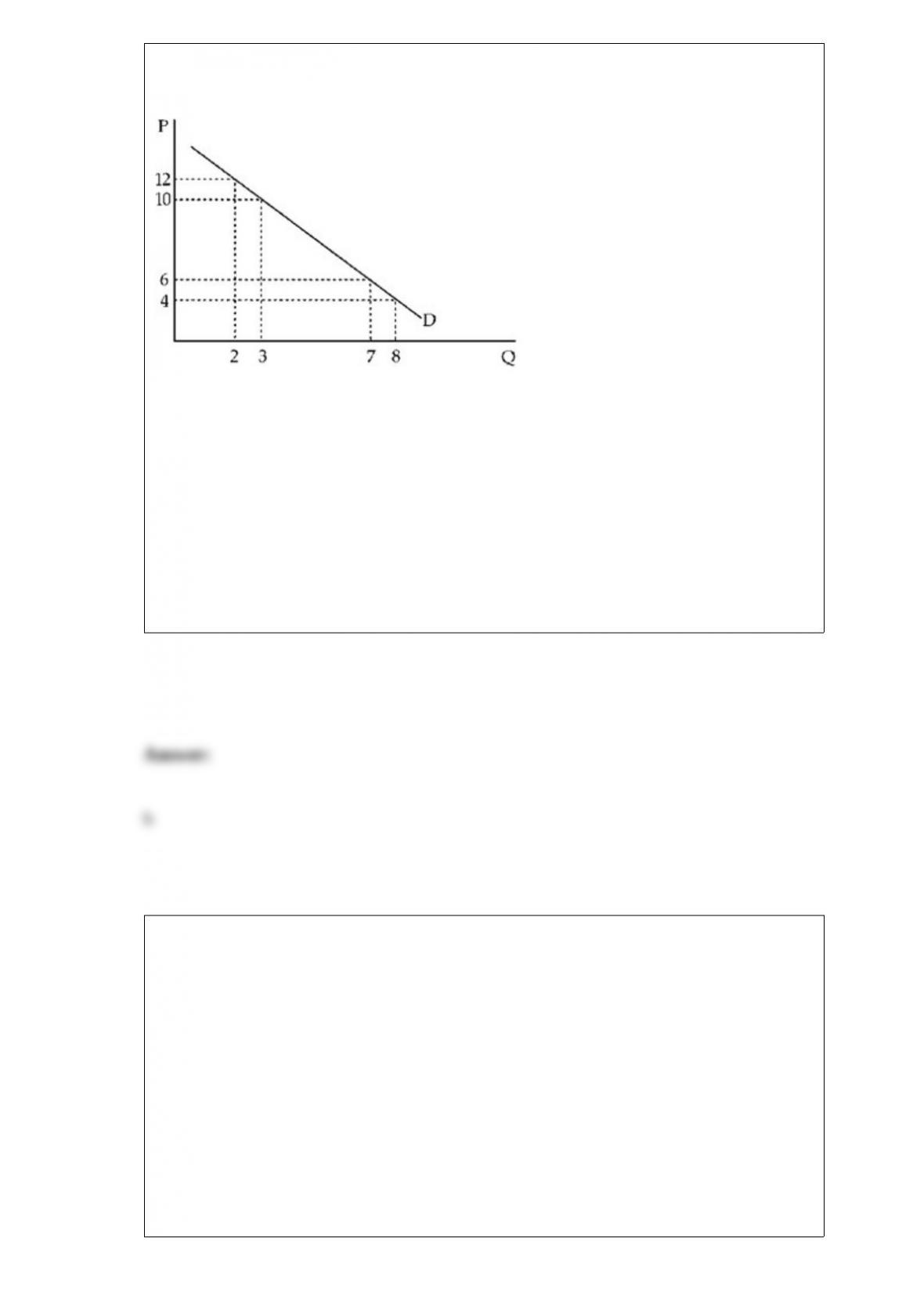
Figure 6-2
From Figure 6-2, we can infer that demand is ____ between P = 12 and P = 10 and ____
between P = 6 and P = 4.
a. elastic; elastic
b. elastic; inelastic
c. inelastic; elastic
d. inelastic; inelastic
If two countries each are currently producing two goods, and each begins to specialize
in the good in which it has a comparative advantage, what will happen to total (world)
output?
a. It will increase.
b. It will decrease.
c. It will be unchanged in both countries.
d. It will rise in one country and fall in the other, but the total is unchanged.
e. Uncertain; economic theory has no answer to this question.

There is no trade-off between efficiency and equality.
a. True
b. False
Zero economic profit means that the firm’s owners receive no compensation for their
investment.
a. True
b. False
The poverty line is the income level
a. earned by a worker employed full-time at the minimum wage.

b. below which a family is officially considered “poor.”
c. above which a family is not entitled to government assistance.
d. that is the average for American families.
Sometimes, the taxes with the smallest excess burden are:
a. progressive
b. regressive
c. proportional
d. digressive
The marginal propensity to consume is
a. disposable income divided by consumption.
b. the change in consumption divided by the change in disposable income.
c. consumption divided by disposable income.
d. the change in disposable income divided by the change in consumption.

For any combination or outputs, there is an efficient allocation of income.
a. True
b. False
How much the quantity of a good traded changes after a shift of the supply curve
depends on
a. the size of the shift.
b. the slope of the demand curve.
c. whether the market is subject to price controls.
d. All of the above are correct.

Scarcity is a concept that applies to all of the following except
a. time.
b. natural resources.
c. human wants.
d. machinery.
The marginal revenue product
a. tells how many dollars the marginal physical product is worth.
b. is the marginal physical product times price of the product under perfect competition.
c. is the marginal physical product times marginal revenue.
d. All of the above are correct.