
A subsidy on a product will generate more actual benefit for consumers (and less for
producers) when
a. the supply of the product is relatively inelastic.
b. the supply of the product is relatively elastic.
c. the demand for the product is relatively elastic.
d. either a or c is true.
Which of the following will lead to an increase in aggregate demand in the United
States?
a. a higher price level
b. an increase in the real interest rate
c. an increase in wealth due to a substantial appreciation in the value of stocks
d. a decrease in real income in Japan and Western Europe
Refer to Table 11-1. The maximum profit this monopolist can earn is
a. $5.
b. $15.
c. $16

d. $28
When using the money supply figures to measure the direction of monetary policy
during the last several decades, it is better to look at changes in the M2 money supply
rather than M1 because
a. the increase in popularity of interest-earning checking accounts in the 1980s distorted
the M2 money supply but not the M1 money supply.
b. the increase in popularity of interest-earning checking accounts in the 1980s distorted
the M1 money supply but not the M2 money supply.
c. the decrease in popularity of interest-earning checking accounts in the 1980s
distorted the M1 money supply but not the M2 money supply.
d. the decrease in popularity of interest-earning checking accounts in the 1980s
distorted the M2 money supply but not the M1 money supply.
Which of the following would not affect this year’s GDP?
a. the paint you purchased when painting your house
b. the new car your parents purchased and gave to you as a birthday present
c. a Gateway computer purchased by the U.S. government
d. the value of a used car you purchased, at its sale price

The minimum points of the average variable cost and average total cost curves occur
where
a. the marginal cost curve lies below the average variable cost and average total cost
curves.
b. the marginal cost curve intersects those curves.
c. the average variable cost and average total cost curves intersect.
d. the slope of total cost is the smallest.
If firms in a competitive price-searcher market are currently experiencing economic
profits, then over time,
a. new firms will enter the market, and the current firms will experience a decrease in
demand for their products until zero economic profit is again restored.
b. new firms will enter the market, and the current firms will experience an increase in
demand for their products until zero economic profit is again restored.
c. some existing firms will exit the market, and the remaining firms will experience an
increase in demand for their products until zero economic profit is again restored.
d. some existing firms will exit the market, and the remaining firms will experience a
decrease in demand for their products until zero economic profit is again restored.
Beginning from full-employment equilibrium, illustrate graphically how each of the
following would impact the economy.
If an economy operates at a short-run equilibrium output that exceeds its long-run
capacity, which of the following will be most likely to direct the economy toward full
employment?
a. Improvements in technology will shift the LRAS curve to the right.
b. Resource prices will increase, causing the SRAS curve to shift to the left.
c. The unemployment rate will increase, causing the economy’s aggregate supply curve
to shift to the right.
d. Interest rates will decline, shifting the aggregate demand curve to the right.

Prior to World War II,
a. the growth of real GDP was more stable than has been the case since the war.
b. the growth of real GDP was less stable than has been the case since the war.
c. unemployment seldom exceeded 4 percent of the labor force.
d. double-digit swings in real GDP during a single year were unheard of.
Other things constant, which of the following would most likely cause the supply of
garden hoses to decrease?
a. an increase in the price of plastic used to make garden hoses
b. a technological advance that lowers the cost of producing garden hoses
c. the occurrence of a very dry year with little rain
d. a decrease in the price of grass seed
If you were a government official and wanted to raise the price of wheat, which of the
following actions would you take?

a. Take wheat from government storage and sell it.
b. Encourage farmers to use more fertilizer.
c. Lower the price of rye.
d. Subsidize purchases of farm equipment.
e. Encourage farmers to grow less wheat.
Which of the following best explains why a firm in a competitive price-taker market
must take the price determined in the market?
a. The short-run average total costs of firms that are price takers will be constant.
b. If a price taker increased its price, consumers would buy from other suppliers.
c. Firms in a price-taker market will have to advertise in order to increase sales.
d. There are no good substitutes for the product supplied by a firm that is a price taker.
Regulatory policies requiring lenders to extend more low down-payment loans to
higher-risk borrowers along with the Fed’s low short-term interest rate policy during
2002-2004 caused
a. an increase in demand for housing and higher housing prices.
b. an increase in demand for housing and lower housing prices.
c. a reduction in demand for housing and higher housing prices.
d. a reduction in demand for housing and lower housing prices.

Which of the following will increase economic freedom?
a. institutions and policies supportive of voluntary exchange
b. high tariff rates
c. high taxes
d. rapid and unpredictable inflation
e. all of the above
If you compared the short-run demand and long-run demand for education at your
college, you would almost certainly find that
a. the long-run demand curve was steeper than the short-run demand curve.
b. a tuition increase would reduce enrollment more in the long run than in the short run.
c. a reduction in tuition would increase enrollment in the short run but not in the long
run.
d. the short-run and long-run demand curves were identical.

Economic analysis suggests that bureaucrats and public-sector managers have a strong
incentive to
a. make sure that their budgets are as small as possible so more funds will be available
for other government programs.
b. expand their budgets to sizes beyond what would be considered economically
efficient.
c. ensure that their budgets are exactly the size that would be considered economically
efficient.
d. economize on their spending and return unspent funds to the general treasury.
A firm in a competitive price-searcher market can raise its price without losing all of its
customers. This is a result of
a. low entry barriers.
b. a perfectly elastic market demand.
c. the small number of firms in the market.
d. product differentiation.
Which of the following contributed to the soaring housing prices during 2002-2005?

a. the Fed’s low-interest rate policy
b. regulations that reduced the required down payment and other lending standards for
home mortgages
c. the increased leverage lending by Fannie Mae, Freddie Mac, and large investment
banks
d. all of the above
The “quantitative easing” policies of the Fed during, and following, the financial crisis
of 2008-2009,
a. expanded the reserves available to the banking system, leading to a rapid increase in
the M1 money supply as banks used the reserves to extend additional loans.
b. reduced the reserves available to the banking system, leading to a sharp reduction in
outstanding loans and a decline in the M1 money supply.
c. expanded the reserves available to the banking system, but the M1 money supply
increased slowly because the banks enlarged their excess reserves.
d. reduced the reserves available to the banking system, leading to a substantial increase
in outstanding loans and the M1 money supply.
The growth of third-party payments (payments by insurers and the government) of
healthcare services during the last four decades has been accompanied by
a. a reduction in expenditures on healthcare as a share of the economy.

b. an increase in the sensitivity of consumers to the prices of healthcare services.
c. persistent increases in the prices of healthcare services and rapid growth in the total
expenditures on healthcare.
d. an increase in the incentive of suppliers to provide healthcare services at a low cost.
If nominal GDP rises from one year to the next, then
a. the economy must be producing a larger output of goods and services.
b. prices at which goods and services are sold must be higher.
c. either output, or the general level of prices, or both must be rising.
d. employment and productivity must be rising.
“Now that Terrance paints the broad surfaces and I do the trim work, we can paint a
house in three-fourths the time that it took for each of us to do both.” This statement
most clearly reflects
a. the importance of secondary effects.
b. the fallacy of composition.
c. the law of comparative advantage.
d. behavior inconsistent with economizing.
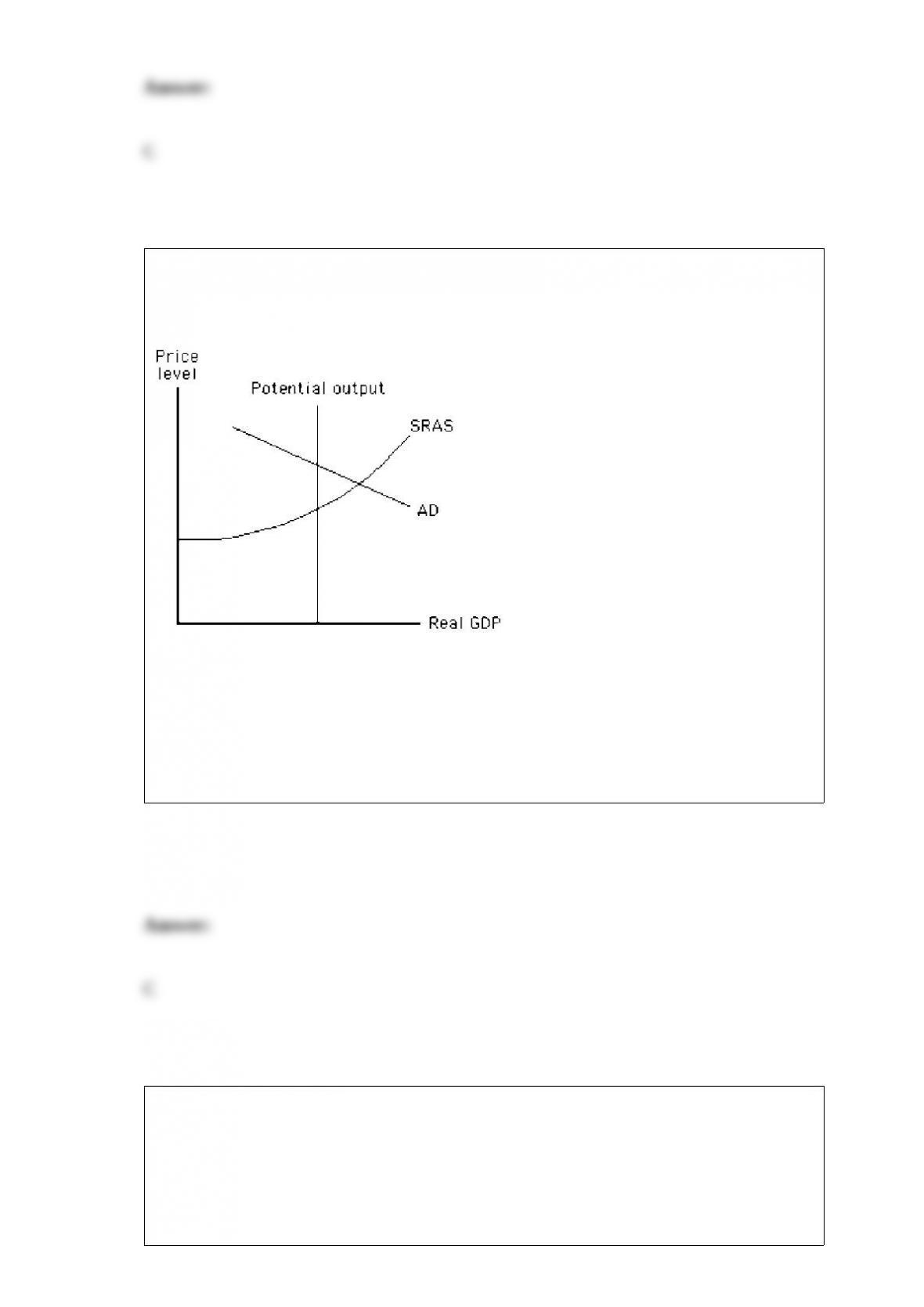
Figure 14-6
In the situation shown in Figure 14-6, how could the Fed return the economy to
potential output?
a. decrease government spending
b. decrease taxes
c. sell U.S. government bonds to banks
d. lower the discount rate
e. lower the required reserve ratio
Economic analysis assumes that
a. people act only out of selfish motives.
b. people are motivated by a variety of forces; however, changes in personal benefits
and costs affect behavior only when individuals are motivated by selfishness.

c. people are basically unselfish, and their actions are, therefore, difficult to predict.
d. changes in the personal benefits and costs associated with an activity will exert a
predictable influence on the behavior of both those who are selfish and those who are
unselfish.
Which of the following contributes to the poor performance of the healthcare industry?
a. An increasing share of healthcare costs is paid for directly by consumers.
b. The tax system discourages the purchase of healthcare through employers, while
offering advantages to those who purchase healthcare plans directly.
c. State regulations often force insurers to cover items such as in-vitro fertilization, drug
rehabilitation, and marriage counseling, which drive up insurance costs.
d. State regulations make it attractive for health insurers to provide only low-cost,
catastrophic health insurance.
If a price searcher is producing at a level of output such that its marginal cost is $16 and
its marginal revenue is $9, the firm should
a. increase output in order to reduce per-unit costs.
b. decrease the price of its product and expand output.

c. increase price and reduce its rate of output.
d. reduce both price and output.
Most income transfer programs in the United States
a. are means-tested programs that transfer income to the poor.
b. allocate income to small businesses and small farmers.
c. are designed to help those with very little economic and political power.
d. allocate income to concentrated interest groups, such as the elderly, large farmers,
and business interests.
Which of the following would cause the demand for computer programmers to
increase?
a. a decline in the productivity of computer programmers
b. an increase in the productivity of computer programmers
c. an increase in the wages of computer programmers due to legislative action (that is,
the establishment of a price floor for computer programmers)
d. a reduction in the price of a competitive input that can be substituted for computer
programmers
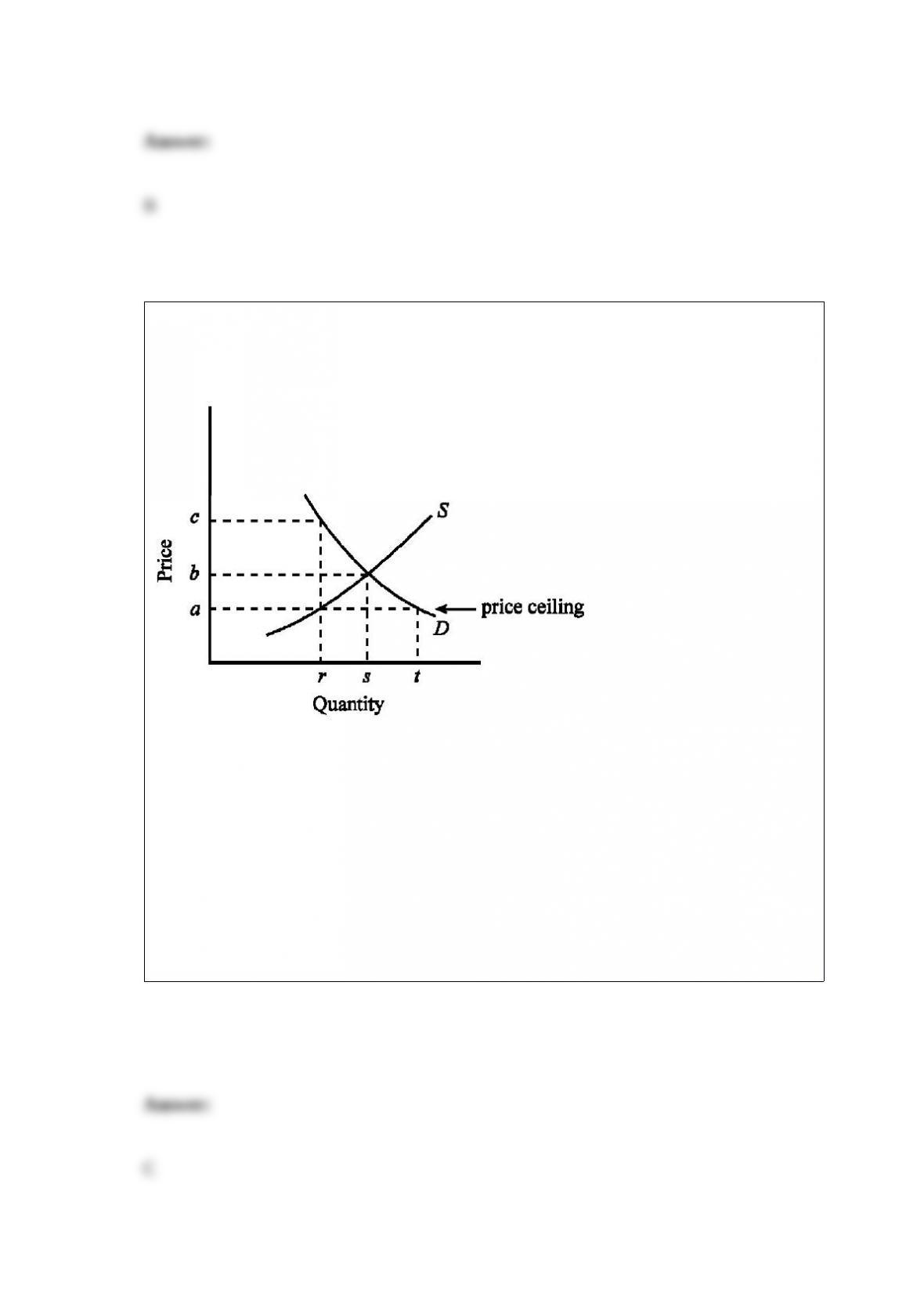
Use the figure below to answer the following question(s).
Figure 4-4
Given the demand and supply conditions shown in Figure 4-4, what will happen as the
result of imposing a price ceiling of a?
a. Demand for the product will decline.
b. Supply will increase.
c. There will be a shortage of the product.
d. Over time, the quality of the product offered by suppliers will increase.

If a country’s currency depreciates, which of the following will most likely happen?
a. Net exports will fall and aggregate demand will increase.
b. Net exports will rise and aggregate demand will increase.
c. Net exports will fall and aggregate demand will decrease.
d. Net exports will rise and aggregate demand will decrease.
Other things constant, which of the following would cause the M1 money supply to
decline?
a. an increase in the quantity of U.S. currency held overseas
b. a shift of funds from interest-earning checking deposits to money market mutual
funds
c. a reduction in the general public’s holdings of currency outside of banks because
debit cards have become more popular and widely accepted
d. a shift of funds from money market mutual funds into stock and bond mutual funds
because the fees to invest in the latter have declined