In general, agricultural price supports
a. raise food prices.
b. have no impact on food prices.
c. are designed to lower food prices.
d. c and d
Firm X is a single seller of good X. There are, however, two substitutes for good X.
Given this,
a. firm X cannot be a monopolist because the theory of monopoly assumes there are no
substitutes for the good the single seller sells.
b. firm X may be a monopolist because the two substitutes may be close substitutes.
c. firm X cannot be a monopolist because if substitutes exist for the good it produces,
its demand curve is horizontal but monopolists face downward-sloping demand curves.
d. none of the above
Exhibit 3-4
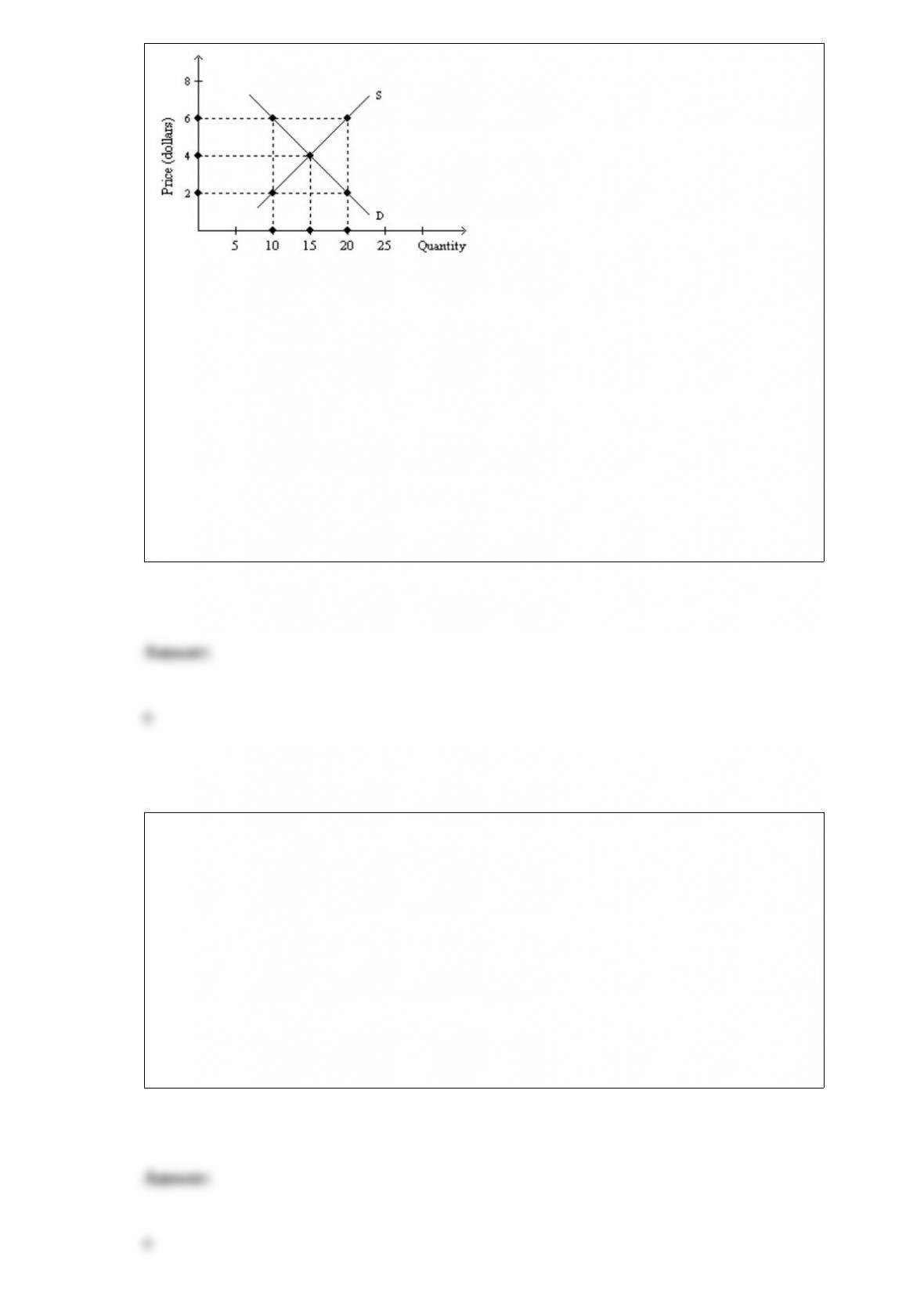
A price of $4 in the market will result in a
a. shortage of 10 units.
b. surplus of 10 units.
c. surplus of 5 units.
d. shortage of 5 units.
e. none of the above
For a perfectly competitive firm,
a. price equals marginal revenue only for the first unit of the good produced and sold.
b. only at a lower price can more units of a good be sold.
c. demand is perfectly inelastic.
d. a and b
e. none of the above

John is willing to give up 2 apples tomorrow to get one apple today, whereas Bill is
willing to give up only 1.5 apples tomorrow to get one apple today. It follows that
a. John has a higher rate of time preference than Bill, because he is willing to give up
more tomorrow to get something today.
b. Bill has a higher rate of time preference than John, because he is willing to give up
less tomorrow to get something today.
c. if we factor in the price of apples, John and Bill (probably) have the same rate of time
preference.
d. Bill has a lower rate of time preference than John, because he is willing to give up
more tomorrow for something today.
e. John has a lower rate of time preference than John, because he is willing to give up
more tomorrow to get something today.
The general and likely purpose of a (labor) strike is to convince management that
a. the supply curve of labor is what the union says it is.
b. the demand curve (for the product they sell) is what the union says it is.
c. workers have a higher marginal physical product than the management think they
(the workers) have.
d. it is not in their best interest to raise the prices of the product they sell.
e. none of the above
Economic rent is a payment in excess of
a. average fixed cost.
b. average variable cost.
c. opportunity cost.
d. explicit cost, but not necessarily implicit cost.
e. none of the above
Among the stated objectives of the National Collegiate Athletic Association (NCAA)
regulations is to
a. maintain the amateur standing of college athletes.
b. prevent schools with more money from getting all of the good players.
c. enhance the competitiveness of college sports.
d. all of the above
Economists use the term utility to mean usefulness.
a. True
b. False
The larger the Gini coefficient, the
a. greater the degree of income inequality.
b. greater the degree of income equality.
c. smaller the population.
d. larger the population.
e. b and d
The white rats in the Texas A & M study acted the same way a person who
a. sought to achieve consumer equilibrium would act.
b. is irrational would act.
c. didn’t want to assume any risk would act.
d. didn’t like any goods would act.
e. There was no study done at Texas A & M with white rats.
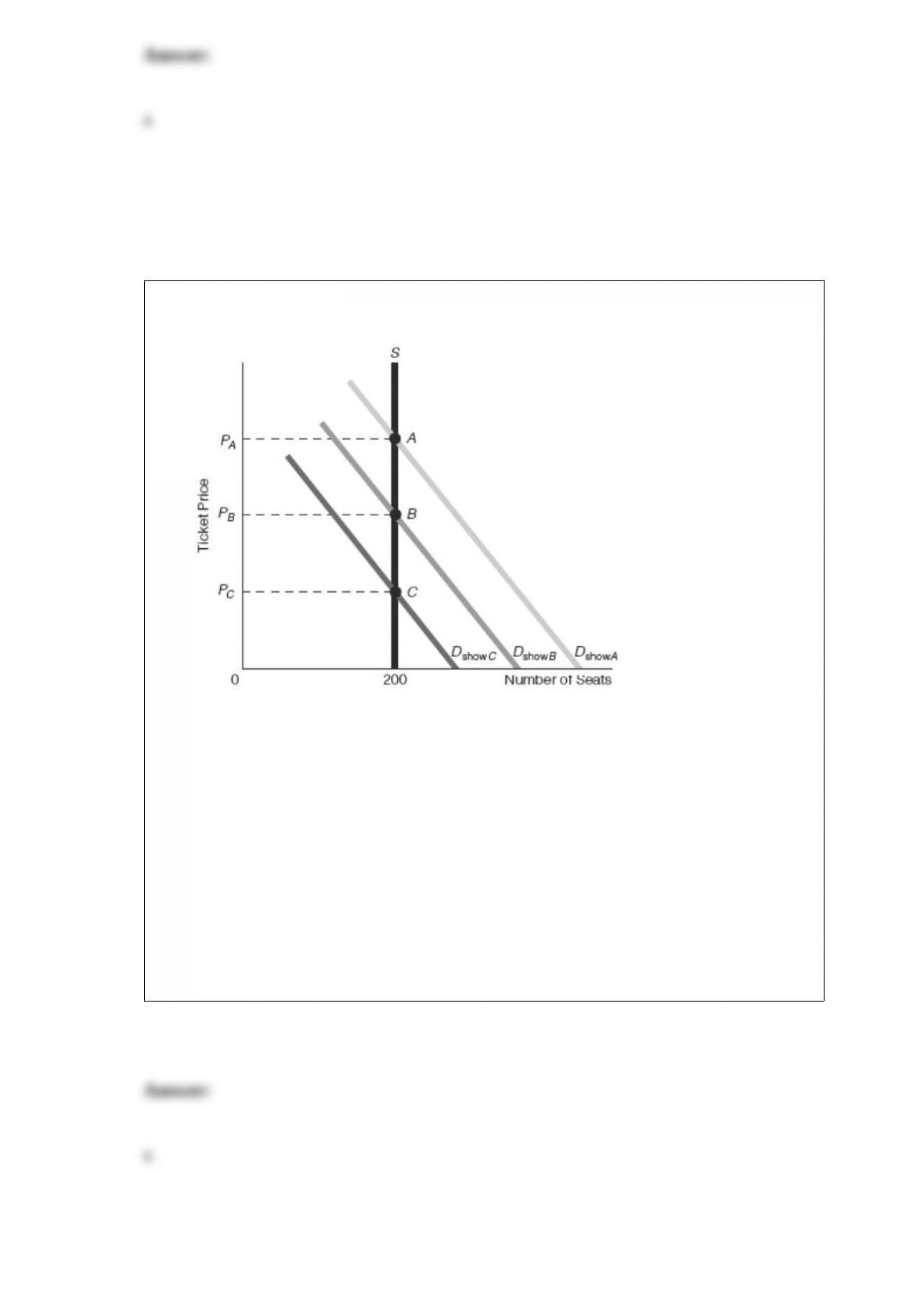
Exhibit 5-4
If television studio executives choose to charge a price of PB to view the taping of all
shows, they will find that there is a shortage of tickets to view the taping of show
___________ and a surplus of tickets to view the taping of show ______________.
a. A; C
b. C; A
c. B; A
d. B; C