
Economists have shown that when the ultimatum game experiment is carried out, both
allocators and recipients act as if fairness is important.
A perfectly competitive firm in long-run equilibrium produces output at the lowest
possible average total cost.
If the equilibrium exchange rate exceeds the par exchange rate in the market for
pounds, the pound is overvalued.
Increasing the federal budget deficit will contribute to increasing the federal
government debt.

New firms are able to enter monopolistically competitive markets because there are low
barriers to entry.
Holding all else constant, a rise in interest rates in the United States will cause the
dollar to appreciate in international exchange markets.
A very large number of small sellers who sell identical products imply
A) a multitude of vastly different selling prices.
B) a downward-sloping demand for each seller’s product.
C) the inability of one seller to influence price.
D) chaos in the market.
China began pegging its currency, the yuan, to the dollar in 1994. Because the yuan has

been ________ at the pegged exchange rate, the Chinese government ________ its
reserves of dollars as the government purchased more ________ to maintain the pegged
exchange rate.
A) undervalued; increased; dollars
B) undervalued; decreased; yuan
C) overvalued; decreased; yuan
D) overvalued; increased; yuan
Which of the following is a normative economic statement?
A) Rising global demand for coal has led to increases in the price of coal.
B) With rising mortgage rates and rising unemployment rates, the number of unsold
homes has increased.
C) The state of Texas is considering increasing funds for light-rail development to
promote the use of public transportation.
D) Pharmaceutical manufacturers should not be allowed to patent their products so
prescription drugs would be more affordable.
A monopoly is a firm that is the only seller of a good or service that does not have
A) a patent.
B) a close complement.

C) a barrier to entry.
D) a close substitute.
In an “underground economy,” the production of goods and services
A) is not measured or included in GDP.
B) is not measured but is included in GDP.
C) is measured and included in GDP.
D) is usually too insignificant to be included in GDP.
Which of the following would you expect to result in faster economic growth?
A) the invention of new computers that increase labor productivity
B) a decrease in the average level of education in the economy
C) a decrease in the stock of capital per worker
D) a decrease in research and development spending

The best measure of a country’s standard of living is
A) GDP per labor hour.
B) GDP per unit of capital.
C) GDP per capita.
D) total nominal GDP.
Making “how much” decisions involve
A) calculating the total benefits of the activity and determining if you are satisfied with
that amount.
B) calculating the total costs of the activity and determining if you can afford to incur
that expenditure.
C) calculating the average benefit and the average cost of an activity to determine if it is
worthwhile undertaking that activity.
D) determining the additional benefits and the additional costs of that activity.
Suppose a bank has $100 million in checking account deposits with no excess reserves
and the required reserve ratio is 20 percent. If the Federal Reserve reduces the required

reserve ratio to 15 percent, then the bank will now have excess reserves of
A) $0.
B) $5 million.
C) $15 million.
D) $20 million.
In a production possibilities frontier model, a point inside the frontier is
A) allocatively efficient.
B) productively efficient
C) allocatively inefficient.
D) productively inefficient.
Which of the following antitrust laws forbade firms to engage in price discrimination if
the effect would lessen competition or create a monopoly?
A) the Sherman Act
B) the Clayton Act
C) the Robinson-Patman Act
D) the Cellar-Kefauver Act
If demand is inelastic, the absolute value of the price elasticity of demand is
A) one.
B) less than one.
C) greater than one.
D) greater than the absolute value of the slope of the demand curve.
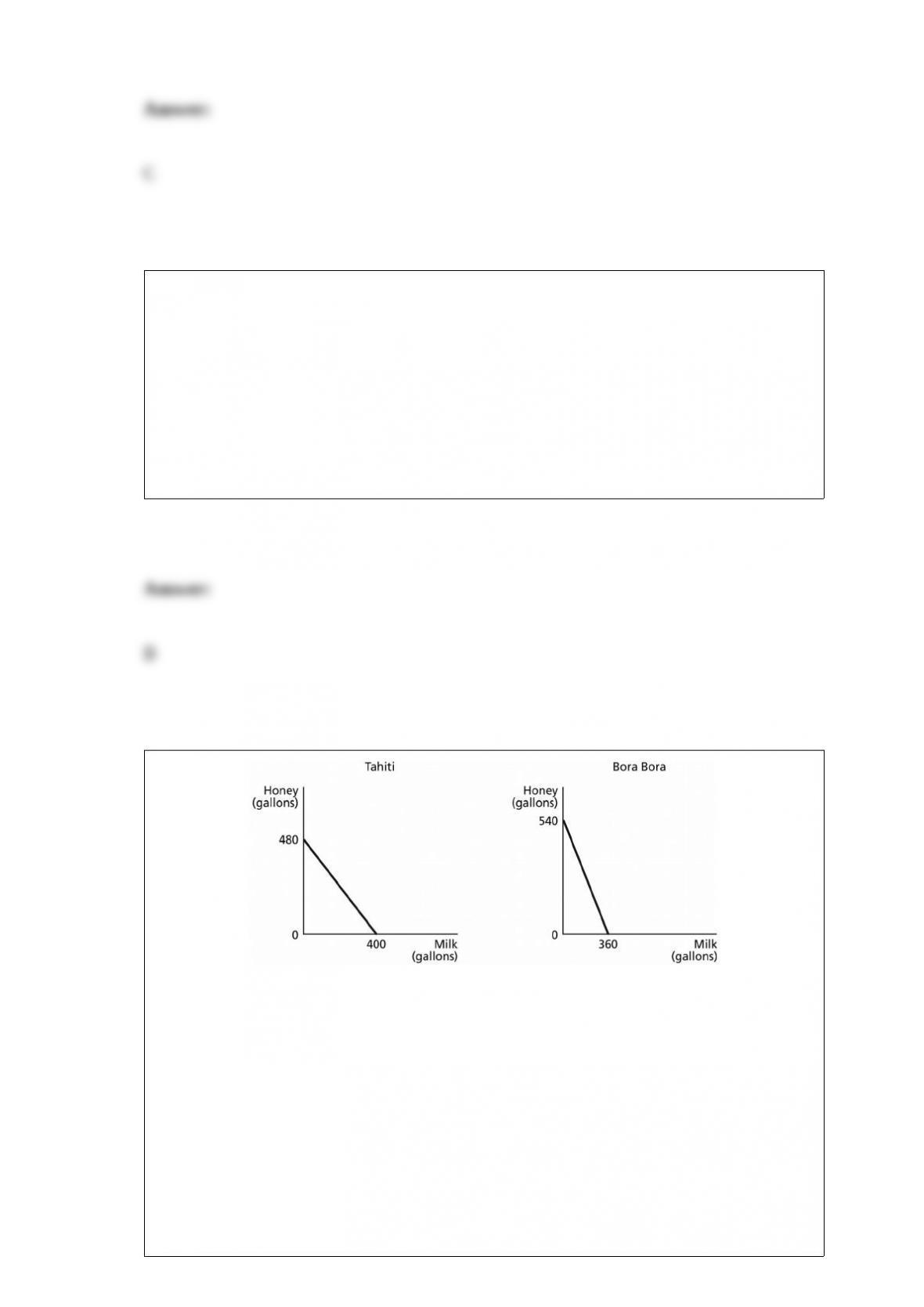
Figure 2-13 Figure 2-13
shows the production possibilities frontiers for Tahiti and Bora Bora. Each country
produces two goods, milk and honey.
Which country has a comparative advantage in the production of honey?
A) Bora Bora
B) They have equal productive abilities.
C) Tahiti
D) neither country

Article Summary. Seeking ways to improve education, Garrett Johnson has
organized technology competitions called hackathons where participants such as
students, teachers, and engineers build applications designed to improve
secondary and higher education systems. These applications can include ways for
teachers to improve skills, more productive study habits for students, improving
school safety, or any number of ideas related to education. Several hackathons
have been planned for around the country, including a virtual hackathon, entry is
free, and each contest will award $5,000 in prizes to the winners. Source: Nancy
Dahlberg, “Hackathon tackling education reform this week,” Miami Herald,
October 7, 2013.
The article addresses education reform by way of newly designed applications.
Education reform could lead to a more skilled and better trained public. A more skilled
and better trained public would
A) cause the market supply curve for labor to shift to the right.
B) cause the market demand curve for labor to shift to the right.
C) not shift the market demand curve for labor.
D) cause both the market demand curve for labor and the market supply curve for labor
to shift to the left.
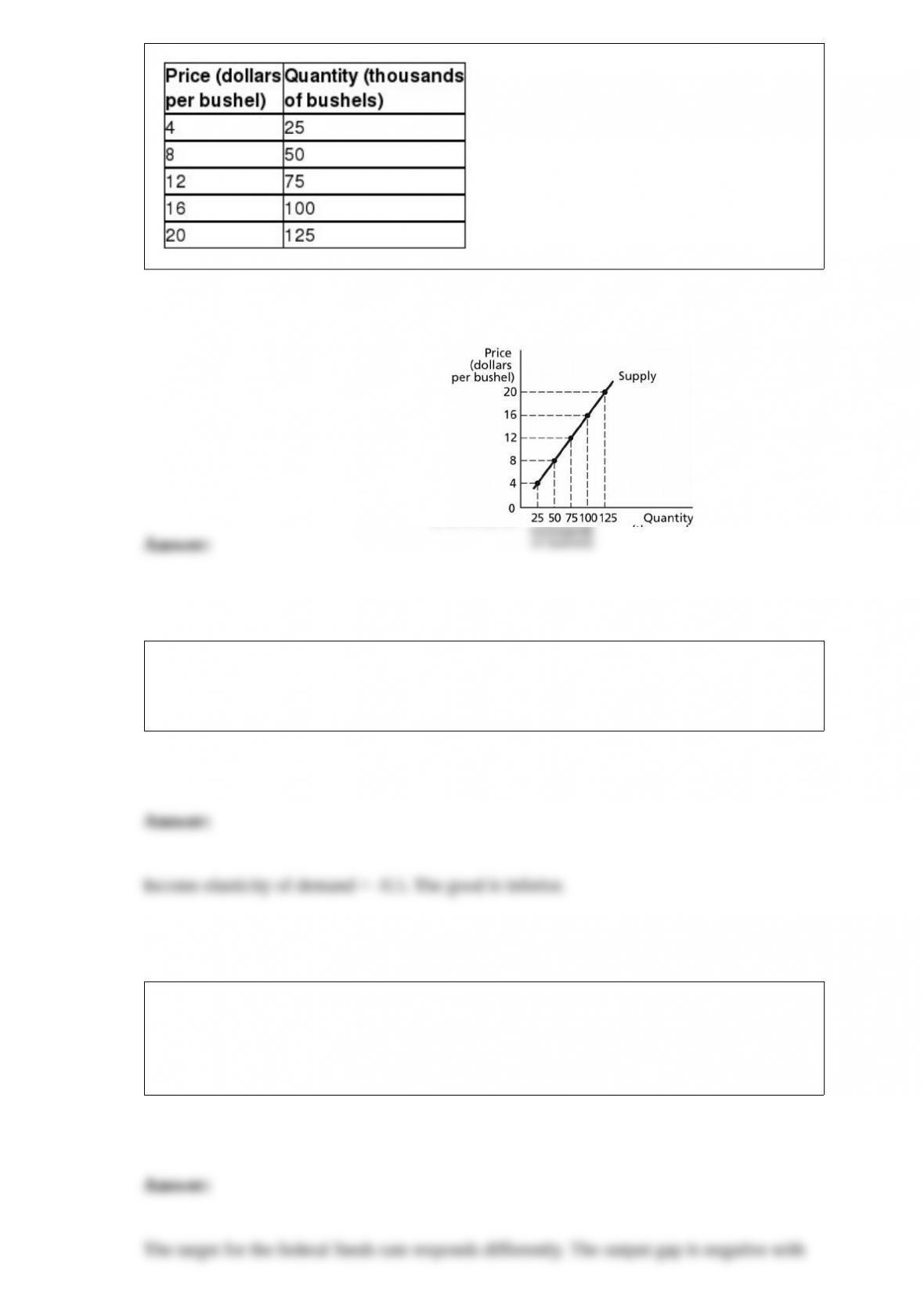
Use the following supply schedule for cherries to draw a graph of the supply curve. Be
sure to label the supply curve and each axis, and show each point on the supply curve.
In the Taylor rule, does the target for the federal funds rate respond differently for a
recession caused by a decrease in aggregate demand and for a recession caused by a
decrease in short-run aggregate supply? Explain whether there is or is not a difference
in how the target for the federal funds rate changes.
What are the most important differences between perfectly competitive markets and
monopolistically competitive markets?
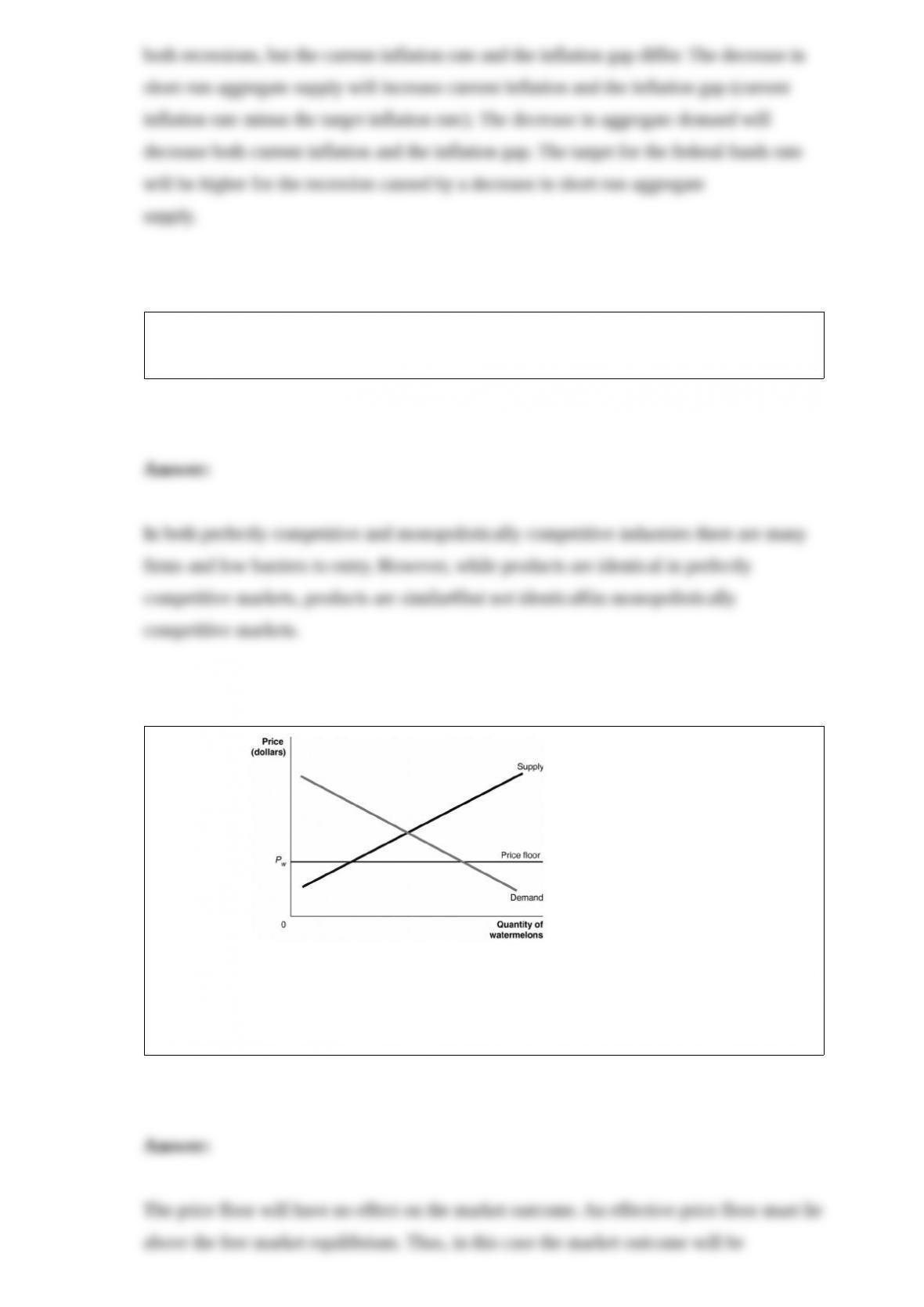
Figure 4-12
which shows the market for watermelons. Suppose the government imposes a price
floor of Pw. How will the price floor affect the quantity supplied, quantity demanded
and quantity exchanged?
Why do we not count the value of intermediate goods and services in gross domestic
product? Does the value of intermediate goods and services show up in gross domestic
product? If so, how?