
When a teacher in a private school points out to her high school principal that since
there are empty seats in all classrooms, the cost of additional students is really zero, she
is using the
a. law of comparative advantage.
b. principle of marginal analysis.
c. theory of externalities.
d. notion of the cost decreases of the service sector.
e. concept of opportunity cost.
The nation’s disposable income increases by $400 billion and, as a result, consumer
spending increases by $320 billion. Therefore, the MPC equals
a. 0.16.
b. 0.20.
c. 0.60.
d. 0.80.
e. 0.96.

Along with changes in the level of economic activity, measured by GDP, what other
economic variable tends to rise and fall as a consequence?
a. precipitation
b. regulation
c. circulation
d. unemployment
A firm facing a horizontal demand curve
a. cannot affect the price it receives for its output.
b. always produces at an output at which P = MR.
c. faces perfectly elastic demand for its product.
d. All of the above are correct.
The structural deficit is defined as
a. that part of the deficit that is so hard to remove that it is never reduced.
b. the portion of the budget deficit that occurs because the economy is not at full
employment.

c. the hypothetical deficit the economy would have under current fiscal policies if the
economy were operating near full employment.
d. the actual budget deficit that exists in the economy.
Due to new methods of electronically transferring assets from savings accounts to
checking accounts, many economists favor moving savings accounts from
a. M1 into M2.
b. M2 into M3.
c. M3 into M2.
d. M2 into M1.
The most important single factor in determining the exchange rate in the short run is
a. inflation differentials.
b. interest rate differentials.
c. monetary growth differentials.
d. price differentials.
The “cost disease of personal services” phenomenon helps explain why medical care
has become so expensive.
a. True
b. False
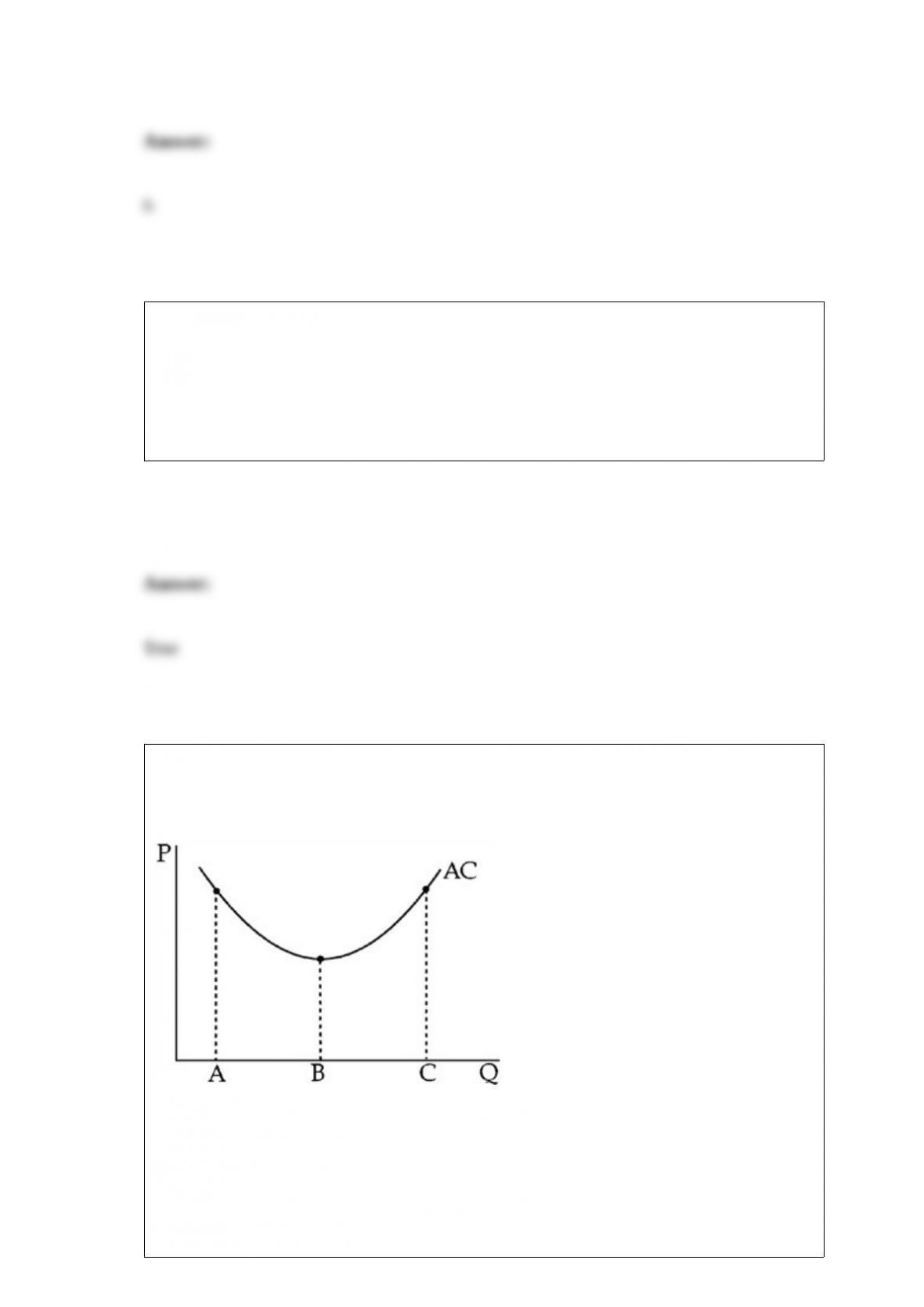
Figure 7-11
Figure 7-11 shows an average cost curve with points on it that correspond to three
quantity levels. Which of the following statements must be wrong?
a. The firm’s technology may show increasing marginal returns as production increases
from A to B.

b. The firm may have positive fixed costs.
c. As production expands from A to B to C, the firm may become increasingly difficult
to manage efficiently.
d. The firm’s average fixed cost may rise as production increases from B to C.
Economic profit can be viewed as
a. a reward for bearing risks.
b. an undeserved “reward” for exercising monopoly power.
c. a reward for innovation.
d. All of the above are correct.
Progressive income taxes are designed to
a. make the distribution of income less equal.
b. leave unchanged the distribution of income.
c. let the market determine the distribution of income after taxes.
d. make the distribution of income more equal.

With the invention of banking, one important aspect of money was that
a. banks have some discretion over the money supply.
b. banks have complete control over the money supply.
c. governments lost all control over the money supply.
d. individuals have no discretion over the money supply.
As the slope of the aggregate supply curve increases, this indicates that
a. the economy is getting close to potential GDP.
b. the economy is reducing employment.
c. inflation will be less of a problem.
d. output is falling.

Which of the following is the best example of an intermediate good?
a. a tire purchased by an auto company
b. a new house purchased by a newly married couple
c. grain sold to foreign farmers
d. All of the above are intermediate goods.
Is the national debt a burden to future generations?
a. No, as long as foreigners own a significant share of the national debt.
b. No, as long as the national debt is owned purely by U.S. citizens.
c. Yes, debt is always a burden to future generations.
d. Yes, unless foreigners increase their share of the national debt.
Technological change or the effects of automation cause
a. structural unemployment.
b. frictional unemployment.

c. seasonal unemployment.
d. cyclical unemployment.
If the level of investment spending increases by $100 and the MPC in the economy is
0.8, then the cumulative spending increase after three rounds of spending is
a. $280.
b. $260.
c. $244.
d. $220.
Figure 17-8
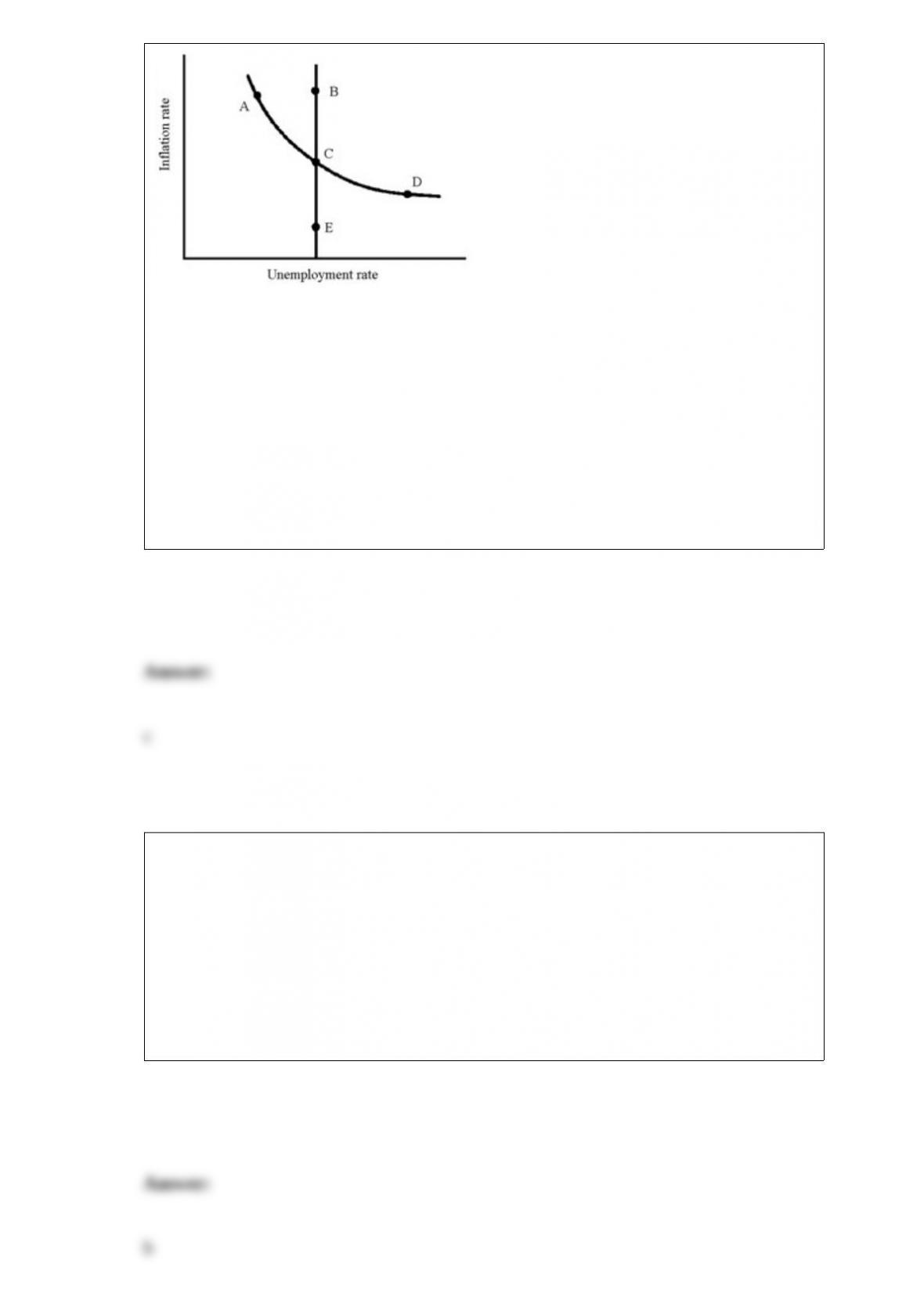
In Figure 17-8, which of the following movements reflects the Fed’s anti-inflationary
policy of the early 1980s and the following market adjustment?
a. A to B to C
b. E to A to B
c. C to D to E
d. D to E to C
Under a gold standard, a discovery of gold will
a. decrease the general price level.
b. increase the general price level.
c. cause increased unemployment.
d. cause decreased rates of economic growth.

Dividend refers to
a. a corporation’s regular payments to lenders.
b. part of the revenue given to stockholders of a corporation.
c. a lender’s legal claim on the assets of a bankrupt corporation.
d. a prepayment of a corporation’s legal obligation.
The division of labor benefits society only if
a. a system of exchange exists.
b. society uses all of its resources efficiently.
c. society has no specialized resources.
d. labor resources are not scarce.
Believers in a fixed-rule approach to stabilization policy propose that
a. Congress should balance the high employment budget.
b. the Fed should keep the money supply growth constant.

c. the economy be stabilized by automatic mechanisms.
d. All of the above are correct.
If a firm decides to ignore the reactions of its rivals to its policies, the appropriate
model to analyze its behavior is
a. game theory.
b. perfect competition.
c. monopoly.
d. cartels.
Price and quantity decisions made by a company have vital influences on
a. the firm’s labor requirements.
b. consumer response to the product.
c. future success of the company.
d. All of the above are correct.

Suppose the stock market rises, causing a rapid increase in consumers’ wealth. This
would lead to
a. a downward movement along the consumption function.
b. a downward shift of the consumption function.
c. an upward movement along the consumption function.
d. an upward shift of the consumption function.
The Fed is institutionally independent. A major advantage of this is that monetary
policy
a. is subject to regular congressional scrutiny.
b. will often offset fiscal policy.
c. is not controlled by politicians.
d. is usually coordinated with fiscal policy.

Which of the following observations concerning labor cost patterns over the last
century is true?
a. Average real wages started rising after 1973.
b. Hourly compensation rates have fallen dramatically.
c. Compensation growth slowed markedly.
d. Average hours worked per week have increased by almost 50 percent.
Economic growth is most likely to solve the problems of
a. environmental pollution.
b. world poverty.
c. emotional stress.
d. social alienation.
The reason that the multiplier is smaller if there are variable taxes is that
a. taxes add to government spending, which increases income.

b. people get angry about taxes and decide to work less.
c. tax increases shift the expenditure line upward.
d. part of an increase in income is taken away in taxes.
Tools used by economists include
a. historical study.
b. mathematical reasoning.
c. statistical inference.
d. All of the above are correct.
When firms have had to defend themselves against the charge that they have adopted
unjustifiably low prices either to drive a competitor out of business or to prevent the
entry of a rival, they have been accused of
a. creating a trust.
b. conspiracy.
c. predatory pricing.
d. price discrimination.

Which of the following was the result of the Federal Reserve’s purchase of
mortgage-backed securities in 2009?
a. MBS interest rates declined, home mortgage rates declined, and the Fed turned a
profit on these operations.
b. MBS interest rates declined, home mortgage rates declined, but the Fed had a loss on
these operations.
c. MBS interest rates increased, home mortgage rates declined, and the Fed turned a
profit on these operations
d. MBS interest rates increased, home mortgage rates increased, but the Fed had a loss
on these operations