1) The term V in the equation of exchange is equal to:
A.M/nominal GDP.
B.nominal GDP/M.
C.the reciprocal of the price level.
D.nominal GDP/Q.
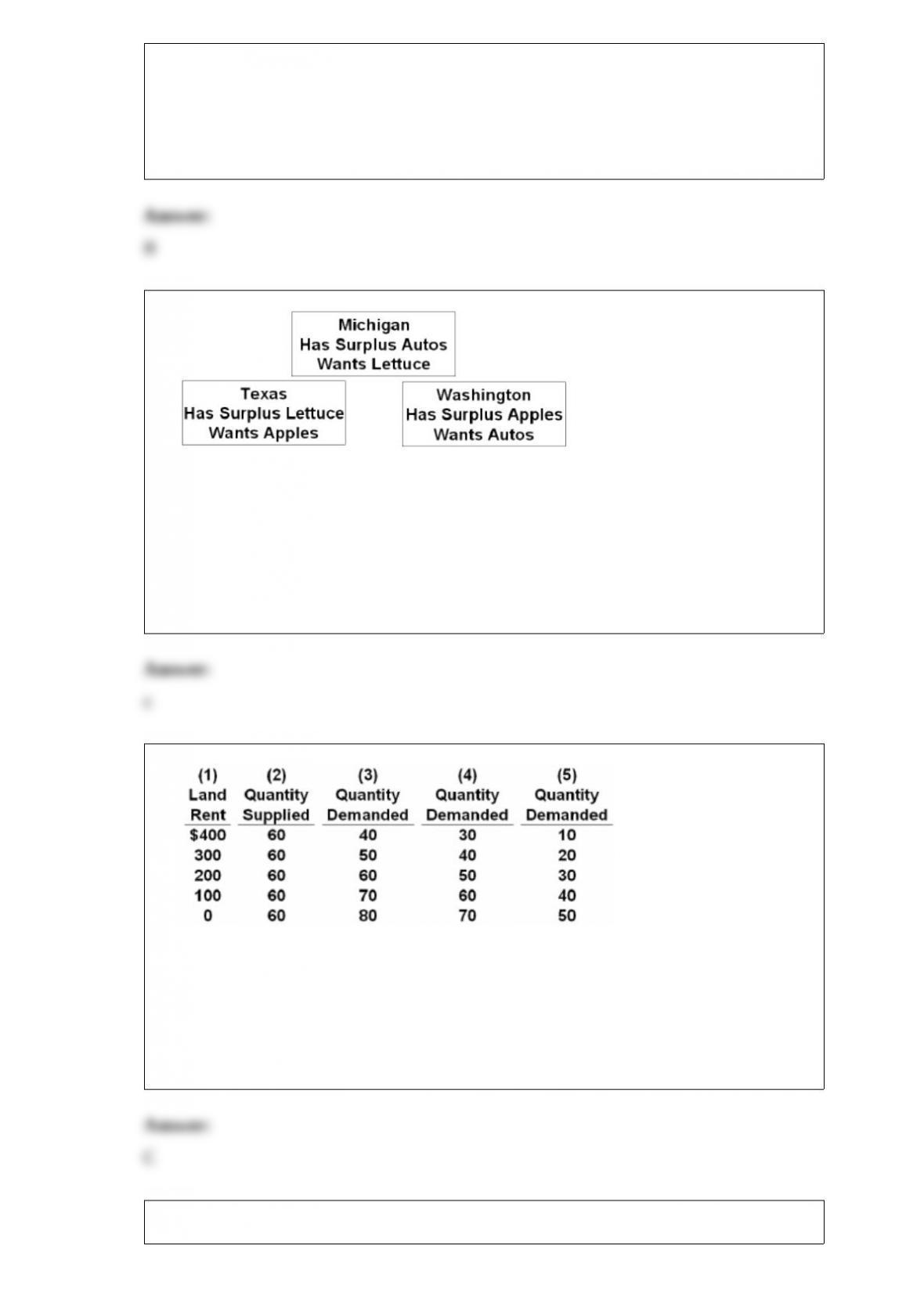
2)
given the above information and assuming trade occurs between the three states we can
expect:
a.that there is no means by which michigan can obtain lettuce while specializing in the
production of autos.
b.that money will not be needed to accomplish the desired exchanges.
c.money to flow counterclockwise from michigan to texas to washington.
d.money to flow clockwise from michigan to washington to texas.
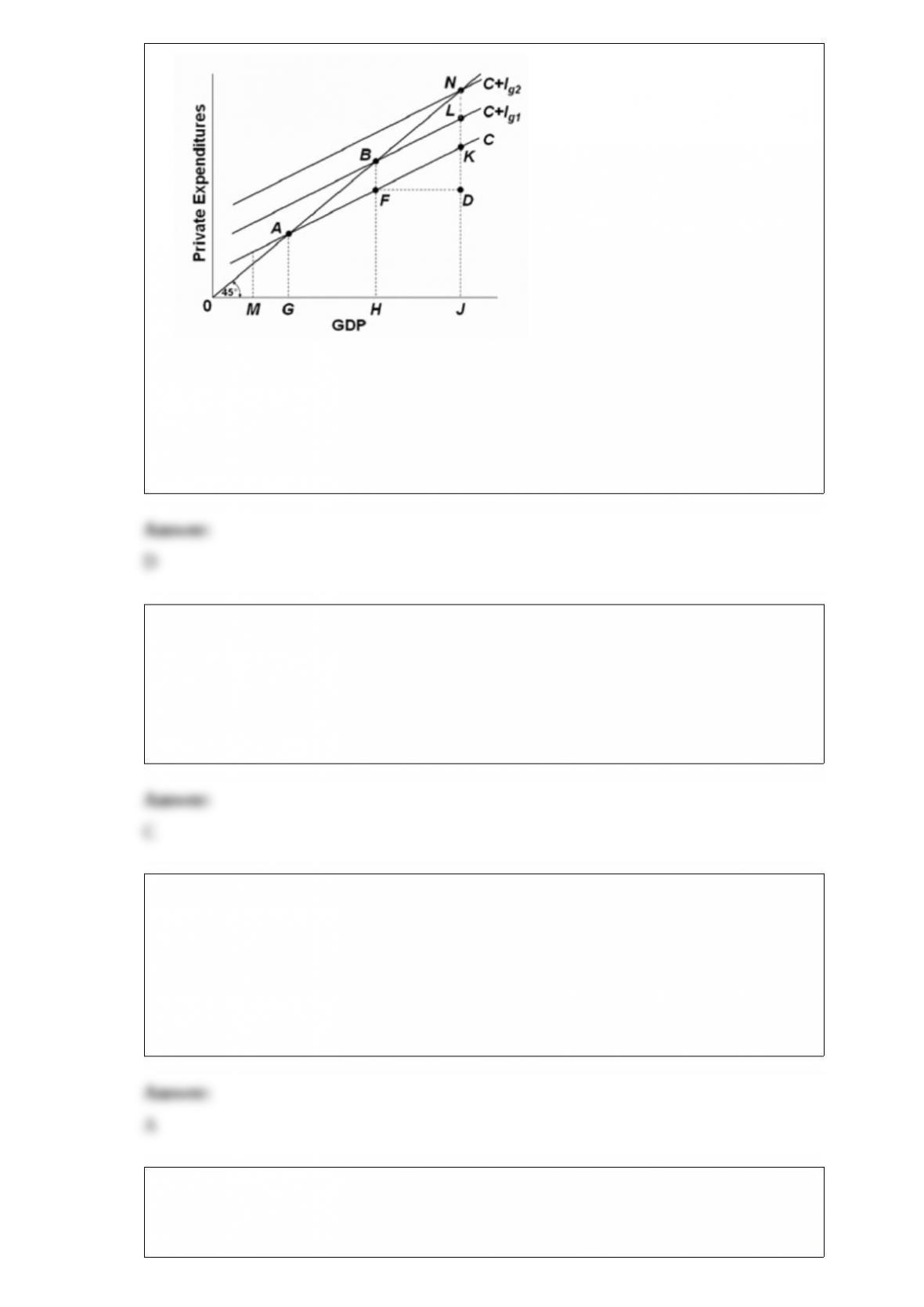
3)
Refer to the above table, in which the values for columns (2) through (5) are in acres.
Zero land rent will occur if the relevant columns are:
A.(1), (2), and (3) only.
B.(1), (2), and (4) and (1), (2), and (5).
C.(1), (2), and (5) only.
D.(1), (2), and (3) and (1), (2), and (4).
4) The DVCs are:

A.located primarily in Northern Europe.
B.located primarily in Western Europe.
C.located primarily in Africa, Asia, and Latin America.
D.more-or-less evenly distributed over the various continents.
5) which form of business enterprise accounts for the largest number of firms in the
united states?
a.corporations
b.proprietorships
c.partnerships
d.cooperatives
6) a profit-maximizing monopolist will set its price:
a.as far above atc as possible.
b.along the elastic portion of its demand curve.
c.where the marginal cost curve intersects the demand curve.
d.as close as possible to the minimum point of atc.
7) suppose there are 5 million unemployed workers seeking jobs. after a period of time,
1 million of them become discouraged over their job prospects and cease to look for
work. as a result of this, the official unemployment rate would:
a.decline.
b.increase.
c.increase in the short run but eventually decline.
d.be unchanged.
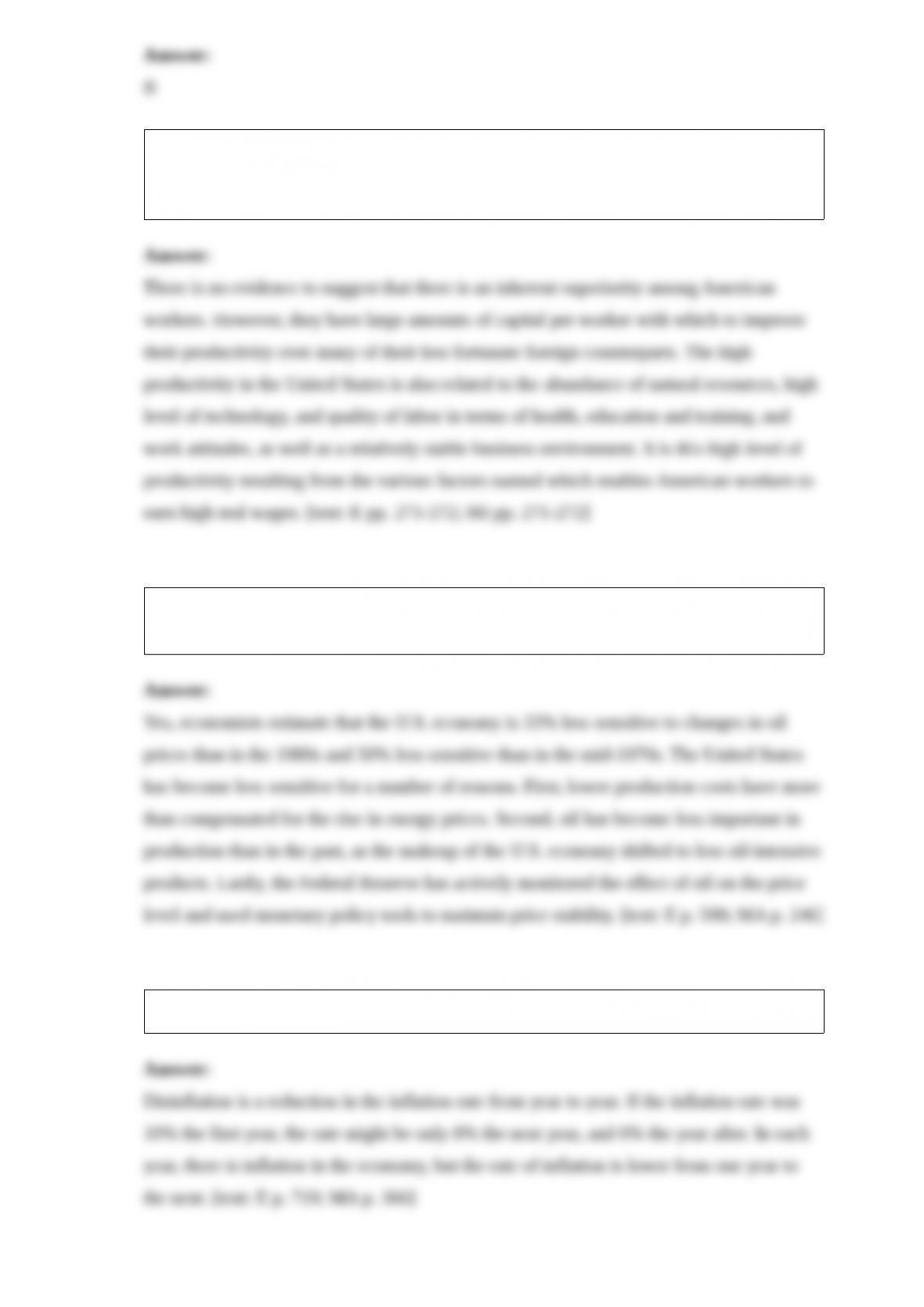
8)
Refer to the above diagram that applies to a private closed economy. The APC is equal
to 1 at income level:
A.J.
B.M.
C.H.
D.G.
9) The amount by which Federal tax revenues exceed Federal government expenditures
during a particular year is the:
A.Federal reserve.
B.budget deficit.
C.budget surplus.
D.public debt.
10) Which of the following is most likely to increase the 4-firm concentration ratio of a
particular industry?
A.a horizontal merger between two of the industry’s largest firms.
B.a vertical merger between one of an industry’s largest firms and one of the many input
suppliers in the resource market.
C.a conglomerate merger involving one of the industry’s major firms.
D.an agreement by all the industry firms to divide up the market among them.
11) which of the following will cause a decrease in market equilibrium price and an
increase in equilibrium quantity?
a.an increase in supply.

b.an increase in demand.
c.a decrease in supply.
d.a decrease in demand.
12)
symbols: q = number of workers demanded; w = wage rate; and vtp = value of the
cumulative total product (output) of the particular number of workers.
assumptions: (1) the current wage in zinnia is $20 and the current wage in marigold is
$12; (2) full employment exists in both countries.
refer to the above data, symbols, and assumptions. migration of workers will:
a.increase the combined value of total product but reduce the wage in zinnia.
b.increased the combined value of total product but reduce the wage in marigold.
c.reduce the combined value of total product but increase the wage in marigold.
d.reduce the combined value of total product but increase the wage in zinnia.
13) In the taste-for-discrimination model:
A.a decline in discrimination will reduce the actual African-American-white wage ratio.
B.an increase in collective discrimination coefficients of employers will reduce the
demand for African-American workers, decrease the African-American wage, and
increase African-American employment.
C.firms that discriminate will have lower costs than firms that do not discriminate.
D.competitive forces will tend to reduce discrimination in the very long run.
14) (Last Word) According to Yale University’s Environmental Performance Index
(EPI):
A.countries with lower GDP per person tend to have healthier environments.
B.countries with higher GDP per person tend to have healthier environments.
C.there is no correlation between GDP per person and environmental quality.
D.growth in GDP per person initially improves environmental quality and then
gradually reduces it.
15) The higher real wages earned by American workers primarily reflect the fact that
Americans have a greater inherent ability to produce goods and services than do foreign
workers. Evaluate.
16) (Last Word) Have rises in oil prices lost their inflationary punch in the United
States? If so, why?
17) What is disinflation? Give examples of it.
18) Fill in the table below. Describe your result.
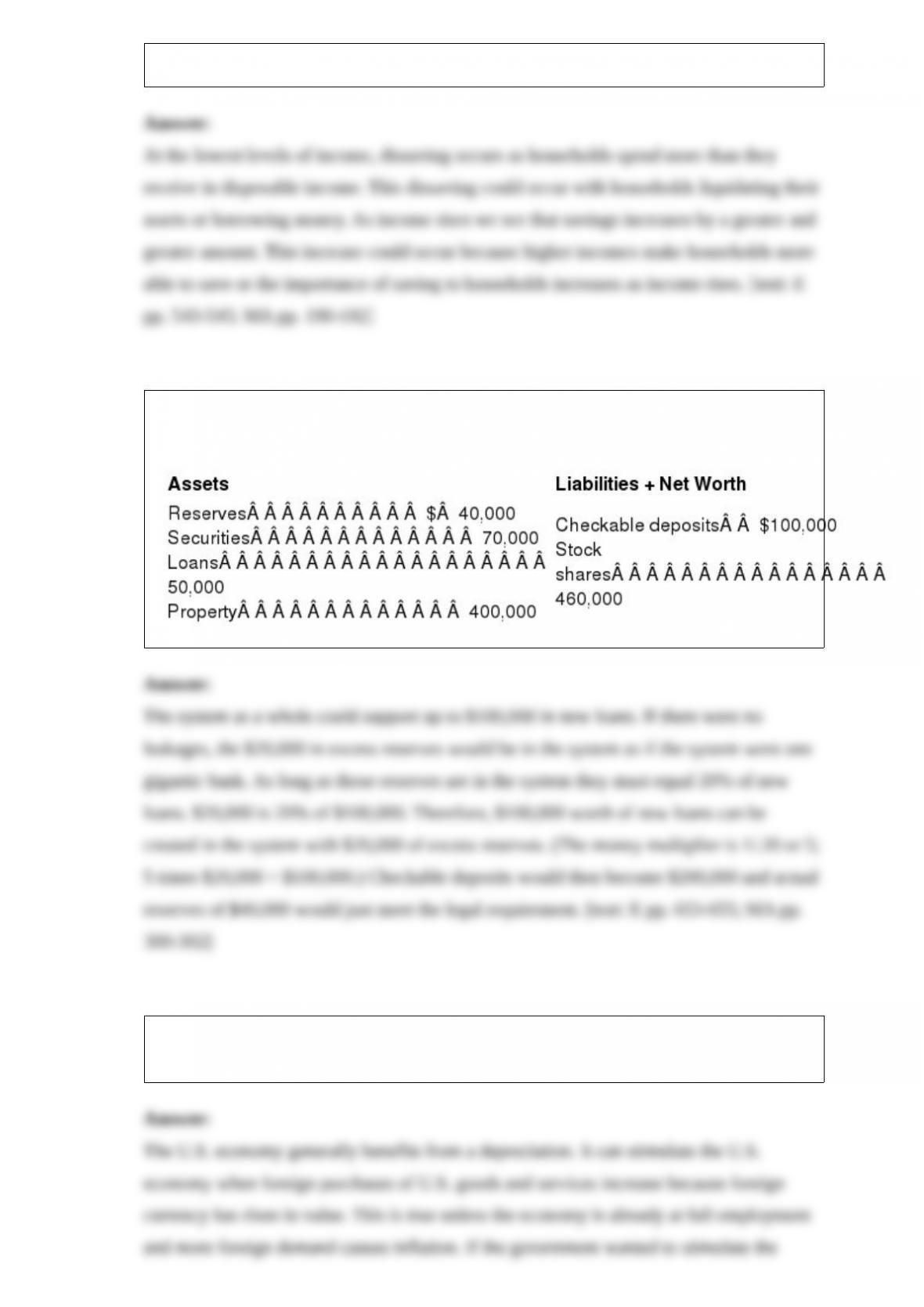
19) If the balance sheet below were for the entire banking system instead of just a
single bank, by how much could loans be expanded? Assume a reserve ratio of 20%.
20) Why might a government intervene in the foreign exchange markets to try to
increase or decrease the value of its currency?

21) How do preferences and risk contribute to income inequality?
22) If a nations balance of payments is always in balance, why isnt it also always in
equilibrium?
23) Explain what is meant by fractional reserve banking.

24) The more progressive a tax system, the greater is the economys built-in stability.
Explain this statement for both recessionary and peak phases of the business cycle.