In June of 2010, the government had a debt of about $8.6 trillion. Over the next year
real GDP grew by about 1.6% and inflation was about 2%. What is the largest deficit
the government could have run over this time without raising the debt-to-GDP ratio?
a. about $68.8 billion
b. about $137.6 billion
c. about $275.2 billion
d. about $309.6 billion
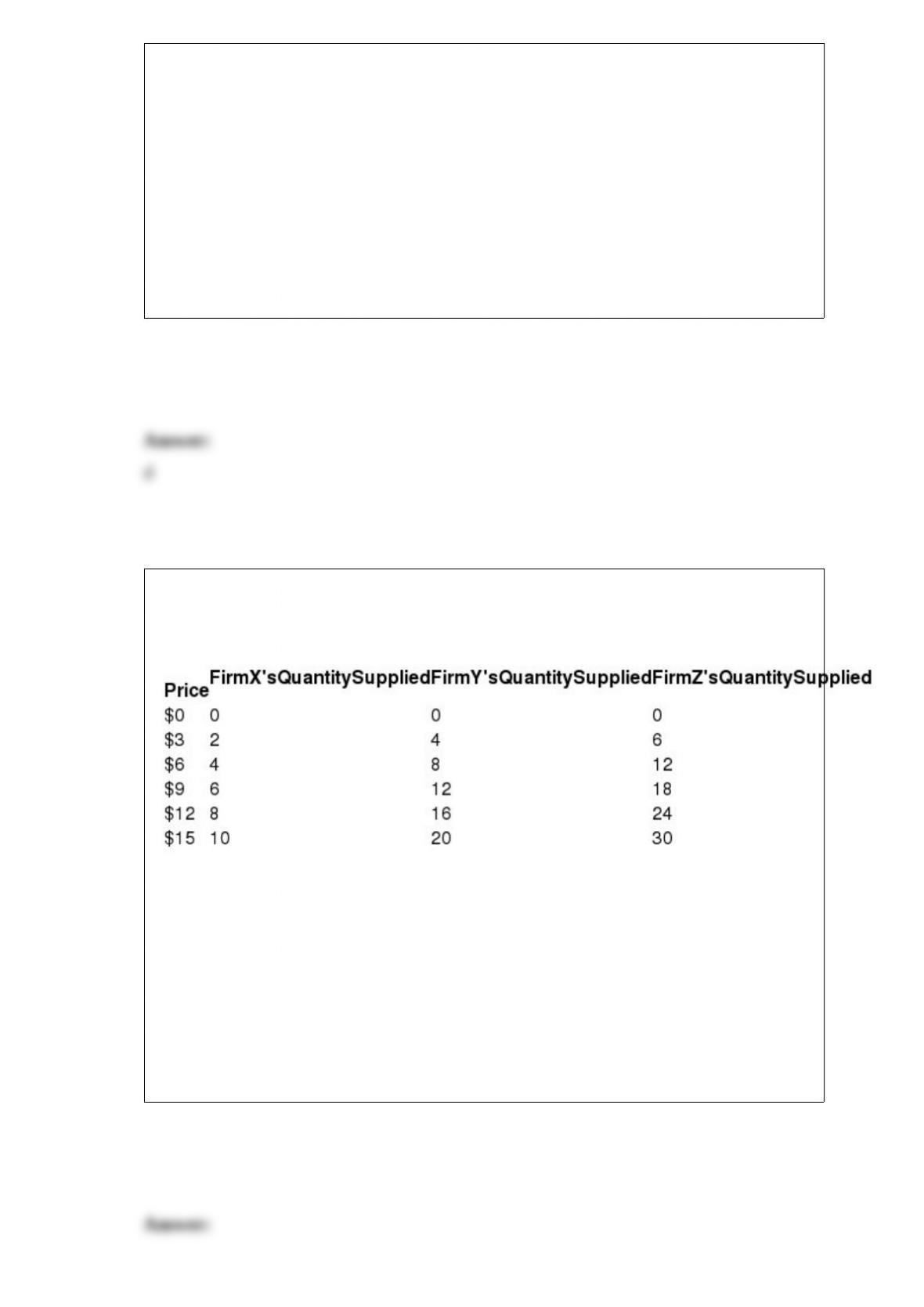
Table 4-8
RefertoTable4-8.Suppose Firm X and Firm Y are the only two sellers in the market. If
the market price decreases from $12 to $9, quantity supplied will
a. decrease by 6 units.
b. decrease by 12 units.
c. increase by 6 units.
d. increase by 12 units.

The discount rate is the rate the Federal Reserve charges banks for loans. By lowering
this rate, the Fed provides banks with a greater incentive to borrow from it.
a. True
b. False
In the context of aggregate demand and aggregate supply, the wealth effect refers to the
idea that, when the price level decreases, the real wealth of households
a. increases and as a result consumption spending increases. This effect contributes to
the downward slope of the aggregate-demand curve.
b. decreases and as a result consumption spending increases. This effect contributes to
the upward slope of the aggregate-supply curve.
c. increases and as a result households increase their money holdings; in turn, interest
rates increase and investment spending decreases. This effect contributes to the
downward slope of the aggregate-demand curve.
d. decreases and as a result households increase their money holdings; in turn, interest
rates increase and investment spending decreases. This effect contributes to the upward
slope of the aggregate-supply curve.

In the short run, open-market purchases
a. increase investment and real GDP, and decrease nominal interest rates.
b. increase real GDP and nominal interest rates, and decrease investment.
c. increase investment and nominal interest rates, and decrease real GDP.
d. decrease investment, nominal interest rates, and real GDP.
When you rent a car, you might treat it with less care than you would if it were your
own. This is an example of
a. market risk.
b. moral hazard.
c. adverse selection.
d. risk aversion.
A statement describing how the world is
a. is a normative statement.

b. is a positive statement.
c. would only be made by an economist speaking as a policy adviser.
d. would only be made by an economist employed by the government.
If the economy unexpectedly went from inflation to deflation,
a. both debtors and creditors would have reduced real wealth.
b. both debtors and creditors would have increased real wealth.
c. debtors would gain at the expense of creditors.
d. creditors would gain at the expense of debtors.
Economist A.W. Phillips found a negative correlation between
a. output and unemployment.
b. unemployment and the interest rate.
c. output and the interest rate.
d. wage inflation and unemployment.

Jim transfers money from his money market account to his savings account. This action
a. reduced M1 and increases M2.
b. increases M1 and reduces M2.
c. has no effect on M1 or M2.
d. increases M1 and M2.
For an economy as a whole, income must equal expenditure because
a. the number of firms is equal to the number of households in an economy.
b. individuals can only spend what they earn each period.
c. every dollar of spending by some buyer is a dollar of income for some seller.
d. every dollar of saving by some consumer is a dollar of spending by some other
consumer.
If the sacrifice ratio is 4, then reducing the inflation rate from 9 percent to 5 percent
would require sacrificing
a. 4 percent of annual output.
b. 8 percent of annual output.
c. 12 percent of annual output.
d. 16 percent of annual output.
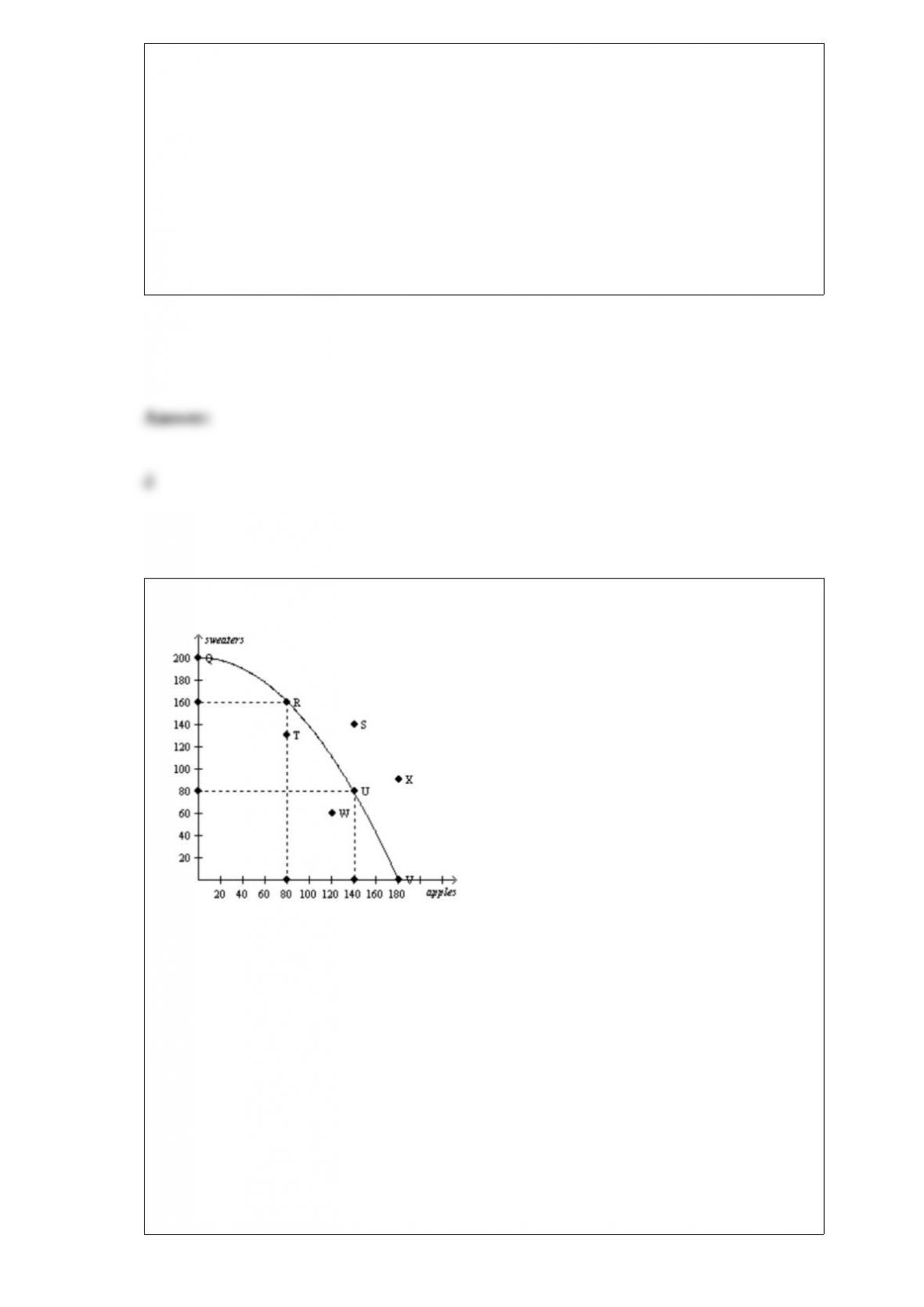
Figure 2-14
Consider the production possibilities curve for a country that can produce sweaters,
apples (in bushels), or a combination of the two.
Refer to Figure2-14. If this economy devotes all of its available resources to producing
apples, then it will produce
a. 0 bushels of apples and 200 sweaters.
b. 80 bushels of apples and 160 sweaters
c. 180 bushels of apples and 200 sweaters.
d. 180 bushels of apples and 0 sweaters.

Structural unemployment is often thought to explain relatively long spells of
unemployment.
a. True
b. False
Which of the following would help explain why the aggregate demand curve slopes
downward?
a. An unexpectedly low price level raises the real wage, which causes firms to hire
fewer workers and produce a smaller quantity of goods and services.
b. A lower price level causes domestic interest rates to rise and the real exchange rate to
appreciate, which stimulates spending on net exports.
c. A higher price level increases real wealth, which stimulates spending on
consumption.
d. A lower price level reduces the interest rate, which encourages greater spending on
investment goods.

Other things the same, an increase in the price level causes the interest rate to
a. increase, the dollar to depreciate, and net exports to increase.
b. increase, the dollar to appreciate, and net exports to decrease.
c. decrease, the dollar to depreciate, and net exports to increase.
d. decrease, the dollar to appreciate, and net exports to decrease.
Which of the following steps does an economist take when studying the economy?
a. devise theories
b. collect data
c. analyze data
d. All of the above are correct.
In the circular-flow diagram, which of the following is nota factor of production?

a. labor
b. land
c. capital
d. money
Which of the following statements about mutualfundis correct?
a. A mutual fund is a financial intermediary.
b. A mutual fund acquires its funds primarily by selling shares to the public.
c. People who buy shares from a mutual fund accept all of the risk and return associated
with the mutual fund’s portfolio.
d. All of the above are correct.
The adage, “There is no such thing as a free lunch,” means
a. even people on welfare have to pay for food.
b. the cost of living is always increasing.
c. people face tradeoffs.

d. all costs are included in the price of a product.
When the price of peaches changes, the demand curve for peaches
a. shifts because the price of peaches is measured on the vertical axis of the graph.
b. shifts because the quantity demanded of peaches is measured on the horizontal axis
of the graph.
c. does not shift because the price of peaches is measured on the vertical axis of the
graph.
d. does not shift because the price of peaches is measured on the horizontal axis of the
graph.
People can reduce the inflation tax by
a. reducing savings.
b. increasing deductions on their income tax.
c. reducing cash holdings.
d. None of the above is correct.

If a stock or bond is risky
a. risk averse people may be willing to hold it as part of a diversified portfolio.
b. risk averse people may be willing to hold it if the expected return is high enough.
c. both A and B are correct.
d. risk averse people will not hold it.
GDP is not a perfect measure of well-being; for example,
a. GDP incorporates a large number of non-market goods and services that are of little
value to society.
b. GDP places too much emphasis on the value of leisure.
c. GDP fails to account for the quality of the environment.
d. All of the above are correct.

A program to reduce inflation is likely to have higher costs if the sacrifice ratio is
a. high and the reduction is unexpected.
b. high and the reduction is expected.
c. low and the reduction is unexpected.
d. low and the reduction is expected.
If the reserve ratio is 4 percent, then $81,250 of new money can be generated by
a. $325 of new reserves.
b. $3,250 of new reserves.
c. $20,312.50 of new reserves.
d. $2,031,250 of new reserves.
Economists generally support
a. trade restrictions.
b. government management of trade.
c. export subsidies.

d. free international trade.
A monopoly is a market with one
a. seller, and that seller is a price taker.
b. seller, and that seller sets the price.
c. buyer, and that buyer is a price taker.
d. buyer, and that buyer sets the price.
Your accountant tells you that if you can continue to earn the current interest rate on
your balance of $750 for the next three years, you will have $944.78 in your account. If
your accountant is correct, then what is the current interest rate?
a. 6 percent
b. 7 percent
c. 8 percent
d. 10 percent

In 2002 mortgage rates fell and mortgage lending increased. Which of the following
could explain both of these changes?
a. The demand for loanable funds shifted rightward.
b. The demand for loanable funds shifted leftward.
c. The supply of loanable funds shifted rightward.
d. The supply of loanable funds shifted leftward.
Which of the following is notcorrect?
a. Across countries there are large differences in the average income per person. These
differences are reflected in large differences in the quality of life.
b. With a growth rate of about 2 percent per year, average income per person doubles
about every 60 years.
c. The ranking of countries by average income changes substantially over time.
d. In some countries real income per person has changed very little over many years.

Figure 3-14
Refer to Figure3-14. If Arturo and Dina switch from each person dividing their time
equally between the production of tacos and burritos to each person spending all of
their time producing the good in which they have a comparative advantage, then total
production of burritos will increase by
a. 50.
b. 100.
c. 150.
d. 300.
In 1995 House Speaker Newt Gingrich threatened to send the United States into default
on its debt. During the day of this announcement, U.S. interest rates rose and the real
exchange rate of the U.S. dollar depreciated. Which of these changes is consistent with
the results of the open-economy macroeconomic model?
a. the increase in U.S. interest rates
b. the depreciation of the real exchange rate of the U.S. dollar
c. Both a and b are consistent.
d. Neither a nor b are consistent.

When economists are trying to explain the world, they are scientists. When they are
trying to improve it, they are
What measure of GDP shows the value of goods and services produced if we valued
these good and services at the prices that prevailed in some specific year in the past?
If the inflation rate was 8%, and the tax rate was 20%, and you deposited money in a
bank account that pays 12%, what is your after tax real interest rate? Show you work.
Figure 2-22
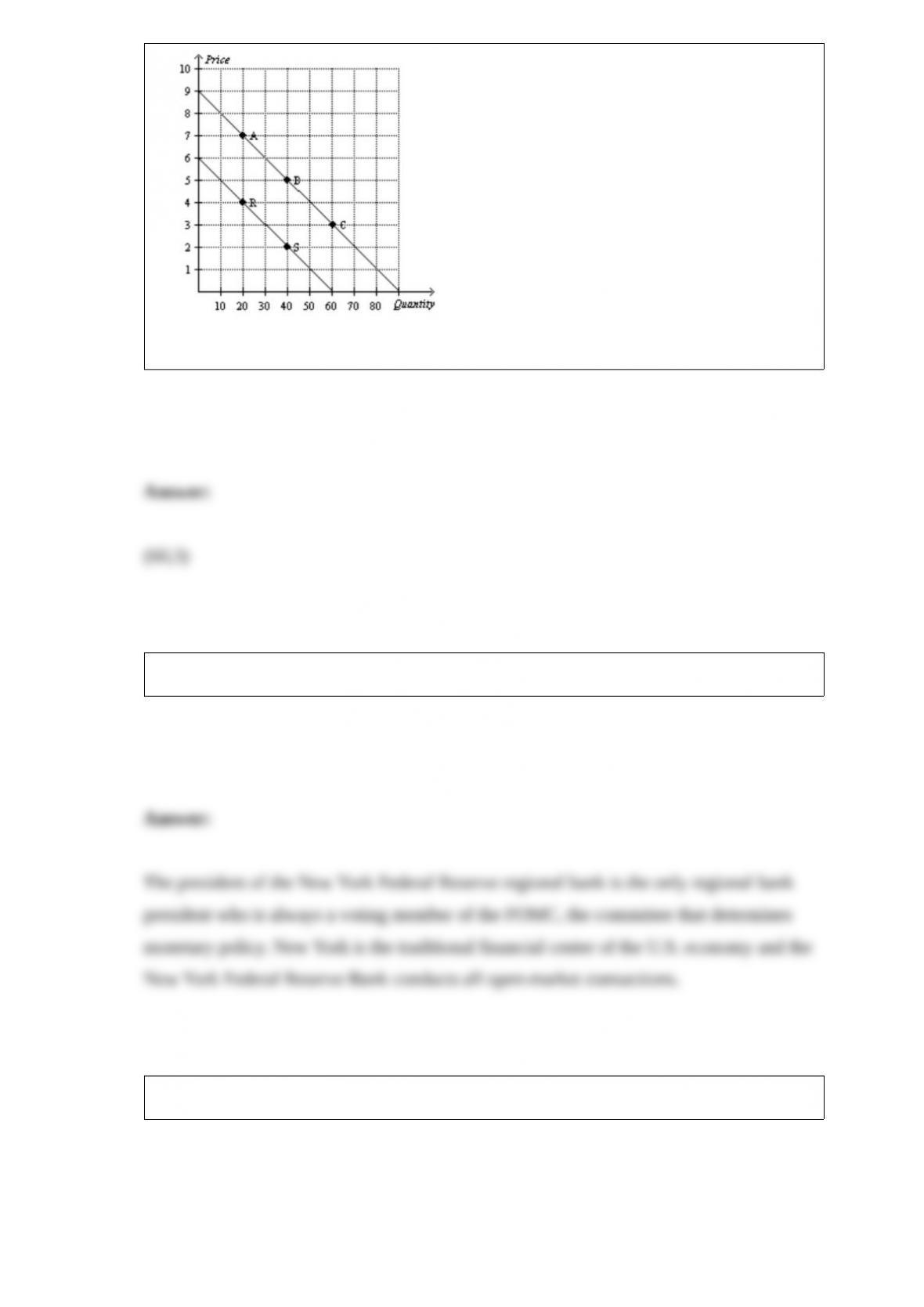
RefertoFigure2-22.What are the coordinates of point C?
What makes the New York Federal Reserve regional bank so important?
Figure 2-22
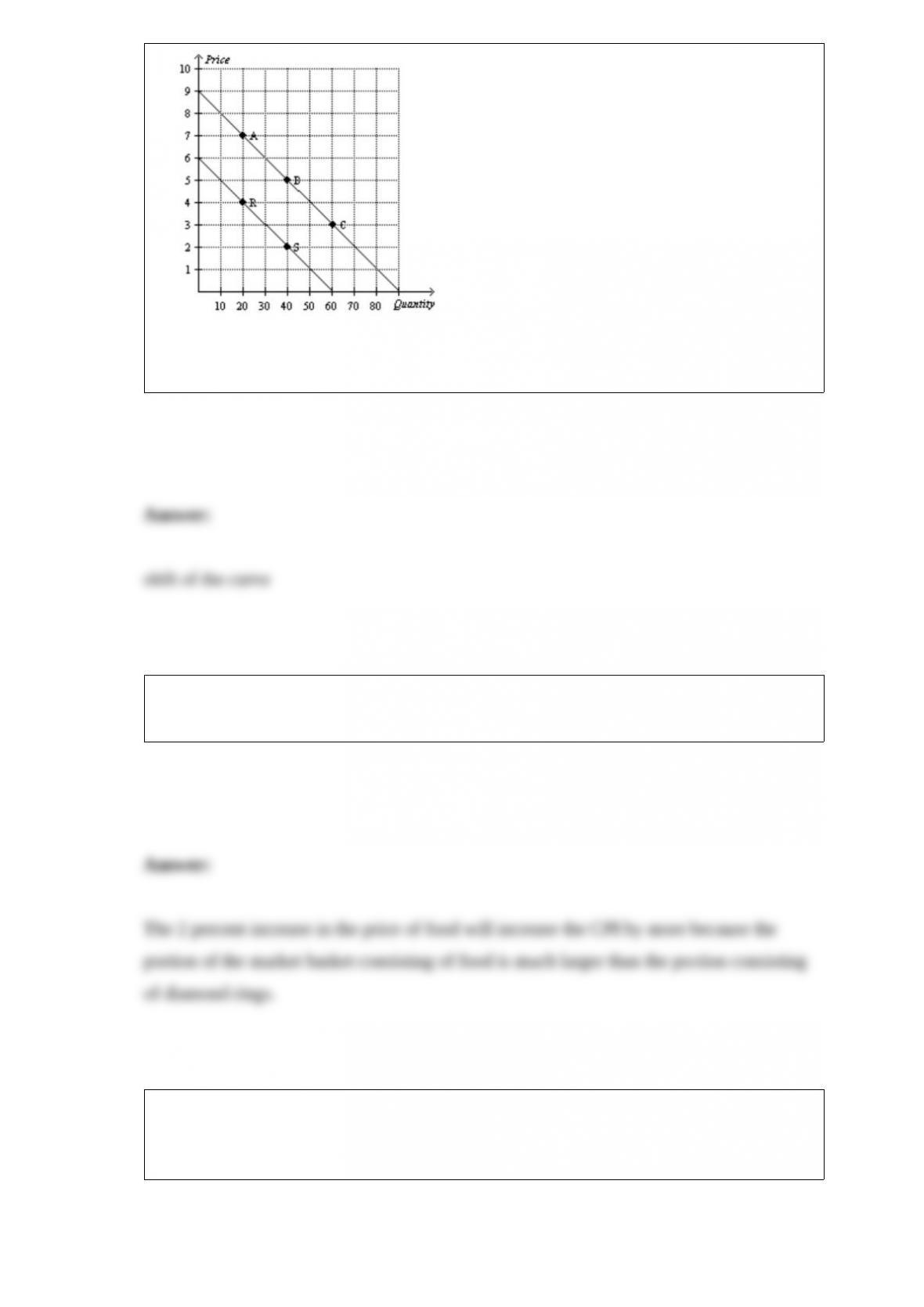
Refer to Figure2-22. Is a move from point A to point R considered a shift of the curve
or a movement along the curve?
Which is likely to have the larger effect on the CPI, a 2 percent increase in the price of
food or a 3 percent increase in the price of diamond rings? Explain.
Suppose the Federal Reserve lowers the target on the interest rate in the Federal Funds
market. The Federal Reserve will _____ the money supply and aggregate demand will
_____.
In the terminology of macroeconomics, what’s the difference between a saver and an
investor?
Consumption is $5.5 trillion, investment is $1 trillion, government expenditures are
$1.5 trillion, transfer payments are $.5 trillion, exports are $.75 trillion and imports are
$1.25 trillion. What is GDP?
How does a reduction in the money supply by the Fed make owning stocks less
attractive?
What is the difference between human capital and technology?
Concerns about the bankruptcy of an appliance manufacturer diminish after a new CEO
is appointed and some of the company’s less productive factories are sold. What type of
risk for bondholders falls? What happens to the interest rate on this company’s bonds?
Explain the pattern seen between GDP per person and quality of life measures such as
life expectancy, literacy, and Internet usage.