Most studies have found that tobacco and marijuana are substitutes rather than
complements.
a. True
b. False
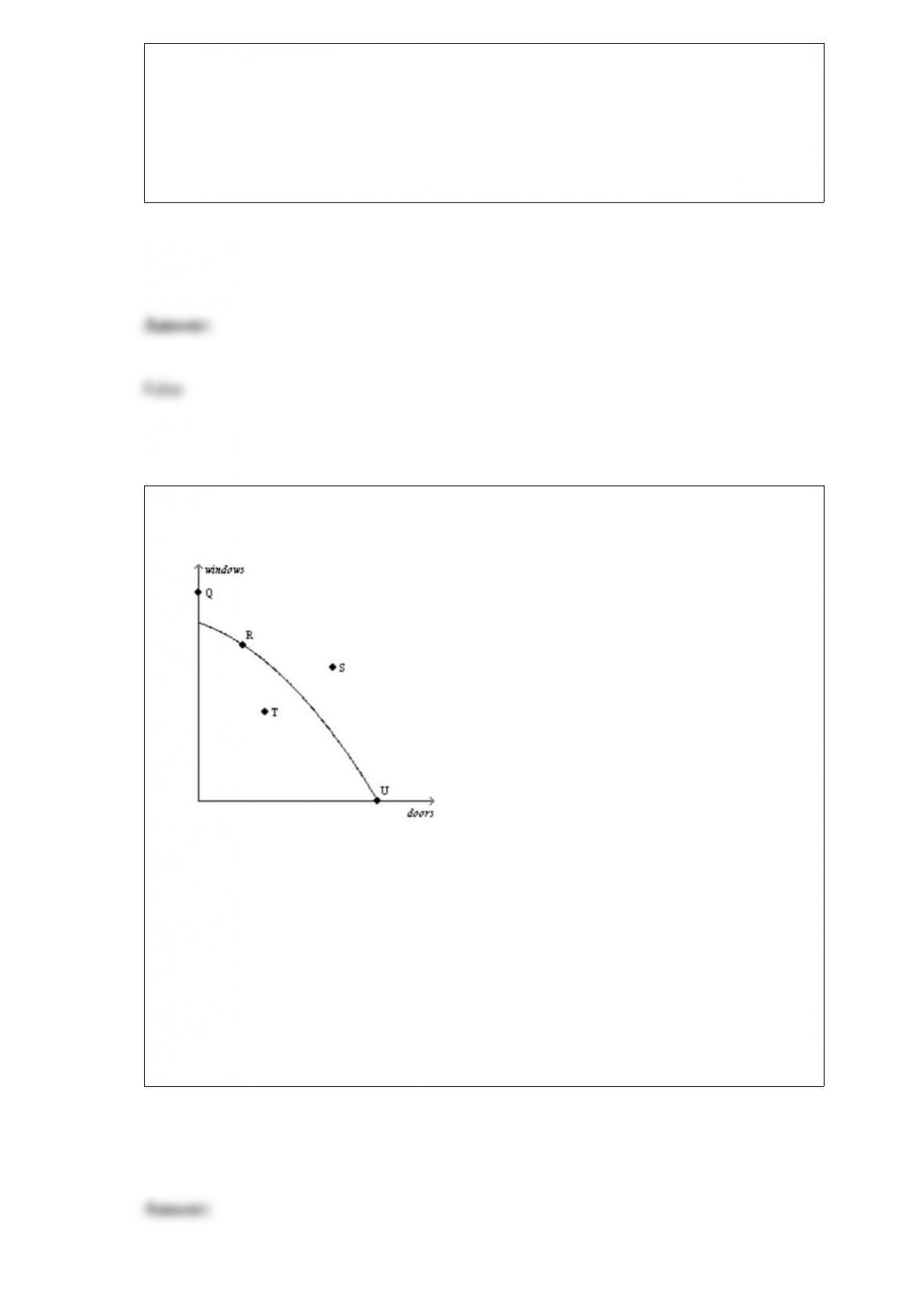
Figure 2-4
Refer to Figure2-4. At which point is this economy producing its maximum possible
quantity of doors?
a. R
b. S
c. T
d. U

Imagine an economy in which: (1) pieces of paper called dollarare the only thing that
buyers give to sellers when they buy goods and services, so it would be common to use,
say, 50 dollars to buy a pair of shoes; (2) prices are posted in terms of yardsticks, so you
might walk into a grocery store and see that, today, an apple is worth 2 yardsticks; and
(3) yardsticks disintegrate overnight, so no yardstick has any value for more than 24
hours. In this economy,
a. the yardstick is a medium of exchange but it cannot serve as a unit of account.
b. the yardstick is a unit of account but it cannot serve as a store of value.
c. the yardstick is a medium of exchange but it cannot serve as a store of value, and the
yollar is a unit of account.
d. the yollar is a unit of account, but it is not a medium of exchange and it is not a liquid
asset.
For an imaginary economy, the consumer price index was 80 in 2014, 100 in 2015, and
140 in 2016. Which of the following statements is correct?
a. If the basket of goods that is used to calculate the CPI cost $40 in 2014, then that
basket of goods cost $60 in 2015.
b. If the basket of goods that is used to calculate the CPI cost $25 in 2015, then that
basket of goods cost $35 in 2016.
c. The overall level of prices increased by 60 percent between 2014 and 2016.
d. All of the above are correct.

A problem that the Fed faces when it attempts to control the money supply is that
a. since the U.S. has a fractional-reserve banking system, the amount of money in the
economy depends in part on the behavior of depositors and bankers.
b. the Fed has to get the approval of the U.S. Treasury Department whenever it uses any
of its monetary policy tools.
c. while the Fed has the ability to change the money supply by a large amount, it does
not have the ability to change it by a small amount.
d. federal legislation in the 1950s stripped the Fed of its power to act as a lender of last
resort to banks.
Dale is a guitar teacher and Terrence is a tile layer. If Dale teaches Terrence’s daughter
to play the guitar in exchange for Terrence tiling Dale’s kitchen floor,
a. only Dale is made better off by trade.
b. only Terrence is made better off by trade.
c. both Dale and Terrence are made better off by trade.
d. neither Dale nor Terrence are made better off by trade.

Which of the following is an example of human capital?
a. the comfortable chair in your dorm room where you read economics texts
b. the amount you get paid each week to work at the library
c. the things you have learned this semester
d. any capital goods that require a human to be present to operate
If the price of a good has risen over time,
a. it must have become more scarce.
b. it must have become less scarce.
c. it has become more scarce only if the price adjusted for inflation has risen.
d. it has become less scarce only if the price adjusted for inflation has risen.
Rafael is the newlyappointed plant manager for a company that manufactures head
phones. Rafael’s senior supervisors told him that the output the firm produces, given the
number of workers employed, indicates that some workers may be shirking. According
to efficiency wage theory, what should he do?

a. pay all workers more than the equilibrium wage rate
b. pay all workers below the equilibrium wage rate to make up for the loss from
shirking
c. make sure that workers are getting paid exactly the equilibrium wage rate
d. fire the workers with the most seniority
In a simple circular-flow diagram, firms
a. purchase resources from households.
b. purchase the output produced by households.
c. receive income by selling resources to households.
d. All of the above are correct.
A national chain of grocery stores wants to finance the construction of several new
stores. The firm has limited internal funds, so it likely will
a. demand the required funds by buying bonds.
b. demand the required funds by selling bonds.
c. supply the required funds by buying bonds.

d. supply the required funds by selling bonds.
Each day Sue works 8 hours and produces 7 units of goods and services. Mary works
10 hours each day and produces 10 units of goods and services. It follows that
a. Sue’s productivity is higher than Mary’s.
b. Mary’s productivity is higher than Sue’s.
c. Sue’s income per hour will be higher than Mary’s.
d. Sue’s income per day will be higher than Mary’s.
If the supply of a product increases, then we would expect equilibrium price
a. to increase and equilibrium quantity to decrease.
b. to decrease and equilibrium quantity to increase.
c. and equilibrium quantity to both increase.
d. and equilibrium quantity to both decrease.

The consumer price index is subject to substitutiobiabecause
a. some pairs of goods are complements rather than substitutes.
b. some goods are inferior rather than normal.
c. the law of demand applies to most, if not all, goods.
d. the index does not take into account the likelihood that consumers substitute
newly-introduced goods for more- established goods.
Exchange rates are 100 yen per dollar, 0.8 euro per dollar, and 12 pesos per dollar. A
bottle of beer in New York costs 6 dollars, 500 yen in Tokyo, 6 euro in Munich, and 84
pesos in Cancun. Where is the most expensive and the cheapest beer, in that order?
a. Cancun, New York
b. Munich, Tokyo
c. Tokyo, Munich
d. New York, Cancun

Morgan, a financial advisor, has told her clients the following things. Which of her
statements is notcorrect?
a. “U.S. government bonds generally pay a higher rate of interest than corporate bonds.”
b. “The interest received on corporate bonds is taxable.”
c. “U.S. government bonds have the lowest default risk.”
d. “If you purchase a municipal bond, you can sell it before it matures.”
In the markets for the factors of production in the circular-flow diagram,
a. households are sellers and firms are buyers.
b. households are buyers and firms are sellers.
c. households and firms are both buyers.
d. households and firms are both sellers.
David Ricardo was the author of the 1817 book
PrinciplesofPoliticalEconomyandTaxation.
a. True

b. False
In the short run, an increase in the money supply is likely to lead to
a. lower unemployment and lower inflation.
b. lower unemployment and higher inflation.
c. higher unemployment and lower inflation.
d. higher unemployment and higher inflation.
Which of the following is correct concerning the open-economy macroeconomic
model?
a. The net-capital-outflow curve slopes upward.
b. The key determinant of net capital outflow is the real exchange rate.
c. The supply of dollars in the market for foreign-currency exchange is vertical.
d. None of the above is correct.

The Bureau of Labor Statistics computes labor-force participation rates for the entire
adult population and for more narrowly defined groups.
a. True
b. False
A species of snakes became extinct due to pollution in a river where the snakes once
lived. This is an example of
a. a market failure caused by an externality.
b. a market failure caused by market power.
c. a market failure caused by equality.
d. There is no market failure in this case.
Which of the following is notcorrect?

a. By saving a larger portion of its GDP, a country can raise its output per worker.
b. Savers supply their money to the financial system with the expectation that they will
get it back with interest at a later date.
c. Financial intermediaries are the only type of financial institution.
d. The financial system helps match people’s saving with other people’s borrowing.
Discouraged workers are people who want to work but have given up trying to find a
job after an unsuccessful search.
a. True
b. False
In the circular-flow diagram, which of the following items flows from households to
firms through the markets for goods and services?
a. goods and services
b. dollars paid to land, labor, and capital
c. dollars spent on goods and services
d. wages, rent, and profit

If a country has a higher level of productivity than another, then it also has a higher
level of real GDP.
a. True
b. False
Which of the following statements is correct?
a. NASDAQ is an important stock exchange in the United States.
b. The demand for a corporation’s stock is largely based on people’s perception of the
corporation’s profitability in the future.
c. Compared to the Standard & Poor’s 500 Index, the Dow Jones Industrial Average
incorporates the stock prices of a much smaller number of corporations.
d. All of the above are correct.

A balanced budget would require that when real GDP was growing rapidly,
a. the government raise taxes or cut expenditures. This would increase the magnitude of
economic fluctuations.
b. the government raise taxes or cut expenditures. This would decrease the magnitude
of economic fluctuations.
c. the government cut taxes or raise expenditures. This would increase the magnitude of
economic fluctuations.
d. the government cut taxes or raise expenditures. This would decrease the magnitude
of economic fluctuations.
When there is a reserve requirement, banks
a. must hold exactly the required quantity of reserves.
b. may hold more than, but not less than, the required quantity of reserves.
c. may hold less than, but not more than, the required quantity of reserves.
d. must seek the Fed’s permission whenever they wish to expand or contract their loans
to customers.
Diversification cannot reduce market risk.

a. True
b. False
Every week, the Bureau of Labor Statistics produces data on unemployment.
a. True
b. False
Policies that reduce the time it takes unemployed workers to find new jobs can reduce
the economy’s natural rate of unemployment.
a. True
b. False