
Congress has divided the authority to police mergers between the Antitrust Division of
the U.S. Department of Justice (AD) and the Federal Trade Commission (FTC). How is
this authority divided?
A) The AD decides whether proposed horizontal mergers will be challenged; the FTC
decides whether proposed vertical mergers will be challenged.
B) Both the AD and the FTC are responsible for merger policy.
C) The AD always renders its opinion on any proposed merger first. If the AD approves
the merger, the case then goes to the FTC for final approval. If the AD disallows the
merger, the decision stands and the FTC does not become involved.
D) The AD establishes the guidelines that are used to evaluate proposed mergers; the
FTC uses these guidelines to decide whether a proposed merger will be allowed to take
place.
If a perfectly competitive firm’s price is less than its average total cost but greater than
its average variable cost, the firm
A) is earning a profit.
B) should shut down.
C) is incurring a loss.
D) is breaking even.
A one-time tax rebate, which is not expected to be extended in future years, will

A) have a small positive effect on consumption and aggregate demand.
B) have no effect on consumption and aggregate demand.
C) have a significant positive effect on consumption and aggregate demand, with
aggregate demand growing by a multiple of the tax rebate.
D) increase aggregate supply and aggregate demand.
A Federal Reserve publication proclaimed that “Trade is a win-win situation for all
countries that participate.” This statement is
A) false since it ignores the workers who lose their jobs as result of international trade.
B) false since not all countries participate in international trade.
C) true because it refers to countries; individuals may be losers as a result of
international trade.
D) true because all consumers and workers benefit from international trade.
The expansionary monetary and fiscal policies of the 1960s resulted in
A) high inflation rates and high rates of unemployment.
B) low inflation rates and low rates of unemployment.
C) low inflation rates and high rates of unemployment.
D) high inflation rates and low rates of unemployment.

Which of the following factors has significantly increased the supply of labor in the
United States since 1950?
A) a large increase in the substitution effect as a result of higher wages
B) a low birth rate and an aging population
C) an increase in the number of people who have received college degrees
D) an increase in the labor force participation rate of women
The Bretton Woods exchange rate system was a
A) floating exchange rate system.
B) managed float exchange rate system.
C) fixed exchange rate system.
D) flexible exchange rate system.

Which of the following is one of the most important benefits of money in an economy?
A) Money allows for the exchange of goods and services.
B) Money allows for the accumulation of wealth.
C) Money makes exchange easier, leading to more specialization and higher
productivity.
D) Money encourages people to produce all of their own goods (self-sufficiency) and
therefore increases economic stability.
If the price of toothpaste is represented by equation P = 40 – .5QD, then the
corresponding quantity of toothpaste demanded is represented by the equation
A) QD = 20 – .5P.
B) QD = 40 – P.
C) QD = 80 – 2P.
D) QD = -20 + P.
Figure 2-11
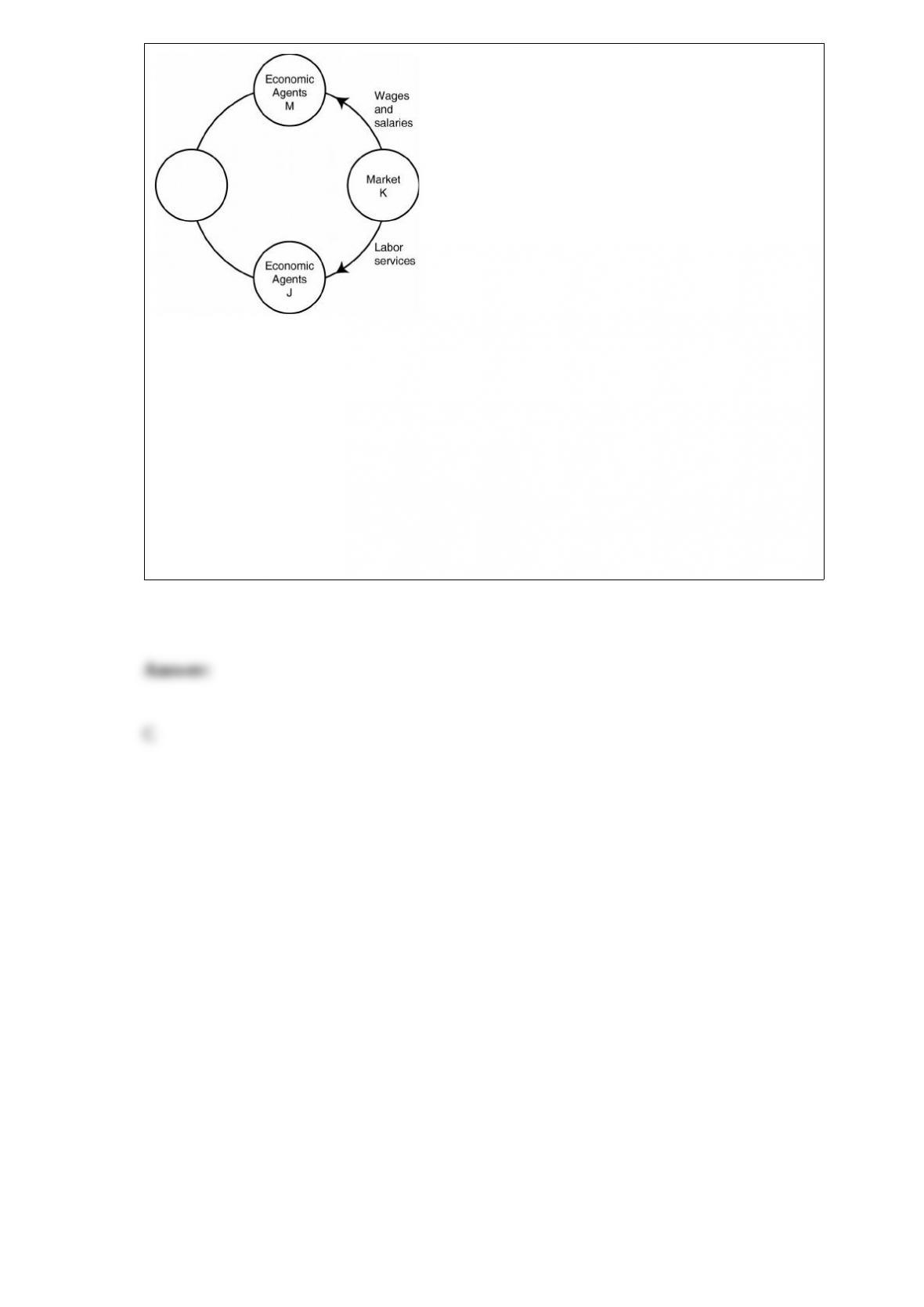
One segment of the circular flow diagram in the figure shows the flow of labor services
from market K to economic agents J. What is market K and who are economic agents J?
A) K = factor markets; J = households
B) K = product markets; J = households
C) K = factor markets; J = firms
D) K = product markets; J = firms