
1) there is virtually universal agreement among economists that foreign direct
investment in the united states has reduced the economic welfare of the average u.s.
citizen.
a.true
b.false
2) appreciation of the dollar’s exchange value worsens the international competitiveness
of boeing inc., whereas a dollar depreciation improves its international competitiveness.
a.true
b.false
3) which of the following refers to a market-sharing pact negotiated by trading partners
to moderate the intensity of international competition?
a.orderly marketing agreement
b.local content requirements
c.import quota
d.trigger price mechanism
4) a cartel tends to be most successful in maximizing the profits of its members when
there are a large number of producers in the cartel and these producers’ cost and demand
conditions greatly differ from each other.
a.true
b.false
5) in u.s. trade law, section 301 cases involve accusations of:
a.international dumping by u.s. companies
b.full-cost pricing by u.s. companies
c.unfair trade practices by foreign nations
d.trade embargoes by foreign nations
6) the high point of u.s. protectionism occurred with the passage of the kennedy act in
the 1960s.
a.true
b.false
7) the central bank of the united kingdom could prevent the pound from appreciating
by:
a.selling pounds on the foreign exchange market
b.buying pounds on the foreign exchange market
c.reducing its inflation rate relative to its trading partners
d.promoting domestic investment and technological development
8) according to the keynesian income-adjustment mechanism, income differentials
among nations guarantee current-account equilibrium in a world of fixed exchange
rates.
a.true
b.false
9) in figure 2.4 the marginal rate of transformation of wheat into autos is
a.one and two-thirds
b.two and one-third
c.three fifths
d.three sevenths
10) given the foreign currency market for the swiss franc, the supply of francs slopes
upward, because as the dollar price of the franc rises:
a.america’s demand for swiss merchandise rises
b.america’s demand for swiss merchandise falls
c.switzerland’s demand for american merchandise rises
d.switzerland’s demand for american merchandise falls
11) the north american free trade agreement was expected to benefit ____ the most.
a.canada
b.mexico
c.greenland
d.united states
12) in the early 1980s, the federal reserve pursued a tight monetary policy. all else being
equal, the impact of that policy was to ____ interest rates in the united states relative to
those in europe and cause the dollar to ____ against european currencies.
a.decrease, depreciate
b.decrease, appreciate
c.increase, depreciate
d.increase, appreciate
13) if canada experiences increasing opportunity costs, its supply schedule of steel will
be:
a.downward-sloping
b.upward-sloping
c.horizontal
d.vertical
14) by reducing available supplies of a product, an export embargo leads to falling
prices in the target nation and increasing target-nation consumer surplus.
a.true
b.false
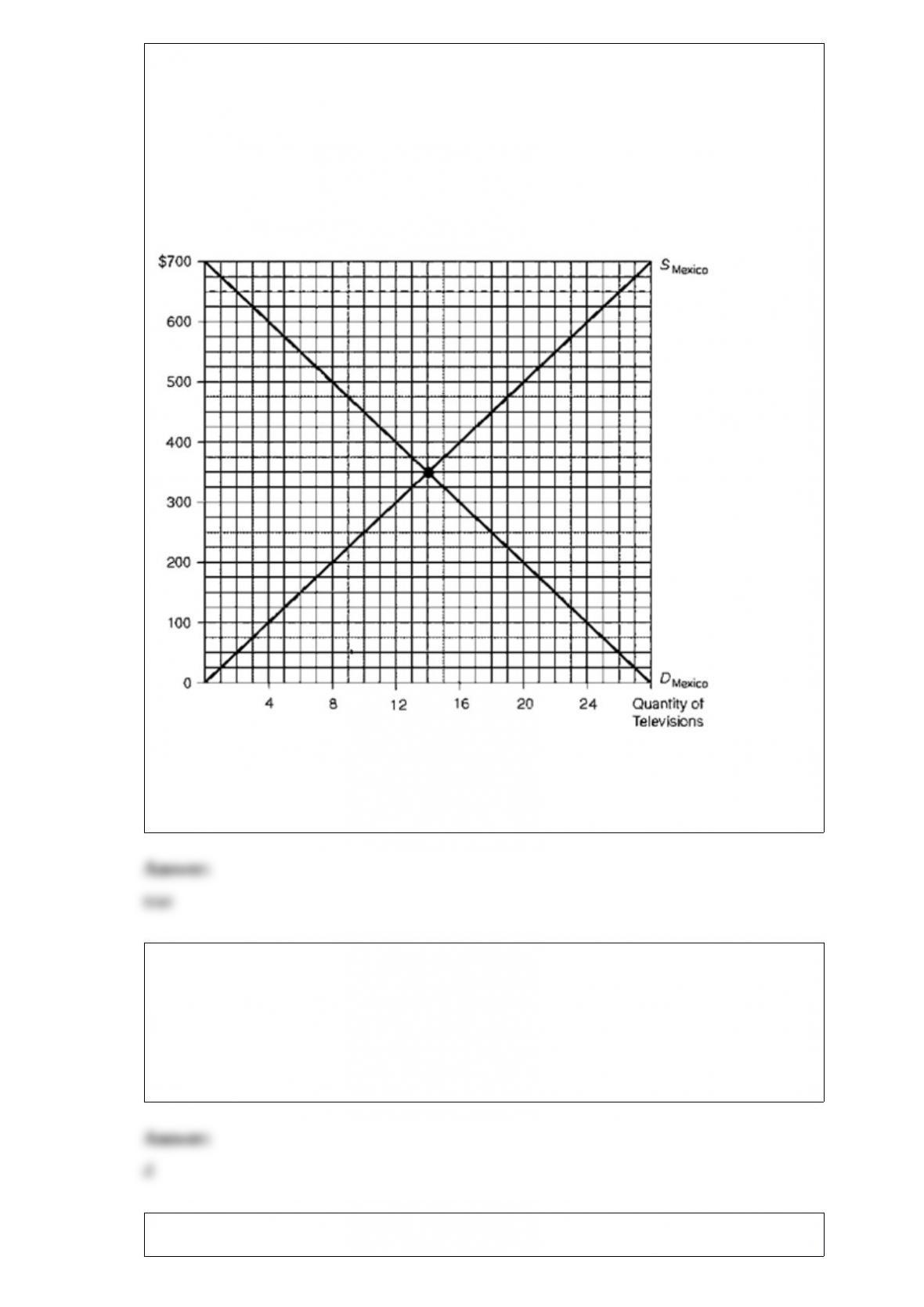
15) figure 5.5 illustrates the television market for mexico, assumed to be a small
country that is unable to affect the world price. smexico is the domestic supply schedule
and dmexico is the domestic demand schedule. suppose that japan can supply
televisions to mexico at a price of $100 per set.
figure 5.5. mexico’s television market
consider figure 5.5. compared to free trade, the japanese export quota leads to an
increase in mexican producer surplus of $1050.
a.true
b.false
16) small nations (e.g., tanzania) with more than one major trading partner tend to peg
the value of their currencies to:
a.gold
b.silver
c.a single currency
d.a basket of currencies
17) international joint ventures can lead to welfare losses when the newly established

firm:
a.adds to the preexistent productive capacity
b.enters markets neither parent could have entered individually
c.yields cost reductions unavailable to parent firms
d.gives rise to increased amounts of market power
18) suppose the united states and japan enter into a voluntary export agreement in
which japan imposes an export quota on its automakers. the largest share of the export
quota’s “revenue effect” would tend to be captured by:
a.the u.s. government
b.japanese automakers
c.american auto consumers
d.american autoworkers
19) the export-import bank of the united states encourages american firms to sell
overseas by providing direct loans and loan guarantees to foreign purchasers of
american goods. to american firms, this represents a:
a.specific subsidy
b.ad valorem subsidy
c.domestic subsidy
d.export subsidy
20) figure 5.3 illustrates the apple market for sweden, assumed to be a ‘small” country
that is unable to affect the world price. ssweden is the domestic supply and dsweden is
the domestic demand. ssweden+quota is sweden’s supply schedule with an import
quota.
figure 5.3. sweden’s apple market
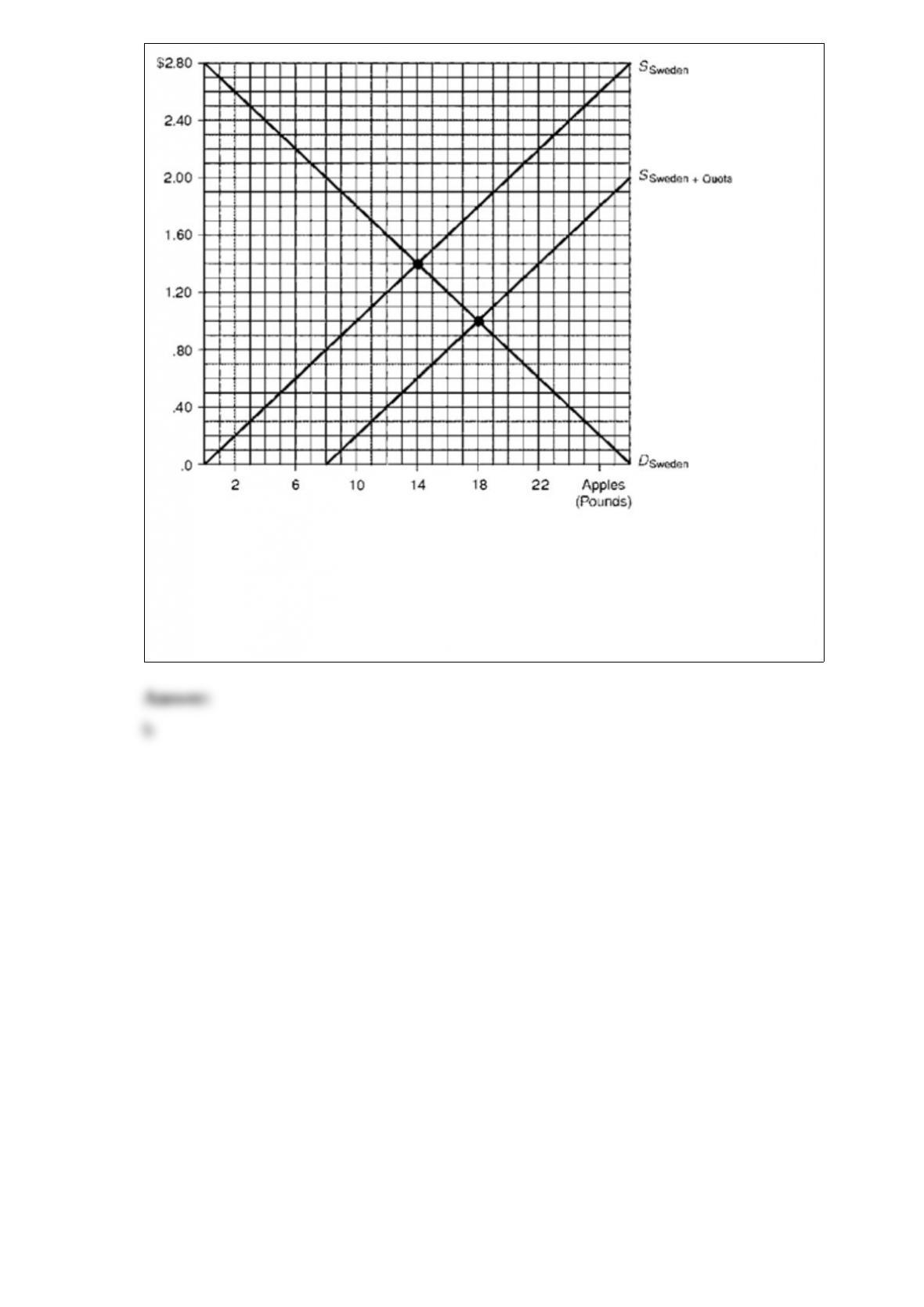
consider figure 5.3. if ssweden+quota represents the supply schedule after a quota is
levied, sweden’s imports will equal:
a.6 apples
b.8 apples
c.10 apples
d.12 apples