
In a simple circular flow model of an economy
a. households buy factors of production from businesses.
b. the flow of income to households from businesses is greater than the flow of
expenditures by households for goods produced by businesses.
c. businesses buy final goods and services produced by households.
d. the total amount of labor hours worked equals the total number of goods produced.
e. households are owners of resources and purchasers of final goods and services.
Perfectly competitive firms have zero economic profits in the long run because
a. they all produce slightly different products.
b. of nonprice competition.
c. of freedom of entry and exit.
d. of the outgrowth of advertising expenditures.
e. of the law of diminishing marginal utility.
Firms that become monopolies because their operating systems and design standards
gain widespread adoption are monopolies because of

a. control over basic inputs.
b. government action.
c. network effects.
d. economies of scale.
e. product differentiation.
The main reason for the current trend toward a growing spirit of cooperation between
unions and management is
a. that there is significant union presence on corporate boards of directors.
b. that about half of all American workers now belong to unions, so management is
more inclined to listen.
c. the lack of urgency in meeting demands, since most workers now enjoy comfortable
wages and working conditions.
d. a desire to survive in a highly competitive economy under increasing pressure from
foreign competition.
e. the passage of new federal labor laws that now require cooperation under threat of
federal intervention.
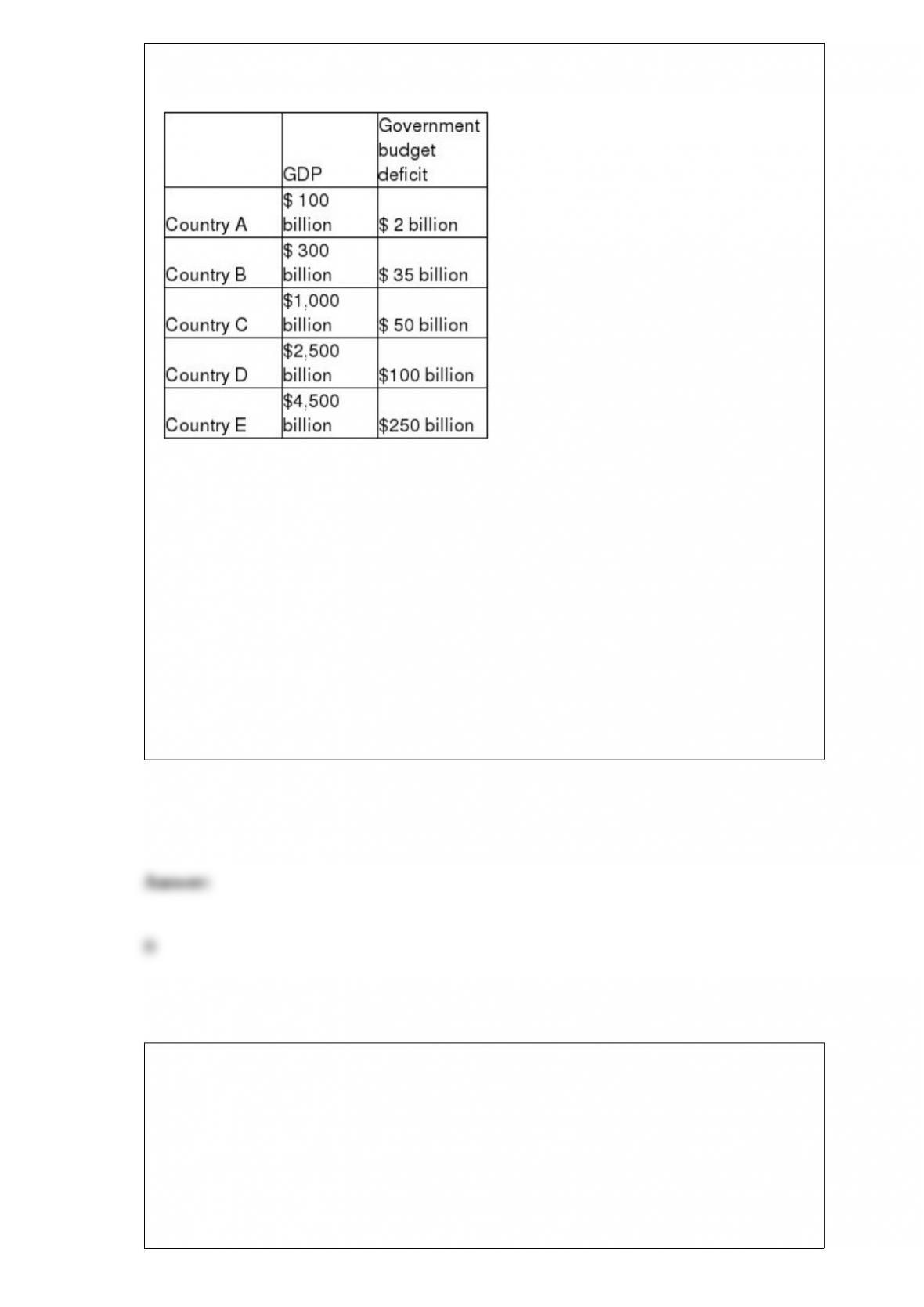
Which of the following countries in the table above has the most burdensome budget
deficit?
a. Country A
b. Country B
c. Country C
d. Country D
e. Country E
One way the government can reduce the financial burden to firms that install pollution
control equipment is to use
a. tax credits.
b. effluent fees.
c. direct regulation.

d. price controls.
e. quotas.
Which of the following is a principal determinant of the market supply curve?
a. consumer preferences
b. the level of input prices
c. the price elasticity of demand
d. the number of buyers in the market
e. the level of expenditures in the market
When price exceeds marginal cost
a. the market structure is perfectly competitive.
b. resources are optimally allocated from society’s point of view.
c. too much output is being produced, resulting in losses to businesses.
d. a 1-unit increase in output increases the social value of output by more than the social
costs of production.

e. the costs of production are greater than the demand.
The Employment Act of 1946
a. reduced tax rates 10 percent across the board.
b. established the Joint Economic Committee of Congress and the Council of Economic
Advisers.
c. made it a matter of government policy to promote a favorable balance of trade.
d. created automatic stabilizers to replace discretionary fiscal policy.
e. requires the government to undertake spending on public works to ensure full
employment.
The long-run equilibrium price charged by the monopolistic competitor
a. tends to equal marginal cost.
b. tends toward average cost.
c. is the same for all variants of a product within a product group.
d. is generally lower than the perfectly competitive price.

e. is expected to be higher than that of the monopolist.
The concept that people should be taxed so as to result in a socially desirable
redistribution of income is known as the ________ principle.
a. benefit
b. ethical
c. ability-to-pay
d. confiscatory-tax
e. tax reform
Economists criticize wage rates set on the basis of comparable worth because they
a. promote efficiency at the expense of equity.
b. ignore the effect of such important job characteristics as accountability, knowledge
and skills, mental demands, and working conditions.
c. generate surplus value that accrues to the owner rather than the employed.
d. establish wage rates that do not reflect market demand and supply conditions.
e. relate only to government employees and not all workers.

The following questions are based on the following changes in the balance sheet of
Nowhere National Bank.
Assets Liabilities
a. Reserves No change Demand deposits $8,000
Loans and investments $8,000
Total $8,000 Total $8,000
b. Reserves $2,000 Demand deposits $10,000
Loans and investments $8,000
Total $10,000 Total $10,000
c. Reserves $10,000 Demand deposits $10,000
Loans and investments No change
Total $10,000 Total $10,000
d. Reserves “$8,000 Demand deposits “$8,000
Loans and investments No change
Total “$8,000 Total “$8,000
e. Reserves $10,000 Demand deposits No change
Loans and investments $10,000
Total $20,000 Total No change
Which letter best indicates the change in the balance sheet after the proceeds of the loan
have been spent by the borrower?
a. a

b. b
c. c
d. d
e. e
The trend toward a decline in the rate of inflation since the middle to late 1980s has
been generally attributed to
a. higher prices abroad, leading to a reduction in our imports.
b. the growth in manufacturing employment relative to employment in services.
c. an increase in tariffs to keep out foreign goods.
d. the monetary policy pursued by the Fed.
e. expansionary fiscal programs undertaken by Presidents Bush and Clinton.
The Golden Rule of Output Determination is, in fact, the same for both a monopolist
and a perfectly competitive firm because
a. price is equal to marginal cost for both market types.
b. price and marginal revenue are identical for a perfectly competitive firm.

c. price exceeds marginal revenue for both market types.
d. profits are maximized for both firm types as long as marginal revenue exceeds
marginal cost.
e. marginal revenue and marginal cost curves are identical for both market types.
Which of the following categories of federal government expenditures are ranked
correctly in order of their importance?
a. income security, Social Security, interest, health, national defense
b. Social Security, national defense, income security, Medicare, health
c. transportation, health, interest, national defense, veterans’ benefits
d. interest, health, national defense, agriculture, energy
e. national defense, Medicare, education, Social Security, general government
An oligopolistic market is one with
a. firms having no power over price.
b. few sellers.

c. few buyers.
d. several monopolists operating simultaneously.
e. product groups.
An unfavorable supply shock
a. shifts aggregate demand to the right.
b. shifts aggregate supply to the right.
c. shifts aggregate demand to the left.
d. shifts aggregate supply to the left.
e. has no effect on either aggregate supply or aggregate demand, only on the quantities
supplied and demanded.
In general, supply curves slope upward to the right because
a. increases in the price of a commodity lead to rightward shifts of the supply curve.
b. rising prices motivate producers to offer more units for sale.
c. technology progresses over time, increasing the ability of firms to produce more at
existing prices.

d. of increases in input prices as production is increased.
e. empirical studies almost always show that this is the case.
A country that can produce a unit of some good with less resources than another
country is considered with respect to the other country to possess a(n) ________
advantage.
a. strategic
b. absolute
c. limited
d. bilateral
e. selective
The dire predictions of the 1974 Club of Rome’s The Limits of Growth report are in part
discredited because
a. the United States’ mineral resources are infinite in supply.
b. growing populations do not consume resources at higher rates.
c. the U.S. economy has significantly reduced its overall consumption of resources

because of its affluence.
d. as minerals become scarce and increase in price, it becomes cost effective for users to
find substitutes.
e. they assumed the developing countries would industrialize more rapidly than they
have.
The EPA has estimated that it would cost $60 billion to remove 85 to 90 percent of
water pollutants from industrial and municipal sources, but a zero discharge of
pollutants would cost about $320 billion. This suggests that
a. pollution control costs increase at an increasing rate as the level of pollution desired
is lowered.
b. the costs of pollution remain the same as the environment becomes more polluted.
c. achieving a zero level of pollution is not very costly compared with the benefits of
clean water.
d. the costs of pollution to society rise as the levels of pollution decline.
e. society is better off if it makes only minimal efforts to control the level of pollution.
The monetarist view gained adherents in the late 1960s because
a. of the obvious difficulty in using fiscal policy to restrain spending.
b. the 1968 surtax was effective in reducing inflation.
c. it was demonstrated empirically that MV = PQ.
d. at the time the U.S. economy was stagnant.
e. Keynesians and monetarists finally agreed on the line of causation between the
money supply and GDP.
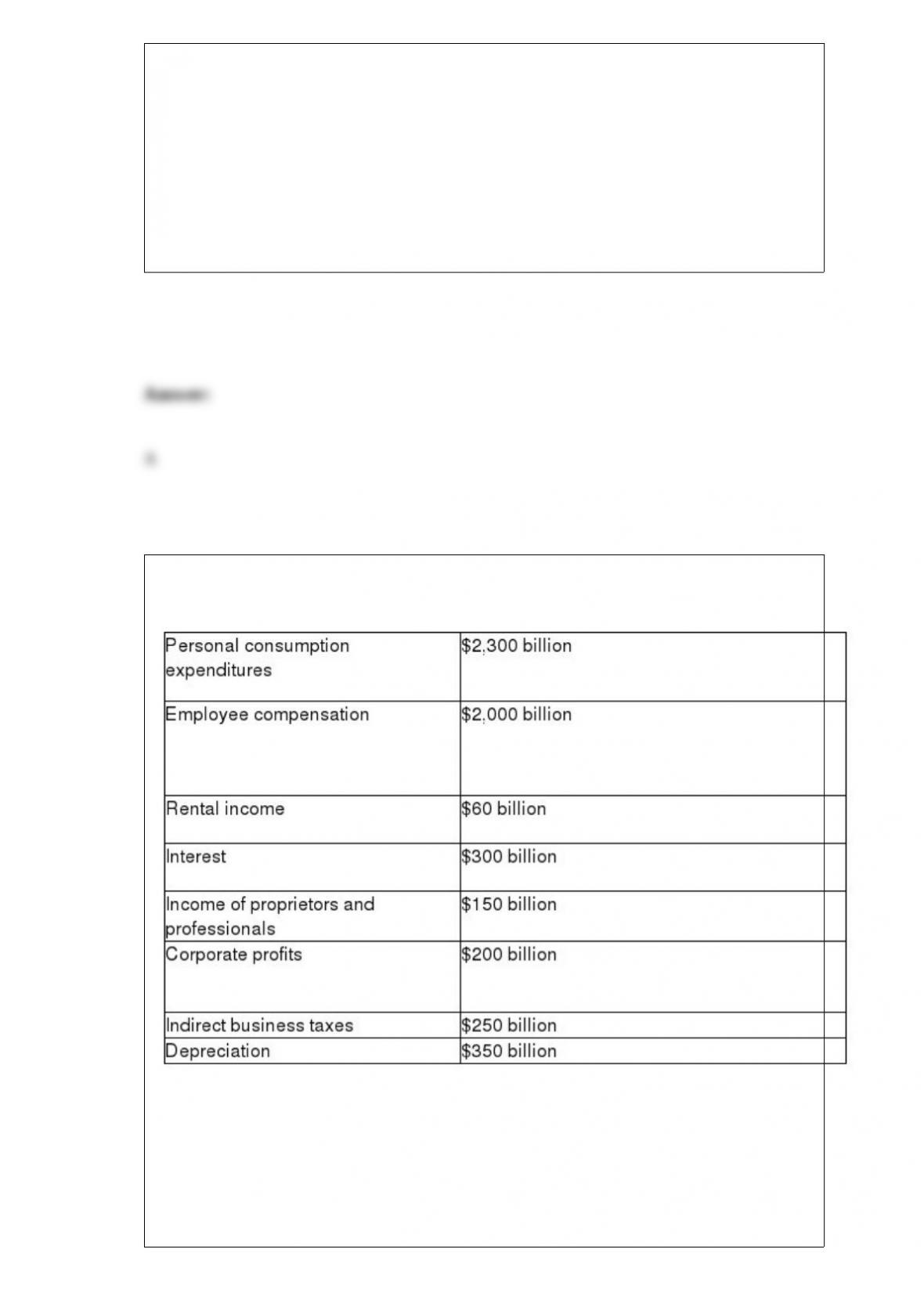
The next question is based on the following information:
The largest income component of U.S. GDP is
a. corporate profits.
b. rental and interest income.

c. employee compensation.
d. personal and corporate taxes.
e. welfare payments.
For this firm profits are maximized at an output rate of
a. 0Q.
b. 0P.
c. 0W.
d. 0U.
e. 0V.
New residents moving into a growing community increase the
a. size of housing.
b. elegance of housing.
c. housing surplus.
d. quantity demanded of housing.

e. demand for housing.
Short-run costs that increase and decrease as an output increases or decreases are called
________ costs.
a. variable
b. secondary
c. derived
d. partial
e. potential
The table below shows the net effect of an open market operation undertaken by the
Fed. Use it to answer the following question.
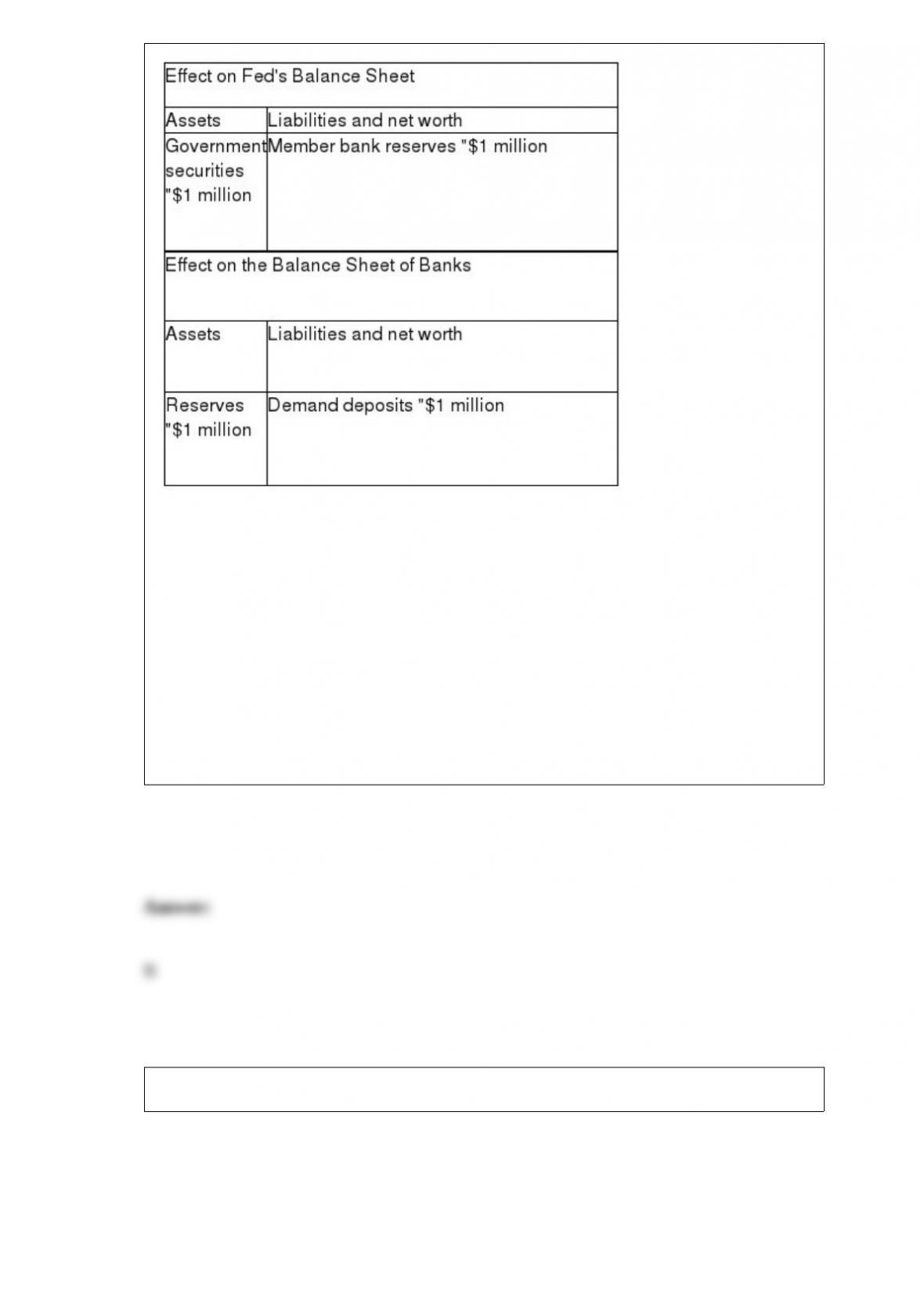
The Fed has
a. increased bank reserves, thereby decreasing the supply of money.
b. sold government securities, thereby decreasing the supply of money.
c. sold government securities, thereby increasing the supply of money.
d. increased the national debt.
e. purchased government securities, thereby increasing the supply of money.
The following questions are based on the following table:
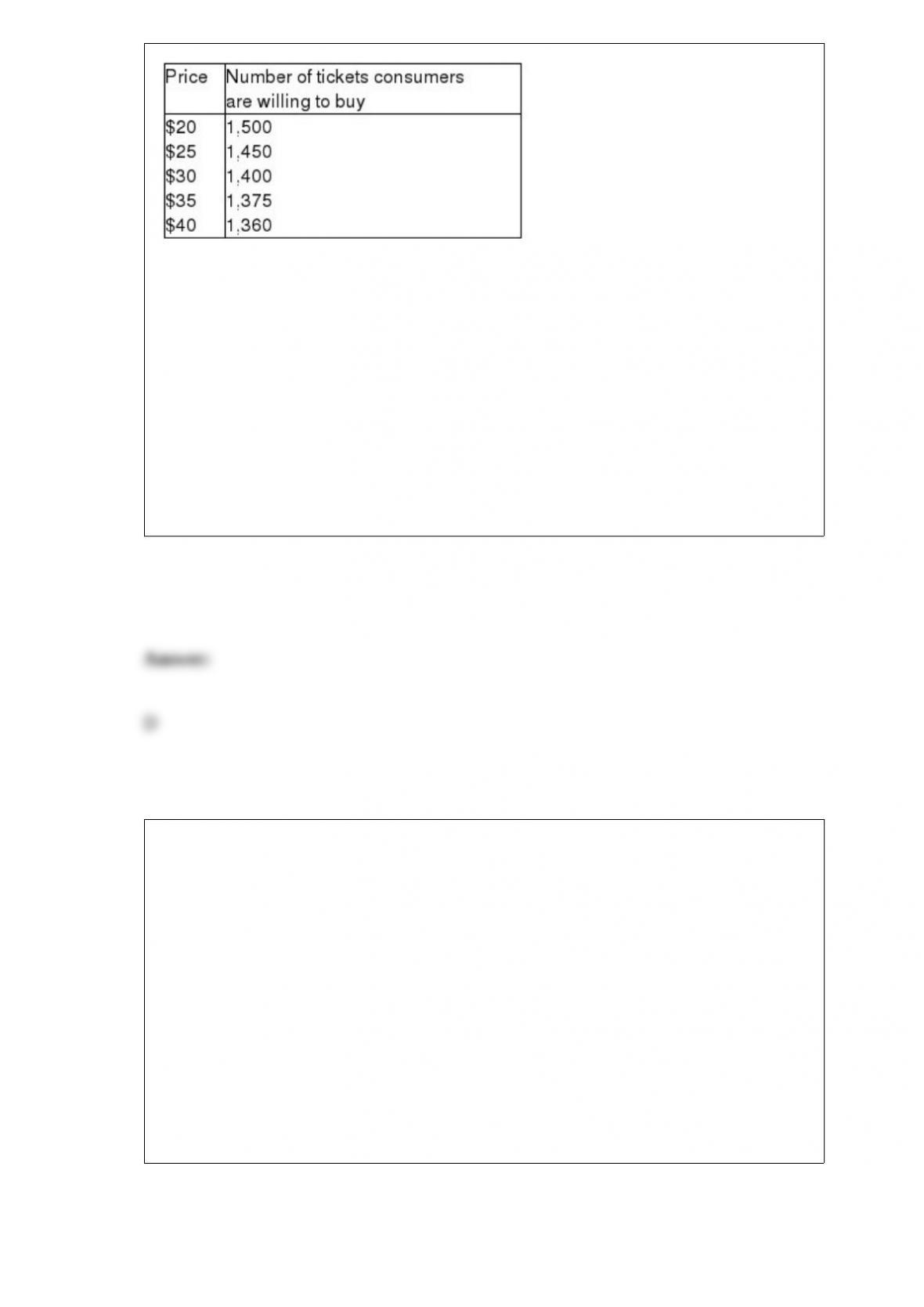
If 1,375 seats were available at any particular time, the equilibrium price would be
a. $20.
b. $25.
c. $30.
d. $35.
e. $40.
Government services are valued in GDP at cost rather than at their market prices
because
a. price changes occur frequently as a result of inflation, which distorts the
measurement of GDP.
b. it is necessary to avoid counting intermediate goods in GDP.
c. otherwise government and private transfer payments would end up being counted in
GDP.
d. most government services produced are not purchased by their users.
e. the price of a service is not always a measure of the worth of a service.

The exchange rate system that provides an automatic balance-of-payments adjustment
regardless of domestic economic policies is best described as
a. fixed.
b. flexible.
c. indexed.
d. pegged.
e. the gold exchange.