
One of the reasons that pollution problems are as large as they are is that
a. markets let individuals and firms deplete valuable resources without charging money
for doing so.
b. markets are incapable of incorporating valuable resources such as air and pure water.
c. governments use resources without paying for them the way that individuals and
firms must.
d. markets are not an efficient means to address scarcity.
Hot dogs and hot dog buns are found to be related by the cross elasticity of demand. If
they are complementary goods, the cross elasticity will be
a. positive.
b. equal to zero.
c. negative.
d. unknown.
The net worth of a bank
a. determines the level of bank loans possible.

b. is determined by subtracting liabilities from assets.
c. is determined by subtracting assets from liabilities.
d. can never be a negative value.
If a farmer’s opportunity cost of producing 10,000 bushels of wheat is 5,000 fewer
bushels of soybeans, then her opportunity cost of producing 5,000 bushels of soybeans
must be 10,000 fewer bushels of wheat.
a. True
b. False
A recession is a period of time in which the total output of the economy rises.
a. True
b. False

Net utility is
a. equal to total utility from the quantity acquired of a good minus the utility lost by
having to pay for it.
b. equal to the sum of the marginal utilities.
c. equal to an optimal number easily calculated by the consumer.
d. always greater than total utility.
Total profit is represented by the vertical distance between a total revenue curve and a
total cost curve.
a. True
b. False
Figure 4-3
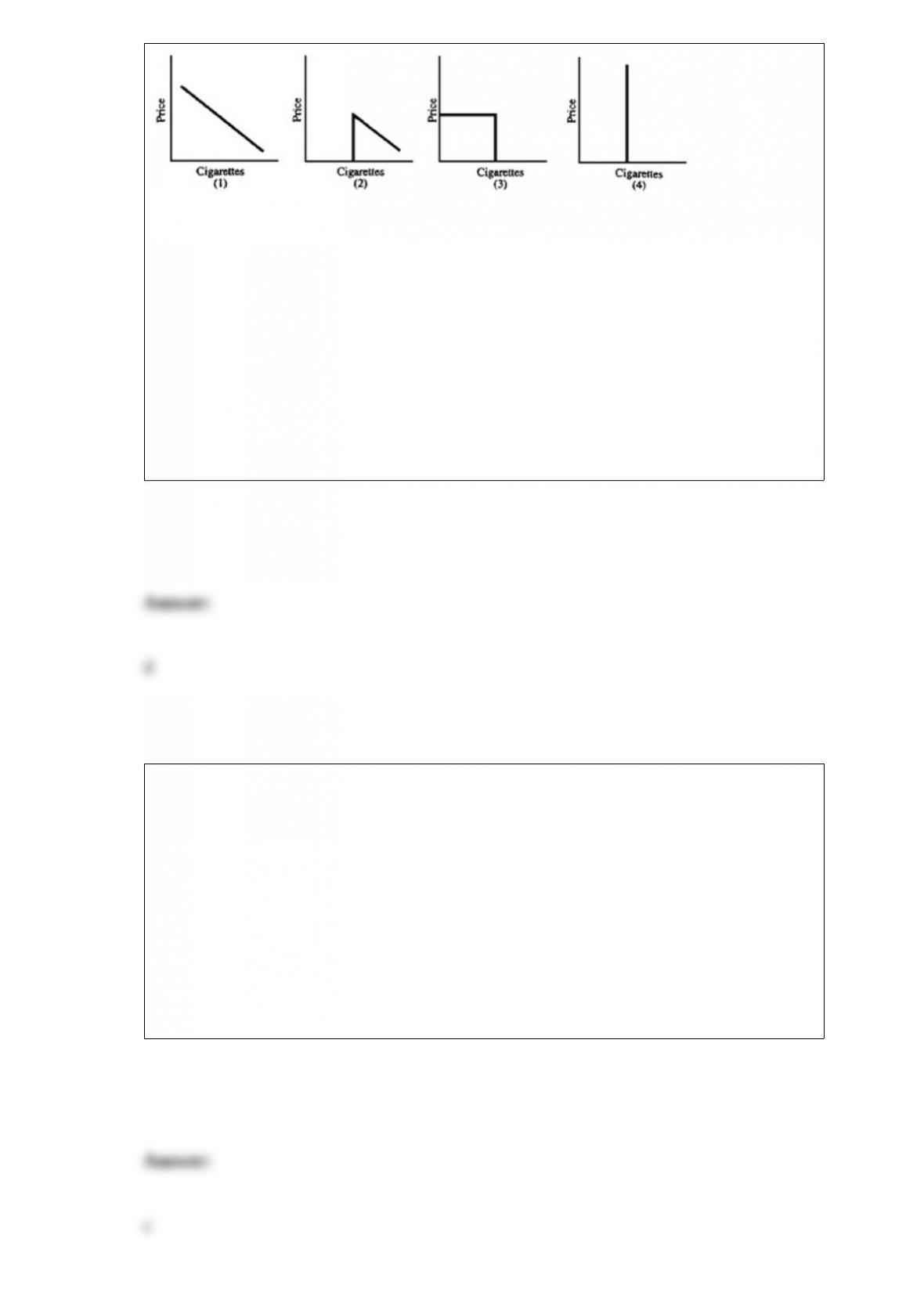
A 1985 Harvard study showed that the price of cigarettes does not affect how much an
individual smokes but whether he smokes. If this is correct, which graph in Figure 4-3
shows the typical individual’s demand curve for cigarettes?
a. 1
b. 2
c. 3
d. 4
The divergence between money costs and opportunity costs will be greatest in which of
the following situations?
a. A university purchases 100 computers.
b. A university employs people from town in the commissary (people prefer this job to
working in the paper factory).
c. A university employs otherwise unemployed teenagers to paint crosswalks and curbs.
d. A university replaces the roof of the fine arts building.

If consumers receive an increase in income of $1,000, their spending will increase by a
smaller amount.
a. True
b. False
Which of the following was a lesson from the 2007-2009 financial crisis?
a. The financial system needed more leverage in order to operate.
b. The job of stabilizing the economy should be assigned exclusively to monetary
policy.
c. Monetary policy is finished once the Fed reduces the federal funds rate to zero.
d. The business cycle still exists.
The shortened work week coupled with rising hourly wages in the U.S. economy shows
that
a. the income effect has been dominant.
b. the substitution effect does not exist at all.

c. the U.S. worker is no longer productive.
d. workers have become increasingly lazy.
An increase in the reserve supply
a. will result in inflation if the unemployment rate is high.
b. causes interest rates to rise.
c. shifts the aggregate demand curve inward.
d. will probably cause inflation if the economy is at potential GDP.
Direct taxes are levied on specific economic activities.
a. True
b. False

Average physical product measures the output per unit of input.
a. True
b. False
During periods of U.S. prosperity,
a. imports from other countries are undesirable
b. imports from other countries are sought out
c. countries importing goods to the U.S. may use their earnings to buy American goods
d. countries importing goods to the U.S. are unable to buy American goods
Once a firm has selected a price for its product, quantity is decided by consumers and
their demand curves.
a. True
b. False
Cross-elasticity of demand could be used to measure the responsiveness of the quantity
demanded of swimming pools to a change in the price of picnic tables.
a. True
b. False
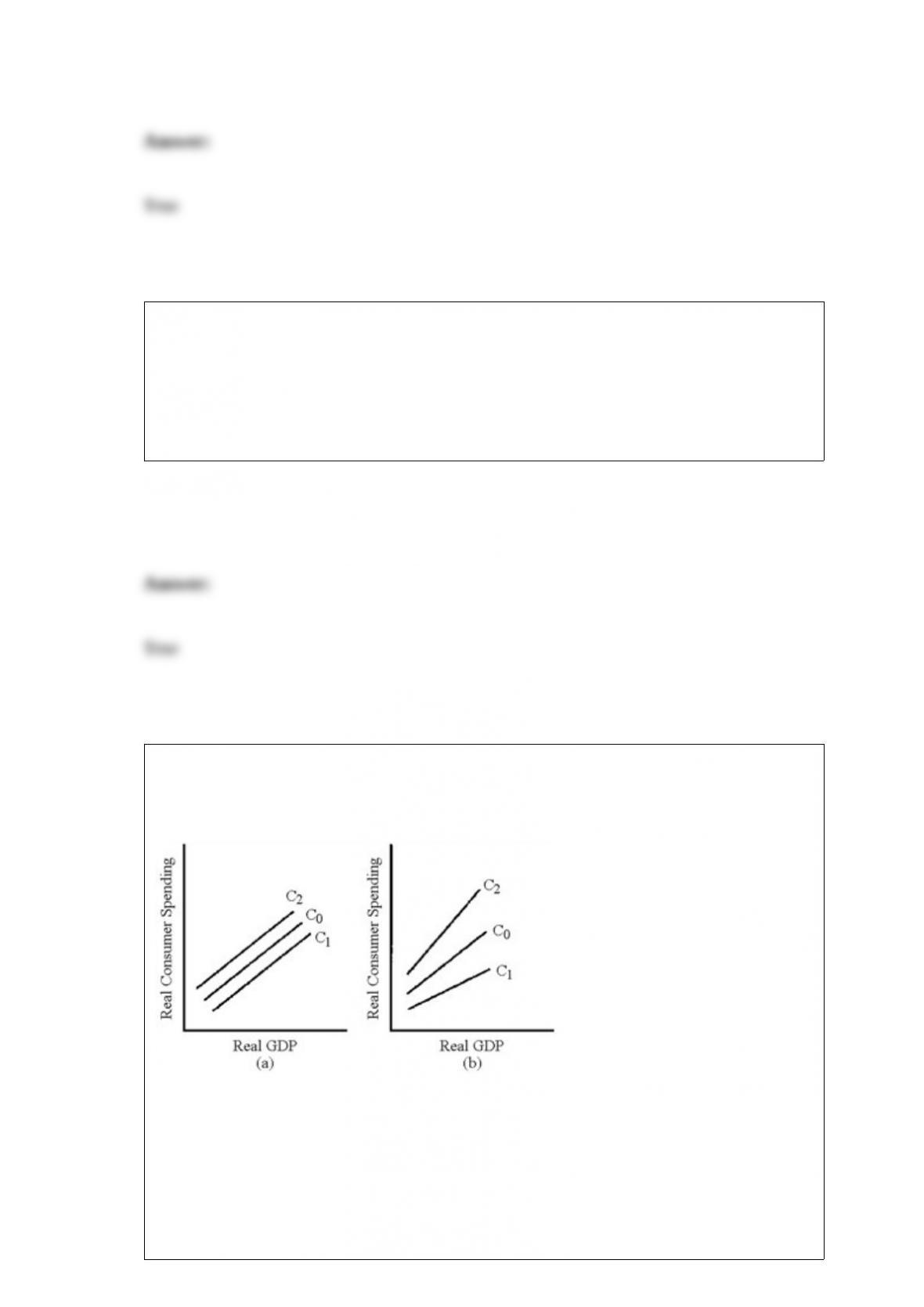
Figure 11-3
In Figure 11-3, which line represents the change in the consumption schedule caused by
a cut in fixed taxes?
a. C1 in graph (a)
b. C2 in graph (a)

c. C1 in graph (b)
d. C2 in graph (b)
Game theory may be used to solve problems of interdependent decision making by
large firms.
a. True
b. False
Monetizing the debt has what effect on the economy?
a. slow increase in AS with steady inflation
b. rapid increase in AD with an increase in inflation
c. rapid increase in AS with a drop in inflation
d. decrease in AD with an increase in inflation

According to the data on real U.S. GDP,
a. economic growth has been irregular, with periodic downturns.
b. economic growth has been consistent, with few downturns.
c. economic growth has been extremely rapid, but with major collapses.
d. economic growth has been elusive, but downturns have been eliminated.
In the contemporary United States, labor productivity has been growing at
approximately
a. 1.5 percent per year
b. 2.0 percent per year.
c. 2.6 percent per year.
d. 3.9 percent per year.

A market
a. may be an organized exchange.
b. refers to a set of sellers and buyers whose actions affect a commodity’s price.
c. is that area in which buyers and sellers compete to affect a product price.
d. All of the above are correct.
When economies of scale are present,
a. costs per unit decline as output expands.
b. the government feels responsible for breaking up the firm.
c. firms always make handsome profits.
d. costs fall as the size of the product is increased.
The crowding-out effect of higher interest rates can be avoided by
a. expansionary monetary policy.
b. expansionary fiscal policy.
c. contractionary monetary policy.

d. decreasing taxes.
The distinction between real and nominal rates of interest is understood by
a. most public policy makers.
b. the majority of the American population.
c. a majority of legislators.
d. relatively few Americans.
The relationship between money growth rates and inflation between 1982 and 2010
helps explain why, by the 1990s, most economists had
a. adopted the monetarist explanation of inflation.
b. adopted a rules-only approach to monetary policy.
c. become more convinced of the monetary causes of inflation.
d. abandoned monetarism as the primary explanation of inflation.

Which of the following phrases indicates that income is being spoken of?
a. Tuesday, at 12:30 p.m.
b. July 14, 1948
c. from January 1 to March 30
d. yesterday afternoon
Which of the following is the injection into the circular flow model?
a. Money deposited in a savings account.
b. Income earned through exports.
c. Goods imported from abroad.
d. Taxes paid by the individuals.

The majority of American workers are employed in the manufacturing sector.
a. True
b. False