
To what do economists attribute the rapid growth of labor productivity in the United
States relative to other countries?
A) the flexibility of U.S. labor markets and the efficiency of the U.S. financial system
B) the strict government rules in the United States that regulate a firm’s ability to hire
and fire workers
C) the low rate of job mobility in the United States
D) the high level of unemployment benefits the United States pays relative to other
countries like Canada
A budget constraint
A) represents the bundles of consumption that make a consumer equally happy.
B) refers to the limited amount of income available to consumers to spend on good and
services.
C) reflects the desire by consumers to increase their income.
D) shows the prices that a consumer chooses to pay for products he consumes.
Over the past twenty years, the number of small family farms has fallen significantly
and in their place there are fewer, but larger, farms owned by corporations. Which of
the following best explains this trend?
A) diseconomies of scale in farming
B) economies of scale in farming
C) diminishing returns to labor in farming
D) declining productivity
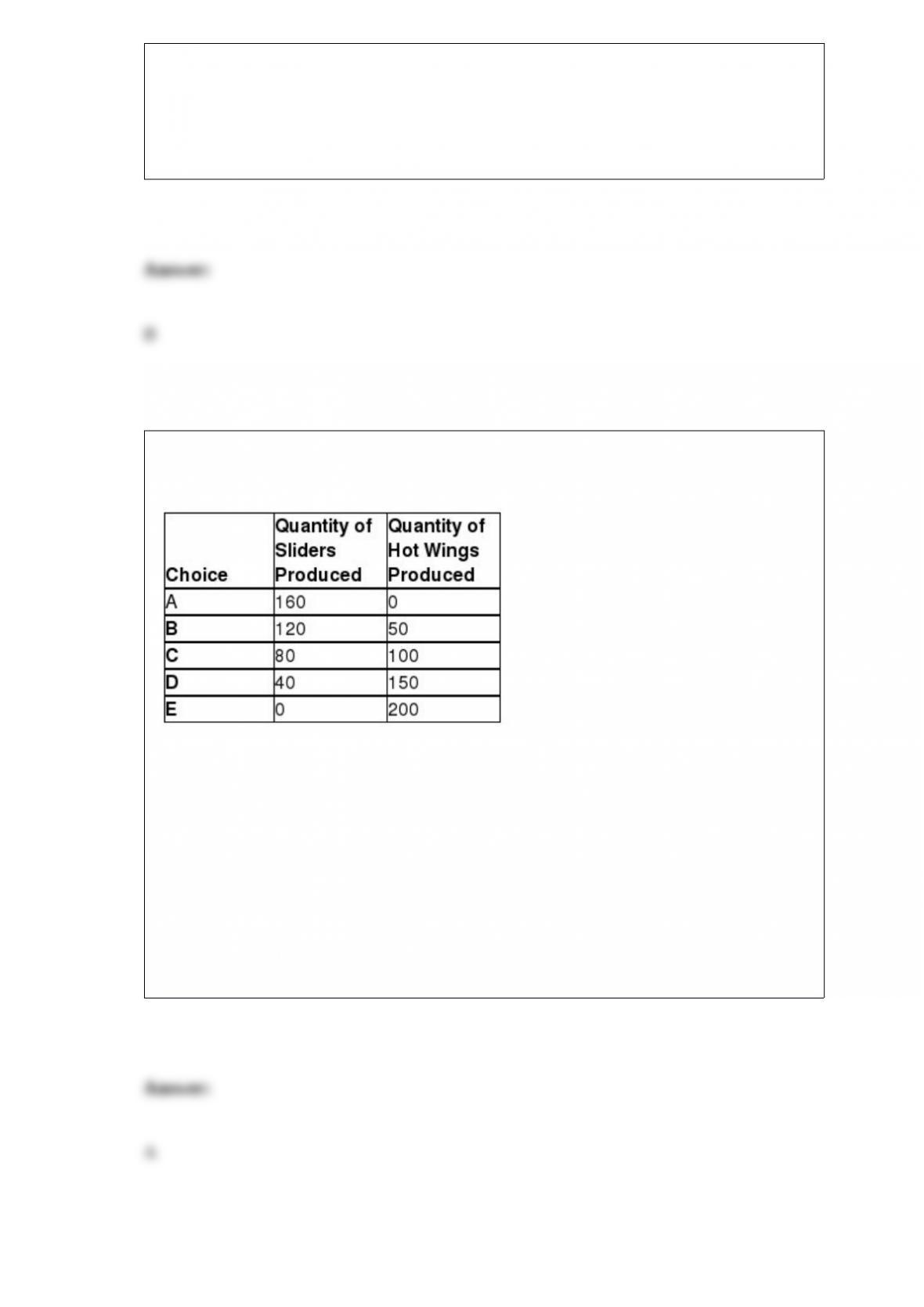
Table 2-3
Production Choices for Dina’s Diner
Assume Dina’s Diner only produces sliders and hot wings. A combination of 80 sliders
and 100 hot wings would appear
A) along Dina’s production possibilities frontier.
B) inside Dina’s production possibilities frontier.
C) outside Dina’s production possibilities frontier.
D) at the vertical intercept of Dina’s production possibilities frontier.

Which of the following is considered a negative supply shock?
A) increasing investment in the economy causes the capital stock to rise
B) an unexpected increase in the price of natural gas
C) a decline in wages
D) an improvement in technology
Let D = demand, S = supply, P = equilibrium price, Q = equilibrium quantity. What
happens in the market for sushi if the Surgeon General announces that a majority of the
raw fish that is imported to make sushi contains high levels of toxic mercury?
A) D decreases, S no change, P and Q decrease
B) S decreases, D no change, P increases, Q decreases
C) D and S decrease, P and Q decrease
D) D no change, S increases, P decreases, Q decreases
A free market fails when
A) there is government intervention.
B) there is an external effect in either production, consumption, or both.
C) firms that produce goods which create positive externalities go bankrupt.
D) firms that produce goods which create negative externalities earn high profits.
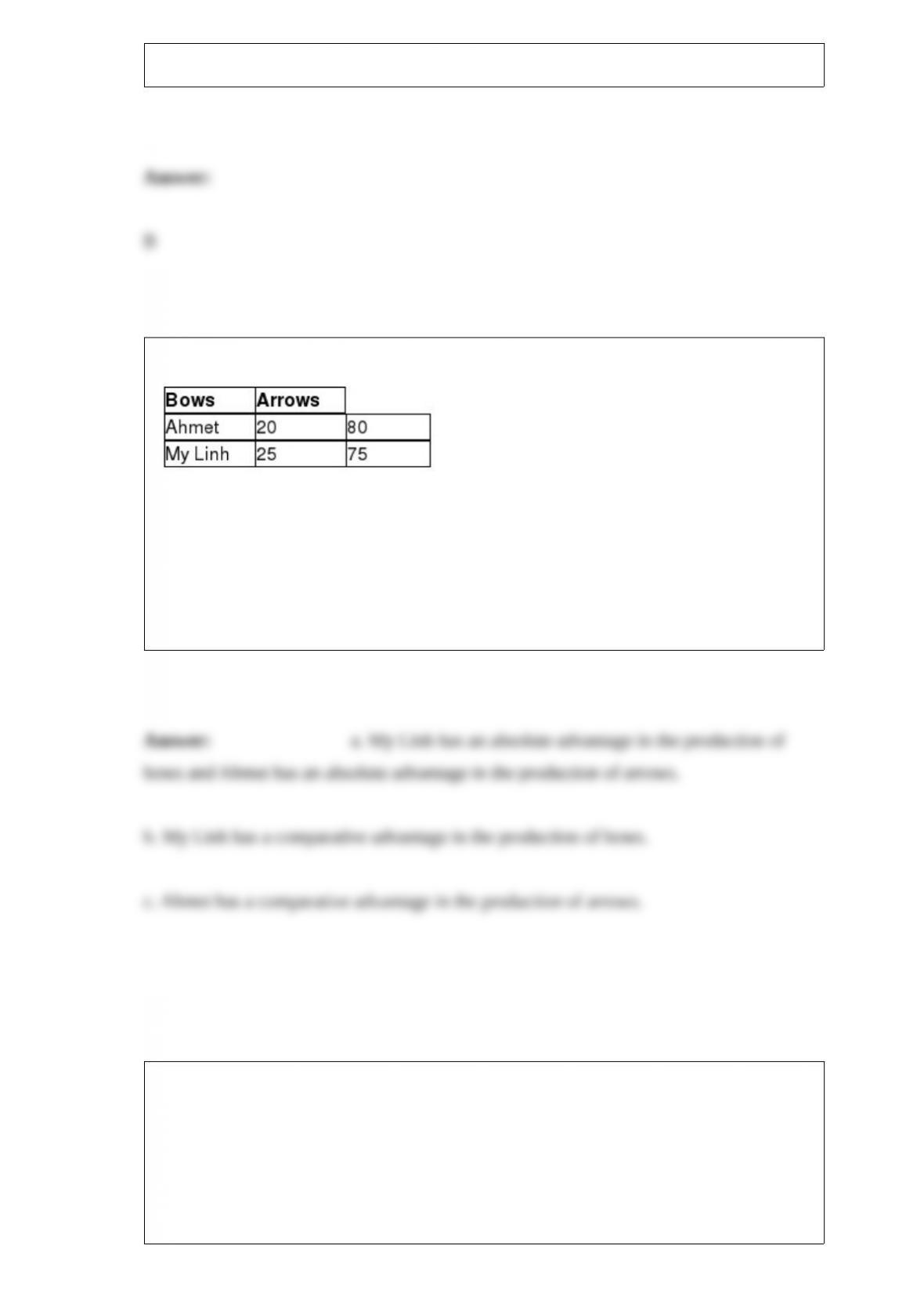
Table 9-5
Table 9-5 shows the output per week for bows and arrows by Ahmet and My Linh.
a.Which person has an absolute advantage in the production of bows? arrows?
b. Which person has a comparative advantage in the production of bows?
c. Which person has a comparative advantage in the production of arrows?
Whenever a buyer and a seller agree to trade,
A) the agreement is made based on absolute advantage.
B) they must have identical opportunity costs in producing their respective products.
C) one party will always be worse off.
D) both must believe they will be made better off.
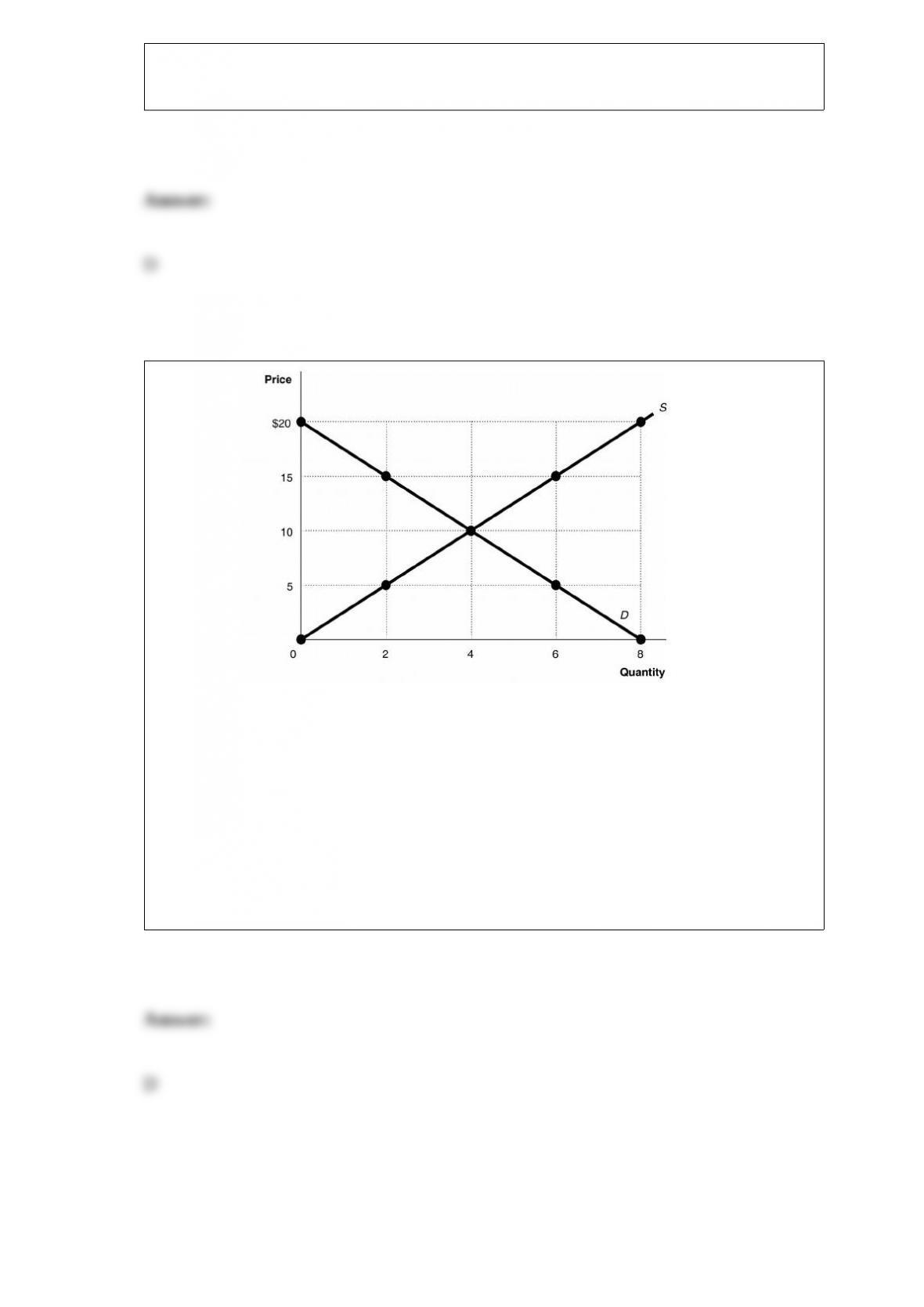
Figure 3-5
At a price of $0,
A) there would be a surplus of 8 units.
B) there would be a surplus of 0 units.
C) there would be a shortage of 0 units.
D) there would be a shortage of 8 units.
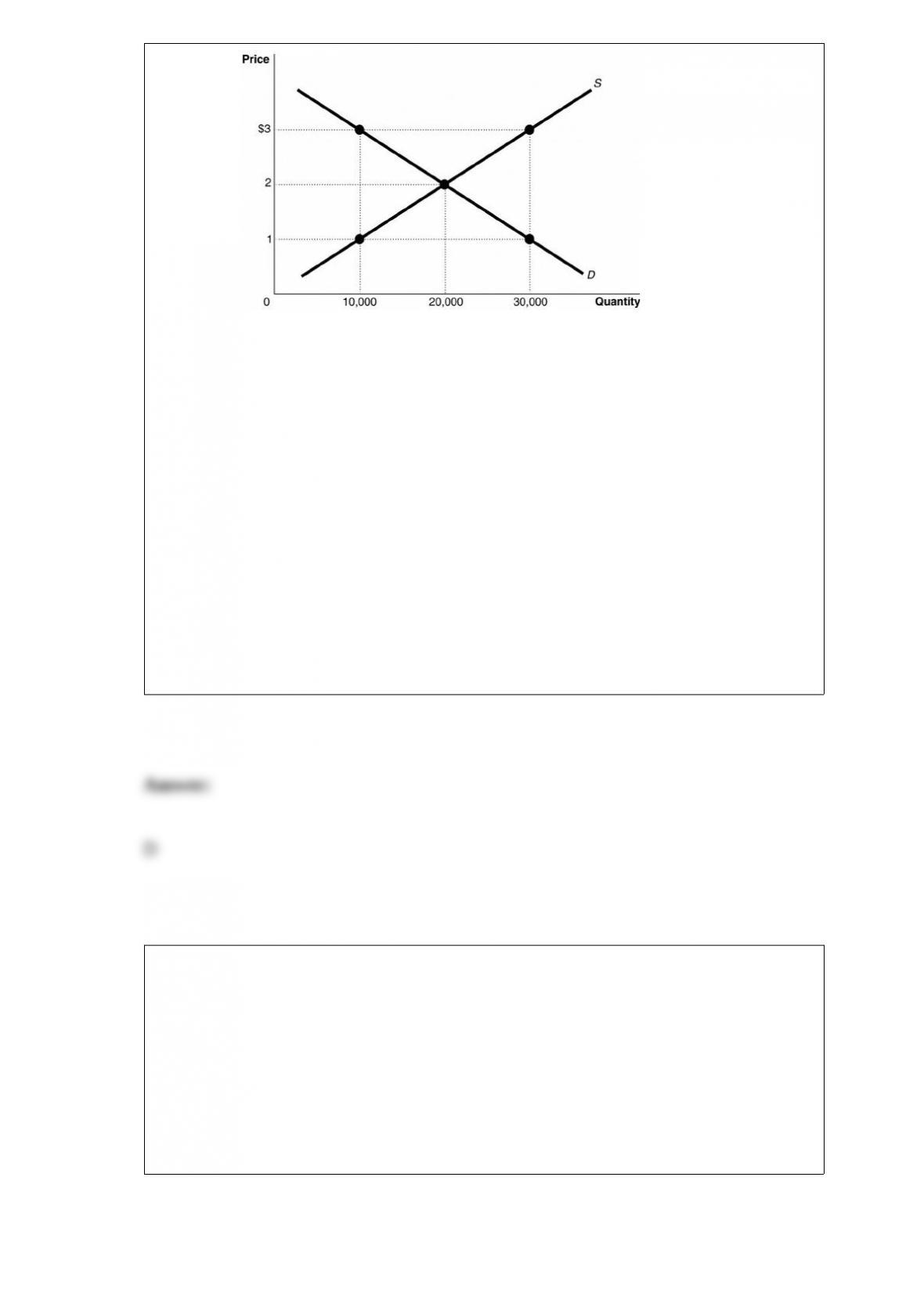
Figure 4-7
The figure above represents the market for iced tea. Assume that this is a competitive
market. If the price of iced tea is $3, what changes in the market would result in an
economically efficient output?
A) The price would decrease, the quantity supplied would increase, and the quantity
demanded would decrease.
B) The quantity supplied would decrease, the quantity demanded would increase, and
the equilibrium price would decrease.
C) The price would decrease, the demand would increase, and the supply would
decrease.
D) The price would decrease, quantity demanded would increase, and quantity supplied
would decrease.
Average variable cost can be calculated using any of the formulas below except
A) TVC/Q.
B) (TC – FC)/Q.
C) (TC – FC)/Q.
D) (TC/Q) – AFC.

All other factors held constant, increased growth in aggregate demand will
A) increase inflation.
B) reduce unemployment.
C) move the economy to a higher point on the short-run Phillips curve.
D) All of the above are correct.
With which of the following statements would a “real business cycle” theorist most
closely agree?
A) “Monetary policies have greatest impact on real GDP when they are anticipated.”
B) “Expansionary monetary policy allows the central bank to control inflation and
unemployment simultaneously.”
C) “Wages adjust slowly to changes in inflation as long as expectations are formed
rationally.”
D) “Technological shocks to the economy explain deviations of real GDP from its
potential level.”
After getting an A on your economics exam, you decide to go to your favorite Mexican
restaurant to celebrate. You are having trouble deciding whether to order the chipotle
chicken chimichanga or the cilantro seafood enchiladas. Use the rule of equal marginal
utility per dollar to determine which one to purchase: (a) the chimichanga for $8 which
gives you 120 units of utility, or (b) the enchiladas for $15 which gives you 195 units of
utility?
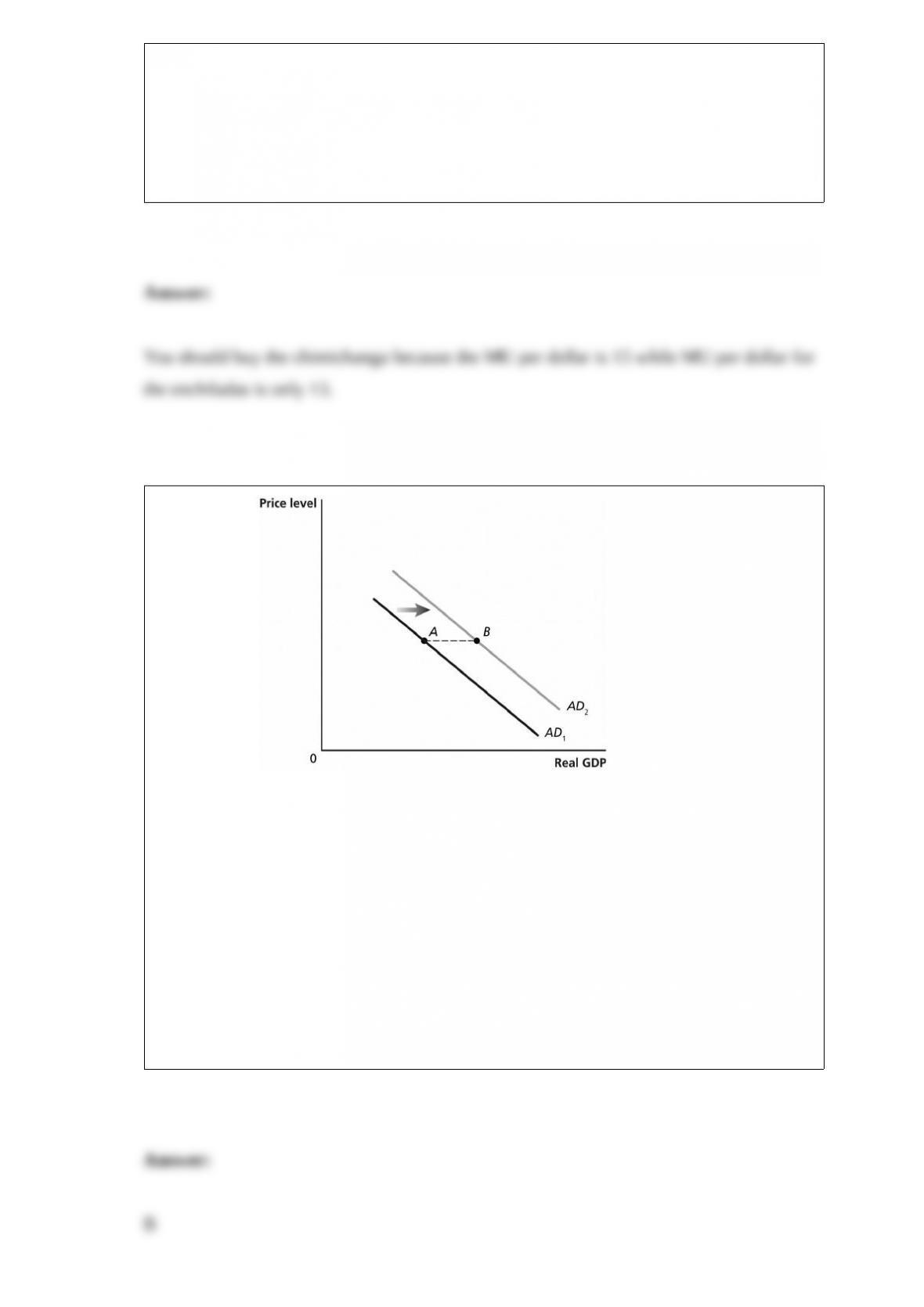
Figure 16-11
In the graph above, the shift from AD1 to AD2 represents the total change in aggregate
demand. If government purchases increased by $50 billion, then the distance from point
A to point B ________ $50 billion.
A) would be equal to
B) would be greater than
C) would be less than
D) may be greater than or less than