Money is
a. an asset that is widely accepted as a means of payment in the economy
b. any asset that is convertible into cash
c. an asset that is backed by a precious metal such as gold or silver
d. any financial asset created and issued by government
e. anything used to pay for goods and services, including currency, checks, and credit
cards
Since the Federal Reserve Banking Act of 1978, what has been the Fed’s chief
responsibility?
a. Encouraging investment
b. Regulating foreign trade
c. Minimizing the interest payments on the national debt
d. Achieving a low and stable rate of inflation
e. Keeping the interest rate low
If the physical plant for a corporation is considered to be a fixed input, then

Which of the following is not an important macroeconomic goal?
a. Stable prices
b. Full employment
c. Rapid economic growth
d. Low interest rates
e. None of the above is an important macroeconomic goal
Governments have learned that a(n)
a. increased budget deficit tends to reduce interest rates and increase investment, thus
increasing the growth of the capital stock
b. reduced budget deficit tends to reduce interest rates and increase investment, thus
increasing the growth of the capital stock
c. reduced budget deficit tends to increase interest rates and increase investment, thus
increasing the growth of the capital stock
d. reduced budget deficit tends to increase interest rates and increase investment, thus
reducing the growth of the capital stock
e. increased budget deficit tends to increase interest rates and increase investment, thus
reducing the growth of the capital stock
If a firm increases its output level by 50 percent and, as a result, long-run total cost rises
by 40 percent, the firm is experiencing
If a newspaper reporter wanted to learn about changes in the U.S. price levels, she
would probably get that information by looking at the
a. real gross domestic product
b. consumer price index
c. latest press release from the Council of Economic Indicators
d. nominal gross domestic product
e. gross national product
Rapid economic growth, stable prices and __________ are the three important
macroeconomic goals about which most economists agree.
a. an unemployment rate of zero
b. zero inflation
c. full employment
d. a high exchange rate
e. low interest rates
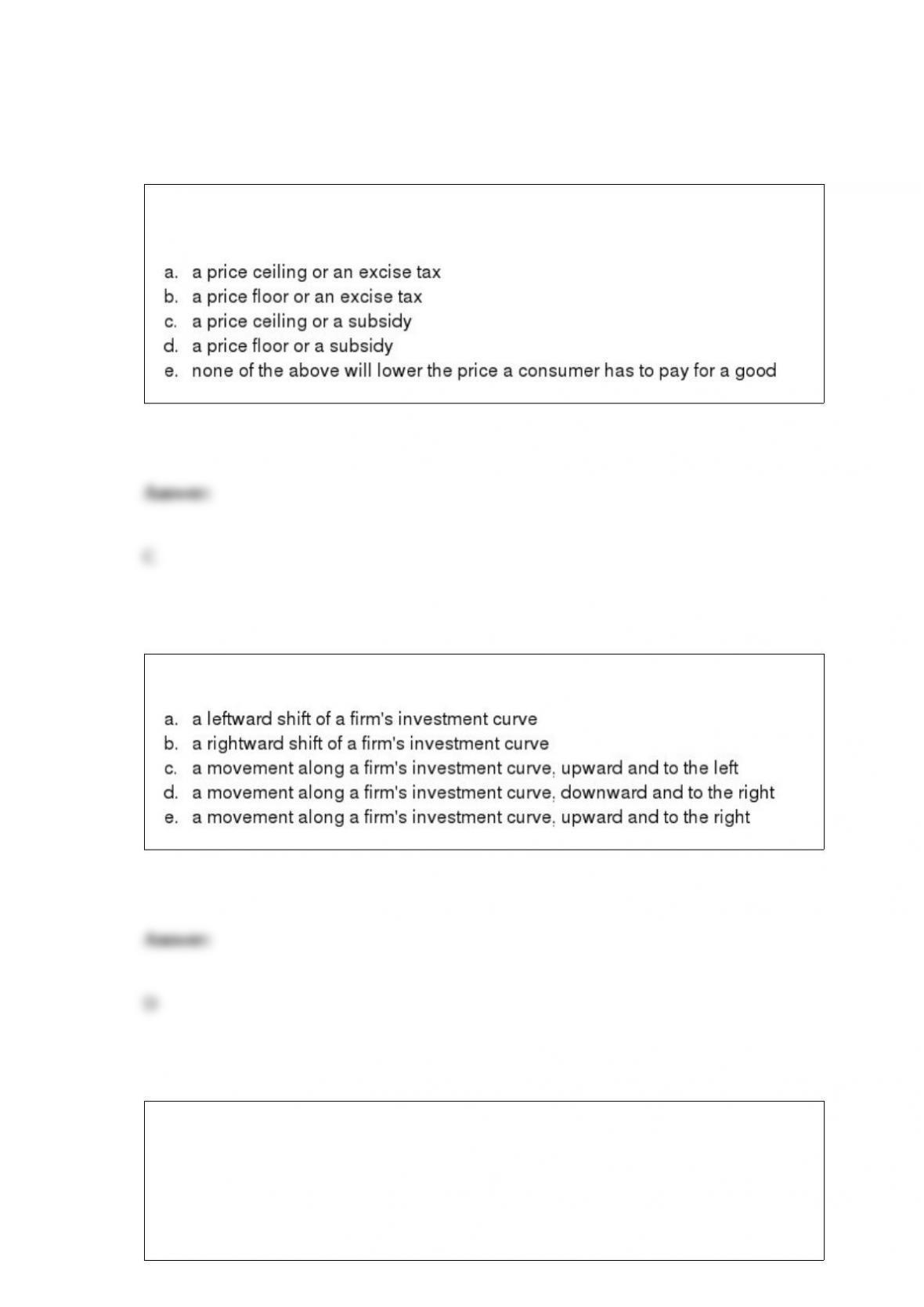
If the government thinks the price that a consumer has to pay for a good is too high,
then which of the following would solve this problem?
A decrease in the interest rate is represented by
Assume that Chile can produce one pound of coffee or 40 pillows in an hour, and that
the United States can produce one pound of coffee or 20 pillows in an hour,
a. the terms of trade should be between 20 and 40 pillows per pound of coffee, and the
United States should produce both coffee and pillows
b. the terms of trade should be between 20 and 40 pillows per pound of coffee, and
Chile should produce pillows
c. the terms of trade should be between 20 and 40 pillows per pound of coffee, and
Chile should produce coffee
d. the terms of trade should exceed 40 pillows per pound of coffee, and Chile should
produce coffee
e. no trade will occur, since the United States does not have an absolute advantage in
producing either good
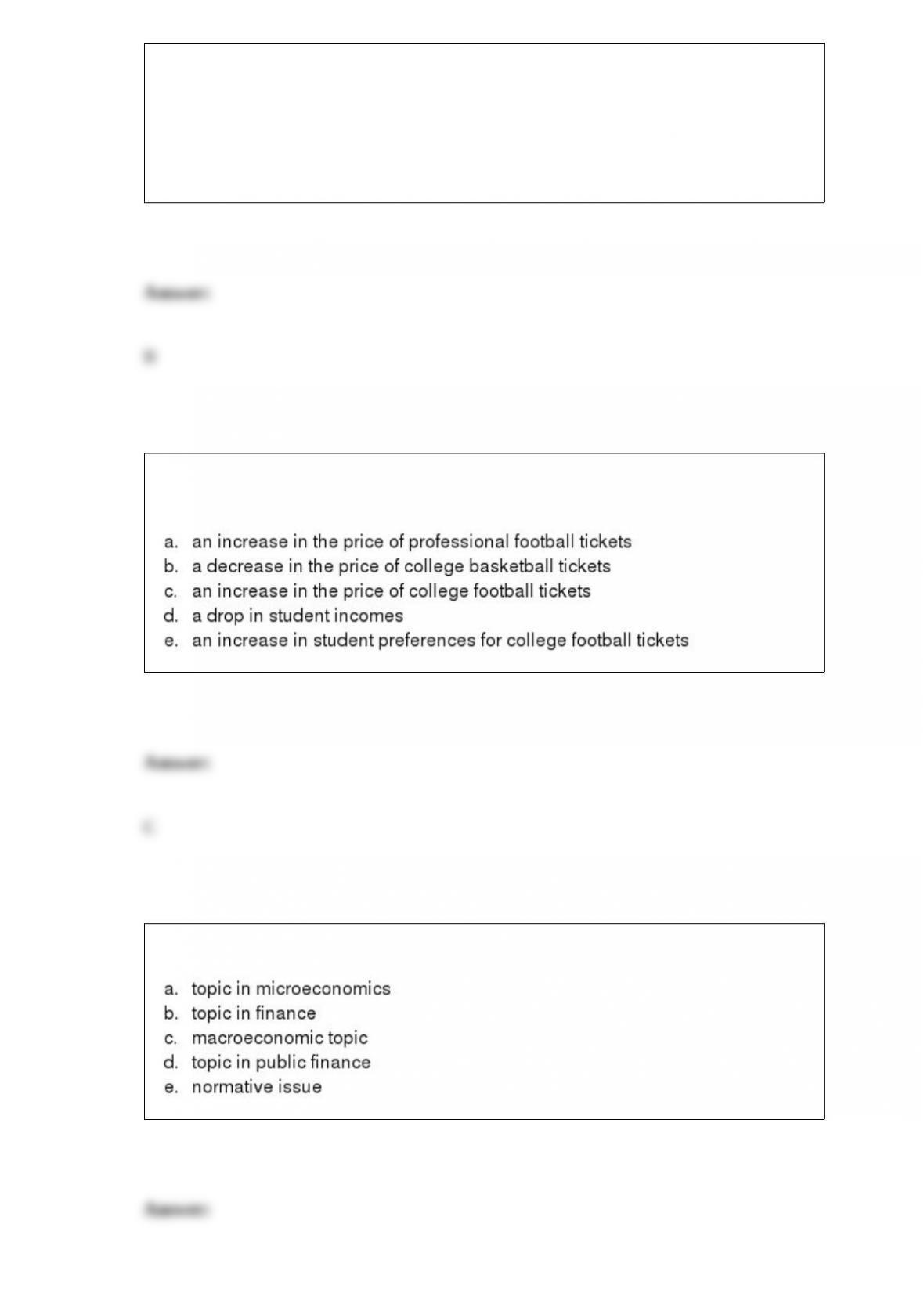
Which of the following would not cause the demand curve for college football tickets
to shift?
The price that a firm’s only competitor charges would be a

Agrophonic.com has issued 80 million shares of stock. You own 5 million of them. You
also own Agrophonic.com bonds with a present value of $1 million. What percentage of
Agrophonic.com do you own?
Which of the following is true?
a. The federal budget deficit is a flow and so is the national debt.
b. The national debt is both a stock and a flow.
c. The federal budget deficit is a stock and the national debt is a flow.
d. The federal budget deficit is a flow and the national debt is a stock.
e. The federal budget deficit is a stock and so is the national debt.
All of the following, except one, are characteristics of monopolistic competition. Which
is the exception?
If a 10 percent rise in the price of bananas leads to a 20 percent reduction in the
quantity of bananas demanded, then the price elasticity of demand is 2.00.
When economists and government officials speak about the money supply, they usually
mean M2.
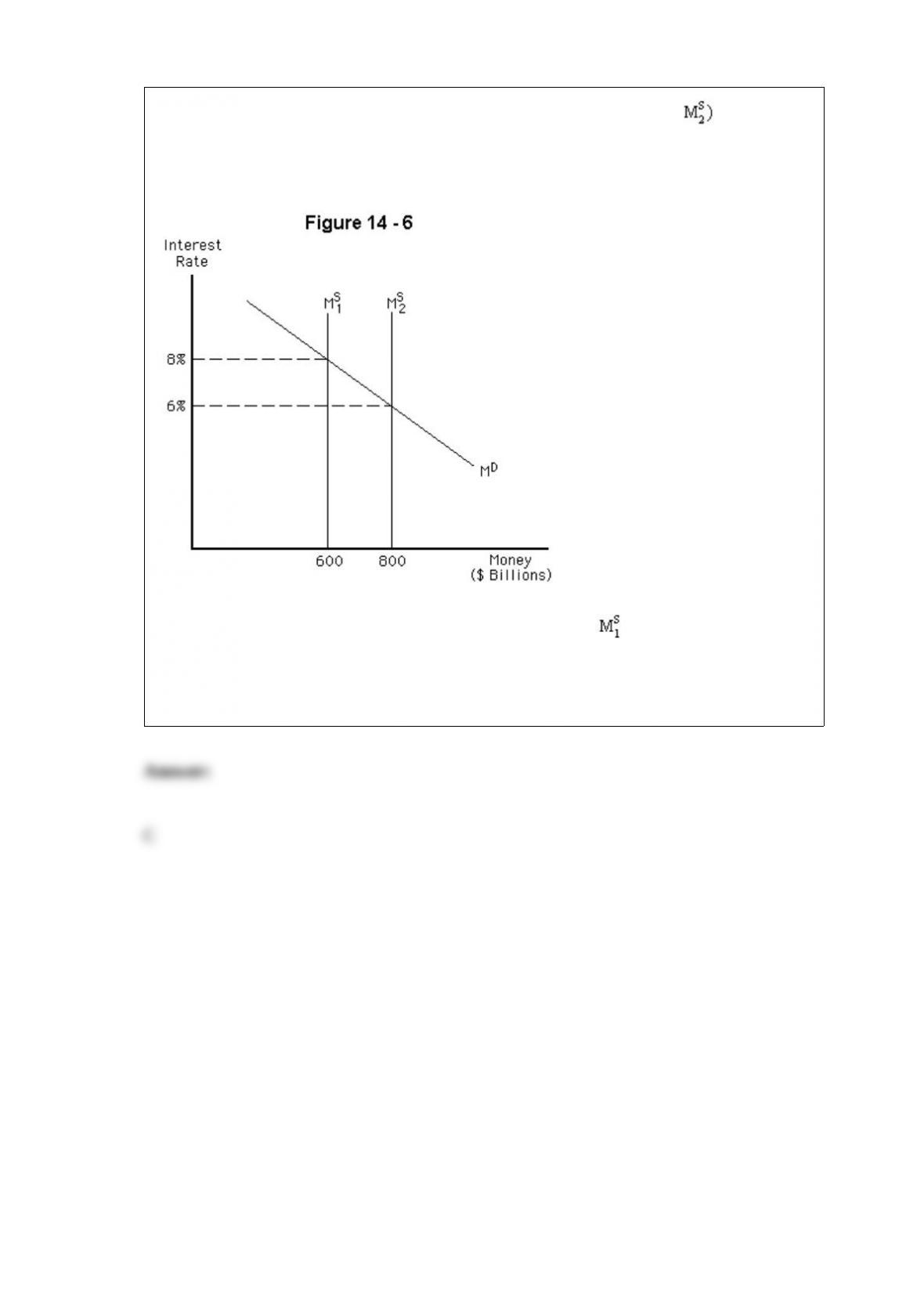
Refer to Figure 14-6. Suppose the Fed increases the money supply (to . As a result,
the interest rate falls initially to 6 percent. After spending and GDP change, what will
happen to the interest rate?
a. It will remain at 6 percent.
b. It will rise as the money supply curve shifts back toward
c. It will rise as the money demand curve shifts to the right.
d. It will fall as the money supply curve shifts farther to the right.
e. It will fall as the money demand curve shifts to the left.