
The payment received by suppliers of entrepreneurial skills is called profit.
If, when price changes by 35 percent, the quantity demanded changes by 7 percent, then
the absolute value of the price elasticity of demand is 5.
The circular flow of income shows that GDP can be measured as the sum of wages,
interest, rent, and profits received by households or total expenditures on goods and
services by households, firms, government, and the rest of the world.
Equilibrium in a competitive market results in the greatest amount of economic surplus
from the production of a good or service.

A sunk cost is a cost that has already been paid and cannot be recovered.
The payment received by suppliers of entrepreneurial skills is called rent.
If the demand for a product is elastic, the quantity demanded changes by a larger
percentage than the percentage change in price.
If currency speculators decide that the value of the dollar should rise in the future
relative to the yen, this will increase the demand for dollars and decrease the supply of
dollars.

All else equal, as the price of a product falls, the quantity supplied decreases.
Nominal income is equal to real income if the CPI is less than 100.
The market demand curve in a perfectly competitive market is downward-sloping.
Producers in perfect competition receive a smaller producer surplus than a monopoly
producer.

Purchasing a firm’s stock in an IPO can be risky because financial information may not
be fully disclosed.
The law of one price states that identical products should sell for the same price
everywhere as long as transactions costs are zero.
If a firm in Thailand borrows dollars from a U.S. bank, its interest payments on the loan
in bahts will decrease if the baht appreciates against the dollar.
Table 15-1
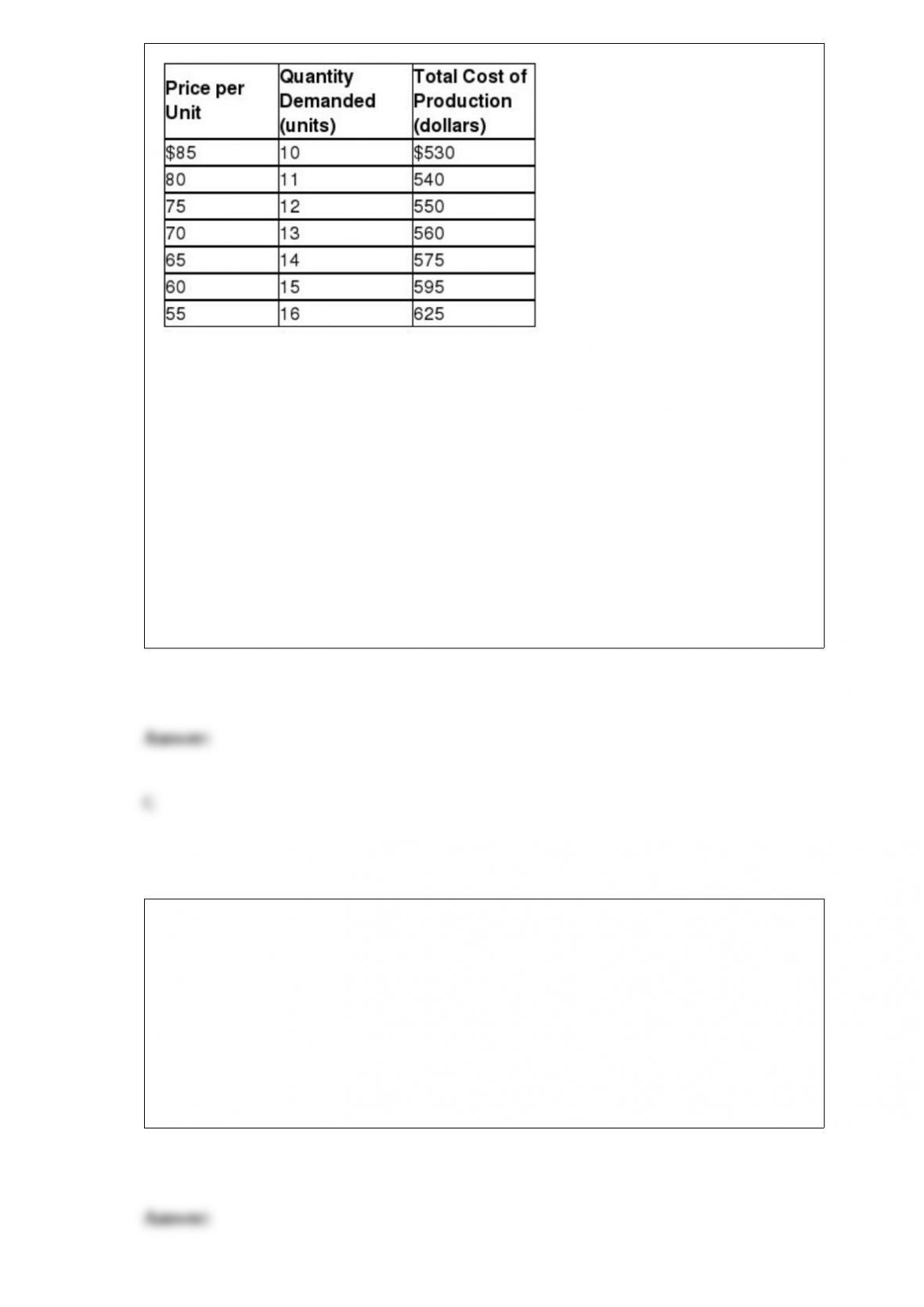
A monopoly producer of foreign language translation software faces a demand and cost
structure as given in Table 15-1.
What is the firm’s profit-maximizing output and what is the price charged to sell this
output?
A) P = $85; Q = 10
B) P = $80; Q = 11
C) P = $70; Q = 13
D) P = $65; Q = 14
Equilibrium GDP is equal to
A) autonomous expenditure times the marginal propensity to consume.
B) autonomous expenditure times the marginal propensity to save.
C) autonomous expenditure times the multiplier.
D) autonomous expenditure.

Figure 13-2
Ceteris paribus, a decrease in the capital stock would be represented by a movement
from
A) SRAS1 to SRAS2.
B) SRAS2 to SRAS1.
C) point A to point B.
D) point B to point A.
Emily is a writer. She buys pens and paper for $20 and writes a 500-page novel that she
sells to a publishing company for $500,000. If the publisher prints 1 million copies that
sell for $25 each, what is the contribution to GDP of Emily’s novel?
A) $25 million
B) $20 million
C) $500,000
D) $50,000

If a 35 percent increase in price of golf balls led to an 42 percent decrease in quantity
demanded, then the demand for golf balls is
A) unit-elastic.
B) perfectly elastic.
C) relatively inelastic.
D) relatively elastic.
Economists assume that
A) individuals behave in unpredictable ways.
B) consumer behavior is explained by the existence of unlimited resources.
C) people put other people’s interests ahead of their own.
D) optimal decisions are made at the margin.
There is often a trade-off between
A) productive efficiency and allocative efficiency.
B) limited and unlimited resources.
C) voluntary and involuntary exchanges.
D) economic efficiency and economic equity.
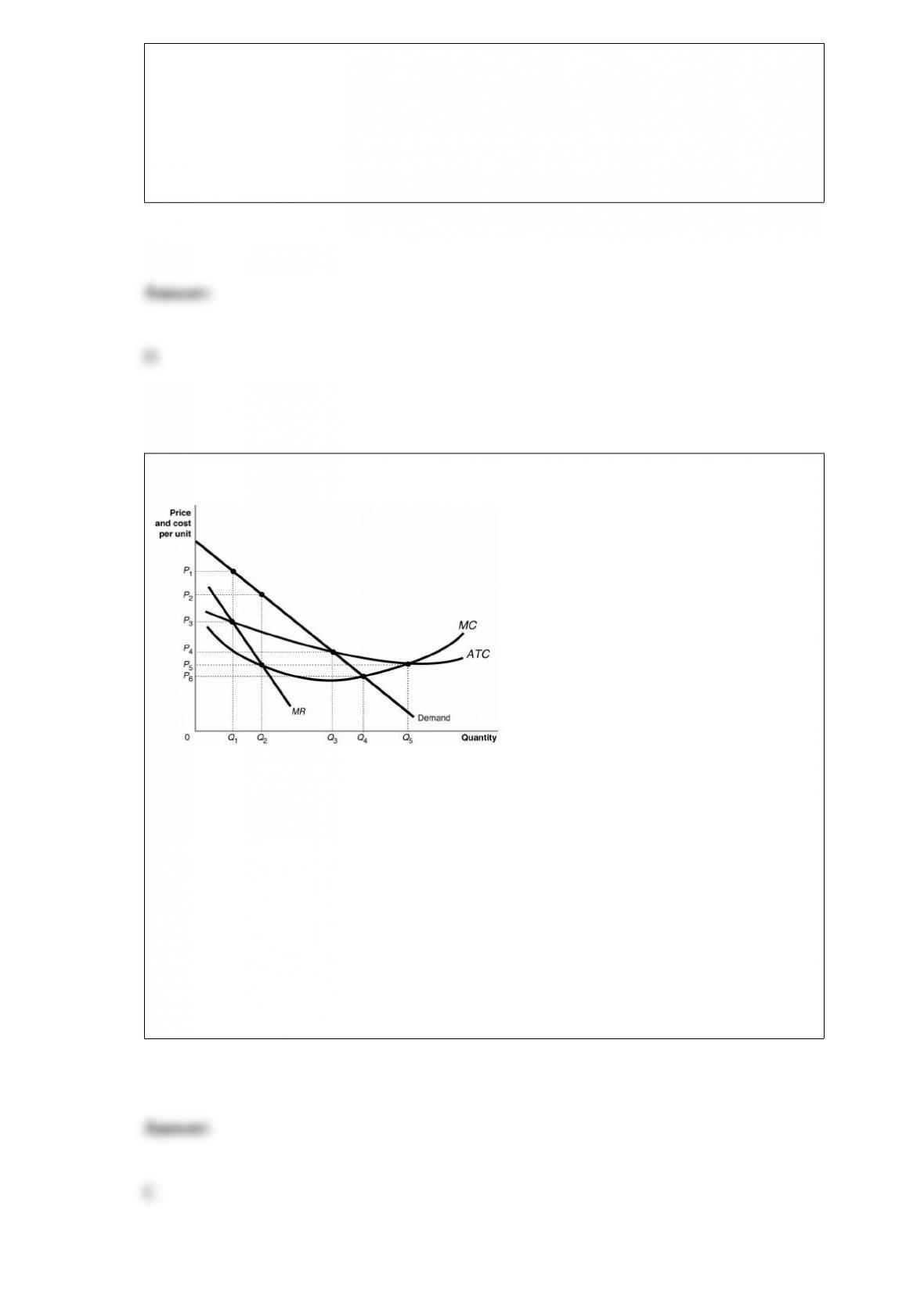
Figure 15-16
Figure 15-16 shows the market demand
and cost curves facing a natural monopoly. Which of the following would be true if
government regulators require the natural monopoly to produce at the economically
efficient output level?
A) This results in a misallocation of resources.
B) The marginal cost of producing the last unit sold exceeds the marginal benefit.
C) The firm will sustain persistent losses and will not continue in business in the long
run.
D) The firm will break even.

Some corporate governance experts believe that serving on a company’s board of
directors for an extended length of time diminishes that member’s independence from
the company’s CEO. If this is true, it would tend to
A) reduce the principal-agent problem.
B) increase the principal-agent problem.
C) be in the best interest of shareholders.
D) have no impact on the company’s performance, since the CEO is only one member
of top management.
Firms in perfectly competitive industries are unable to control the prices of the products
they sell and earn a profit in the long run. Which of the following is one reason for this?
A) Owners of perfectly competitive firms realize that their short-run profits are
temporary. Therefore, they either sell their businesses or develop other products that
will earn short-run profits.
B) Firms in perfectly competitive industries can use advertising in the short run to
persuade consumers that their products are better than those of other firms. But
eventually consumers realize that all of the firms sell virtually identical products.
C) Firms from other countries are able to produce similar products at lower costs.
D) Firms in these industries sell identical products.
Since 1999, the U.S. ________ account has recorded relatively minor transactions, such
as migrants’ transfers, and sales and purchases of nonproduced, nonfinancial assets.

A) current
B) capital
C) financial
D) balance of trade account
The aggregate expenditure model focuses on the short-run relationship between
________ and ________.
A) real spending; real GDP
B) unemployment; inflation
C) nominal spending; nominal GDP
D) planned inventories; unplanned inventories
Damian owns a tattoo parlor and has hired three tattoo artists to work for him. The
marginal product of labor is 8 for the first artist, 12 for the second artist, and 7 for the
third artist. What is Damian’s average product of labor for these three tattoo artists?
You have been hired as an economic advisor for a developing country. You have been
asked to focus on education as a means for the country’s development. Explain to the
prime minister how improving education and training can contribute to his country’s
economic growth, and why it is important for the government to take a pro-active role
in promoting education.
What is asymmetric information?
What are transactions costs? Why do transactions costs create XOAiculties in finding a
private solution to the problem of pollution?
The problem typically during a recession is not that there is too little money, but too
little spending. If the problem was too little money, what would be its cause? If the
problem was too little spending, what could be its cause?
Explain the concepts of cross-price elasticity of demand and income elasticity of
demand. What do positive and negative values indicate for each of these demand
elasticities ?
If the GDP deflator is less than 100, which will be higher: nominal GDP or real GDP?
Why?
What is the difference between ‘straight-time pay,” “commission pay,” and “piece-rate
pay”?