
Scenario 1-1 Suppose a t-shirt manufacturer currently sells 5,000 t-shirts per week and
makes a profit of $10,000 per week. A manager at the plant observes, “Although the last
400 t-shirts we produced and sold increased our revenue by $4,000 and our costs by
$4,800, we are still making an overall profit of $10,000 per week so I think we’re on the
right track. We are producing the optimal number of t-shirts.” Using marginal analysis
terminology, what is another economic term for the incremental cost of producing the
last 400 t-shirts?
A) marginal cost
B) operating cost
C) explicit cost
D) Any of the above terms are correct.
Holding everything else constant, an increase in the price of MP3 players will result in
A) a decrease in the quantity of MP3 players supplied.
B) a decrease in the demand for MP3 players.
C) an increase in the supply of MP3 players.
D) a decrease in the quantity of MP3 players demanded.
Figure 12-2
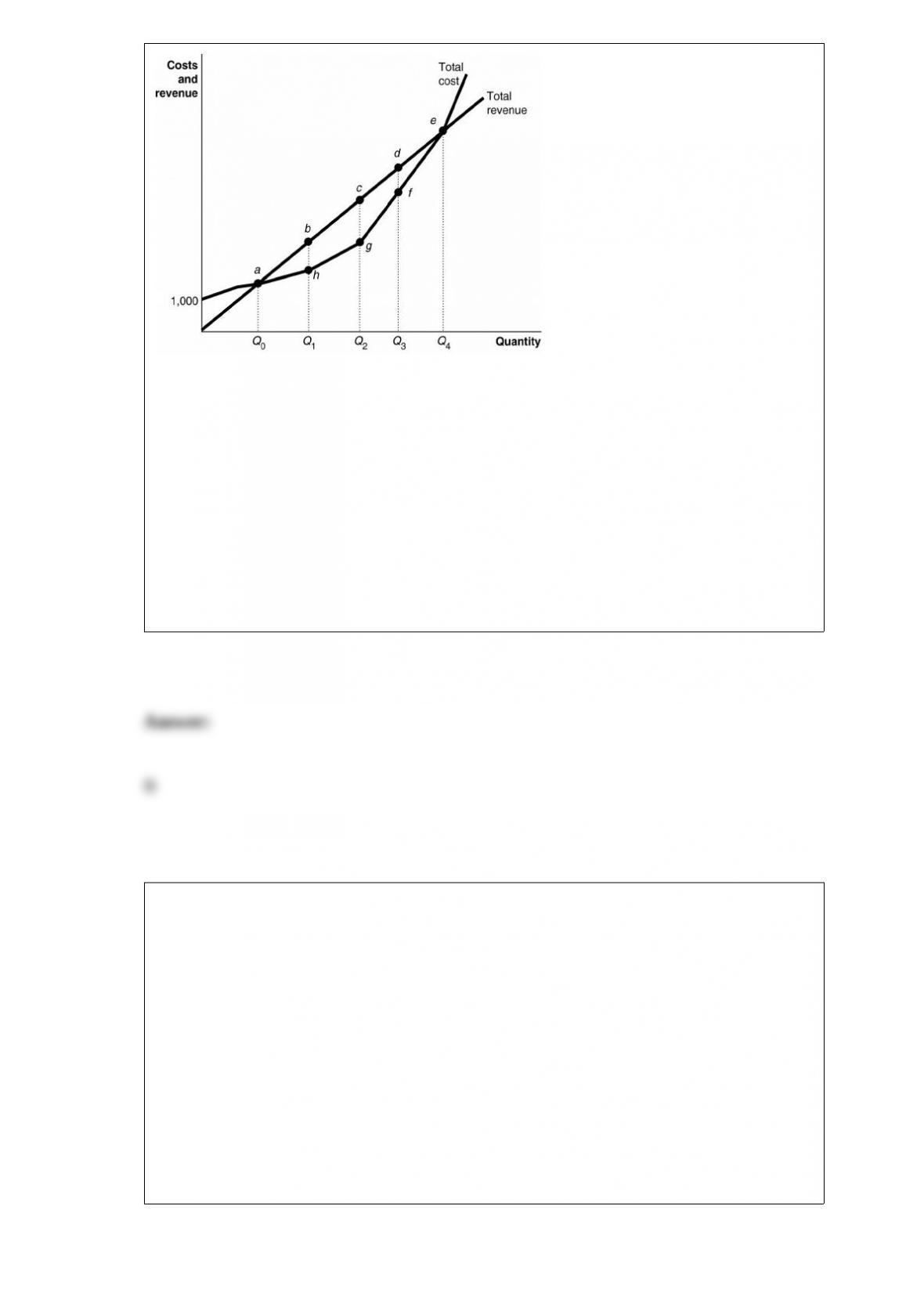
Suppose the firm is currently producing Q2units. What happens if it expands output to
Q3units?
A) Its profit increases by the size of the vertical distance df.
B) It makes less profit.
C) It incurs a loss.
D) It will be moving toward its profit maximizing output.
Which of the following statements is true?
A) An increase in supply causes a change in equilibrium price; the change in price does
not cause a further change in demand or supply.
B) A decrease in supply causes equilibrium price to rise; the increase in price then
results in a decrease in demand.
C) If both demand and supply increase there must be an increase in equilibrium price;
equilibrium quantity may either increase or decrease.
D) If demand decreases and supply increases one cannot determine if equilibrium price
will increase or decrease without knowing which change is greater.

The tax increases necessary to fund future Social Security and Medicare benefit
payments would be
A) small, and have little effect on economic growth.
B) small, but could discourage work effort, entrepreneurship and investment, thereby
slowing economic growth.
C) large, but would have little effect on economic growth.
D) large, and could discourage work effort, entrepreneurship and investment, thereby
slowing economic growth.
Most economists believe that the best monetary policy target is
A) an interest rate.
B) the money supply.
C) total bank reserves.
D) the discount rate.

If prices in the economy rise, then
A) the purchasing power of a dollar rises.
B) the purchasing power of a dollar stays constant.
C) the purchasing power of a dollar declines.
D) the purchasing power of a dollar cannot be determined.
Which of the following is not an example of a trade restriction?
A) tariffs
B) quotas and voluntary export restraints
C) legislation requiring that cars sold in a country have a 50 percent domestic content
D) consumer preferences for goods produced domestically
According to the Centers for Disease Control and Prevention, ________ in 2013 in
which less than 20 percent of the population was considered obese.
A) Colorado was the only state
B) there were only 5 states
C) there were more than 25 states
D) there were no states
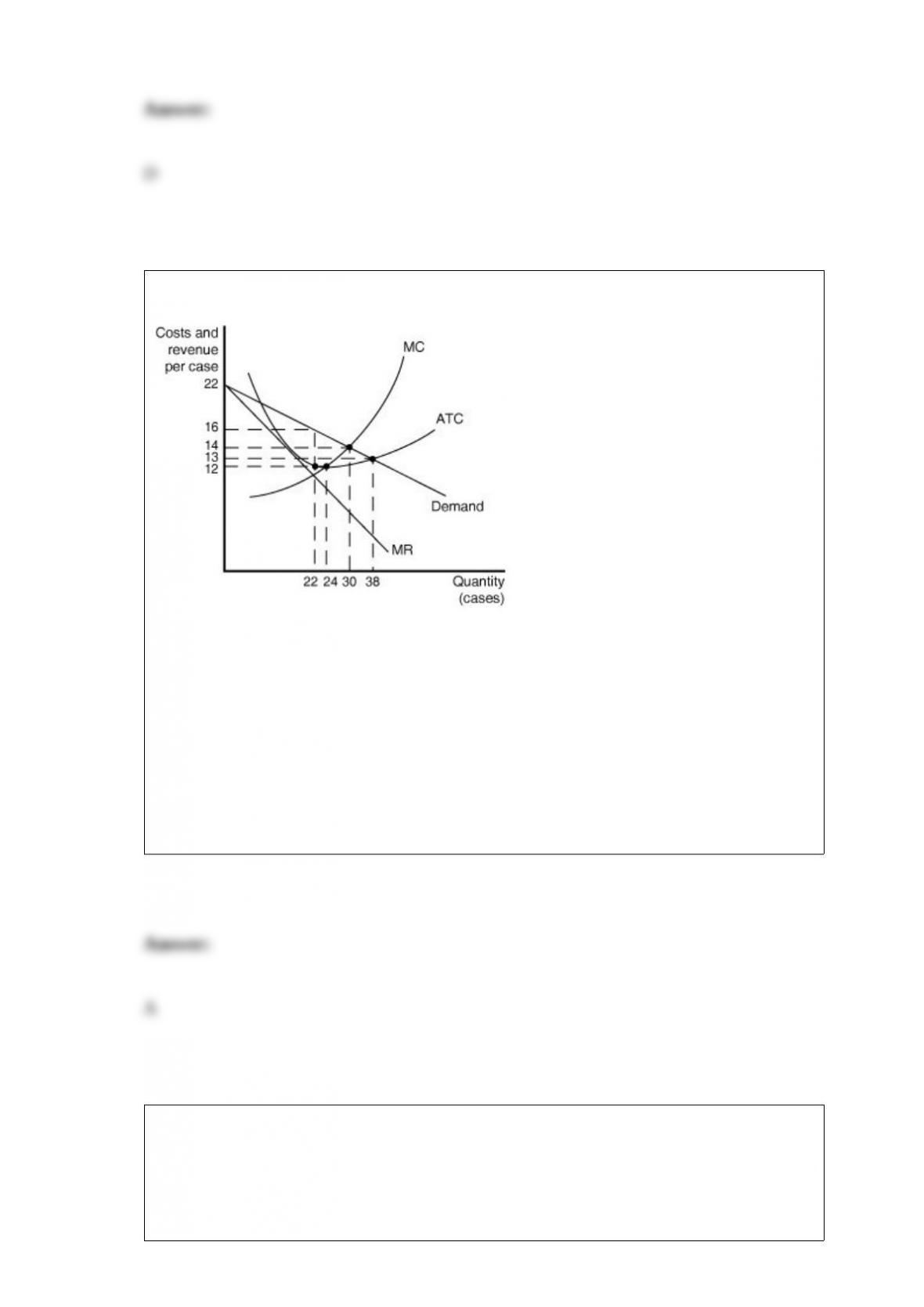
Figure 13-8
Figure 13-8 shows cost and demand
curves for a monopolistically competitive producer of iced tea. What is the
profit-maximizing output level?
A) 22 cases
B) 24 cases
C) 30 cases
D) 38 cases
An increase in capital inflows will
A) increase net foreign investment.
B) increase capital outflows.

C) decrease capital outflows.
D) increase the equilibrium exchange rate.
Fiona shares an office with her ex-husband. Her share of the rent and utilities are $625
per month. She is considering moving to a home office which she will not have to share
with anyone. The home office will not cost her anything as far as extra rent or utilities.
Recently, you ran into Fiona at the gym and she tells you that she has moved into her
home office. Fiona is as rational as any other person. As an economics major, you
rightly conclude that
A) Fiona did not have a choice; her ex-husband was a jerk.
B) Fiona figures that the additional benefit of having her own office (as opposed to
sharing) is at least $625.
C) Fiona figures that the benefit of having her own office (as opposed to sharing) is
zero, since she is no longer paying rent and utilities.
D) The cost of having one’s own space outweighs the benefits.