Babe Ruth, the famous baseball player, earned $80,000 in 193 Today, the best baseball
players can earn more than 400 times as much as Babe Ruth earned in 193 However,
prices have also risen since 193 We can conclude that
a. the best baseball players today are about 400 times better off than Babe Ruth was in
1931.
b. because prices have also risen, the standard of living of baseball stars hasn’t changed
since 1931.
c. one cannot make judgments about changes in the standard of living based on changes
in prices and changes in incomes.
d. one cannot determine whether baseball stars today enjoy a higher standard of living
than Babe Ruth did in 1931 without additional information regarding increases in prices
since 1931.
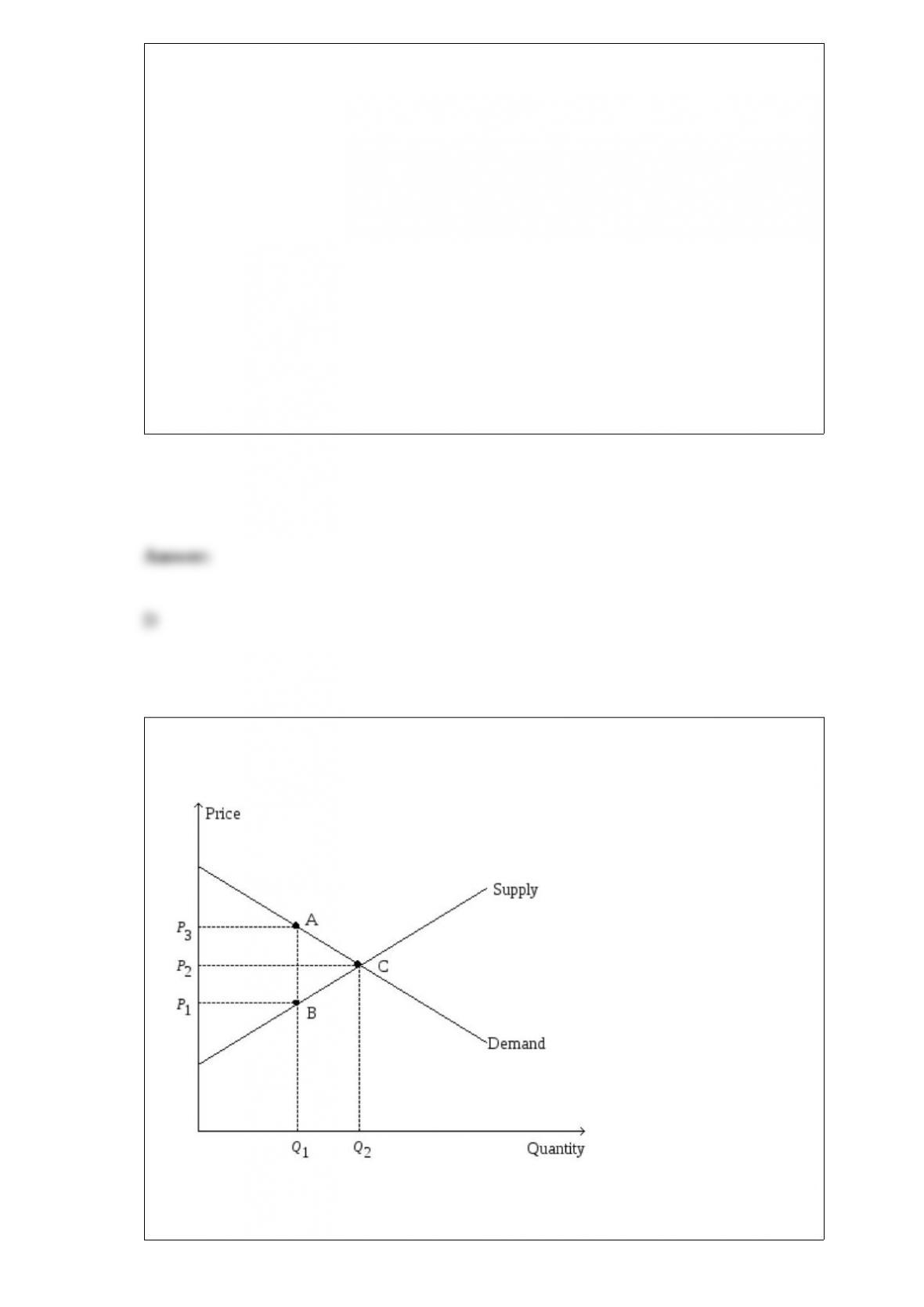
Figure 8-11
Refer to Figure 8-11. The price labeled as P1 on the vertical axis represents the price
a. received by sellers before the tax is imposed.
b. received by sellers after the tax is imposed.
c. paid by buyers before the tax is imposed.
d. paid by buyers after the tax is imposed.
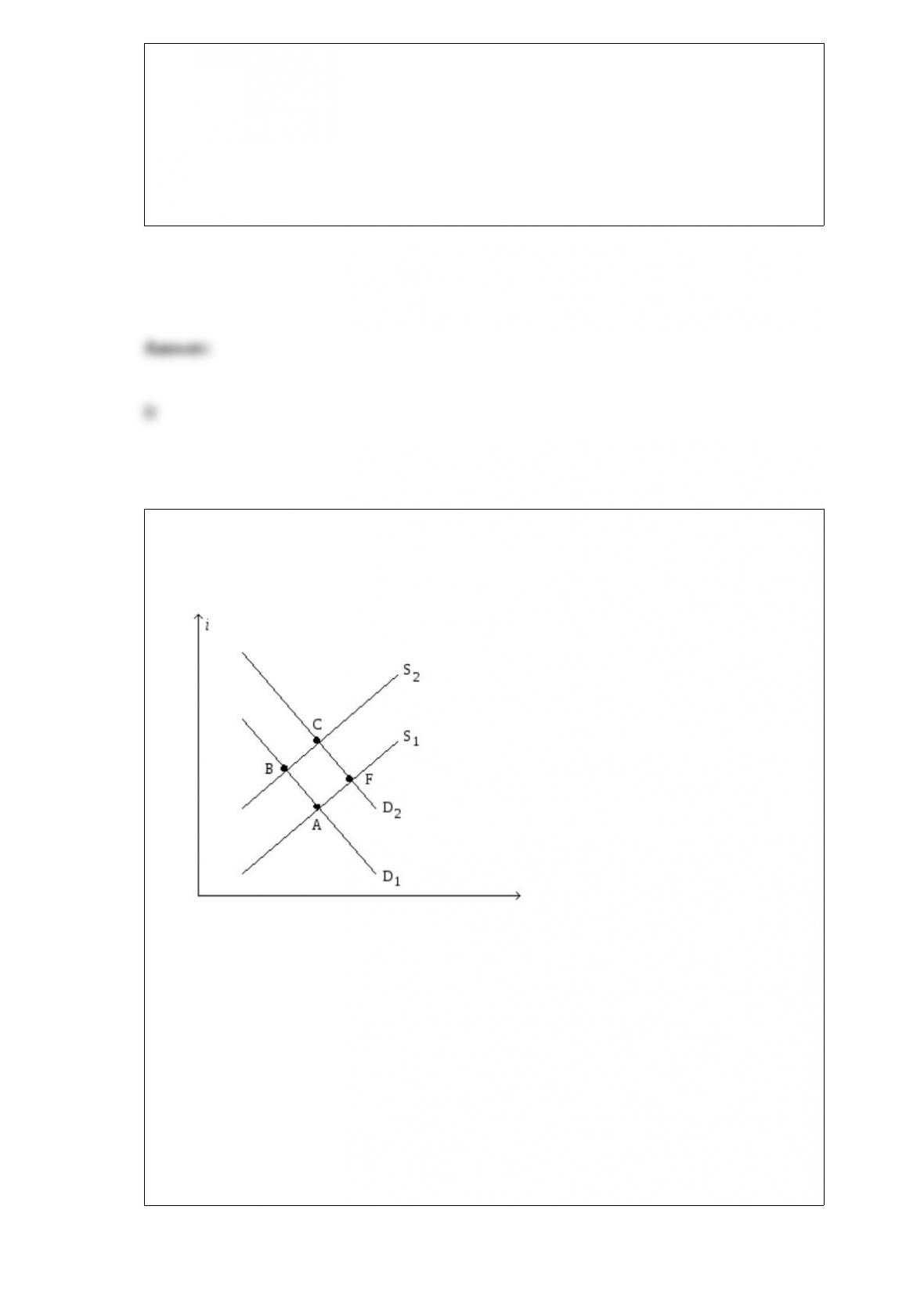
Figure 13-3. The figure shows two demand-for-loanable-funds curves and two
supply-of-loanable-funds curves.
Refer to Figure 13-3. Which of the following movements would be consistent with the
government budget going from deficit to surplus and the simultaneous enactment of an
investment tax credit?
a. a movement from Point A to Point C
b. a movement from Point B to Point A
c. a movement from Point B to Point F
d. a movement from Point C to Point B

Over the past century in the United States, average income as measured by real GDP
per person has grown about
a. 4 percent per year, which implies a doubling about every 18 years.
b. 4 percent per year, which implies a doubling about every 8 years.
c. 2 percent per year, which implies a doubling about every 35 years.
d. 2 percent per year, which implies a doubling about every 18 years.
If the demand for apples is elastic, then an increase in the price of apples will
a. increase total revenue of apple sellers.
b. decrease total revenue of apple sellers.
c. not change total revenue of apple sellers.
d. There is not enough information to answer this question.

Table 4-7
Refer to Table 4-7. If the price were $4, a
a. surplus of 15 units would exist, and price would tend to fall.
b. shortage of 25 units would exist, and price would tend to rise.
c. surplus of 25 units would exist, and price would tend to fall.
d. shortage of 40 units would exist, and price would tend to rise.
Table 15-1
Labor Data for Aridia
Refer to Table 15-1. The labor-force participation rate of Aridia in 2010 was
a. 70%.
b. 77.8%.
c. 80%.
d. 87.5%.

PlayStations and PlayStation games are complementary goods. A technological advance
in the production of PlayStations will
a. increase consumer surplus in the market for PlayStations and decrease producer
surplus in the market for PlayStation games.
b. increase consumer surplus in the market for PlayStations and increase producer
surplus in the market for PlayStation games.
c. decrease consumer surplus in the market for PlayStations and increase producer
surplus in the market for PlayStation games.
d. decrease consumer surplus in the market for PlayStations and decrease producer
surplus in the market for PlayStation games.
Figure 2-5

Refer to Figure 2-5. A movement from point C to point D could be caused by
a. unemployment.
b. a decrease in society’s preference for sweaters.
c. fewer resources available for production of sweaters.
d. All of the above are correct.
A tax of $0.25 is imposed on each bag of potato chips that is sold. The tax decreases
producer surplus by $600 per day, generates tax revenue of $1,220 per day, and
decreases the equilibrium quantity of potato chips by 120 bags per day. The tax
a. decreases consumer surplus by $645 per day.
b. decreases the equilibrium quantity from 6,000 bags per day to 5,880 bags per day.
c. decreases total surplus from $3,000 to $1,800 per day.
d. creates a deadweight loss of $15 per day.

Happy Trails, a bicycle rental company, is considering purchasing three additional
bicycles. Each bicycle would cost them $249.66. At the end of the first year the increase
to their revenues would be $140 per bicycle. At the end of the second year the increase
to their revenues again would be $140 per bicycle. Thereafter, there are no increases to
their revenues. At which of the following interest rates is the sum of the present values
of the additional revenues closest to the price of a bicycle?
a. 5 percent
b. 6 percent
c. 7 percent
d. 8 percent
Gross domestic product measures
a. income and expenditures.
b. income but not expenditures.
c. expenditures but not income.
d. neither income nor expenditures.

A country’s real GDP rose from 500 to 550 while its nominal GDP rose from 600 to
770. What was this country’s inflation rate?
a. 16.7%
b. 20%
c. -14.3%
d. -20%
According to Friedman and Phelps’s analysis of the Phillips curve,
a. the unemployment rate will be below its natural rate whenever inflation is negative.
b. the unemployment rate will be below its natural rate whenever inflation is positive.
c. the unemployment rate will be below its natural rate only if inflation is less than
expected.
d. the unemployment rate will be below its natural rate only if inflation is greater than
expected.
Suppose the United States exports cars to Switzerland and imports cheese from France.
This situation suggests
a. the United States has a comparative advantage relative to France in producing cheese,
and Switzerland has a comparative advantage to the United States in producing cars.
b. the United States has a comparative advantage relative to Switzerland in producing
cars, and France has a comparative advantage relative to the United States in producing
cheese.
c. the United States has an absolute advantage relative to Switzerland in producing cars,
and France has an absolute advantage relative to the United States in producing cheese.
d. the United States has an absolute advantage relative to France in producing cheese,
and Switzerland has an absolute advantage relative to the United States in producing
cars.
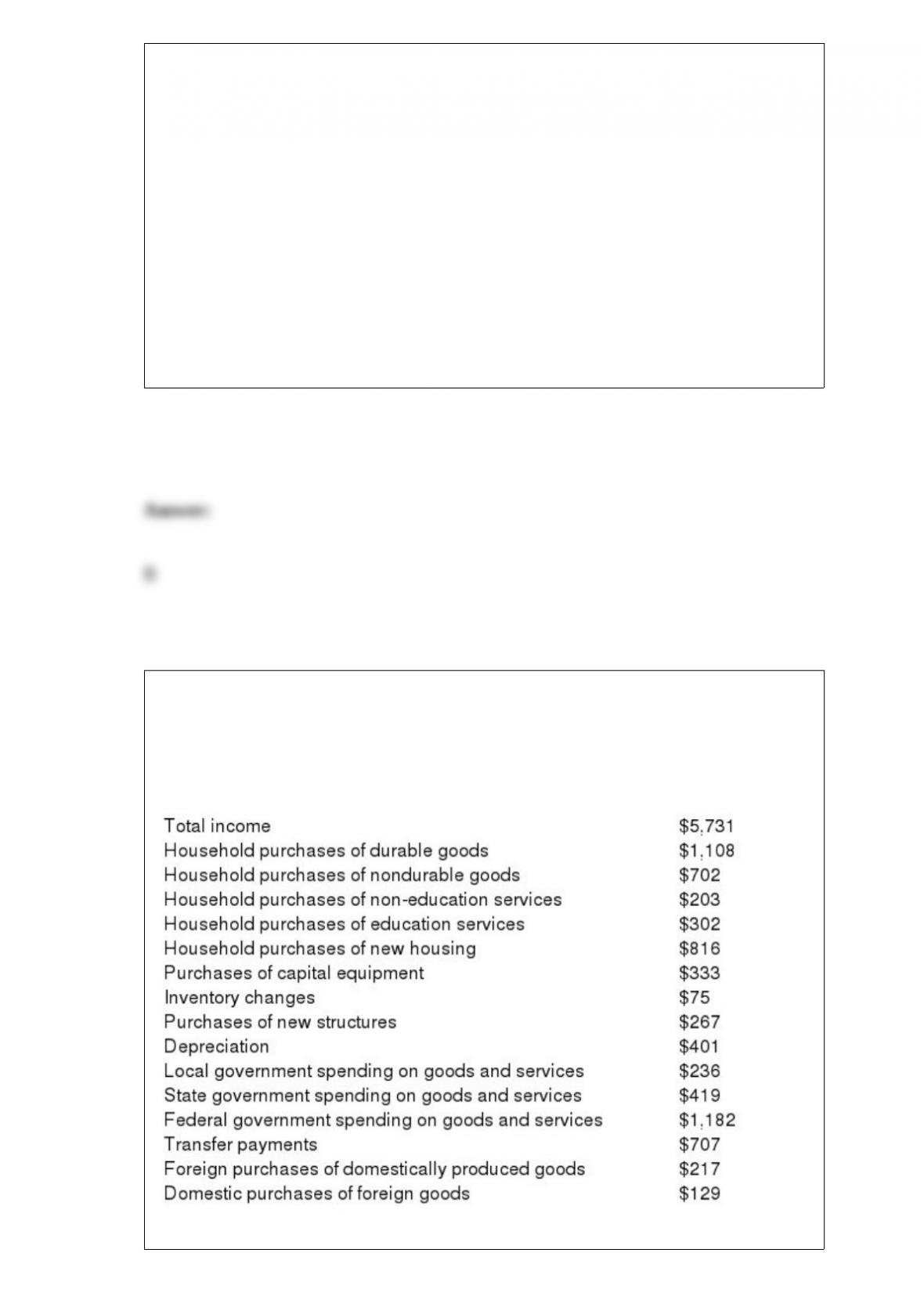
Table 10-2
The table below contains data for the country of Crete for the year 2010.
Refer to Table 10-2. What were Crete’s government purchases in 2010?

a. $1130
b. $1601
c. $1837
d. $2544
According to purchasing-power parity, if a basket of goods costs $100 in the U.S. and
the same basket costs 800 pesos in Argentina, then what is the nominal exchange rate?
a. 8 pesos per dollar
b. 1 peso per dollar
c. 1/8 peso per dollar
d. none of the above is correct
If the demand for dollars in the market for foreign-currency exchange shifts left, then
the exchange rate
a. rises and the quantity of dollars exchanged rises.
b. rises and the quantity of dollars exchanged does not change.

c. falls and the quantity of dollars exchanged falls.
d. falls and the quantity of dollars exchanged does not change.
Which of the following examples of household spending is categorized as investment
rather than consumption?
a. expenditures on durable goods such as automobiles and refrigerators
b. expenditures on intangibles items such as medical care
c. expenditures on new housing
d. All of the above are correct.
Figure 2-2

Refer to Figure 2-2. Devin works as an attorney for a corporation and is paid a salary
in exchange for the legal services he performs. Juan owns office buildings and rents his
buildings to companies in exchange for rent payments. If Devin’s income is represented
by a flow of dollars from Box D to Box B of this circular-flow diagram, then Juan’s
income is represented by a flow of dollars
a. from Box A to Box C.
b. from Box C to Box A.
c. from Box B to Box D.
d. from Box D to Box B.
The classical dichotomy argues that changes in the money supply
a. affect both nominal and real variables.
b. affect neither nominal nor real variables.
c. affect nominal variables, but not real variables.
d. do not affect nominal variables, but do affect real variables.

During the past century the average growth rate of U.S. real GDP per person implies
that it doubled, on average, about every
a. 100 years.
b. 70 years.
c. 35 years.
d. 25 years.
Table 3-9
Barb and Jim run a business that sets up and tests computers. Assume that Barb and Jim
can switch between setting up and testing computers at a constant rate. The following
table applies.
Minutes Needed to Number of Computers
Set Up or Tested in a
40-Hour Week
Refer to Table 3-9. The number of minutes needed by Barb to test a computer is
a. 36.
b. 48.

c. 60.
d. 64.
Alice says that the present value of $700 to be received one year from today if the
interest rate is 6 percent is less than the present value of $700 to be received two years
from today if the interest rate is 3 percent. Beth says that $700 saved for one year at 6
percent interest has a smaller future value than $700 saved for two years at 3 percent
interest.
a. Both Alice and Beth are correct.
b. Both Alice and Beth are incorrect.
c. Only Alice is correct.
d. Only Beth is correct.
Table 6-4
The following table contains the demand schedule and supply schedule for a market for
a particular good. Suppose sellers of the good successfully lobby Congress to impose a
price floor $3 above the equilibrium price in this market.

Refer to Table 6-4. Following the imposition of a price floor $3 above the equilibrium
price, irate buyers convince Congress to repeal the price floor and to impose a price
ceiling $1 below the former price floor. The resulting market price is
a. $2.
b. $3.
c. $4.
d. $5.
In the nation of Wiknam, the money supply is $80,000 and reserves are $18,000.
Assuming that people hold only deposits and no currency, and that banks hold no
excess reserves, then the reserve requirement is
a. 29 percent.
b. 22.5 percent.
c. 16 percent.
d. None of the above is correct.

Other things the same, a decrease in velocity means that
a. the rate at which money changes hands falls, so the price level rises.
b. the rate at which money changes hands falls, so the price level falls.
c. the rate at which money changes hands rises, so the price level rises.
d. the rate at which money changes hands rises, so the price level falls.
If the central bank increases the money supply, in the short run, output
a. rises so unemployment rises.
b. rises so unemployment falls.
c. falls so unemployment rises.
d. falls so unemployment falls.
The government has just passed a law requiring that all residents earn the same annual

income regardless of work effort. This law is likely to
a. increase efficiency and increase equality.
b. increase efficiency but decrease equality.
c. decrease efficiency but increase equality.
d. decrease efficiency and decrease equality.
Minimum-wage laws and unions are similar to each other but different from efficiency
wages in that minimum-wage law and unions
a. cause unemployment, but efficiency wages do not.
b. cause the quantity of labor supplied to exceed the quantity of labor demanded, but
efficiency wages do not.
c. cause wages to be above the equilibrium level.
d. prevent firms from lowering wages in the presence of a surplus of workers.
A demand curve shows the relationship
a. between income and quantity demanded.
b. between price and income.

c. between price and quantity demanded.
d. among income, price, and quantity demanded.
John Maynard Keynes believed the ideas of economists to be
a. generally incorrect.
b. powerful.
c. academic and without practical application.
d. rantings of madmen.
Which of the following are residents of rich countries likely to have in greater
quantities, or better quality, than residents of poor countries?
a. housing
b. healthcare
c. life expectancy
d. All of the above.

Which of the following is physical capital?
a. the strength of workers
b. the knowledge of workers
c. financial assets like cash and bonds
d. the equipment in a factory
Suppose that the tires of a certain tire manufacturer are discovered to be defective.
Other things the same, this news would cause
a. the demand for this company’s stock to decrease, so the price would rise.
b. the demand for this company’s stock to decrease, so the price would fall.
c. the supply of this company’s stock to decrease, so the price would fall.
d. the supply of this company’s stock to decrease, so the price would rise.

From the standpoint of the economy as a whole, the role of insurance is to greatly
reduce or eliminate the risks inherent in life.
The aggregate-demand curve shows the quantity of domestic goods and services that
households, firms, the government, and customers abroad want to buy at each price
level.
Demand deposits are balances in bank accounts that depositors can access by writing a
check or using a debit card.
If demand is perfectly inelastic, the demand curve is vertical, and the price elasticity of
demand equals 0.

Historically, stocks have offered higher rates of return than bonds.
Suppose the nominal interest rate is 5 percent, the tax rate on interest income is 30
percent, and the after-tax real interest rate is 2.1percent. Then the inflation rate is 2
percent.
When the consumer price index is computed, the base year is always the first year
among the years being considered.

According to John Maynard Keynes, an economist must possess a rare combination of
skills including being a mathematician, historian, statesman, and philosopher.
Economic models omit many details to allow us to see what is truly important.
Suppose that there is an excess supply of economics professors. Should universities
necessarily reduce salaries? What does standard economic theory suggest? What does
efficiency-wage theory suggest?

A reduction in the marginal tax-rate includes an income effect that tends to increase
savings.
The investment component of GDP refers to financial investment in stocks and bonds.
The quantity theory of money implies that if output and velocity are constant, then a 50
percent increase in the money supply would lead to less than a 50 percent increase in
the price level.

GDP can measure either the total income of everyone in the economy or the total
expenditure on the economy’s output of goods and services, but GDP cannot measure
both at the same time.
The unemployment rate reported by the Bureau of Labor Statistics clearly understates
the true unemployment rate.
When each person specializes in producing the good in which he or she has a
comparative advantage, each person can gain from trade but total production in the
economy is unchanged.
If your company opens and operates a branch in a foreign country, your company
engages in foreign direct investment.

The Bureau of Labor Statistics’ household survey and establishment survey both yield
information about unemployment.