1)
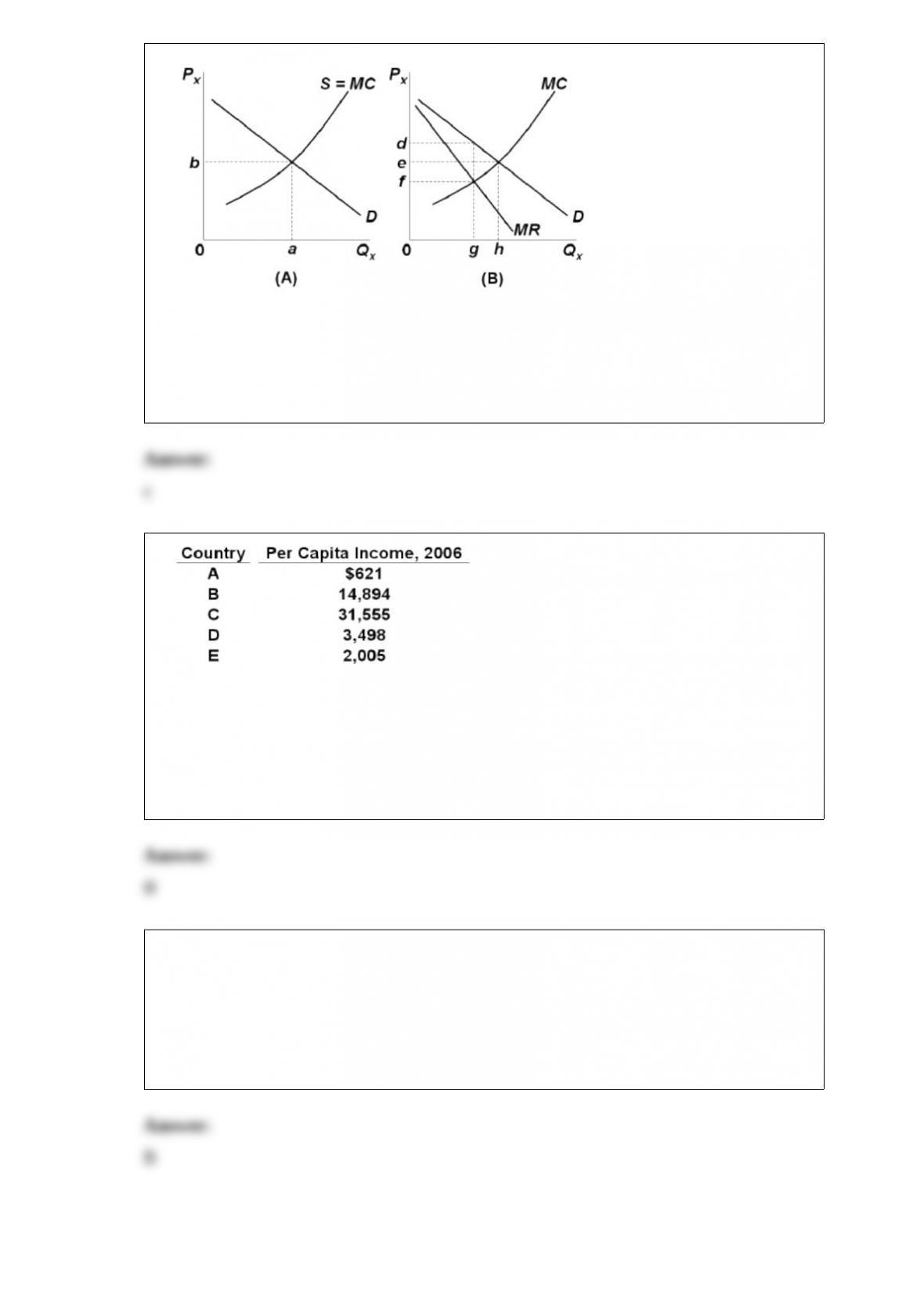
refer to the above diagrams. diagram (b) represents:
a.the pure competition model.
b.an industry in which there is allocative efficiency but not productive efficiency.
c.the pure monopoly model.
d.a long-run constant-cost industry.
2)
Refer to the above table. If per capita income increases by 10 percent over five years in
each of the nations shown, the per capita income gap between country C and country A:
A.will remain the same.
B.will rise from $30,934 to $34,027.
C.may rise or fall depending on the rate of population growth.
D.will rise from $31,555 to $34,710.
3) Suppose that nominal wages fall and productivity rises in a particular economy.
Other things equal, the aggregate:
A.demand curve will shift leftward.
B.supply curve will shift rightward.
C.supply curve will shift leftward.
D. expenditures curve will shift downward.

4) Given a 25 percent reserve ratio, assume the commercial banking system is loaned
up. Now assume the reserve ratio is reduced to 20 percent. As a result of this reduction:
A.we can expect bank lending and bank profits to decline.
B.each dollar of bank reserves will now support a maximum of $5 of checkable
deposits.
C.the banking system must now reduce outstanding loans by 5 percent.
D.the banking system can now increase lending by 5 percent.
5) The food-stamp program is designed to:
A.increase the supply of farm products.
B.decrease the supply of farm products.
C.increase the demand for farm products.
D.decrease the demand for farm products.
6) assume that in 2002 the nominal gdp was $350 billion and in 2003 it was $375
billion. on the basis of this information we:
a.cannot make a meaningful comparison of the economy’s performance in 2002 relative
to 2003.
b.can conclude that the economy was achieving real economic growth.
c.can conclude that real gdp was higher in 2002 than in 2003.
d.can conclude that real gdp was lower in 2002 than in 2003.
7) economy a: gross investment equals depreciation economy b: depreciation exceeds
gross investment economy c: gross investment exceeds depreciation
other things equal, the above information suggests that the production capacity in
economy:
a.b is growing more rapidly than either a or c.
b.a is growing more rapidly than either b or c.
c.a is growing less rapidly than economy b.
d.c is growing more rapidly than economy b.
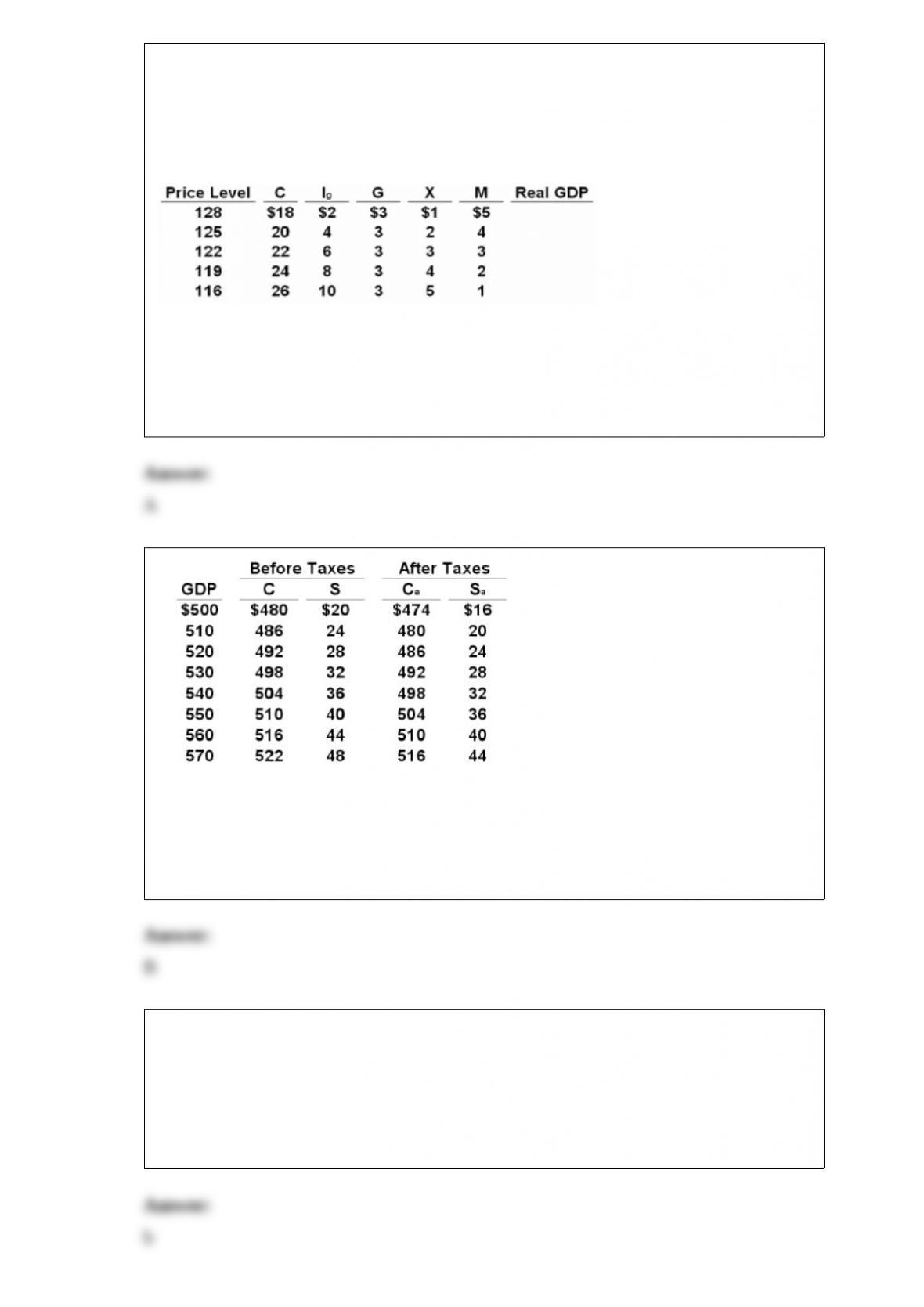
8) Answer the next question(s) on the basis of the following table for a particular
country in which C is consumption expenditures, Ig is gross investment expenditures, G
is government expenditures, X is exports, and M is imports. All figures are in billions of
dollars. Each question is independent of the other questions.
Refer to the above table. The real-balances effect of changes in the price level is:
A.shown by columns (1) and (2) of the table.
B.shown by columns (1) and (5) of the table.
C.shown by columns (1) and (4) of the table.
D.not shown by the data in the table.
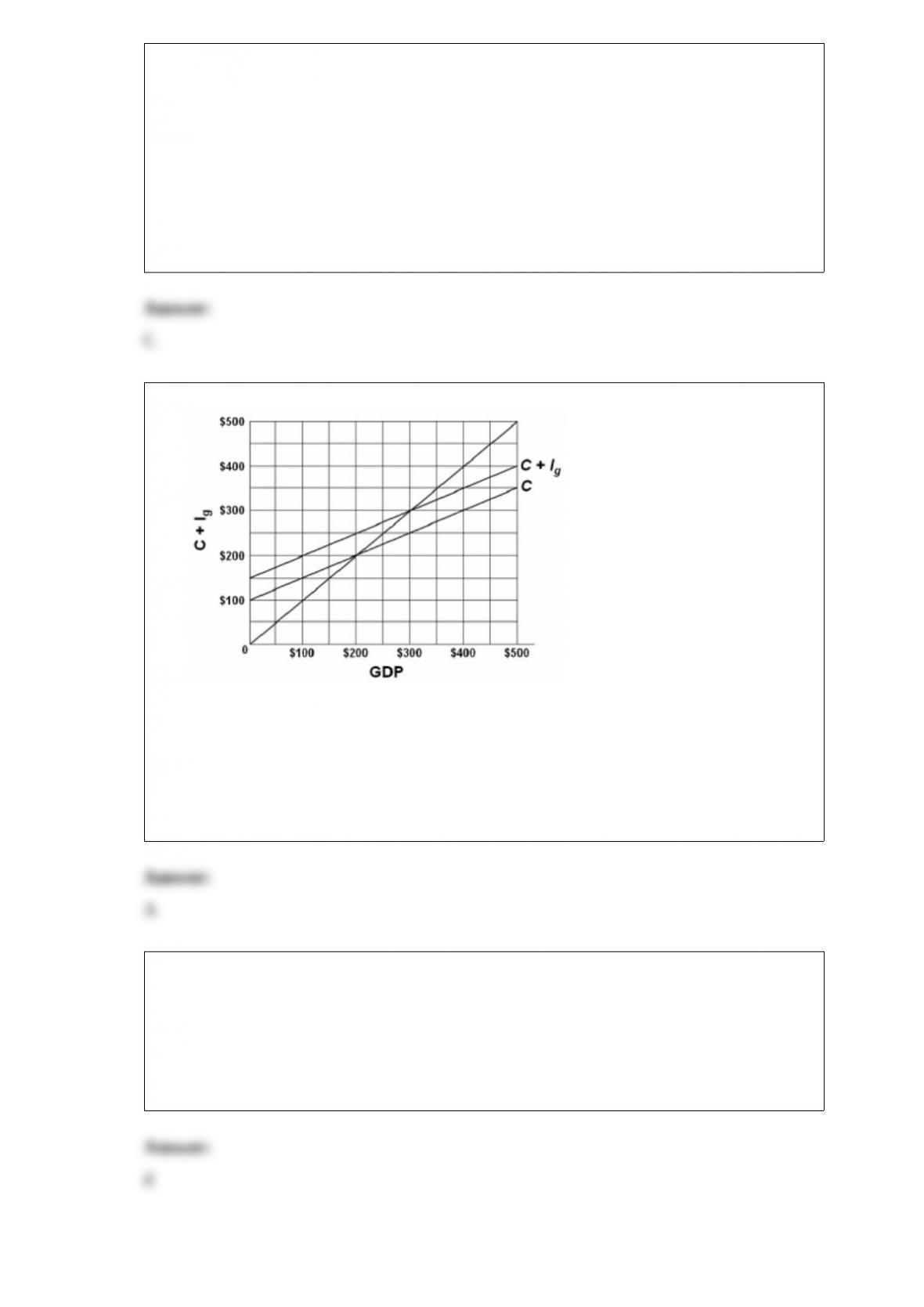
9)
The MPC and MPS in the above economy:
A.are .4 and .6 respectively.
B.are .6 and .4 respectively.
C.are .8 and .2 respectively.
D.cannot be determined from the information given.
10) in the long run a pure monopolist will maximize profits by producing that output at
which marginal cost is equal to:
a.average total cost.
b.marginal revenue.
c.average variable cost.
d.average cost.
11) Other things equal, appreciation of the dollar:
A.increases aggregate demand in the United States and may increase aggregate supply
by reducing the prices of imported resources.
B.increases aggregate demand in the United States and may decrease aggregate supply
by reducing the prices of imported resources.
C.decreases aggregate demand in the United States and may increase aggregate supply
by reducing the prices of imported resources.
D.decreases aggregate demand in the United States and may reduce aggregate supply
by increasing the prices of imported resources.
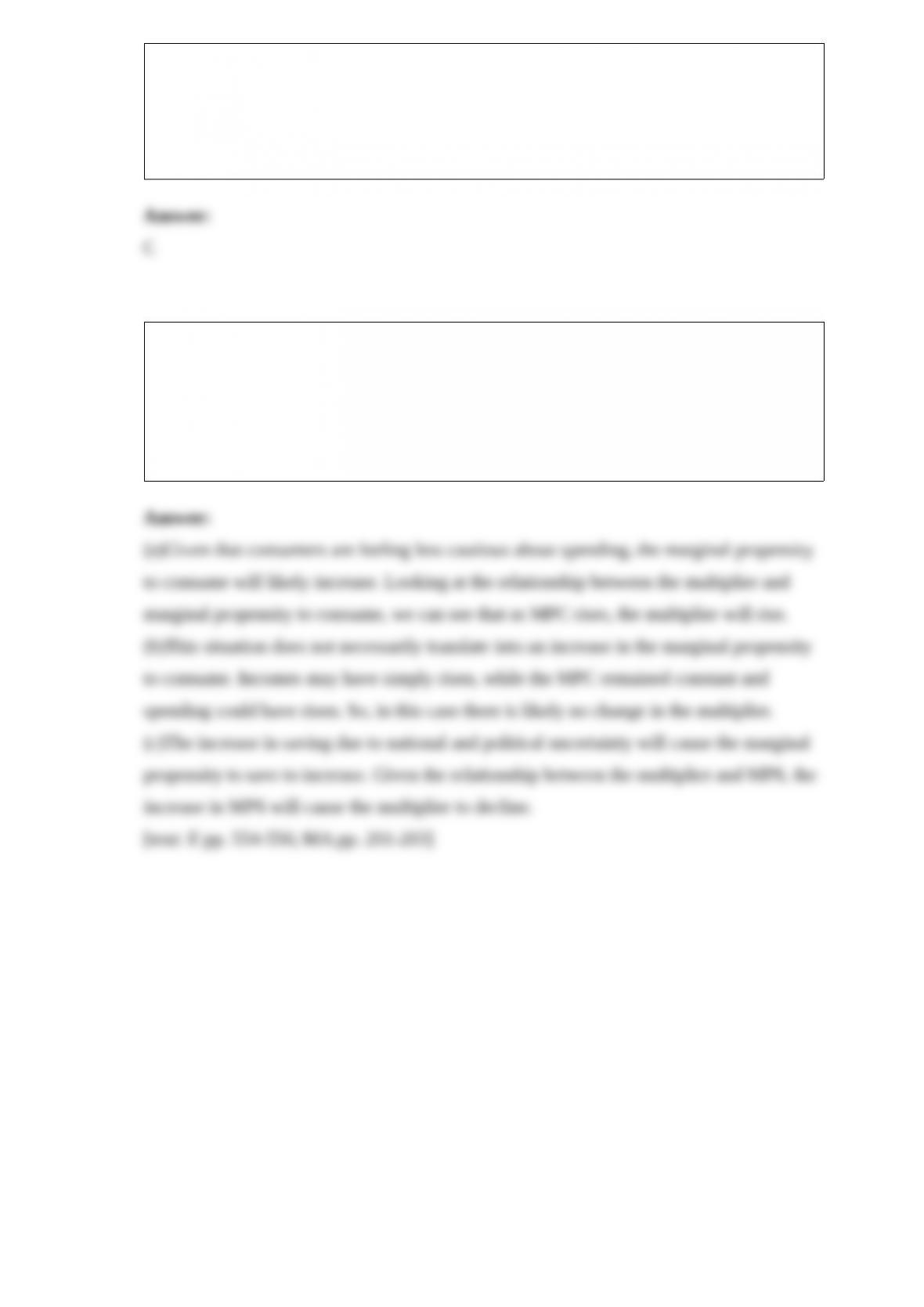
12)
Refer to the above diagram for a private closed economy. At the equilibrium level of
GDP, investment and saving are both:
A.$50.
B.$100.
C.$20.
D.$40.
13) (last word) which of the following problems has not accompanied china’s rapid
economic growth over the past twenty-five years?
a.high rates of inflation.
b.structural unemployment of displaced agricultural workers.
c.uneven economic development.
d.falling per capita income.
14) An increase in the poverty rate:
A.will necessarily shift the Lorenz curve toward the diagonal.
B.will necessarily shift the Lorenz curve away from the diagonal.
C.may leave the Lorenz curve unchanged.
D.normally accompanies strong growth of the economy.
15) Consider the effect of the following on the multiplier.
(a)As a recession ends and recovery begins consumers are feeling less cautious about
spending.
(b)As the economy moves into an expansion, spending increases.
(c)Uncertainty about national security and political relations abroad causes the public to
adjust by saving more to use in case of an economic downturn worldwide.