1)
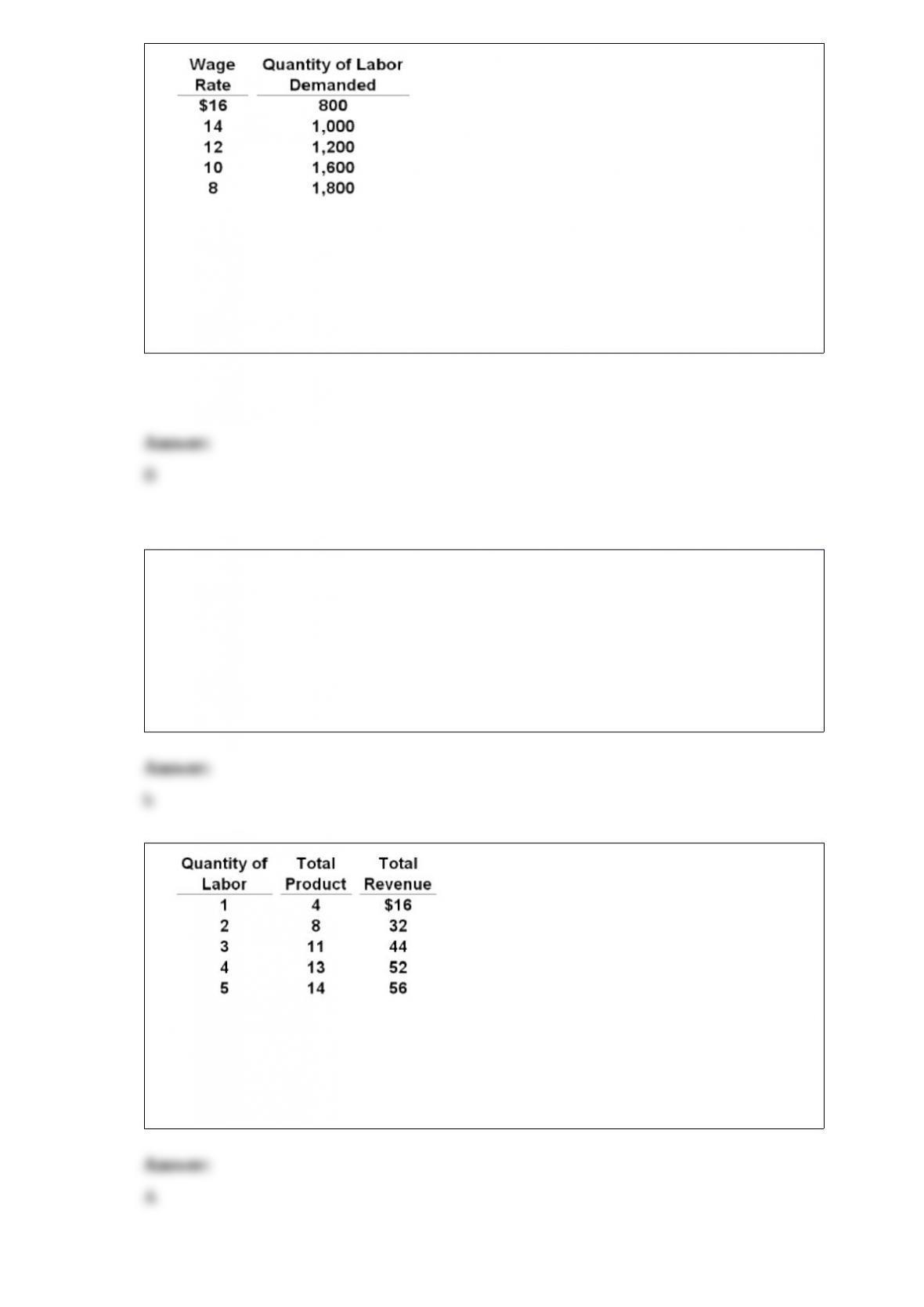
Refer to the above data. Suppose that the union that provides labor to firms in this
market successfully negotiates an increase in the wage rate from $8 to $10. As a result
of the wage increase, firms will hire:
A.fewer workers and the total paid out for wages will decline.
B.fewer workers, but the total paid out for wages will increase.
C.fewer workers, but the total paid out for wages will remain unchanged.
D.more capital, if capital and labor are used in fixed proportions in production.
2) other things equal, and given that the elasticity of demand of health care is 0.2, a 10
percent increase in the price of health care in the united states will reduce the quantity
of health care demanded by about:
a.1 percent.
b.2 percent.
c.5 percent.
d.10 percent.
3)
Refer to the above data. The marginal revenue product of the fourth worker is:
A.$8.
B.$52.
C.$2.
D.$4.
4) Rapid population growth since 1800 has occurred primarily because of:
A.a significant increase in total fertility rates as living standards have risen.
B.a significant reduction in death rates as living standards have risen.
C.a significant increase in replacement rates as living standards have risen.
D.all of these.
5) which of the following best illustrates the circular flow model in action?
a.bobbie goes to work and builds cars, and uses the income she receives to buy food at
the grocery store.
b.evan buys a new couch; the owner of the furniture store uses some of the money from
the sale to pay her supplier, and uses the rest to take her family out to dinner.
c.boeing experiences a surge in orders for new airplanes, prompting the company to
hire more workers.
d.all of the above.
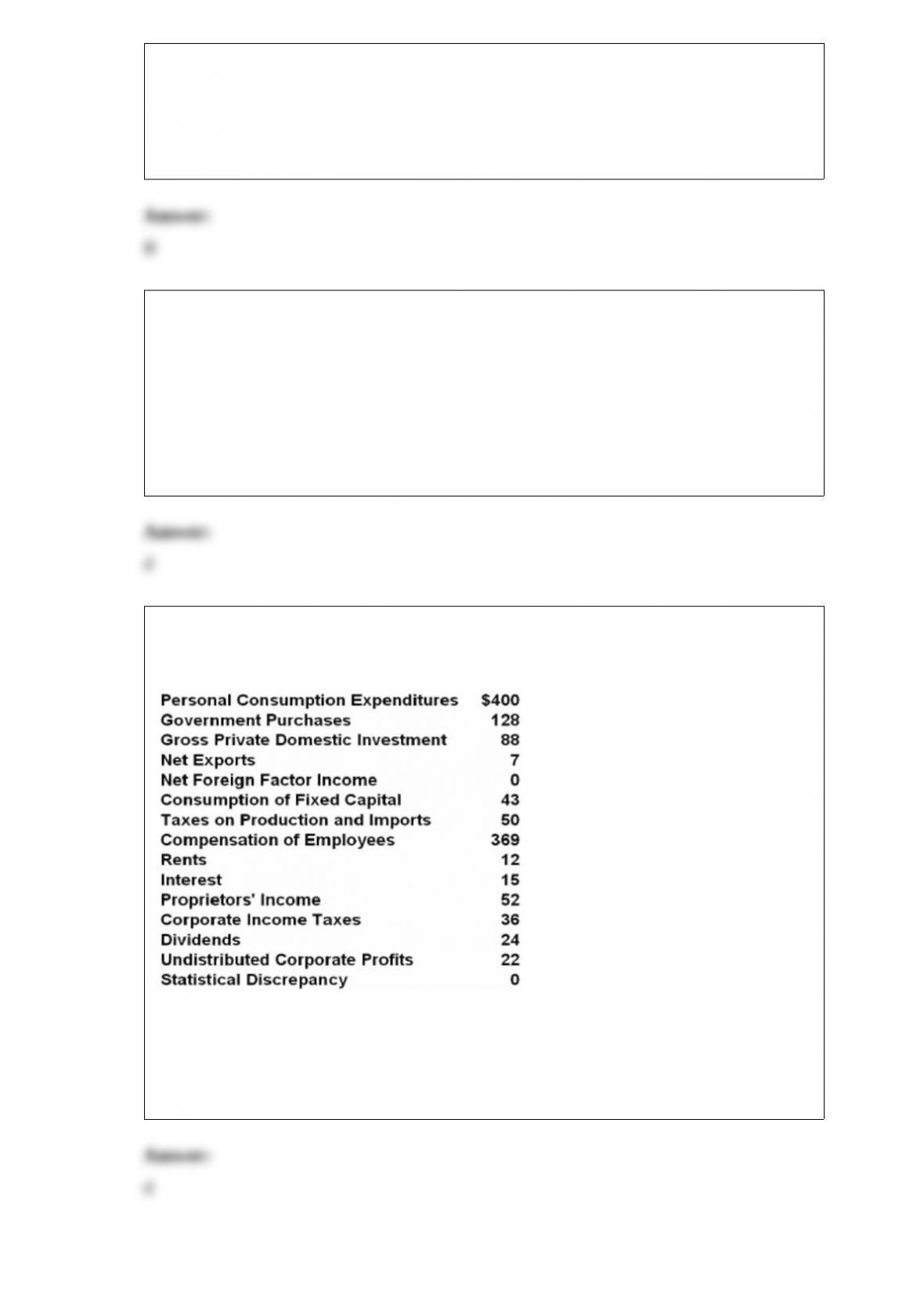
6) answer the next question(s) on the basis of the following national income data for the
economy. all figures are in billions of dollars.
the gross domestic product for the above economy is:
a.$584.
b.$592.
c.$609.
d.$623.

7) which of the following pairs of countries were admitted to the european union in
2007?
a.croatia and kosovo
b.romania and bulgaria
c.switzerland and hungary
d.tunisia and liechtenstein
8) real income can be determined by:
a.dividing the price level by nominal income.
b.inflating nominal income for inflation.
c.dividing the annual rate of inflation into the number “70.”
d.deflating nominal income for inflation.
9) In fisheries management, a fishery is defined as:
A.an operation that breeds and releases fish and other marine animals into the wild.
B.a stock of fish or other marine animals that can be thought of as a logically distinct
group.
C.a company that harvests fish or other marine animals.
D.a government organization that regulates the harvesting of fish and other marine
animals.
10) The seven members of the Board of Governors of the Federal Reserve System are:
A.appointed by the President with the confirmation of the Senate.
B.elected by Congress from a slate of nominees provided by the President.
C.appointed by the Senate Finance Committee.
D.appointed by the presidents of the twelve Federal Reserve Banks.
11) in the past several decades u.s. health care expenditures have:
a.risen absolutely, but declined as a percentage of gdp.
b.declined absolutely, but risen as a percentage of gdp.
c.risen absolutely and as a percentage of gdp.
d.declined absolutely and as a percentage of gdp.

12) In economics, the expression “You can lead a horse to water, but you cannot make it
drink” illustrates the:
A.crowding-out effect.
B.cyclical asymmetry of monetary policy.
C.administrative lag that occurs in formulating monetary and fiscal policies.
D.operational lag in monetary policy.
13) an increase in consumer incomes will:
a.increase the demand for an inferior good.
b.increase the supply of an inferior good.
c.increase the demand for a normal good.
d.decrease the supply of a normal good.
14) The antitrust laws are based on the:
A.creative destruction view of competition.
B.idea that competition leads to greater economic efficiency than does monopoly.
C.view that nonprice competition should be strictly regulated by government.
D.view that all negative externalities should be eliminated by government action.
15)
Refer to the above graphs. These production possibilities curves:
A.demonstrate that there can be gains from specialization and trade between the two
nations.
B.reflect the law of increasing opportunity costs.
C.reflect the law of diminishing marginal utility.

D.imply that specialization will be incomplete.
16) Technological advance improves productive efficiency by:
A.lowering average total cost.
B.increasing marginal utility.
C.enhancing monopoly power.
D.decreasing a nation’s exports.
17) Which of these sets of nations are low-income developing nations?
A.Brazil, Australia, South Africa
B.Uganda, India, and Madagascar
C.Canada, Switzerland, and France
D.Germany, South Korea, and Mexico
18) What issues in U.S. banking precipitated the creation of the Federal Reserve System
in 1913?
19) Suppose the First National Bank has the following simplified balance sheet. The
reserve ratio is 20%.

Assume that households and businesses deposit $5000 in this bank and that this
currency is added to the banks reserves.
In column (1) show the banks balance sheet after this occurs. Is there a change in the
money supply?
In column (2) show what would happen if the bank now loans all of its excess reserves
to a depositor. Is there a change in the money supply?
20) Identify how ideas from monetarism and rational expectations have been
incorporated into mainstream thinking about macroeconomics.

21) Suppose an economys real GDP is $700 billion in year 1 and $718 billion in year 2.
What is the growth rate of its GDP?
22) What are four real and potential problems with the public debt?
23) How have the values of nominal GDP, real GDP and GDP price index changed in
the United States since the year 2000?

24) Trace the cause-effect chain that results from an expansionary monetary policy.
25) Why does price equal marginal revenue for the purely competitive firm? What is
the relationship to the demand curve for the firm?
26) What is the GDP price index?
27) Suppose Mark has the option of investing in two different investments that cost
$200 each. One promises to earn 5% in compounded interest over the next 5 years. The
other promises to earn $255.26 in 5 years. Assume the interest rate is 5%. Which asset

will he choose?