When surveyed regarding the potential benefit of a public good, consumers will tend to
underestimate their benefit from consumers the good.
Cleantown and Grimyville are identical except for the inferior air quality in Grimyville.
All potential residents have identical tastes. Apartments in Cleantown rent for $400 per
month. The cost of breathing Grimyville air is $75 per month. The quantity of
apartments in each town is fixed.
Whether or not people have identical tastes, a commonly owned property creates no
social value.
When a payroll tax is imposed, labor is the only source of income that is taxed. When
an income tax is imposed, all sources of income are taxed.
A solution concept is any way of analyzing a game which leads to the discovery of a
Nash equilibrium which solves the game.
A bond that promises a series of payments on different dates is a perpetuity.
The following was heard on a primetime news cast.
“The government has just increased the sales tax. This is unfair to consumers,
particularly the poor, because budgets are already stretched far enough. It would have
been much more fair for the government to have levied an excise tax on firms as a way
of making big business give back to the community.”
Explain why the person’s argument is more than likely incorrect. Be sure to discuss
whether the person has over or understated the effect of the tax on consumers and
producers.
Since Marginal Revenue measures the additional revenue generated by selling one more
unit of the product, it must always be positive.
When the quantity demanded by consumers goes up, we can be sure that there has been
a rise in demand.
According to Pigovian analysis, external costs will cause a good to be underproduced
relative to the social optimum.
An outcome is a Nash equilibrium if and only if both players agree that the outcome is
desirable.
Both first-degree price discrimination and the two-part tariff, when perfectly
implemented, reduce consumers’ surplus to zero.
In third-degree price discrimination, the monopoly receives the highest marginal
revenue from the group that is charged the highest price.
Consider a game in which a player has a dominant strategy.
Consider the following:
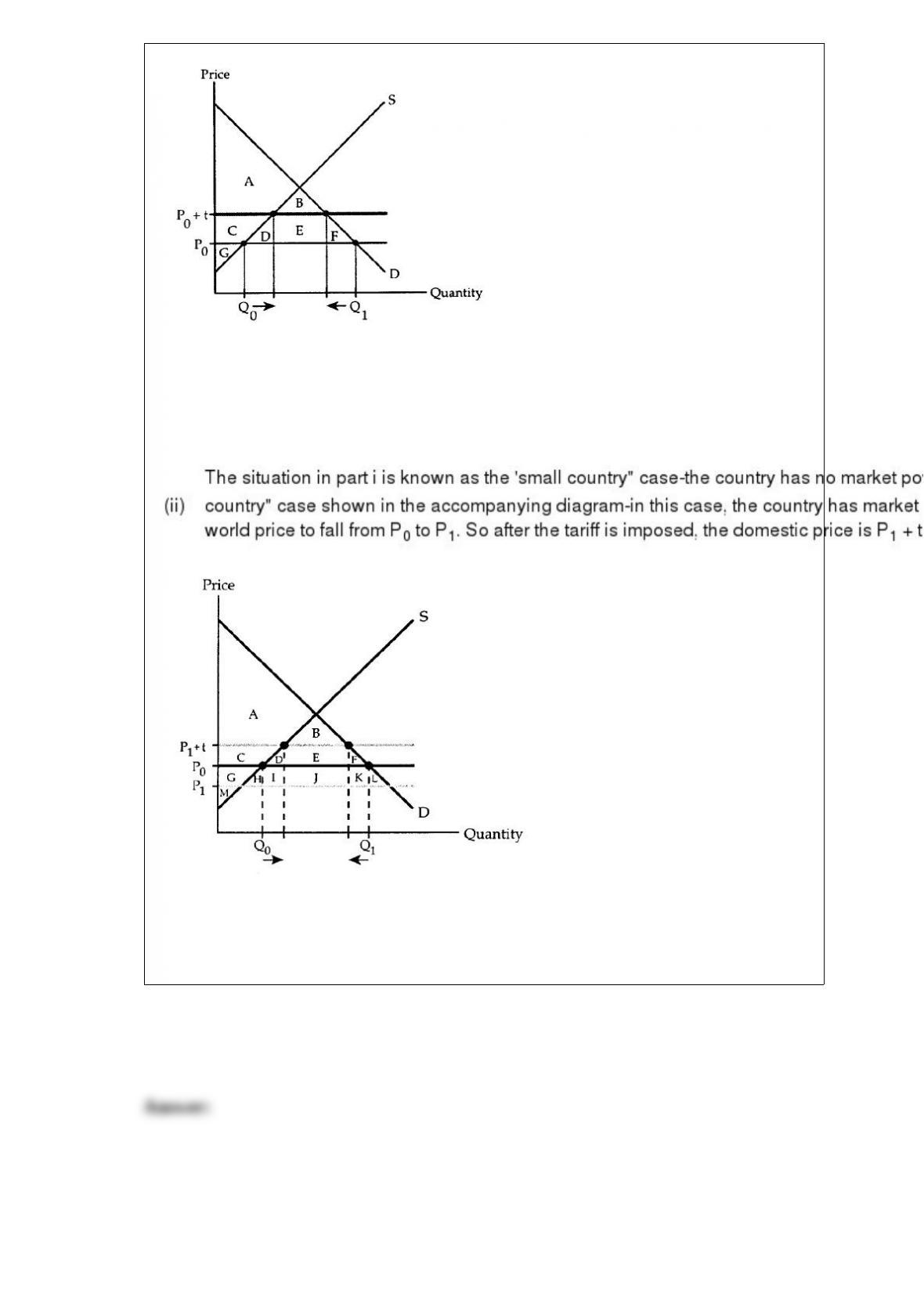
How does the tariff affect consumers’ surplus and producers’ surplus? How much tariff
revenue is collected by the government? Does imposing the tariff cause the country’s
social gain to rise or fall?
How does the tariff affect consumers’ surplus and producers’ surplus in this situation?
How much tariff revenue is collected by the government? When a “large country”
imposes a tariff, will its social gain rise or fall?
Allowing firms compete freely in a market with a negative externality is not socially
optimal because the level of production will be too high.
The equilibrium price of a good will rise in response to either a rise in demand or a fall
in supply.
North Dakota has 300 acres of farmland; each acre can produce either 20 bushels of
wheat or 10 bushels of corn. Iowa has 200 acres of farmland; each acre can produce
either 20 bushels of wheat or 30 bushels of corn.
(i) What is the cost of growing a bushel of wheat in each state? What is the cost of
growing a bushel of corn in each state?
(ii) Suppose each state is self-sufficient and there is no trade. If each state chooses to
produce equal amounts of the two crops, how much wheat and corn will each state
produce?
(iii) If the two states begin to trade, with each specializing in its area of comparative
advantage, which state will produce wheat and which state will produce corn? How will
the total production between the two states compare to the situation where each was
self-sufficient?
The income elasticity of demand is equal to the slope of the Engel curve.
All points on the expansion path have the same marginal rate of technical substitution.