The common way of expressing the efficient market concept is
A) “the only true market is a profitable market.”
B) “there’s no such thing as a free lunch.”
C) “only without government interference can a market survive.”
D) “once an efficient market, always an efficient market.”
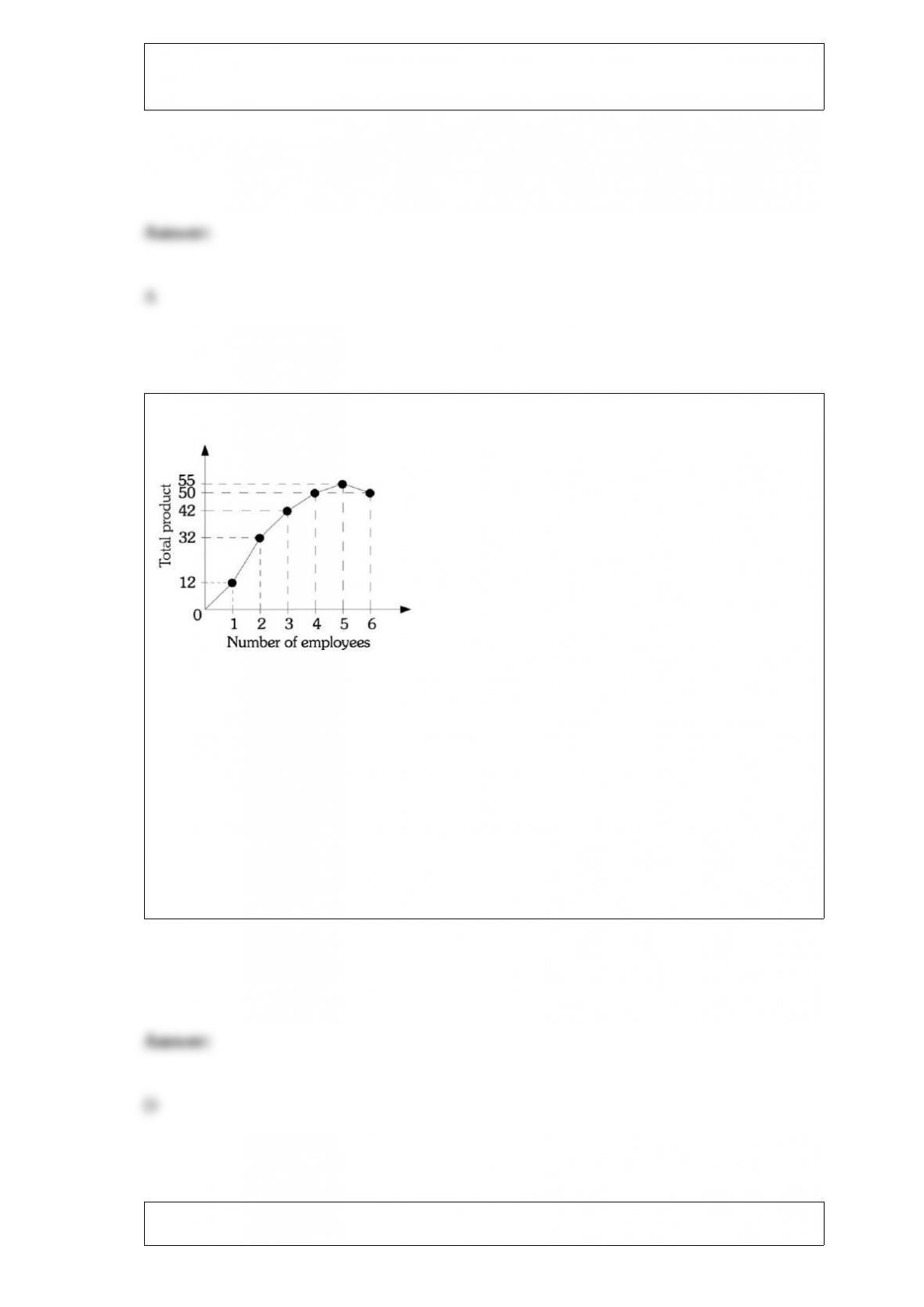
When a firm maximizes total product in the short run, marginal product
A) and average product are zero.
B) is positive but average product is zero.
C) is zero but average product is positive.
D) and average product are positive.
Table 8.3
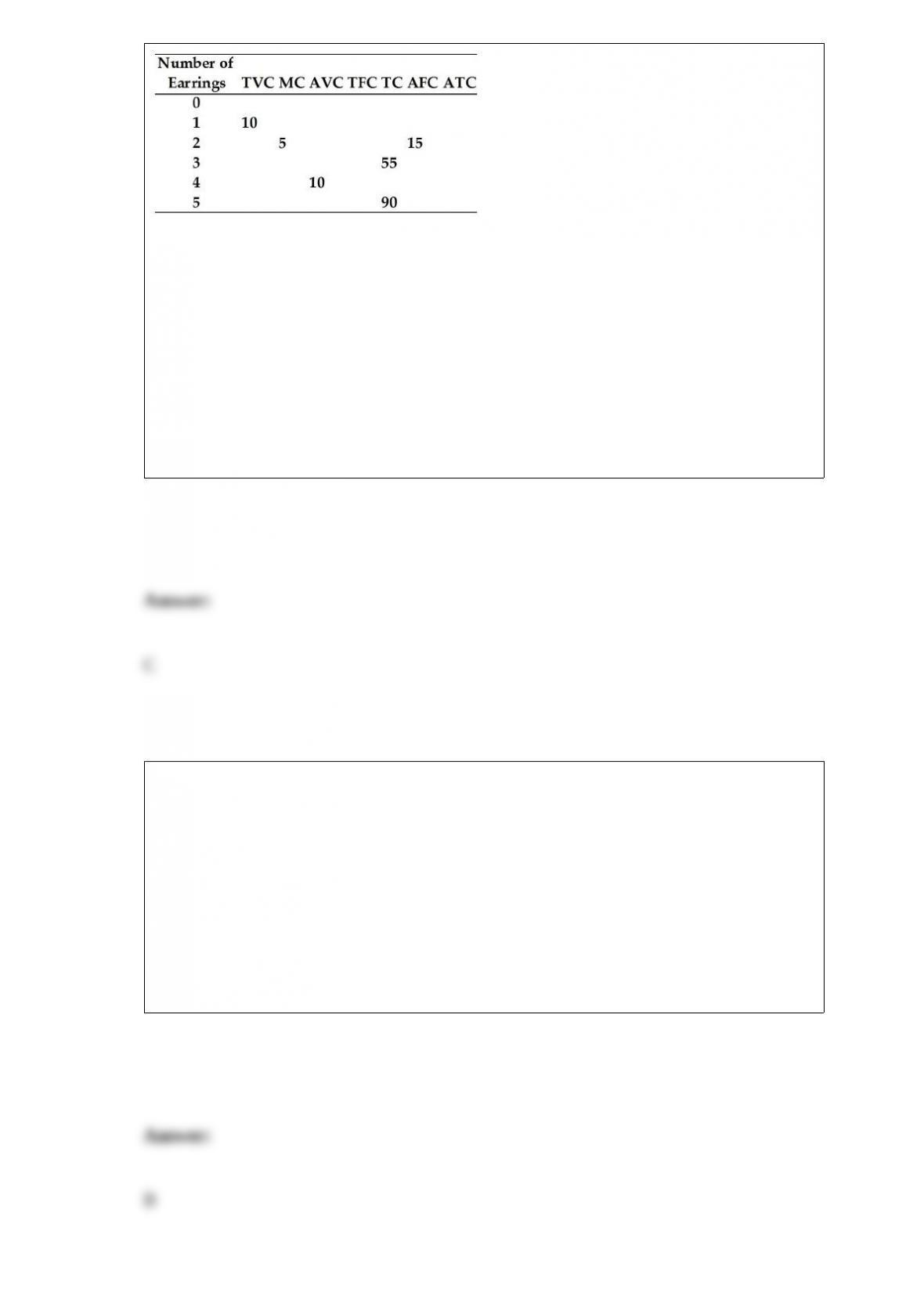
Refer to Table 8.3. If the firm is in a perfectly competitive industry with a market price
of $15 per unit, the firm will produce ________ units and earn a profit of ________.
A) three; $10
B) four; $10
C) four; -$10
D) five; $15
________ arises when people realize they will still receive the benefits of a good
whether they pay for it or not.
A) The voting paradox
B) The free-rider problem
C) Logrolling
D) The drop-in-the-bucket problem

In ________ markets, large oligopolistic firms end up behaving like perfectly
competitive firms.
A) monopolistically competitive
B) monopoly
C) contestable
D) blocked
A national campaign is asking for contributions of $1.00 per citizen to fund the building
of the September 11th memorial in New York City. The total cost of the memorial is
estimated to be $260 million. You decide not to contribute, because your contribution
would be small relative to the total that it won’t make any difference whether you
contribute or not. This is an example of the ________ problem.
A) nonexcludable
B) nonrival in consumption
C) free-rider
D) drop-in-the-bucket

If there are external costs of production and perfectly competitive firms do not account
for these costs, at the equilibrium level of output
A) P = MC = MSC.
B) P = MC and P < MSC.
C) P = MC and P > MSC.
D) P > MC and P = MSC.
The marginal benefit for a particular food is described by MB = 60 – q, where q refers to
the quantity of the food. The marginal cost of producing the food is described by MC =
3q. There is a negative externality associated with food production and the marginal
social cost of food production is MSC = 5q.
The efficient output level is ________, and the efficient price is ________.
A) 10 units of food; $20
B) 10 units of food; $50
C) 0 units of food; $0
D) 20 units of food; $40
If the government imposes a maximum price that is above the equilibrium price,

A) this maximum price will have no economic impact.
B) quantity demanded will be less than quantity supplied.
C) demand will be greater than supply.
D) the available supply will have to be rationed with a nonprice rationing mechanism.
In the long run, a monopoly
A) will always earn zero economic profits.
B) may earn positive economic profits due to entry barriers.
C) will never exit the industry.
D) will yield an efficient outcome.
The difference between current market price and full costs of production for the firm is
known as
A) consumer surplus.
B) producer surplus.
C) market surplus.
D) nonprice surplus.
The demand for Ben & Jerry’s ice cream will likely be ________ the demand for
dessert.
A) more price elastic than
B) less price elastic than
C) equally price elastic as
D) indeterminate from the given information.
Economic growth will most likely occur when
A) a society acquires new resources.
B) a society decides to produce less using existing resources.
C) the society begins to produce the combination of goods society wants most.
D) technology remains unchanged but unemployment increases.

The impossibility theorem is the idea that
A) we cannot devise a voting scheme that respects individual preferences and gives
consistent, non-arbitrary results.
B) it is impossible to exclude someone from enjoying the benefits of a public good.
C) it is impossible for lawmakers to get legislation passed without agreeing to help
other lawmakers get their legislation passed.
D) private parties cannot arrive at the efficient solution without government
intervention.
Your upstairs neighbor has the right to practice his clog dancing at night. But you find
the best time to study is at night, and the noise from the clog dancing makes it hard for
you to concentrate. You tell your neighbor that you will wash his car every week if he
does not practice his clog dancing at night and he agrees to this. This is an example of
the
A) free rider problem.
B) drop-in-the-bucket problem.
C) Coase theorem.
D) fallacy of composition.

A monopolist suffers a loss if its ________ schedule is everywhere above its ________
schedule.
A) ATC; MC
B) MC; AVC
C) ATC; Demand
D) Demand; ATC
A lawn service company has the following production possibilities. With one, two,
three, and four workers, the company can mow 5, 12, 17, and 20 lawns per day,
respectively.
The marginal product of the fourth worker is
A) 2
B) 3
C) 17
D) 20
A government wants to reduce electricity consumption by 10%. The price elasticity of
demand for electricity is -5. The government must ________ the price of electricity by
________.
A) raise; 2.0%
B) raise; 0.5%
C) raise; 1.25%
D) lower; 0.5%
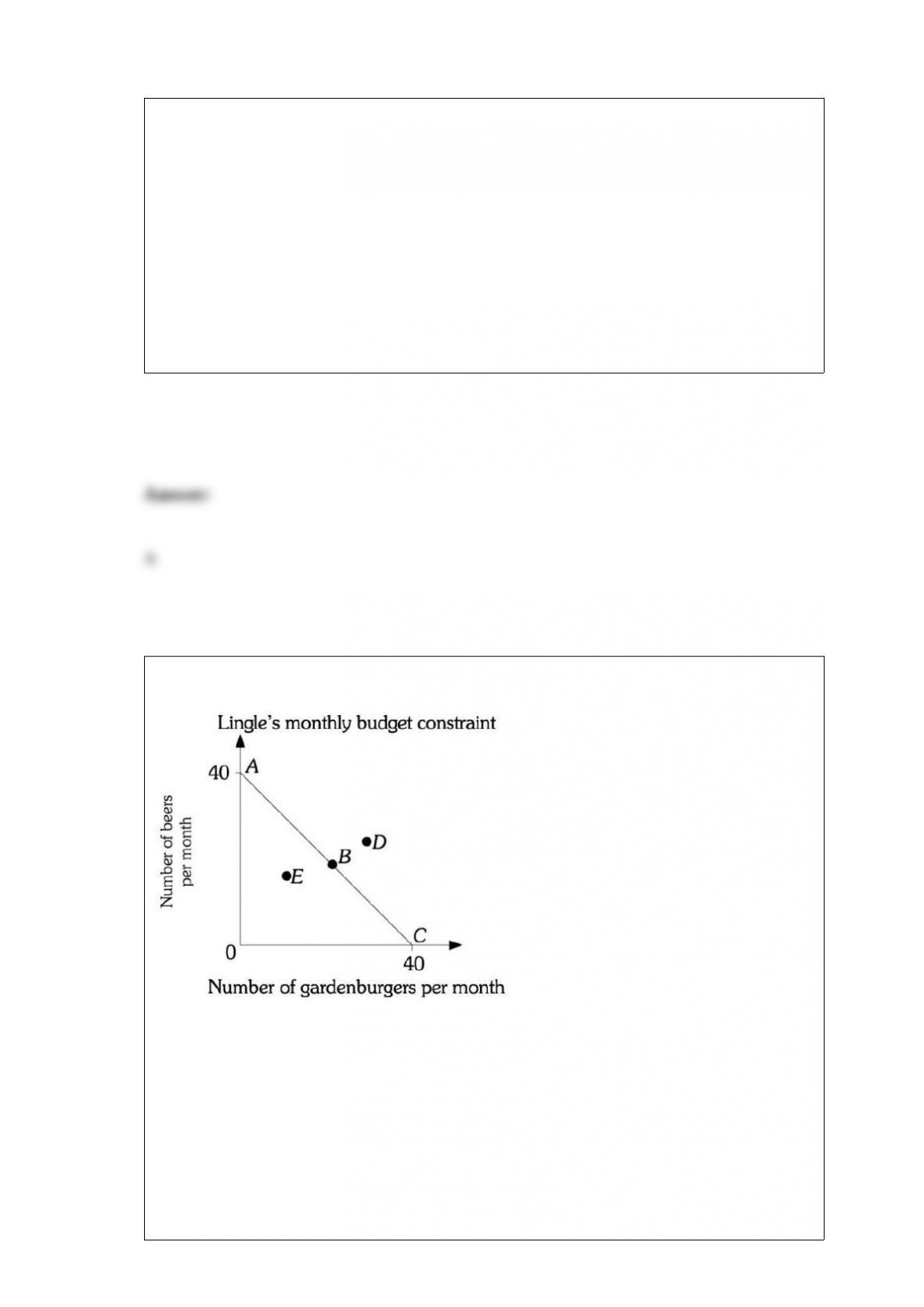
Figure 6.2
Refer to Figure 6.2. Mr. Lingle’s budget constraint is AC. Point C is
A) an available option and Mr. Lingle exactly spends all of his income.
B) an available option and Mr. Lingle does not spend all of his income.
C) not in Mr. Lingle’s opportunity set but is on his budget constraint.
D) not available because it represents a combination of gardenburgers and beer that Mr.
Lingle cannot purchase with his current income.
Figure 7.4
Refer to Figure 7.4. The average product of the sixth worker is
A) -8.33.
B) -5.
C)5
D) 33.
Tom’s Donuts can invest in a new espresso machine that costs $300 and will yield

expected profits of $200 each year for two years. What is the present discounted value
of the expected profits from this investment if the interest rate is 5%?
A) $185.93
B) $276.64
C) $371.89
D) $380.96
A Gini coefficient of ________ means that the income is equally distributed.
A) 0
B) 1
C) 50
D) 100
Related to the Economics in Practice on page 69: Increased preference for coffee in
China would most likely shift the demand curve for coffee to the ________ and lead to
a(n) ________ in the price of coffee, ceteris paribus.
A) left; increase
B) left; decrease
C) right; increase
D) right; decrease
Figure 15.2
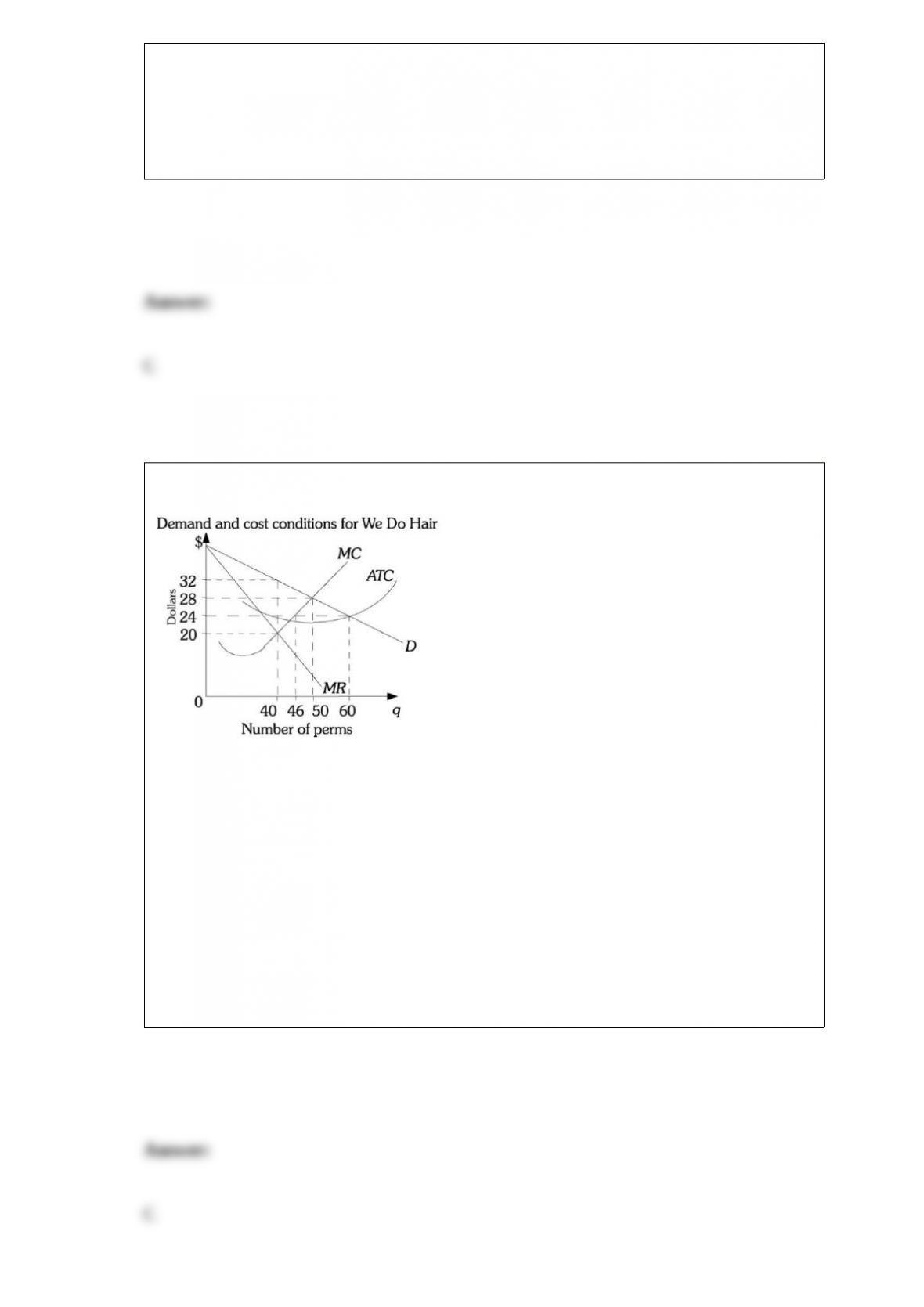
Refer to Figure 15.2. If We Do Hair is maximizing profit as a monopolistically
competitive firm, it is earning a profit of
A) $180.
B) $220.
C) $320.
D) $480.

Less investment takes place at
A) higher market interest rates.
B) lower market interest rates.
C) lower expected rates of return.
D) lower real interest rates.
During 2013, Yolanda’s assets equal $200,000 and her net worth is $50,000. Yolanda’s
liabilities are
A) $50,000.
B) $150,000.
C) $200,000.
D) $250,000.
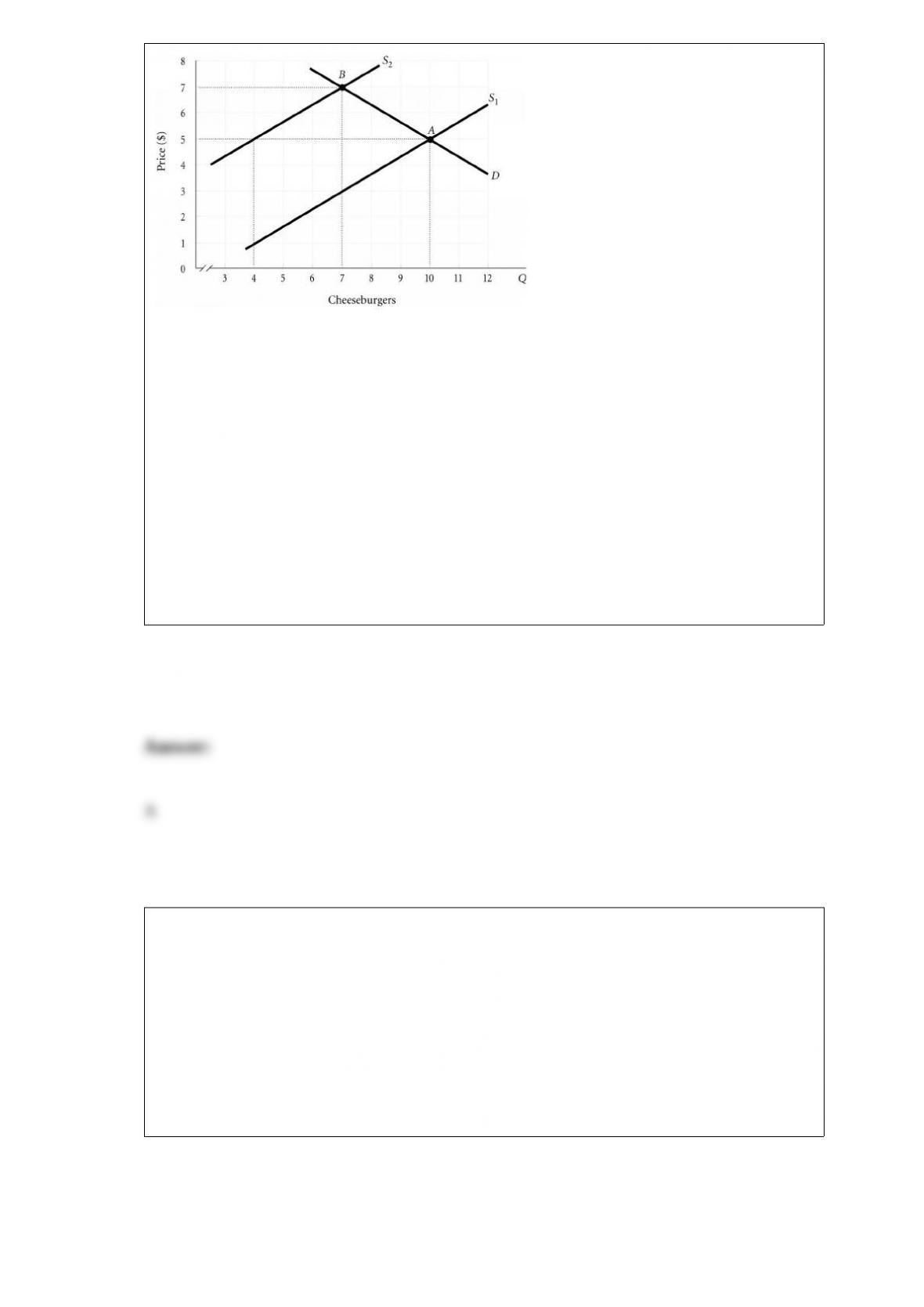
Figure 3.13
Refer to Figure 3.13. The market is initially in equilibrium at Point A. If supply shifts
from S1 to S2, the equilibrium price will change from ________ and the equilibrium
quantity will change from ________.
A) $5.00 to $7.00; 10 to 7
B) $5.00 to $7.00; 4 to 7
C) $7.00 to $5.00; 7 to 4
D) $7.00 to $5.00; 7 to 10
________ is the amount that a consumer pays to consume an additional unit of a good.
A) Marginal social cost
B) Marginal benefit cost
C) Marginal damage cost
D) Marginal private cost

If firms in a monopolistically competitive industry are incurring losses, in the long run
A) investment in this industry will increase to reduce production costs.
B) firms will leave this industry until the remaining firms are earning a normal profit.
C) firms will leave this industry until the firms that remain are earning a positive
economic profit.
D) the government will subsidize the losses incurred by these firms so as to maintain
competition in the industry.
A firm competing in a perfectly competitive labor market desires to maximize
________.
A) marginal profit, not total profit
B) total profit, not marginal profit
C) marginal profit, not average profit
D) average profit, not marginal profit

Wheat is produced in a perfectly competitive market. Market demand for wheat
increases. This will cause the individual wheat farmer’s marginal revenue to ________
and their profit maximizing level of output to ________.
A) increase; increase
B) increase; decrease
C) decrease; increase
D) decrease; decrease
Oligopolists must ________ to their strategy in order to determine their optimal
strategy.
A) anticipate the reaction of their customers
B) anticipate the reaction of their rivals
C) both A and B are correct.
D) none of the above
Compare the market supply curves in a perfectly competitive market and a monopoly
market.
What is a consent decree?
What is meant by the statement “People trade, not nations.”
Suppose that the price elasticity of demand for snow shovels is “1.2. What would have
to happen to the price of a snow shovel for the quantity demanded to fall from 2,000 to
1,800? Use the midpoint formula in your calculations.
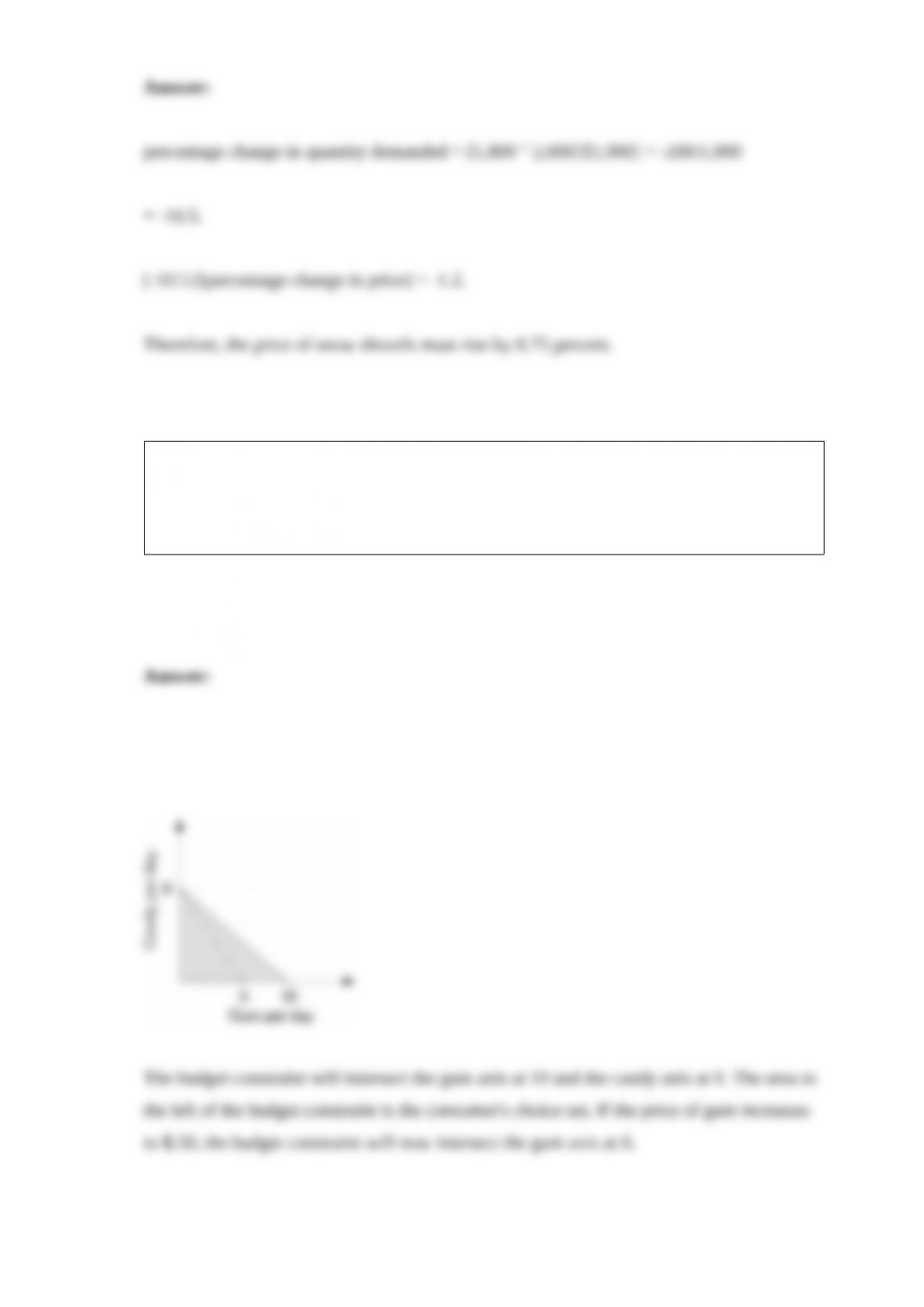
Assume that Paula can buy gum or candy. A pack of gum costs $.30 and a candy bar
costs $.50. Paula has $3.00 a day to spend on gum and candy bars. Draw Paula’s budget
constraint. Shade in Paula’s choice set. On the graph show how Paula’s budget
constraint will be affected if the price of gum increases to $.50.
The railroad companies of Pacific Union and Central Pacific were both built with
massive government subsidies often on a per-mile basic in the late 19th century, which
created railroad monopolies. Both failed soon after completion of their lines. The Great
Northern railroad took much longer to build since it was completed without government
subsidies. It turned out to be much more successful than either Pacific Union or Central
Pacific. What could account for this apparent disparity?
Discuss the theory of the ability-to-pay principle.
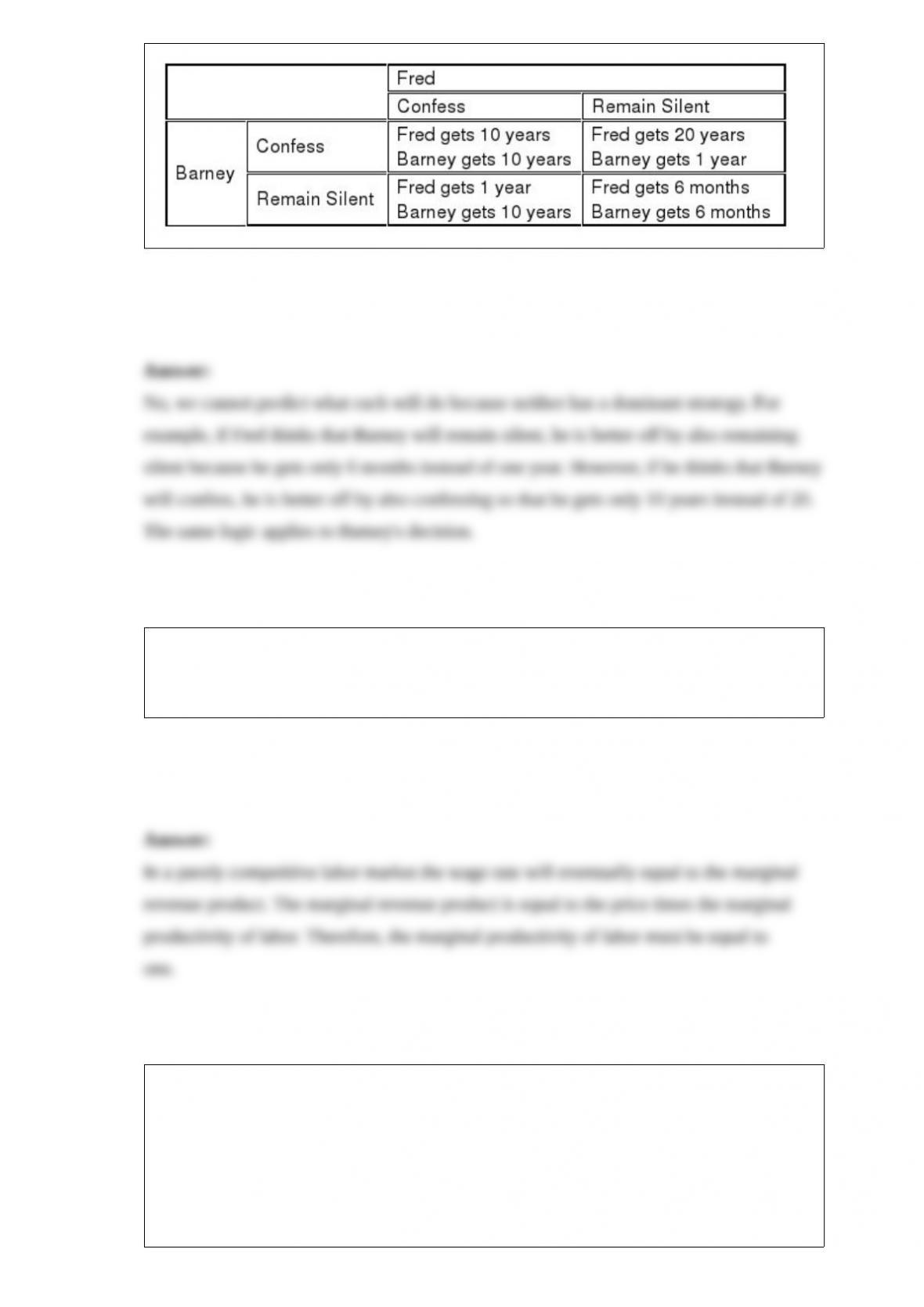
Fred and Barney are arrested and charged with illegal concealment of a weapon. The
police suspect that Fred and Barney have robbed the local McDino’s (fast food
restaurant), but do not have enough evidence to make the robbery charge stick. The
district attorney separates them and offers them the deal shown in the payoff matrix
below. Can we predict what each will do? Explain.
Assume that workers in a purely competitive industry are earning a wage rate of $15
and the price of the product they are producing is also $15 what does this imply about
the marginal productivity of these workers?
Scenario 1
Let’s say that you only have enough time to take two college courses in a semester. You
also only have 15 hours per week to devote to both courses ” French and Economics.
Assume that you could earn a “70” in both courses even if you didn’t study at all for
either course. If you study for either course your productivity is such that each hour
spent studying for a course earns you 2 points for your grade in that course.
Using Scenario 1 what is the maximum grade you could earn in any one course? If you
wanted to earn a grade of 90 in French but no better than a 70 in economics are you
operating on your budget constraint? Why or why not?
If total costs are $18,000 for the year, and the firm has fixed costs of $12,000, what is
the level of the firm’s variable costs?
Below are the demand, marginal cost, and marginal revenue curves for Lita’s, Inc. Lita
has decided that her firm should produce 20 units per day. Is this the profit-maximizing
level of output? Explain.
Explain the income and substitution effects of an increase in the interest rate on savings.
What is a Nash equilibrium?
How does the demand curve facing a monopoly firm compare with the demand curve
facing a perfectly competitive firm?