
Scenario 4.1:
Daniel derives utility from only two goods, cake (Qc) and donuts (Qd). The marginal
utility that Daniel receives from cake (MUc) and donuts (MUd) are given as follows:
MUc = Qd
MUd = Qc
Daniel has an income of $240 and the price of cake (Pc) and donuts (Pd) are both
$3.See Scenario 4.1. What quantity Qc will maximize Daniel’s utility given the
information above?
A) 0
B) 24
C) 40
D) 60
E) none of the above
How does government provision of public goods solve the free rider problem?
A) Governments can impose compulsory taxes to pay for public goods.
B) Governments can convert nonrival goods to rival goods by assigning property rights.
C) Governments can tax public goods to prevent over-use of the resources.
D) Governments cannot solve the free rider problem

Because air cargo as an industry involves the generation of pollutants in engine exhaust,
the equilibrium price of air cargo services
A) is above the optimal level, and quantity is below the optimal level.
B) is below the optimal level, and quantity is above the optimal level.
C) and quantity of trucking services are both above the optimal level.
D) and quantity of trucking services are both below the optimal level.
E) must fall in order for the market to reach equilibrium.
The marginal rate of technical substitution is equal to the
A) slope of the total product curve.
B) change in output minus the change in labor.
C) change in output divided by the change in labor.
D) ratio of the marginal products of the inputs.

One reason individuals are willing to pay for information in uncertain situations is that
information
A) can reduce uncertainty.
B) is a way to diversify.
C) is a method of insurance.
D) is a method of self-insurance.
E) always reduces the difference between the probabilities of possible outcomes.
The Acme Company is a perfect competitor in its input markets and a monopolist in its
output market. The marginal product of labor is 20 and the price of Acme’s output is
$10. For Acme Company, the marginal revenue product of labor is
A) less than $10.
B) $10.
C) $20.
D) less than $200.
E) $200

Oscar consumes only two goods, X and Y. Assume that Oscar is not at a corner solution,
but he is maximizing utility. Which of the following is NOT necessarily true?
A) MRSxy = Px/Py.
B) MUx/MUy = Px/Py.
C) Px/Py = money income.
D) Px/Py = slope of the indifference curve at the optimal choice.
E) MUx/Px = MUy/Py.
Scenario 10.7:
The marginal revenue of green ink pads is given as follows:
MR = 2500 – 5Q
The marginal cost of green ink pads is 5Q.
Refer to Scenario 10.7. How many ink pads will be produced to maximize revenue?
A) 0
B) 250
C) 300
D) 500
E) none of the above

Use the following statements to answer this question:
I. Under profit maximization, the quantity of labor used in production is optimal if MR
= w/MPL.
II. The expression MR = w/MPL implies that the revenue earned from the last unit of
output produced equals the marginal cost of the last unit of output.
A) I and II are true.
B) I is true and II is false.
C) II is true and I is false.
D) I and II are false.
Suppose the supply of coal is perfectly inelastic, and the price elasticity of demand for
coal is -0.4. If the government imposes a binding price ceiling for coal at a price that is
20 percent below the market equilibrium price, what is the impact of this policy on the
market quantity?
A) Excess demand equals 80 percent of the market equilibrium quantity
B) Excess demand equals 8 percent of the market equilibrium quantity
C) Excess demand equals 16 percent of the market equilibrium quantity
D) The policy does not affect the market quantity

In the sequential version of a game using the same players, the same strategies, and the
same possible outcomes as the original game, the equilibrium
A) may be different than in the original game.
B) must be different than in the original game.
C) will be the same as in the original game.
D) is the same as the cooperative version of the original game.
E) is the same as the noncooperative version of the original game.
Firms that issue callable bonds have the option of repaying the principal to the bond
buyers before the stated maturity date for the bonds. Firms may call their bonds before
maturity in order to avoid making some of the coupon payments. Should we expect the
price of a callable bond to be higher or lower than the price of a non-callable bond that
has the same coupon payment, principal, and effective yield?
A) Price of the callable bond should be higher
B) Price of the bonds should be the same
C) Price of the callable bond should be lower
D) We need to know the year in which the bond is called in order to compare the prices
From 1970 to 2010, the real price of eggs decreased and the total annual consumption
of eggs decreased. Which of the following would cause an unambiguous decrease in the
real price of eggs and an unambiguous decrease in the quantity of eggs consumed?
A) A shift to the right in the supply curve for eggs and a shift to the right in the demand
curve for eggs.
B) A shift to the left in the supply curve for eggs and a shift to the right in the demand
curve for eggs.
C) A shift to the left in the supply curve for eggs and a shift to the left in the demand
curve for eggs.
D) none of the above
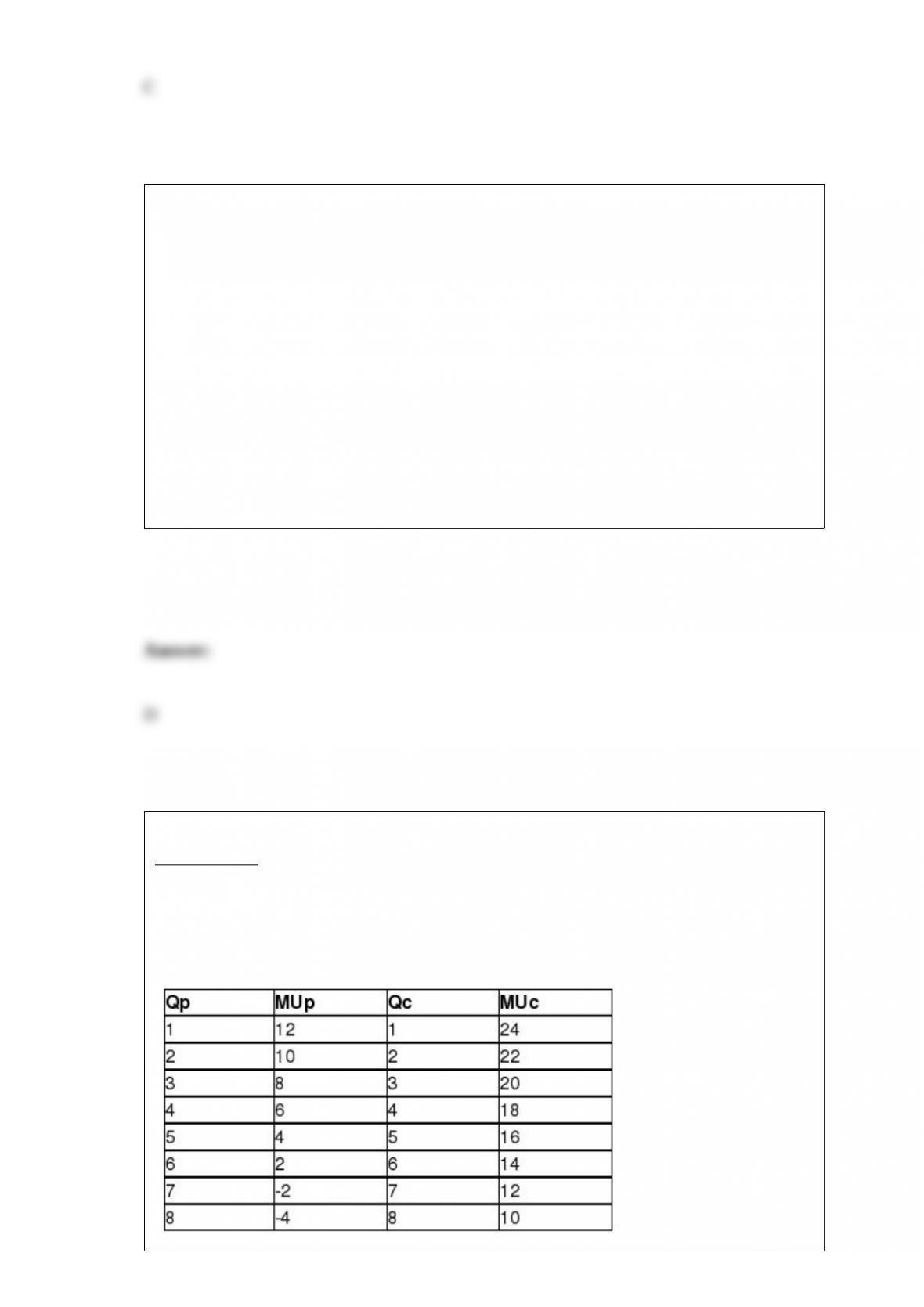
Scenario 3.1:
Andy derives utility from two goods, potato chips (Qp) and Cola (Qc). Andy receives
zero utility unless he consumes some of at least one good. The marginal utility that he
receives from the two goods is given as follows:

Refer to Scenario 3.1. What is the total utility that Andy will receive if he consumes 5
units of potato chips (Qp) and no Cola drink (Qc)?
A) 4 utils
B) 10 utils
C) 30 utils
D) 40 utils
E) none of the above
Coffee and donuts are complements in consumption. Suppose bad weather in the coffee
producing regions of the world, which shifts the coffee supply curve leftward. How do
the general equilibrium price and quantity outcomes compare to the partial equilibrium
outcomes for this situation?
A) General equilibrium price and quantity are higher
B) General equilibrium price is higher and quantity is lower
C) General equilibrium price is lower and quantity is higher
D) General equilibrium price and quantity are lower

A firm has two customers and creates a two-part tariff with a usage fee (P) that exceeds
the marginal cost of production and leaves each customer with positive consumer
surplus such that CS2 > CS1 > 0. If the firm sets the entry fee equal to CS2, then the
number of customers that actually buy the product is equal to:
A) zero.
B) one.
C) two.
D) We don’t have enough information to answer this question.
The fact that Alice spends no money on travel:
A) implies that she does not derive any satisfaction from travel.
B) implies that she is at a corner solution.
C) implies that her MRS does not equal the price ratio.
D) any of the above are possible.
A team of researchers has conducted a study of the well being of the citizens of the
island nation of Zarasa. Using a scale from 1 (least happy) to 10 (most happy), the
researchers find that citizens who earn 100 Zarutas per year have a mean happiness of
2.0, those who earn 200 Zarutas per year have a mean happiness of 6.0, and those who
earn 300 Zarutas per year have a mean happiness of 7.0. The researchers should make
which of the following conclusions?
A) The utility of Zarasians increases with income.
B) The marginal utility of Zarasians increases with income.
C) The marginal utility of Zarasians decreases with income.
D) both A and B
E) both A and C
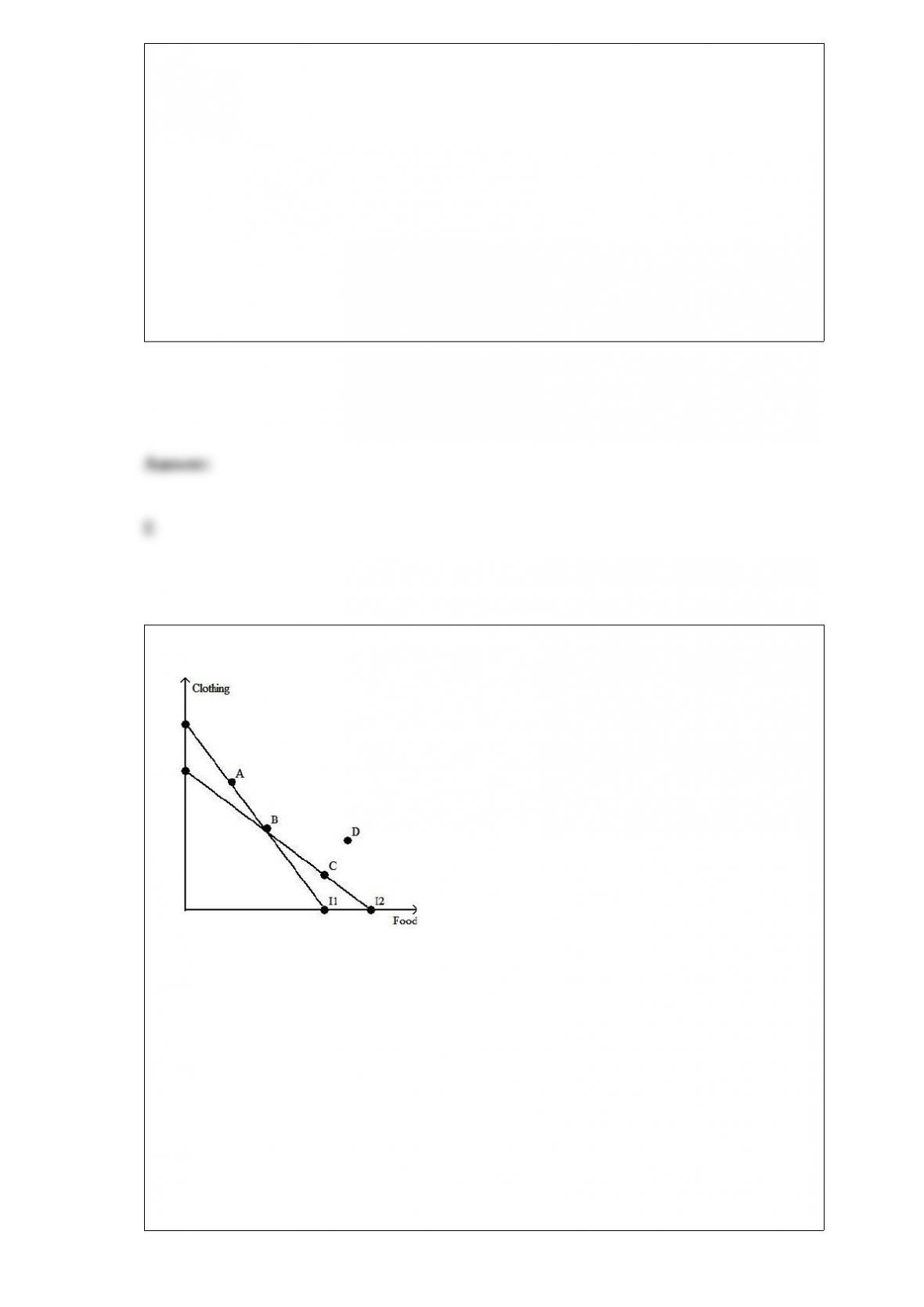
Please consider the following figure:
The consumer chooses A on budget line I1 and B on budget line I2. Which of the
following rankings describes the consumer’s preferences (first is highest ranked and last
is lowest ranked)?
A) A-B-C-D
B) A-D-B-C
C) A-B-D-C
D) We do not have enough information to rank all four bundles.

Scenario 14.4:
John’s firm is a competitor in your product market and a monopsonist in the labor
market. The current market price of the product that your firm produces is $2. The total
product and marginal product of labor are given as:
TP = 100L – 0.125L2 MP = 100 – 0.25L
where L is the amount of labor employed. The supply curve for labor and the marginal
expenditure curve for labor are given as follows:
L = PL -5 MEL = 2L + 5
Refer to Scenario 14.4. Suppose that a pollution tax is imposed on each unit of a firm’s
output. The number of workers hired
A) will decrease.
B) will increase.
C) will not change.
D) will change in an indeterminate fashion.
Scenario 5.3:
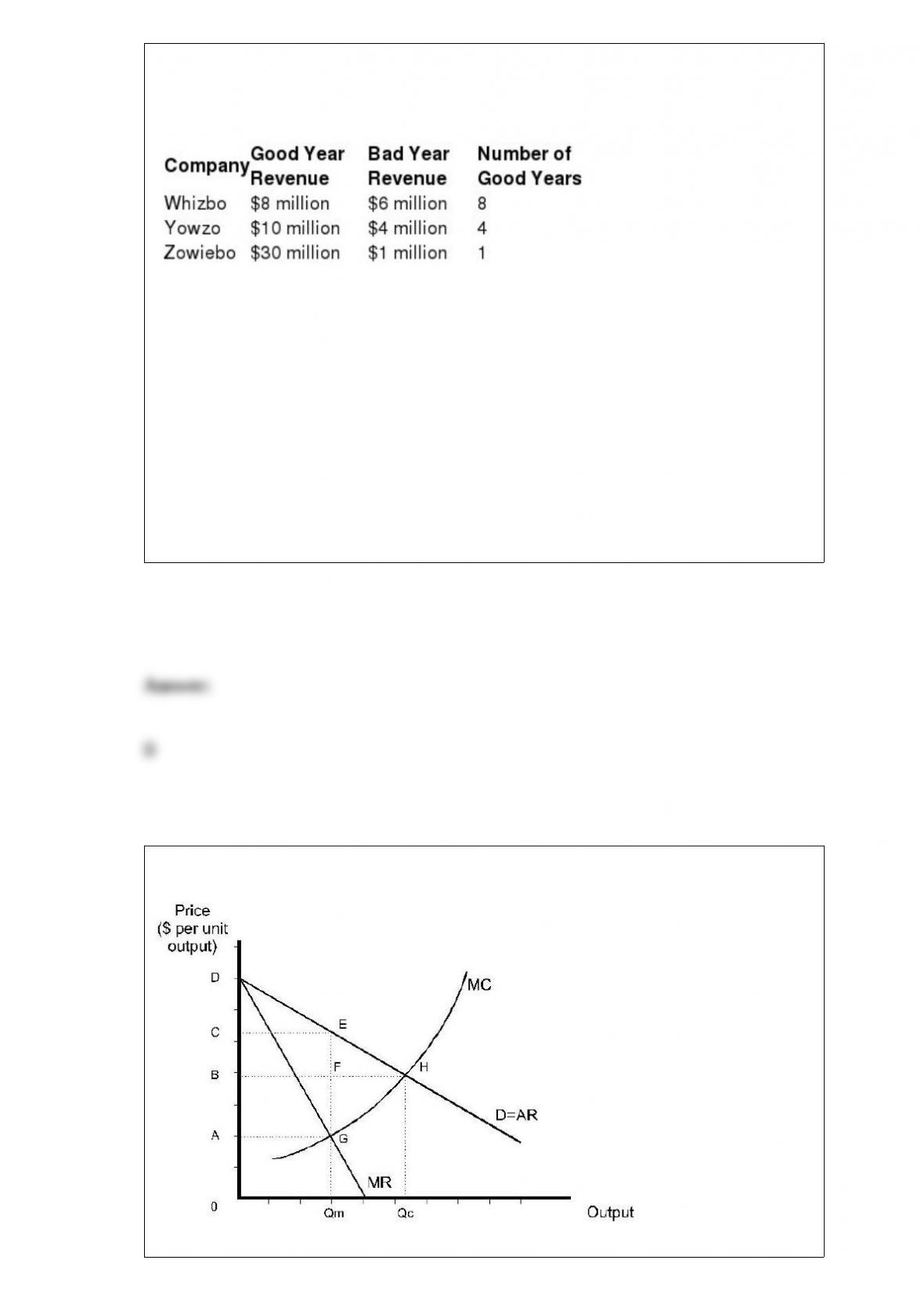
Wanting to invest in the computer games industry, you select Whizbo, Yowzo and
Zowiebo as the three best firms. Over the past 10 years, the three firms have had good
years and bad years. The following table shows their performance:
Refer to Scenario 5.3. The expected revenue from all three companies combined is
A) $11 million
B) $17.9 million.
C) $25.5 million.
D) $29.5 million.
E) $48 million.
Figure 10.2

Refer to Figure 10.2. At output Qm, and assuming that the monopoly has set her price
to maximize profit, the consumer surplus is:
A) CDE.
B) BDEF.
C) ADEG.
D) 0DEQm.
E) none of the above
You may consume ice cream or frozen yogurt, and ice cream consumption is plotted
along the horizontal axis of your indifference map. The prices are denoted PY for frozen
yogurt and PIC for ice cream. Under what condition will you only consume frozen
yogurt?
A) MRS is greater than PIC/PY
B) MRS is less than PIC/PY
C) MRS is less than PY/PIC
D) MRS is infinite

Use the following two statements to answer this question:
I. For a monopolist, at every output level, average revenue is equal to price.
II. For a monopolist, at every output level, marginal revenue is equal to price.
A) Both I and II are true.
B) I is true, and II is false.
C) I is false, and II is true.
D) Both I and II are false.
E) Statements I and II could either be true or false depending upon demand.
Which of the following economic values is NOT an example of a price?
A) Wage earned per hour
B) Annual interest rate paid for borrowed money
C) College tuition per semester
D) all are examples of prices
Sue views hot dogs and hot dog buns as perfect complements in her consumption, and

the corners of her indifference curves follow the 45-degree line. Initially, the price of
hot dogs is $3 per package (8 hot dogs), the price of buns is $3 per package (8 hot dog
buns), and Sue’s budget is $48 per month. How does her optimal consumption bundle
change if the price of hot dog buns increases to $5 per package?
A) Sue does not change her consumption because these goods are perfect complements.
B) She buys the same amount of hot dog buns and buys more hot dogs.
C) She buys the same amount of hot dogs and buys two less packages of hot dog buns.
D) She reduces her consumption by 2 packages of hot dogs and 2 packages of hot dog
buns.
A Rolling Stones song goes: “You can’t always get what you want.” This echoes an
important theme from microeconomics. Which of the following statements is the best
example of this theme?
A) Consumers must make the best purchasing decisions they can, given their limited
incomes.
B) Workers do not have as much leisure as they would like, given their wages and
working conditions.
C) Workers in planned economies, such as North Korea, do not have much choice over
jobs.
D) Firms in market economies have limited financial resources.

Consider the following information:
StowUrStuff Storage is located slightly below sea level in a coastal town. It could build
and maintain a flood control system around its property at an annual cost of $1000, and
if it did so, the probability of a flood’s doing $1,000,000 in damage during the year
would be .005. With no flood control system, the probability of such a flood would be .
01.
If there is no flood insurance and no flood control system is in place, the expected loss
from a flood is
A) $5,000.
B) $10,000.
C) $100,000.
D) $200,000.
E) $1,000,000.
The income elasticity of demand is the
A) absolute change in quantity demanded resulting from a one unit increase in income.
B) percent change in quantity demanded resulting from the absolute increase in income.
C) percent change in quantity demanded resulting from a one percent increase in
income.
D) percent change in income resulting from a one percent increase in quantity
demanded.
E) percent change in income resulting from a one percent increase in price.