
A decrease in demand for a good could mean that
a. consumers are willing to pay a higher price for each quantity of the good
b. consumers are willing to buy larger quantities of the good at each price
c. the demand curve has undergone a parallel shift to the right
d. the demand curve has undergone a nonparallel shift to the right
e. the demand curve has shifted to the left
If people have more time to adjust to a price change,
a. demand becomes more elastic, and supply becomes less elastic
b. demand becomes less elastic, and supply becomes more elastic
c. both supply and demand become less elastic
d. both supply and demand become more elastic
e. elasticity of both demand and supply tends toward unity
A person who wins a large sum of money in the state lottery is likely to
a. increase the amount of market work offered at each wage rate

b. not change the amount of work offered at each wage rate
c. decrease the amount of work offered at each wage rate
d. substitute market work for leisure time due to the substitution effect
e. substitute market work for leisure time due to the income effect
If demand is more inelastic than supply is, the
a. larger the portion of the tax that will be paid by producers
b. larger the portion of the tax that will be paid by consumers
c. more likely it is that the tax will be spread equally between producers and consumers
d. smaller the portion of the tax that will be paid by consumers
e. smaller the impact that an income tax will have on consumer preferences
Which of the characteristics of perfect competition assures that economic profit will be
zero in the long run?
a. Each firm is small relative to the market.
b. Each firm has access to perfect information.
c. Goods produced in the market are homogeneous.

d. Each firm is a price taker.
e. There is easy entry and exit in the market.
Within the framework of indifference curve analysis, what prevents the individual from
purchasing more of all goods?
a. Legal prohibitions
b. Budget constraint
c. The slope of the indifference curve
d. Psychological considerations
e. Diminishing marginal utility
If supply increases, then quantity demanded decreases.
a. True
b. False

Which of the following characteristics distinguishes oligopoly from other market
structures?
a. a horizontal demand curve
b. a downward-sloping demand curve
c. production of homogeneous outputs
d. production of differentiated outputs
e. interdependence among firms in the industry
A family on a trip budgets $800 for restaurant meals and fast food. The family can buy
16 restaurant meals if they buy no fast-food meals. What is the price of a restaurant
meal for the family?
a. $5
b. $16
c. $20
d. $50
e. it is impossible to tell from the information given

The slope of a line is defined as the
a. change in the value of the variable on the vertical axis divided by the change in the
value of the variable on the horizontal axis
b. value of the variable on the horizontal axis divided by the value of the intercept on
the vertical axis
c. change in the value of the variable on the horizontal axis divided by the increase in
the value of the variable on the vertical axis
d. value of the variable on the vertical axis divided by the value of the variable on the
horizontal axis
e. change in the value of the variable on the vertical axis times the increase in the value
of the variable on the horizontal axis
With the total cost and total revenue curves, we measure economic profit by the
________ between the two curves. With the per-unit curves, we measure economic
profit by a(n) _______.
a. vertical distance, horizontal distance
b. vertical distance, area
c. area, area
d. area, vertical distance
e. horizontal distance, area

Unions are less likely to strike today than in the past because
a. employers are more willing to hire strike breakers
b. fewer workers, both union and nonunion, are willing to cross picket lines
c. most workers in the U.S. cannot permanently lose their jobs
d. real wages have increased over the last 20 years
e. many high-profile strikes (e.g., Caterpillar) have resulted in union victories
Exhibit 8-10
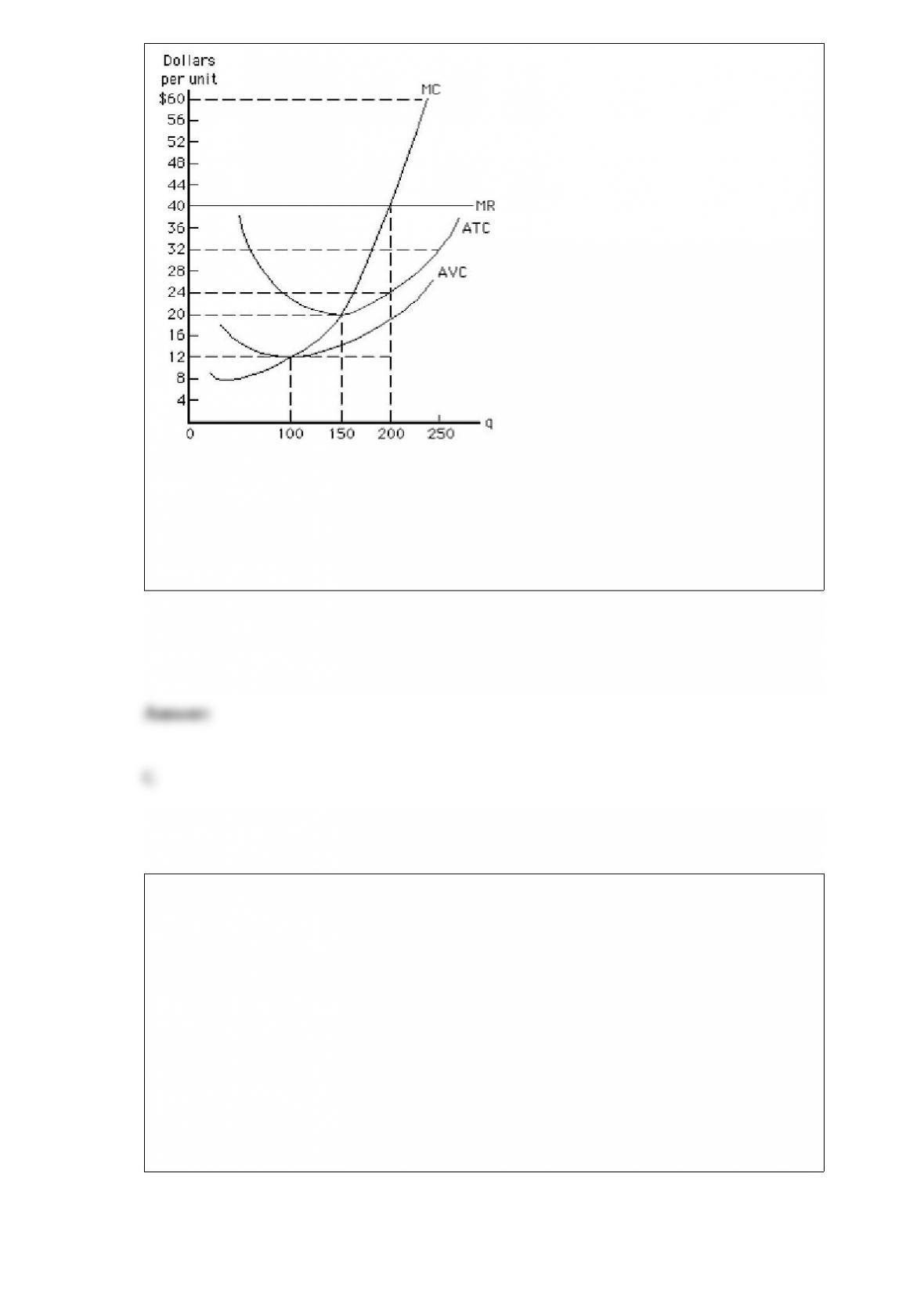
In Exhibit 8-10, price equals
a. $60
b. $24
c. $40
d. $20
e. $32
The law of demand says that the lower the price of a good, other things constant,
a. the smaller the demand for that good
b. the larger the demand for that good
c. the smaller the quantity demanded of that good
d. the larger the quantity demanded of that good
e. the smaller the real income of consumers and the lower the quantity demanded of that
good

What is true at the profit-maximizing quantity for a perfectly competitive firm but not
for a nondiscriminating monopoly?
a. Price equals marginal cost.
b. Price is greater than marginal cost.
c. Marginal revenue equals marginal cost.
d. Marginal revenue is less than marginal cost.
e. Marginal revenue is greater than average revenue.
The slope of an indifference curve is equal to the
a. marginal rate of substitution
b. price elasticity of demand
c. marginal utility of the good measured on the horizontal axis
d. marginal utility of the good measured on the vertical axis
e. relative price of the good measured on the horizontal axis

The market supply curve of labor is
a. upward sloping
b. perfectly inelastic
c. upward sloping at first but then bends backward
d. downward sloping
e. perfectly elastic
Game theory provides us with a general approach to understanding the behavior of
firms when their choices are interdependent
a. True
b. False
If the quality or quantity of a particular public service is very difficult to monitor,
government is more likely to
a. produce the service itself
b. contract with private firms to supply the service
c. take over private corporations to produce the service

d. refuse to provide the service
e. raise the price to consumers of the service
The market demand curve for a resource is the
a. horizontal sum of the demand curves for that resource in all its various uses
b. difference among the demand curves for that resource in all its various uses
c. demand for that resource in its best use
d. sum of the demand curves for that resource in its best two uses
e. vertical sum of the demand curve for that resource in all its various uses
A marginal revenue product curve shows the change in
a. total revenue caused by a one-unit change in output, other things constant
b. total revenue caused by a one-unit change in an input, other things constant
c. total product caused by a one-unit change in output, other things constant
d. total product caused by a one-unit change in an input, other things constant
e. total revenue product caused by a one-unit change in the price of the output, other
things constant

The rotation of the budget line in Exhibit 6-28 from AC to AB represents a(n)
a. increase in the price of clams
b. increase in the price of mussels
c. decrease in the price of clams
d. decrease in the price of mussels
e. increase in the amount the consumer can spend
If all of the income paid to a resource is opportunity costs,
a. the price and quantity of that resource are determined exclusively by supply
b. the price and quantity of that resource are determined exclusively by demand
c. the quantity of that resource is determined exclusively by supply
d. the price of that resource is determined exclusively by demand
e. the quantity of that resource is determined exclusively by demand

When a seller knows more about the condition of a used car than the buyer does, the
information is said to be asymmetric.
a. True
b. False
The total revenue from selling trucks is equal to
a. the price of a truck times the quantity sold
b. the change in quantity sold divided by the change in price
c. average cost times quantity produced
d. the price of a truck times the quantity produced
e. the price of a truck times the price elasticity of demand
The payment of a given sum of money each year that continues indefinitely into the
future is known as

a. a perpetuity
b. a lottery
c. a term payment
d. a permanent annuity
e. an indefinite annuity
The publisher that paid Arthur Arthur, the popular novelist, a $2 million advance on his
recent novel, which sold only 42 copies, fell victim to
a. moral hazard
b. an authority relation
c. the winner’s curse
d. the principal-agent problem
e. adverse selection
The demand for firewood is likely to be more elastic in the summer than in the winter.
a. True
b. False
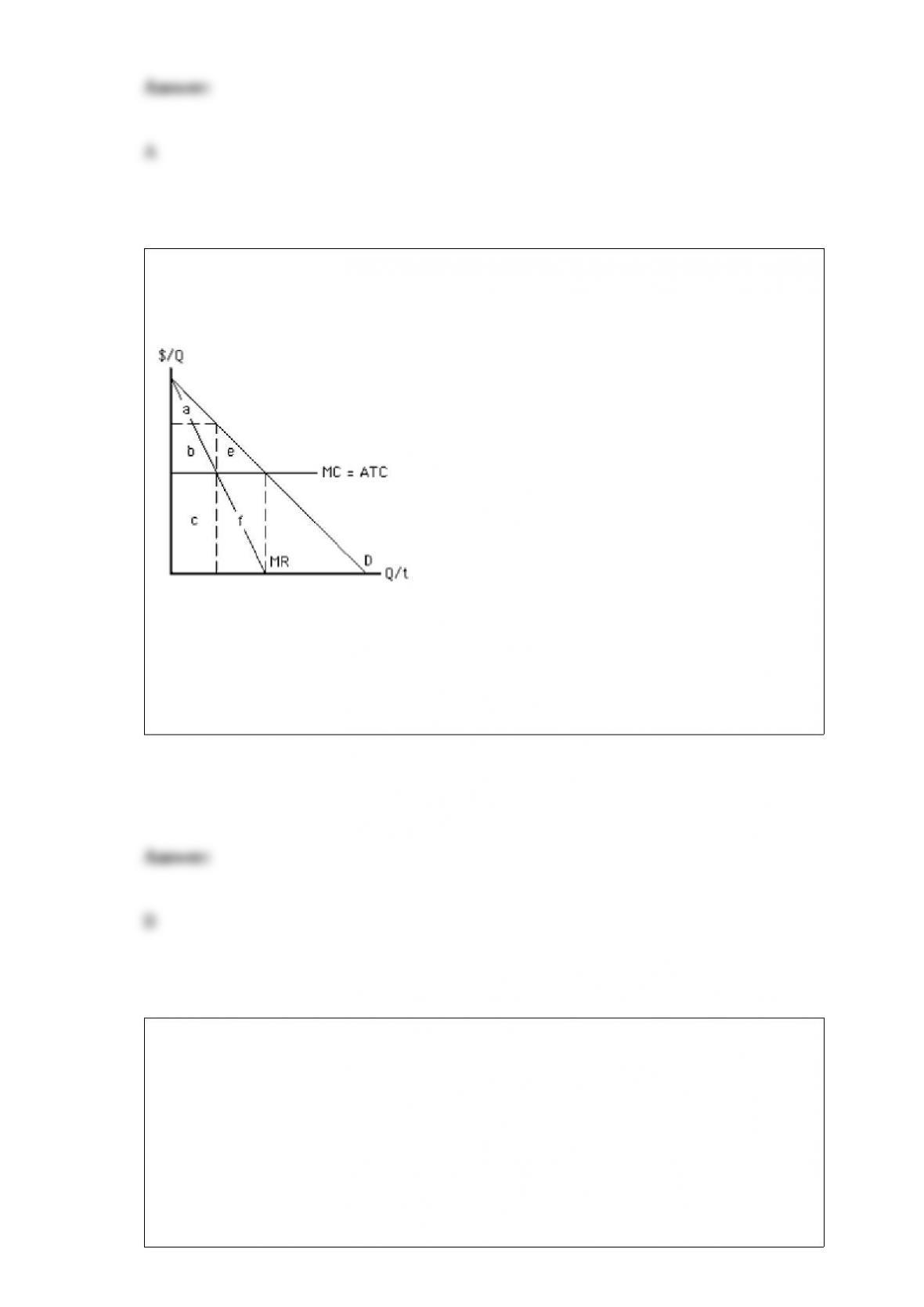
Exhibit 9-17
Which area in Exhibit 9-17 represents monopoly profit without price discrimination?
a. area a
b. area b
c. area c
d. area b + e
e. area b + e + c + f
Which of the following is not assumed constant along the U.S. demand curve for
foreign exchange?
a. the exchange rate
b. U.S. interest rates
c. expected U.S. inflation

d. expected foreign inflation
e. increase in U.S. income
Economic analysis of product differentiation leads to all of the following conclusions
except one. Which is the exception?
a. Product differentiation makes it harder for firms to collude.
b. Product differentiation makes price leadership harder to maintain.
c. Product differentiation sometimes contributes to wasteful allocation of resources.
d. Product differentiation must be based on real, substantive differences among
products.
e. There is a tradeoff between using resources efficiently and providing consumers with
wide choices.
Exhibit 14-2
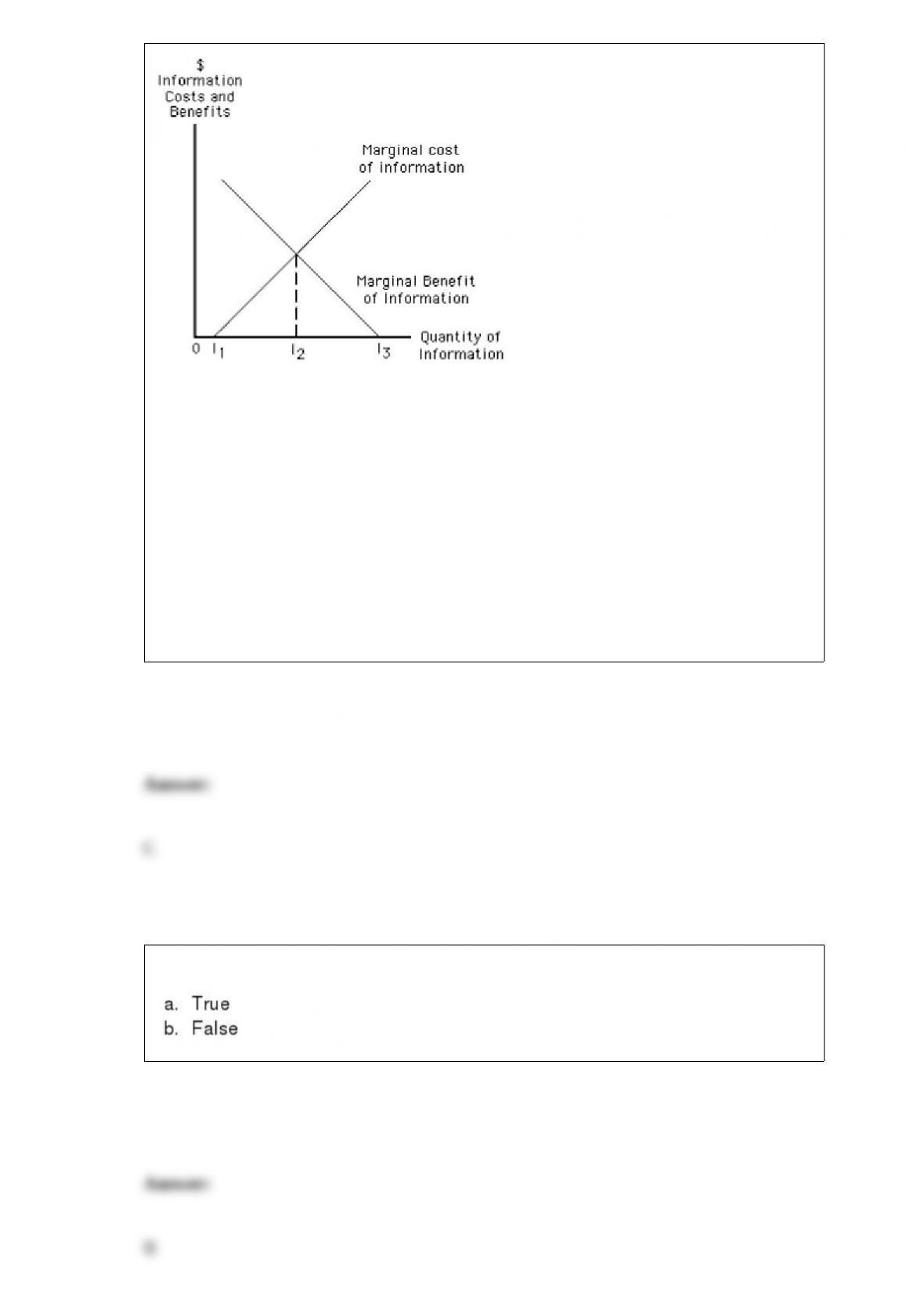
In Exhibit 14-2, if a consumer gathers an amount of information equal to I3,
a. she has made the optimal search
b. she is relying solely on common knowledge
c. she has acquired all available information that is beneficial to her
d. further information will be costless to her
e. she should increase her search
Isoquants map combinations of inputs and outputs that yield equal profit.