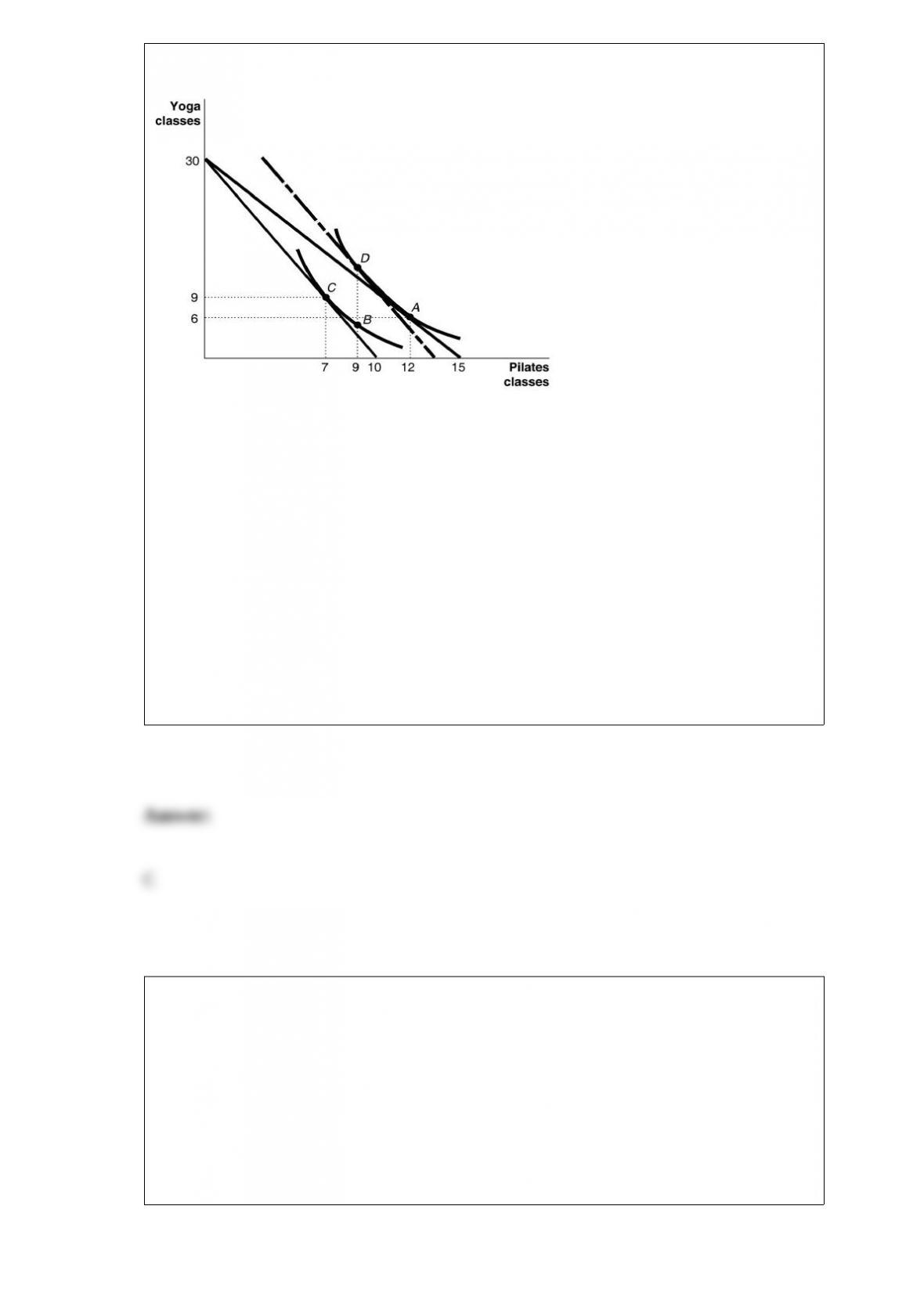
Figure 10-7
Manuri has $300 to spend on Pilates classes and Yoga classes. The price of a group
Pilates class is $20 and the price of a group Yoga class is $10. Manuri’s optimal bundle
is given by “A” in Figure 10-7. Suppose the price of Pilates sessions rise to $30 while
income and the price of Yoga sessions remain unchanged. The substitution effect of this
price change is represented by the movement from
A) A to B.
B) A to C.
C) A to D.
D) D to B.
Which of the following is part of an economic model?
A) assumptions
B) norms
C) opinions
D) preferences of economic agents

Assume weak growth in aggregate demand keeps the economy below potential GDP, so
unemployment rises but inflation falls. This explains the ________ slope of the
short-run Phillips curve.
A) positive
B) negative
C) zero
D) infinite
If the MPC is 0.5, then a $10 million increase in disposable income will increase
consumption by
A) $2 million.
B) $5 million.
C) $15 million
D) $50 million.

Which of the following is true for a monopolistically competitive firm in long-run
equilibrium?
A) P = ATC and MR = MC.
B) P = ATC and P = MC.
C) P > ATC and P > MR.
D) P > MR and MC = ATC.
The economy has gone into a recession. You have majored in computer science and,
because of the recession, have difficulty in finding a job. Should you go back to school
and get a second major?
A) Yes, the recession will ensure that you will never find a job as a programmer.
B) Yes, the recession will lower income in my field permanently.
C) No, the recession will most likely be short-lived and I can get a job after it is over.
D) No, the recession will have no impact on my ability to get a job or my future
income.
Which of the following describes the difference between the market demand curve for a
perfectly competitive industry and the demand curve for a firm in this industry?
A) The market demand curve is a horizontal line; the firm’s demand curve is
downward-sloping.

B) The market demand curve is downward-sloping; the firm’s demand curve is a
vertical line.
C) The market demand curve cannot have a constant slope; the firm’s demand curve has
a slope equal to zero.
D) The market demand curve is downward-sloping; the firm’s demand curve is a
horizontal line.
Why did the United States abandon the gold standard in the 1930s?
A) The government wanted to rapidly expand the money supply in response to the
Great Depression.
B) The government wanted to move away from a floating exchange rate system to a
fixed exchange rate system.
C) The Treasury Department in the United States found it was cheaper to print paper
money instead of gold coins.
D) New sources of gold were discovered, so the price of gold plummeted, dramatically
reducing the value of the dollar.
If actual inflation is less than expected inflation, what is the relationship between the
actual real wage and the expected real wage?
A) The actual real wage is lower than the expected real wage.
B) The actual real wage is higher than the expected real wage.

C) The actual real wage is equal to the expected real wage.
D) The relationship between the actual real wage and the expected real wage cannot be
predicted.
The branch of economics which studies the behavior of entire economies and policies
that affect the economy as a whole is called
A) public economics.
B) microeconomics.
C) macroeconomics.
D) normative economics.
What actions could the Federal Reserve take to achieve consistent growth in real GDP
at 4 percent per year?
A) The Fed could increase in the growth rate of the money supply by 1% each year
until the inflation rate was exactly equal to 4 percent.
B) The Fed could maintain a growth rate of the money supply of 4 percent, regardless
of whether inflation was rising or falling in the economy.
C) The Fed could follow contractionary monetary policy that would reduce the federal
funds rate to zero so investment will rise consistently.
D) The Fed has no direct control over real GDP in the long run, so there are no actions
it could take to achieve that goal.

How do changes in income tax policies affect aggregate demand?
A) Higher taxes increase disposable income, consumption, and aggregate demand.
B) Higher taxes reduce disposable income, consumption, and aggregate demand.
C) Higher taxes increase corporate investment and aggregate demand.
D) Higher taxes increase aggregate supply and thus increase aggregate demand as well.
Just before, during, and after the recession of 2007-2009, net exports in the United
States
A) fell and remained negative.
B) fell, but remained positive.
C) rose and became positive.
D) rose, but remained negative.

The development of a new good or a new process for making a good is called
A) an innovation.
B) an invention.
C) a factor of production.
D) a service.
In the United States, many beekeepers travel from state to state, renting out their bee
colonies to farmers for pollination services. This is an example of
A) a Coasian solution to a positive externality problem.
B) a Pigovian solution to a positive externality problem.
C) a tradable exchange contract.
D) command and control policy.
What does limited liability mean?
A) The owners of the business are personally responsible for paying expenses incurred
by the business.
B) Only employees can have a claim on the assets of the business.
C) The personal assets of the owners cannot be claimed if the business is bankrupt.

D) Anybody with a liability against a firm can claim only what their liability refers to.
In June, buyers of titanium expect that the price of titanium will fall in July. What
happens in the titanium market in June, holding everything else constant?
A) The demand curve shifts to the right.
B) The quantity demanded increases.
C) The quantity demanded decreases
D) The demand curve shifts to the left.
The purchase of Treasury securities by the Federal Reserve will, in general,
A) not change the money supply.
B) not change the quantity of reserves held by banks.
C) increase the quantity of reserves held by banks.
D) decrease the quantity of reserves held by banks.