Samantha’s wealth is $100,000, she expects to work for another 30 years at a constant
salary of $200,000 and live for another 50 years. Assume taxes are zero and that
Samantha completely smooths consumption over her lifetime. Calculate the following:
a. Samantha’s annual consumption
b. Samantha’s annual consumption if she won $50,000 in the lottery during her first
year of work
c. Samantha’s transitory MPC
d. Samantha’s annual consumption if her lottery win paid $50,000 per year for 30 years
e. Samantha’s permanent MPC
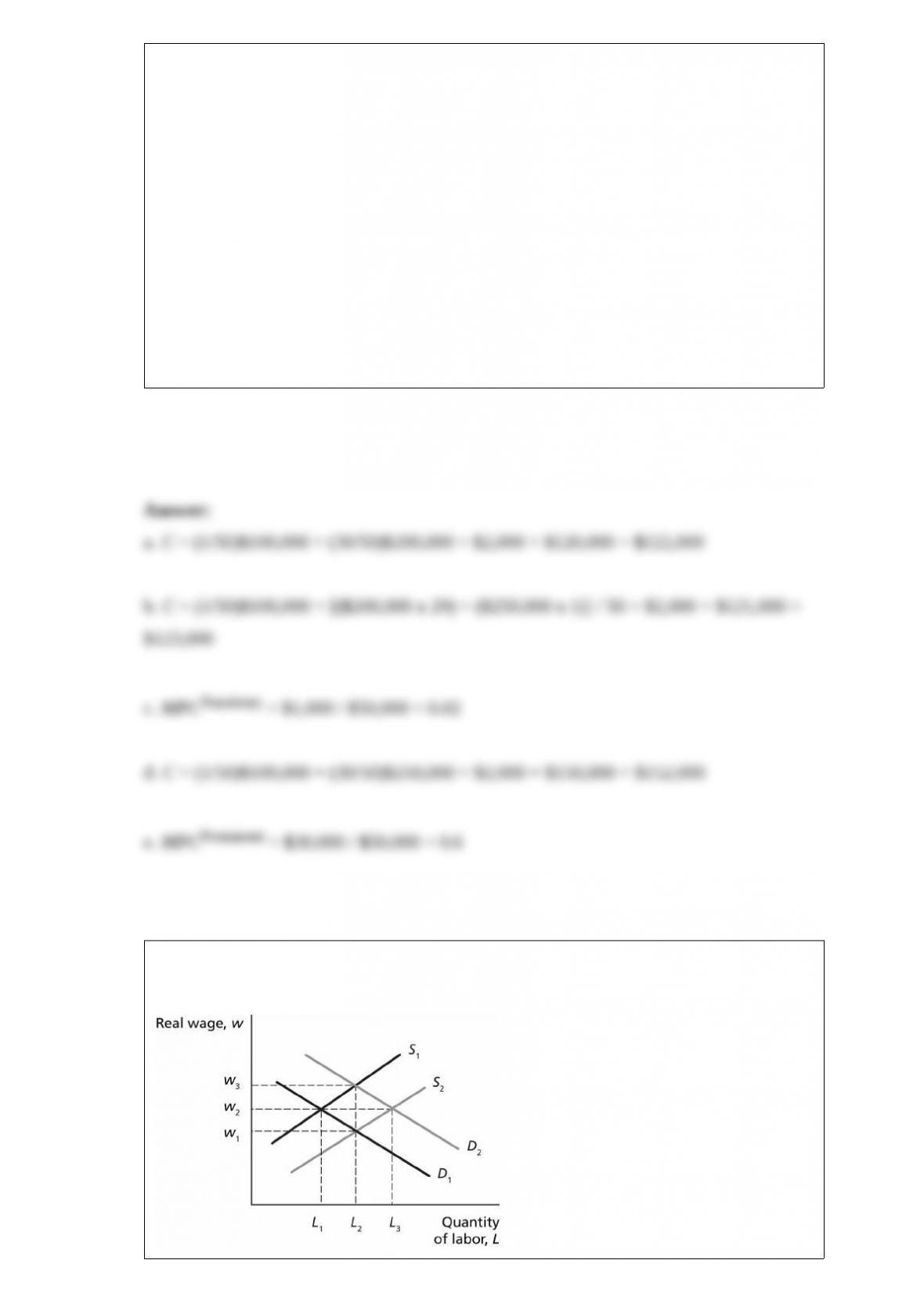
Figure 8.3

Refer to Figure 8.3. Holding other variables constant, a decrease in income taxes
accompanied by an increase in the skill level of workers will result in a
A) shift from curve D1 to curve D2 and a shift from curve S1 to curve S2.
B) shift from curve D2 to curve D1 and a shift from curve S1 to curve S2.
C) shift from curve D1 to curve D2 and a shift from curve S2 to curve S1.
D) shift from curve D2 to curve D1 and a shift from curve S2 to curve S1.
If firms pay efficiency wages, they pay wages that
A) are mandated by the government.
B) will eventually lower the unemployment rate.
C) motivate workers to increase their productivity.
D) are lower than average to ensure maximum profit.
Suppose consumer confidence declines and as a result, consumer spending decreases by
$4 billion dollars. Other things equal, if households spend $0.75 of each extra dollar of
income and save the remaining $0.25, by how much will spending decrease during the
second round through the circular flow?
A) $1 billion
B) $2.25 billion
C) $3 billion
D) $4 billion
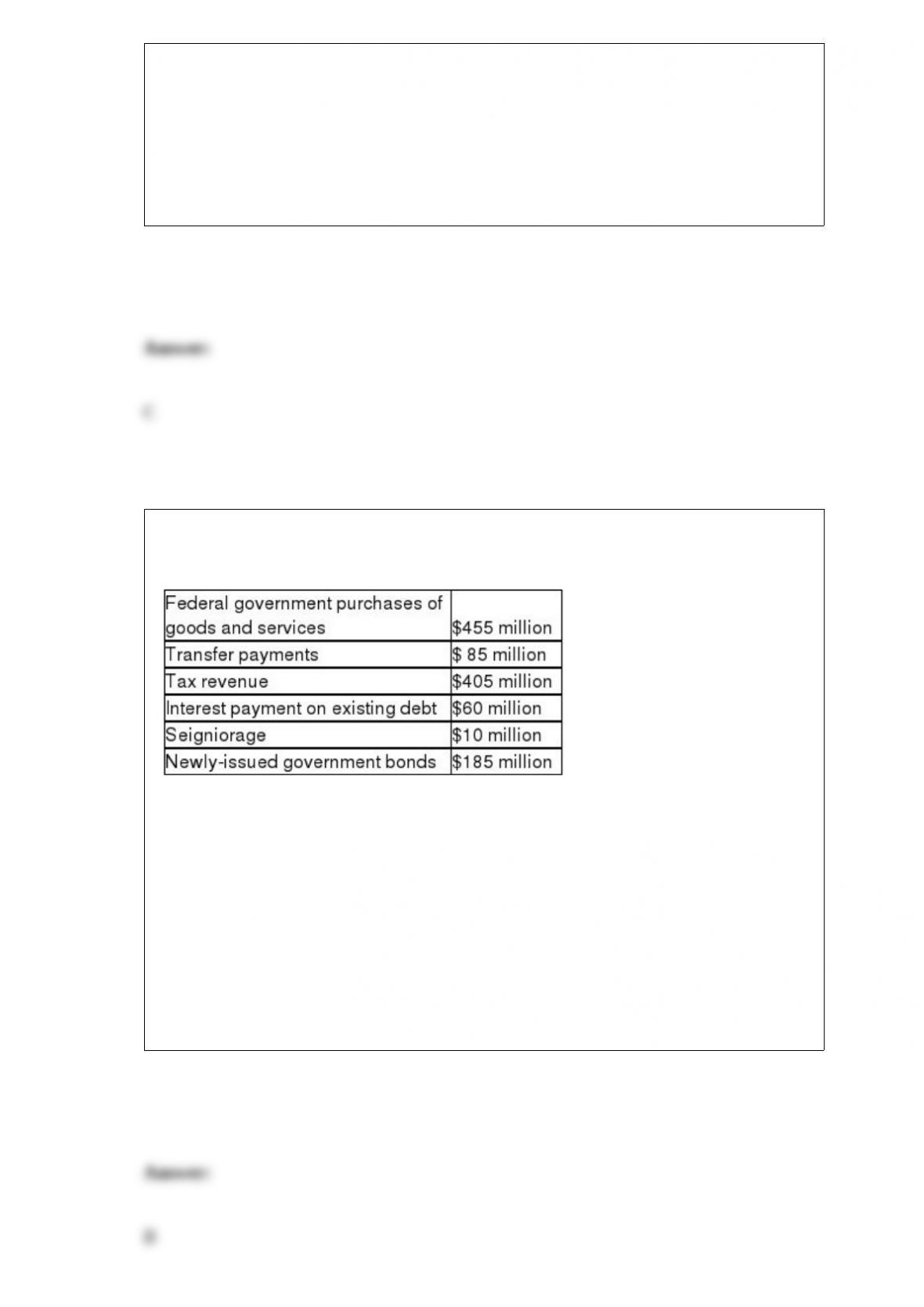
Table 15.1
The data in the table represents budget figures for the nation of Arugula for 2012
Refer to Table 15.1. The budget deficit for Arugula in 2012 is
A) $135 million.
B) $195 million.
C) $380 million.
D) $600 million.

The shadow banking system refers to
A) nonbank financial intermediaries.
B) banks that operate in the underground economy.
C) banks that lend exclusively to foreign governments.
D) all banks that are insured by the Federal Deposit Insurance Corporation.
Under a fixed exchange rate system, at high domestic real interest rates the demand for
domestic currency ________, so the central bank ________ foreign-exchange reserves.
A) increases; acquires
B) increases; loses
C) decreases; acquires
D) decreases; loses
Households in the United States more completely smooth out expenditures on
A) durable goods and nondurable goods than on services.

B) durable goods than on nondurable goods and services.
C) nondurable goods and services than on durable goods.
D) services and durable goods; nondurable goods.
If the MPC is 0.6 and the tax rate is 20%, a $200 decrease in autonomous net exports
will decrease equilibrium income by
A) $384.
B) $416.
C) $478.
D) $1,666.
The money supply will decrease if
A) either the monetary base or the money multiplier increases in value.
B) either the monetary base or the money multiplier decreases in value.
C) either the monetary base increases in value or the money multiplier decreases in
value.
D) either the monetary base decreases in value or the money multiplier increases in

value.
Suppose you made a 20% down payment on a house on January 1, 2013, and on
January 1, 2014 you decide to sell the house. If the price of your house increased by
10%, the return on your investment in the house would be
A) 10%.
B) 20%.
C) 50%.
D) 200%.
Assume that for the fourth quarter of 2012, nominal GDP was $245 billion, potential
real GDP was $260 billion, and the GDP deflator was 112. According to Okun’s law, the
cyclical unemployment rate during the fourth quarter of 2012 was
A) 2.9%.
B) 3.1%.
C) 8%.
D) 8.4%.
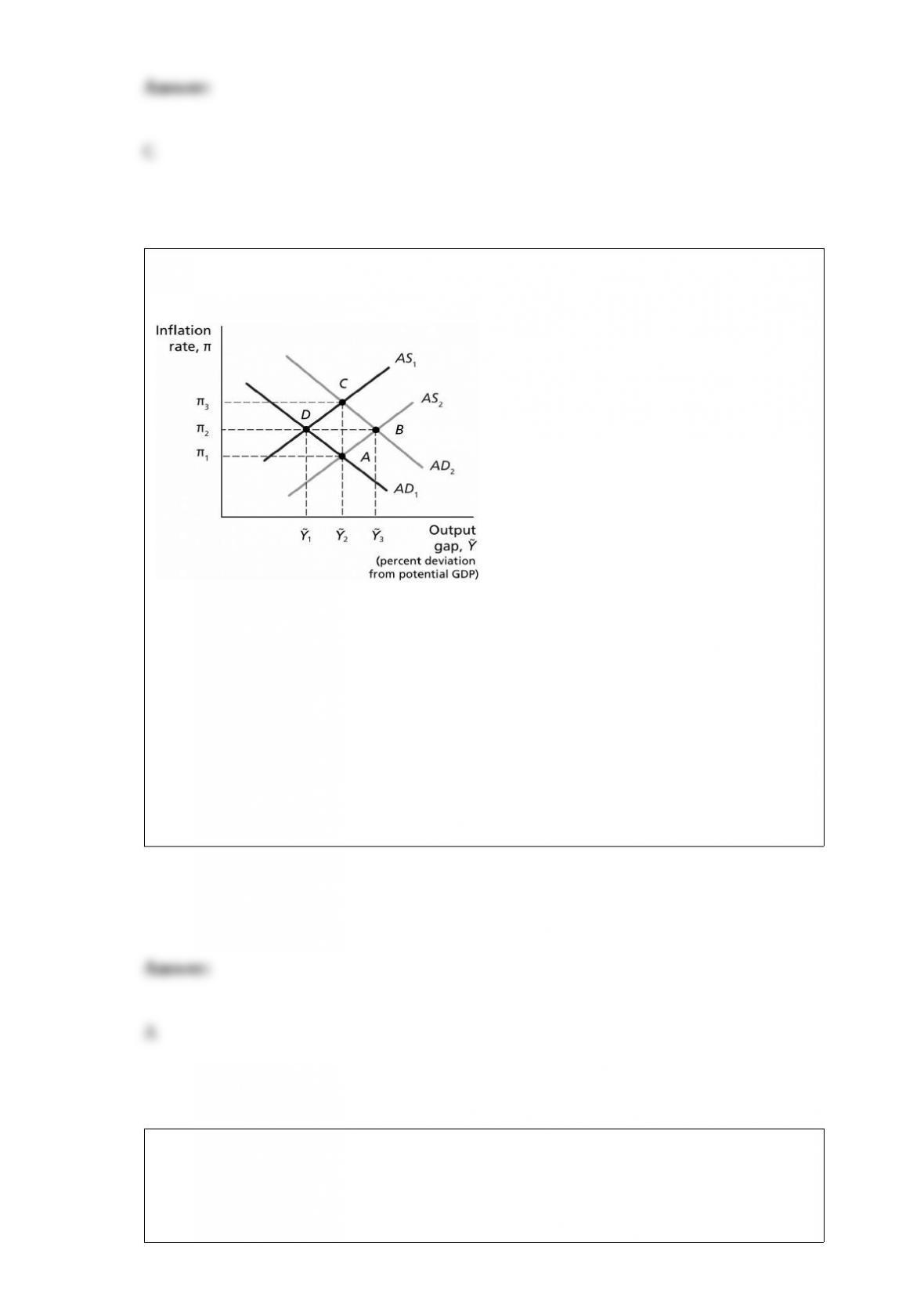
Figure 14.3
Refer to Figure 14.3. Suppose the economy is initially at long-run equilibrium and the
Fed increases the target inflation rate, and to hit this rate, it must reduce the real interest
rate. This is best represented by an initial movement from
A) point A to point B.
B) point A to point D.
C) point A to point C.
D) point B to point C.
The IS curve shows the combinations of ________ and ________ where the goods
market is in equilibrium.
A) aggregate expenditure; real GDP
B) the real interest rate; real GDP
C) potential GDP; aggregate expenditure
D) the nominal interest rate; the quantity of money
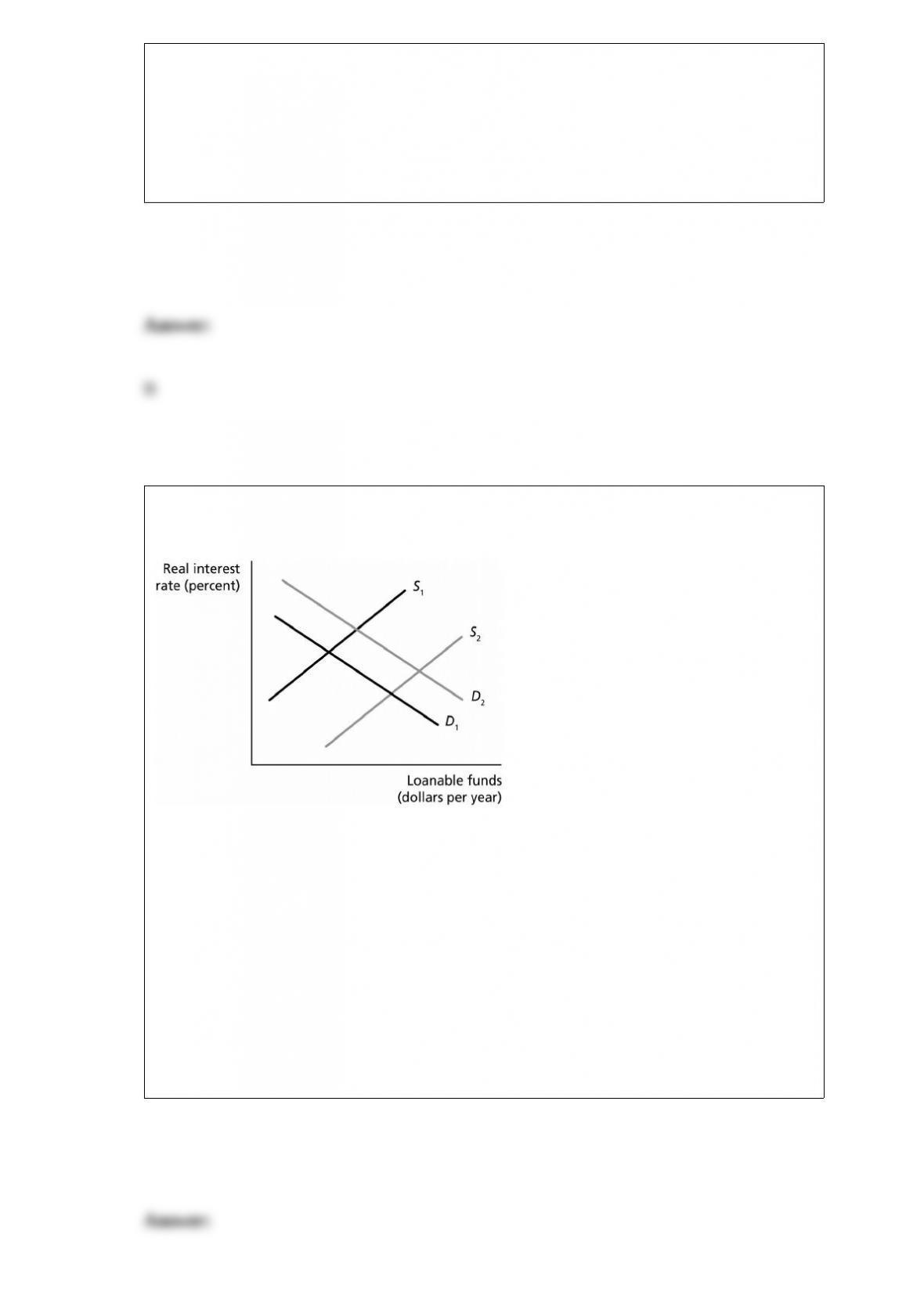
Figure 4.3
Refer to Figure 4.3. All else equal, a decrease in the desire of households to consume
today accompanied by an increase in corporate taxes would cause which of the
following shifts?
A) S1 to S2 and D1 to D2
B) S2 to S1 and D1 to D2
C) S1 to S2 and D2 to D1
D) S2 to S1 and D2 to D1

Suppose y = k1/2, total factor productivity is constant and equal to 1, s = 0.40, and d =
0.10. When the economy reaches the steady state, real GDP per worker is ________.
A) $2
B) $4
C) $8
D) $16
The short-run effect of a negative supply shock is
A) lower inflation and a declining output gap.
B) lower inflation and an increasing output gap.
C) higher inflation and a declining output gap.
D) higher inflation and an increasing output gap.
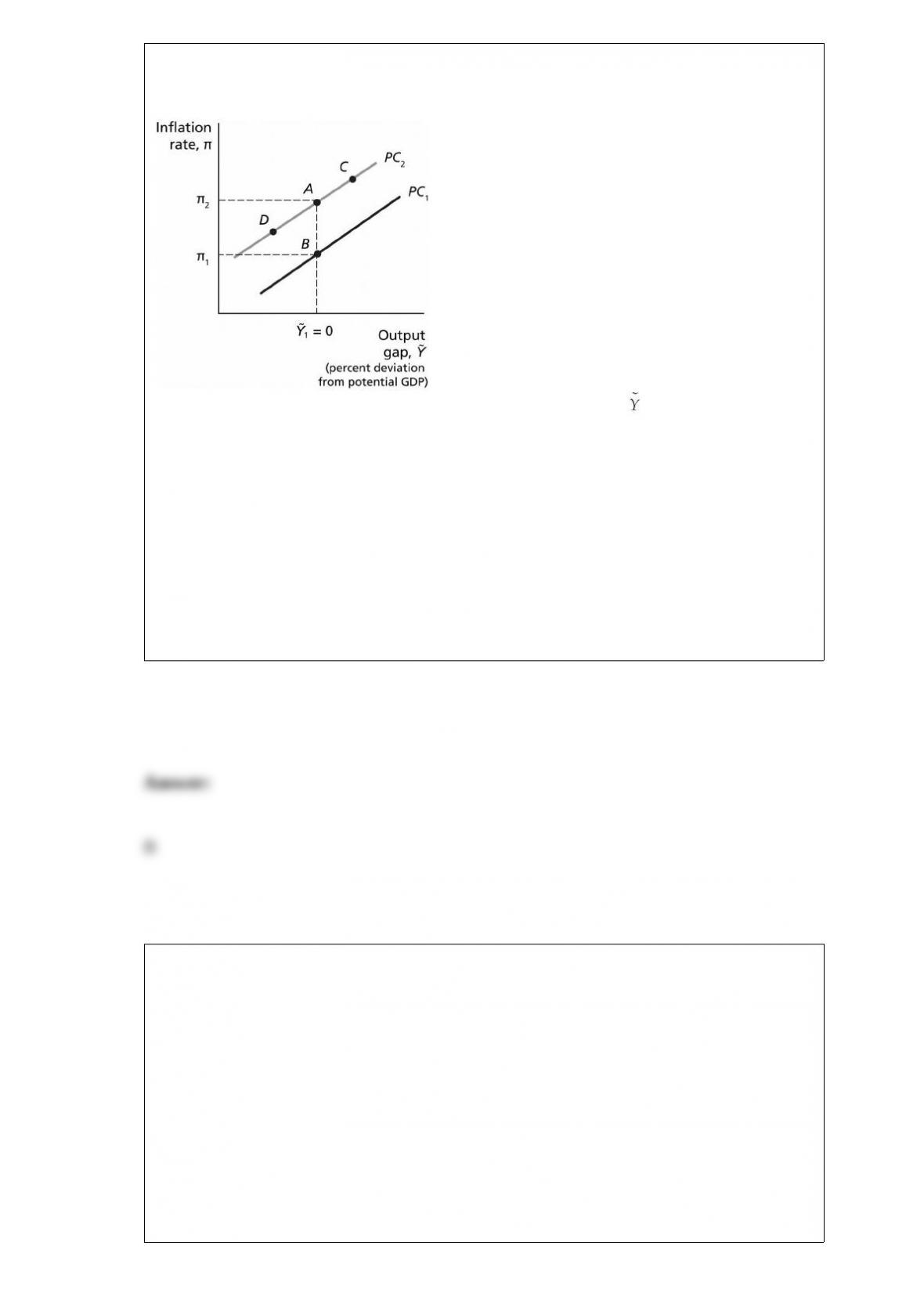
Figure 11.1
Refer to Figure 11.1. Assume the economy is in equilibrium at 1 = 0. Other things
equal, an unexpected large increase in the price of oil will result in a movement from
point ________ to point ________.
A) A; B
B) B; A
C) A; C
D) A; D
C = $5 million + 0.9(1 – 0.1)Y
I = $7 million
G = $6 million
NX = $1 million
Based on the above data, the value of the expenditure multiplier is
A) 1.23
B) 5.26

C) 9.09
D) 11.11
If the actual capital-labor ratio is above the steady-state capital labor ratio, growth from
convergence will be ________, and the economy will grow ________ than it will along
a balanced growth path.
A) negative; slower
B) negative; faster
C) positive; slower
D) positive; faster
As the average annual inflation rate ________, the volatility of inflation tends to
________.
A) decreases; increase
B) increases; increase
C) increases; remain stable
D) decreases; remain stable

Compared to the past, FOMC meetings are now much more transparent. How might
this transparency impact the effectiveness of monetary policy actions?
A) The transparency helps make the Fed’s actions more credible and should help make
policy actions more effective.
B) The transparency undermines the effectiveness since financial markets can more
quickly adjust their behavior to fight the policy actions.
C) The transparency counteracts the secrecy in which fiscal policy is enacted, and
therefore decreases its effectiveness.
D) The transparency lengthens policy lags, so monetary policy takes longer to
implement and take effect.
An increase in the money supply will cause the nominal interest rate to ________ and
the quantity of money to ________.
A) increase; increase
B) increase; decrease
C) decrease; increase
D) decrease; decrease

If the rate of job separation equals 2%, and the natural rate of unemployment is 10%,
then the rate of job finding equals
A) 5%.
B) 16.7%.
C) 18%.
D) 20%.
Hector’s wealth is zero, he expects to work for another 45 years at a constant salary of
$80,000 and live for another 60 years. If yearly taxes are $20,000 and Hector
completely smooths consumption over his lifetime, Hector’s average annual saving is
________ less than it would be if yearly taxes were zero.
A) $5,000
B) $7,500
C) $15,000
D) $20,000

The debt-to-GDP ratio decreases when the primary deficit ________ or when
seigniorage ________.
A) increases; increases
B) increases; decreases
C) decreases; increases
D) decreases; decreases
If the federal government tries to make fiscal policy sustainable by increasing
seigniorage, the economy would experience ________ and will result in ________
potential GDP.
A) a decrease in the growth rate of the money supply; lower
B) an increase in the growth rate of the money supply; higher
C) an increase in inflation; lower
D) a decrease in the real interest rate; higher

The best measure of the standard of living is generally considered to be
A) labor productivity.
B) the average duration of a typical business cycle.
C) the labor force participation rate.
D) real GDP per capita.
Compared to receiving an equilibrium wage, workers who receive efficiency wages are
________ likely to take actions that will get them fired and are ________ likely to
switch jobs.
A) more; more
B) more; less
C) less; more
D) less; less
Assume the economy is initially in equilibrium where potential GDP is less than real
GDP. If the expected inflation rate, the term structure effect, and the default-risk
premium are constant, ________ in the Fed’s target short-term nominal interest rate will
shift up the MP curve which will result in real GDP ________.

A) an increase; falling
B) an increase; rising
C) a decrease; falling
D) a decrease; rising
Which of the following is an explanation as to why fluctuations in real GDP have
become less volatile in the United States since 1950?
A) The government has become less inclined to intervene to stabilize the economy.
B) Unemployment insurance and other government transfer programs have become
more prevalent.
C) The government and the Federal Reserve have decreased regulation and scrutiny of
the financial system.
D) Goods manufacturing has become a larger fraction of GDP.
Although accounts in commercial banks are covered by government insurance,
accounts in other financial institutions are not. If the government decides to bail out
these other types of financial institutions during times of a financial crisis, it risks
increasing the level of ________ in the financial system.
A) moral hazard

B) liquidity
C) asset deflation
D) insolvency