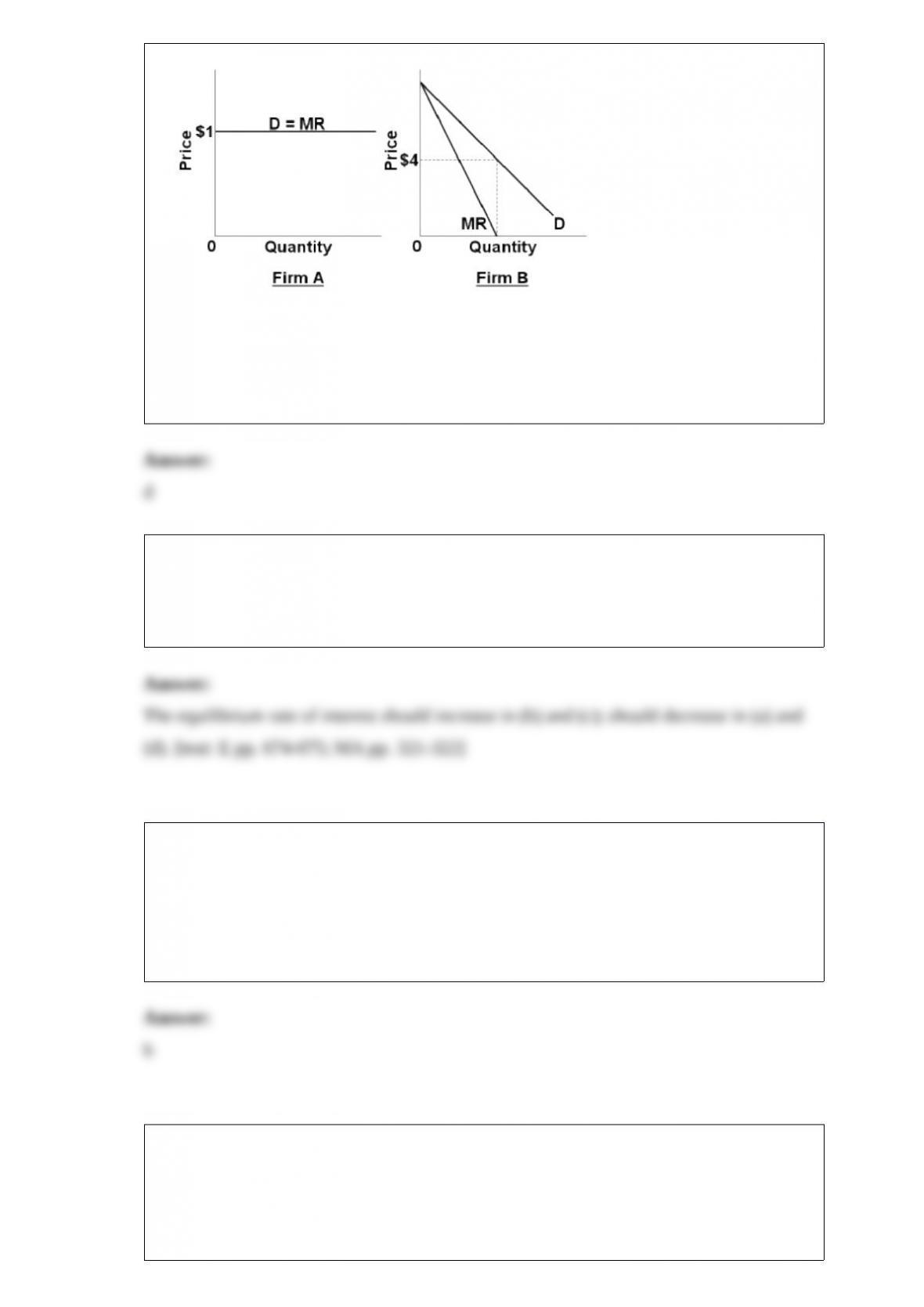
1)
refer to the above diagrams. if $4 is firm b’s profit-maximizing price, its:
a.atc must be $4.
b.mc must be $4.
c.mr must be $4.
d.mc must be zero.
2) Other things being equal, what effect will each of the following have on the
equilibrium rate of interest? (a) an increase in the supply of money; (b) an increase in
the equilibrium level of national income; (c) a decrease in the supply of money; (d) a
leftward shift of the asset demand for money.
3) assume a purely competitive firm is maximizing profit at some output at which
long-run average total cost is at a minimum. then:
a.the firm is earning an economic profit.
b.there is no tendency for the firm’s industry to expand or contract.
c.allocative but not productive efficiency is being achieved.
d.other firms will enter this industry.
4) inflation is undesirable because it:
a.arbitrarily redistributes real income and wealth.
b.invariably leads to hyperinflation.
c.usually is accompanied by declining real gdp.
d.reduces everyone’s standard of living.

5) If you are estimating your total expenses for school next semester, you are using
money primarily as:
A.a medium of exchange.
B.a store of value.
C.a unit of account.
D.an economic investment.
6) If one worker can pick $30 worth of grapes and two workers together can pick $50
worth of grapes, the:
A.marginal revenue product of each worker is $25.
B.marginal revenue product of the first worker is $20.
C.marginal revenue product of the second worker is $20.
D.data given do not permit the determination of the marginal revenue product of either
worker.
7) the total output of a firm will be at a maximum where:
a.mp is at a maximum.
b.ap is at a minimum.
c.mp is zero.
d.ap is at a maximum.
8) New classical economist say that an unanticipated increase in aggregate demand
first:
A.increases the price level and real output, and then reduces short-run aggregate supply
such that the economy returns to the full-employment level of output.
B.increases the price level and real output, and then increases long-run aggregate
supply.
C.increases long-run aggregate supply, and then increases the price level and real
output.
D.reduces short-run aggregate supply, and then reduces long-run aggregate supply.
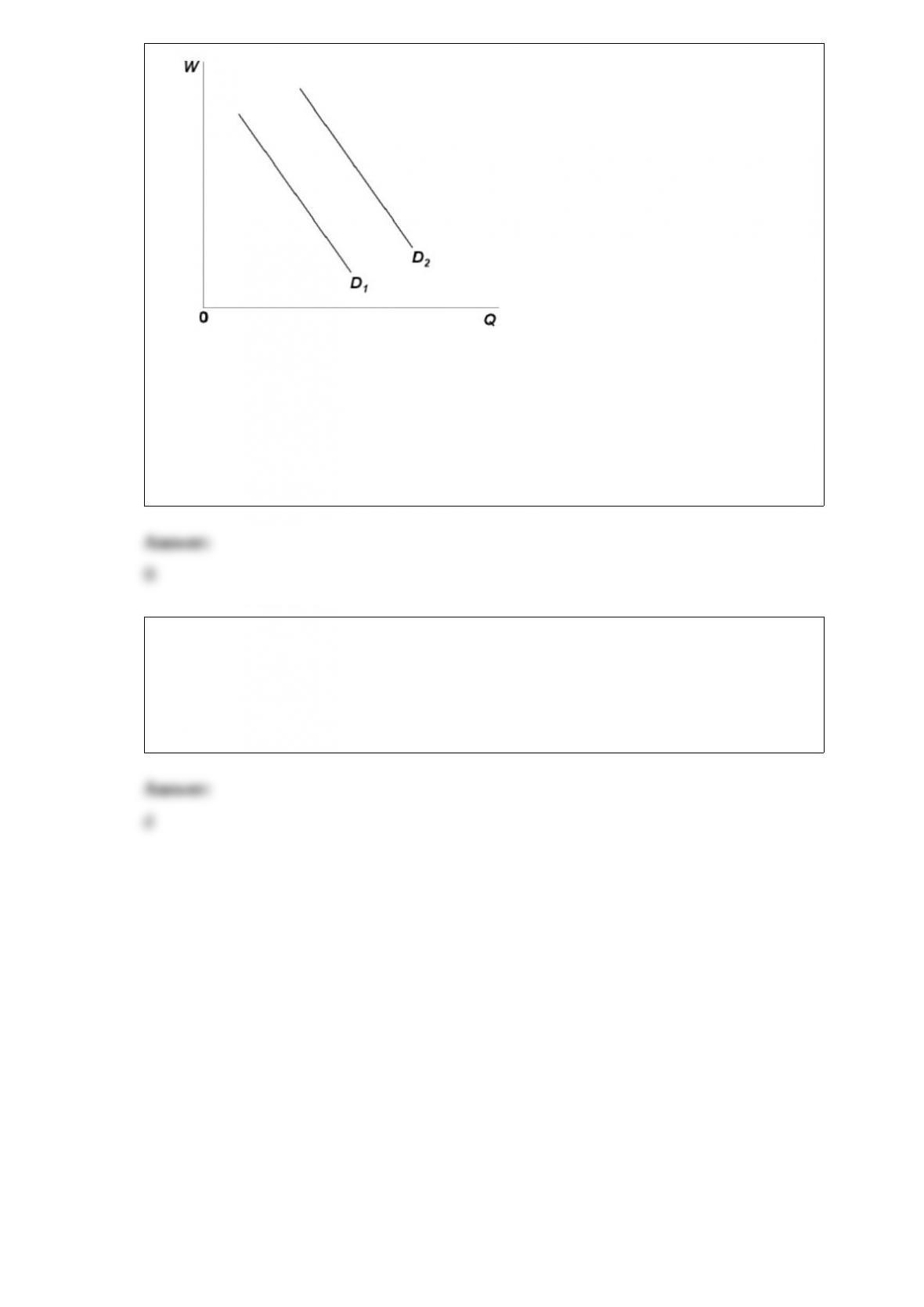
9)
A shift in union labor demand from D1 to D2 in the above diagram might be the result
of:
A.a refusal by union members to buy the product they are producing.
B.an increase in tariffs on products competing with those produced by relevant union
workers.
C.increases in the prices of complementary inputs.
D.a strike (work stoppage) by the union.
10) economists use the term imperfect competition to describe:
a.all industries which produce standardized products.
b.any industry in which there is no nonprice competition.
c.a pure monopoly only.
d.those markets which are not purely competitive.