1) concerning international lending risk of commercial banks, ____ refers to the
probability that part/all of the interest/principal of a loan will not be repaid.
a.country risk
b.credit risk
c.currency risk
d.presidential risk
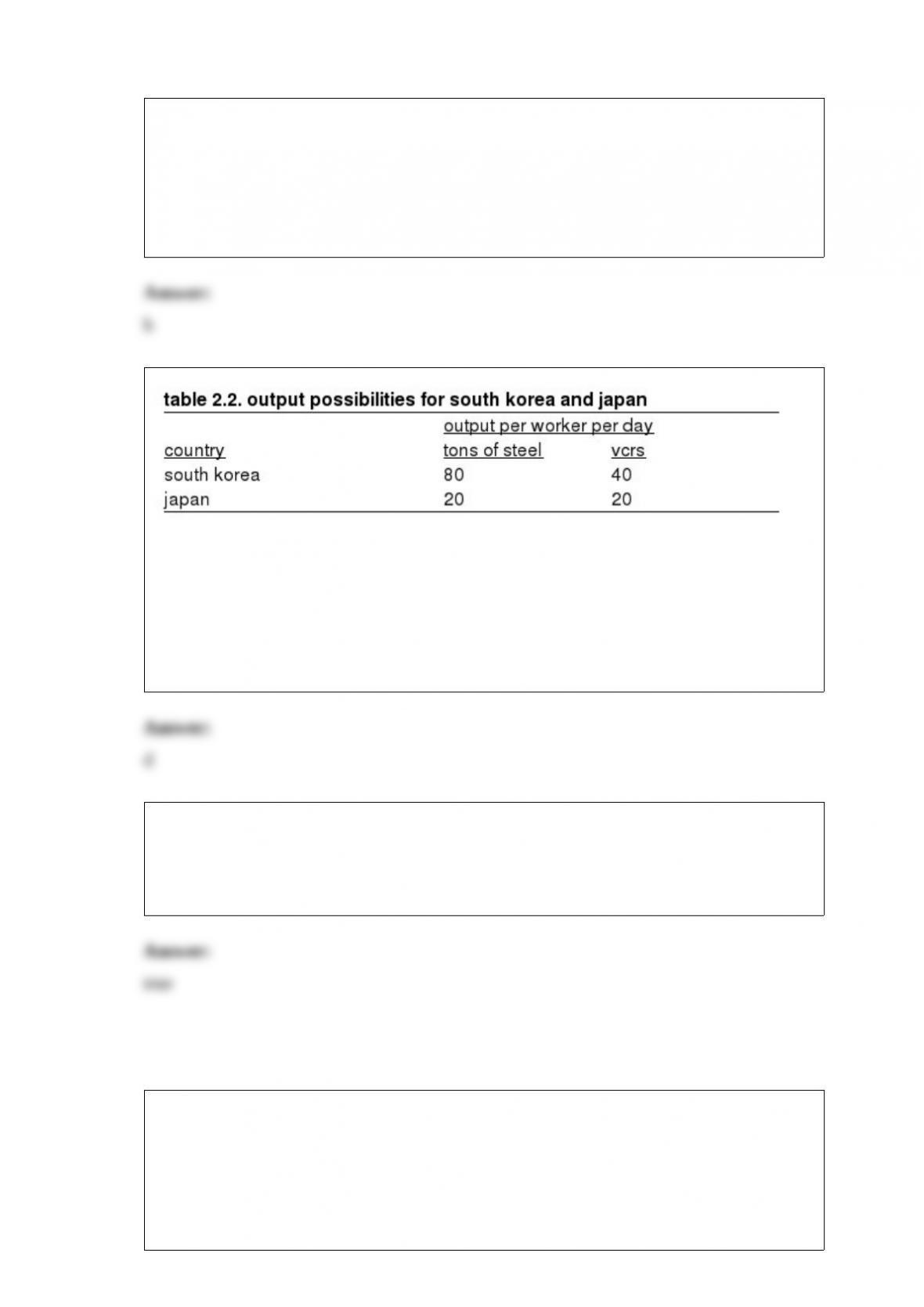
2) referring to table 2.2, the opportunity cost of one vcr in south korea is:
a.1/2 ton of steel
b.1 ton of steel
c.1 1/2 tons of steel
d.2 tons of steel
3) the heckscher-ohlin theory suggests that land-abundant nations will export
land-intensive goods while labor-abundant nations will export labor-intensive goods.
a.true
b.false
4) suppose that sears owes 1 million yen to a japanese electronics manufacturer in 3
months. it could hedge against the risk of a depreciation of the dollar against the yen by
contracting to purchase 1 million yen in the forward market, at today’s forward rate, for
delivery in 3 months.
a.true
b.false
5) if the marginal propensity to save equals 0.1 and the marginal propensity to import
equals 0.3, an autonomous increase in exports of $1,000 would expand domestic
income by $2,500 which leads to an increase in imports of $750.
a.true
b.false
6) the smoot-hawley tariff act of 1930 has generally been associated with:
a.falling tariffs
b.increases in the volume of trade
c.intensifying the worldwide depression
d.efforts to liberalize nontariff trade barriers
7) which trade theory suggests that comparative advantage tends to shift from one
nation to another as a product matures?
a.interindustry trade theory
b.intraindustry trade theory
c.product life cycle theory
d.overlapping demand theory
8) the appropriate expenditure-switching policy to correct a current account deficit is:
a.contractionary monetary policy
b.expansionary fiscal policy
c.currency devaluation
d.currency revaluation
9) which of the following policies permits a specified quantity of goods to be imported
at one tariff rate and applies a higher tariff rate to imports above this quantity?
a.tariff quota
b.import tariff
c.specific tariff
d.ad valorem tariff
10) according to staffan linder, the factor endowment theory is useful in explaining
trade patterns in manufactured goods, but not primary products.
a.true
b.false
11) subsidies to domestic firms may lead to
a.an increase in prices
b.higher volume of exports
c.higher volume of imports
d.increase in welfare of the trading partner
12) a primary reason why nations conduct international trade is because:
a.some nations prefer to produce one thing while others produce other things
b.resources are not equally distributed among all trading nations
c.trade enhances opportunities to accumulate profits
d.interest rates are not identical in all trading nations
13) the world trade organization provides for all of the following except:
a.the usage of the normal-trade-relation (most-favored-nation) clause
b.assistance in the settlement of trade disagreements
c.multilateral tariff reductions
d.bilateral tariff reductions
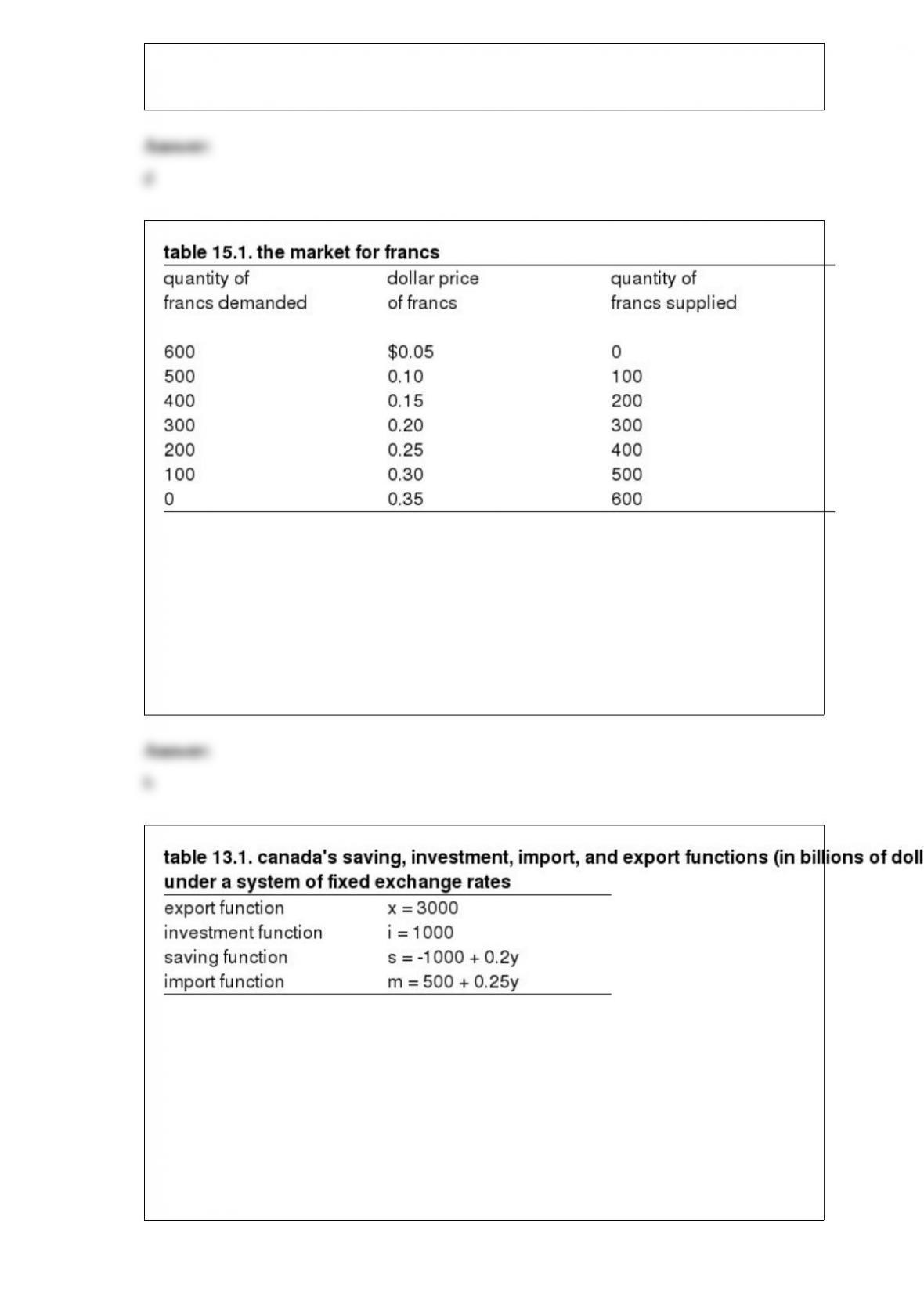
14) refer to table 15.1. under a system of floating exchange rates, the equilibrium
exchange rate equals:
a.$0.15 per franc
b.$0.20 per franc
c.$0.25 per franc
d.$0.30 per franc
15) refer to table 13.1. if improved business optimism leads to increases in canada’s
planned investment spending from $1000 billion to $1200 billion, canada’s equilibrium
income rises by approximately:
a.$444 billion
b.$555 billion
c.$666 billion
d.$777 billion