
1) a perfectly inelastic demand schedule:
a.rises upward and to the right, but has a constant slope.
b.can be represented by a line parallel to the vertical axis.
c.cannot be shown on a two-dimensional graph.
d.can be represented by a line parallel to the horizontal axis.
2) Suppose the firms in a five-firm industry have market shares of 60, 20, 10, 5, and 5
percent, respectively. The Herfindahl index for the industry is:
A.3,600
B.9,025
C.95
D.4,150
3) (1) The composite index of leading indicators turns downward for three consecutive
months, suggesting the possibility of a recession; (2) Economists reach agreement that
the economy is moving into a recession; (3) A tax cut is proposed in Congress; (4) The
tax cut is passed by Congress and signed by the President; (5) Consumption spending
begins to rise, aggregate demand increases, and the economy begins to recover.
Refer to the above information. The recognition lag of fiscal policy is reflected in
events:
A.1 and 2.
B.2 and 3.
C.3 and 4.
D.4 and 5.
4) answer the next question(s) on the basis of the following national income data for the
economy. all figures are in billions of dollars.

refer to the above data. disposable income:
a.cannot be determined from the data given.
b.is $484.
c.is $416.
d.is $502.
5) kara voluntarily quit her job as an insurance agent to return to school full-time to
earn an mba degree. with degree in hand she is now searching for a position in
management. kara presently is:
a.cyclically unemployed.
b.structurally unemployed.
c.frictionally unemployed.
d. not a member of the labor force.
6) for an imperfectly competitive firm:
a.total revenue is a straight, upsloping line because a firm’s sales are independent of
product price.
b.the marginal revenue curve lies above the demand curve because any reduction in
price applies to all units sold.
c.the marginal revenue curve lies below the demand curve because any reduction in
price applies to all units sold.
d.the marginal revenue curve lies below the demand curve because any reduction in
price applies only to the extra unit sold.
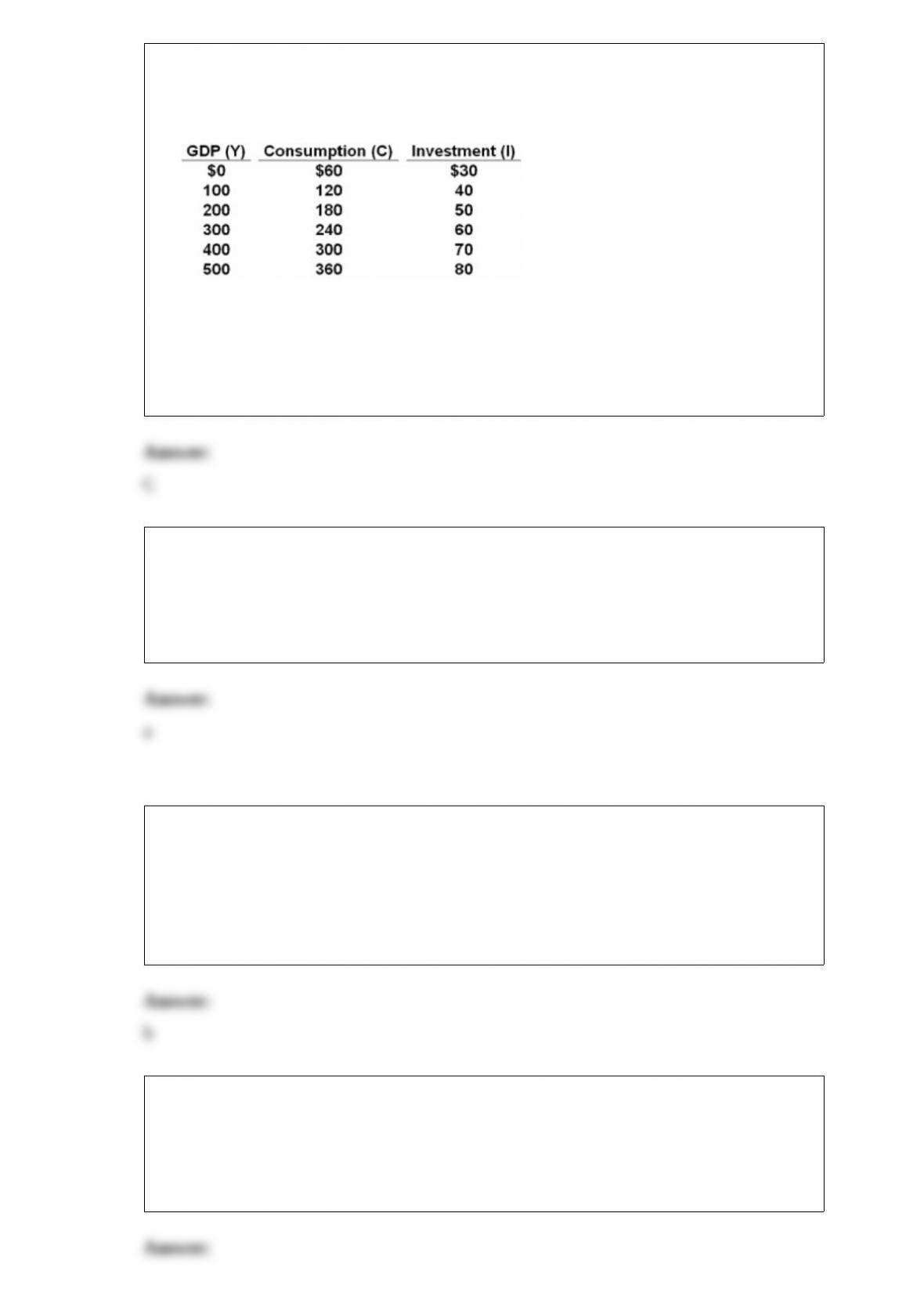
7) (Advanced analysis) Answer the next question(s) on the basis of the following data
for a private closed economy. The letters Y, C, S, and I are used to represent real GDP,
consumption, saving, and investment respectively.
The equation representing the investment schedule for the above economy is:
A.I = .3Y.
B.I = 80 – .3Y.
C.I = 30 + .1Y.
D.I = I0 = 30.
8) in drawing the production possibilities curve we assume that:
a.technology is fixed.
b.unemployment exists.
c.economic resources are unlimited.
d.wants are limited.
9) according to estimates, what percentage of cleaning workers in the united states are
illegal immigrants?
a.12
b.17
c.24
d.43
10) Purchasing common stock by writing a check best exemplifies money serving as a:
A.store of value.
B.unit of account.
C.medium of exchange.
D.index of satisfaction.

11) Suppose that the labor cost-total cost ratio in industry A is 82 percent while in
industry B it is 21 percent. Other things equal, labor demand will be:
A.more elastic in industry A than in B.
B.unit elastic in both industry A and B.
C.more elastic in industry B than in A.
D.relatively elastic in both industry A and B.
12) (Advanced analysis) Answer the next question(s) on the basis of the following
information for a private closed economy where C is consumption, Y is the gross
domestic product, Ig is gross investment, and i is the interest rate:
Refer to the above information. Given that the interest rate is 10 (percent), the amount
that businesses will want to invest will be:
A.$58.
B.$60.
C.$40.
D.$20.