
We are forced to make choices because of:
A) exploitation.
B) efficiency.
C) scarcity.
D) the margin.
Under fixed exchange rates, a revaluation decreases aggregate demand by:
A) increasing exports.
B) reducing imports.
C) causing a financial account deficit.
D) decreasing exports.
The opportunity cost of production:
A) is the price of a good.
B) is what you give up to produce the good.
C) decreases as production increases.
D) is what you gain by producing the good.
If the marginal propensity to consume is 0.8 and government transfers decrease by $30
billion, real GDP will decrease by less than $150 billion.
A) True
B) False
The income”expenditure model predicts that if the marginal propensity to consume is
0.8 and the federal government decreases spending by $200 billion, real GDP will fall
by:
A) $160 billion.
B) $200 billion.
C) $800 billion.
D) $1,000 billion.
Banking crises are:
A) not very harmful to the real economy, since money is neutral in the long run.
B) typically followed by recessions.
C) typically the beginning of long periods of economic growth.
D) usually over with very quickly.
Which of the following is included in GDP?
A) the purchase of 100 shares of Microsoft stock
B) the purchase of a 1965 Ford Mustang
C) Social Security payments from the U.S. government to retired people
D) the purchase of a ticket to a Lady Gaga concert
In the short run, wages and some prices are considered to be:
A) sticky.
B) unpredictable.
C) extremely flexible.
D) irrelevant.
If the dollar value of the pound falls, then the dollar has depreciated.
A) True
B) False
The market(s) that channel the excess savings of households into investment spending
by firms is(are):
A) the stock market.
B) financial markets.
C) the international market.
D) the bond market.
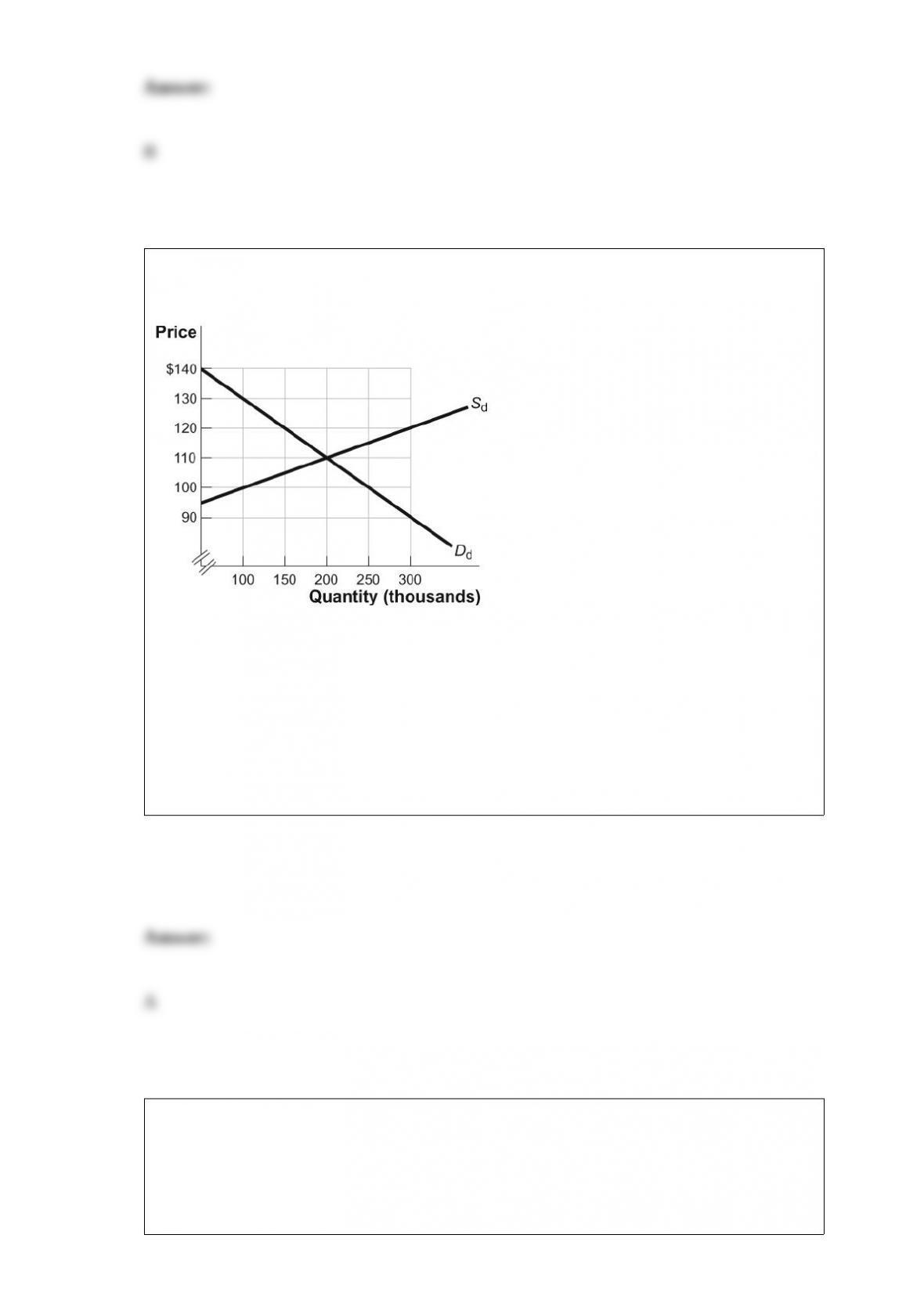
Figure: The Market for MP3 Players
Look at the figure The Market for MP3 Players. Assume that Sdrepresents the domestic
supply curve and Ddrepresents the domestic demand curve. If the world price equals
$100 and there is free trade, consumer surplus _____ and producer surplus _____
compared to autarky.
A) increases; decreases
B) increases; increases
C) decreases; increases
D) decreases; decreases
When the price level increases, everyone becomes poorer.
A) True
B) False

If the equilibrium exchange rate is above the target rate, the government should:
I. buy its domestic currency in foreign exchange markets.
II. engage in expansionary monetary policy.
III. restrict the purchase of foreign currencies.
A) I only
B) II only
C) III only
D) I, II, and III
According to the rule of 70, if a country’s real GDP per capita grows at an annual rate of
2% instead of 3%, it will take _____ additional years for that country to double its level
of real GDP per capita.
A) 35
B) 11.67
C) 23.3
D) 30

Suppose your grandma sends you $100 for your birthday and you deposit that $100 in
your checking account. The reserve ratio is 10%. Based upon this deposit, the bank’s
excess reserves have increased by _____, and if the bank lends these new excess
reserves, the money supply could eventually grow by as much as an additional _____.
A) $90; $1,000
B) $100; $900
C) $90; $900
D) $100; $1,000
If the equilibrium exchange rate is below the target rate, the government should:
I. buy its domestic currency in foreign exchange markets.
II. engage in expansionary monetary policy.
III. restrict the purchase of the domestic currency by foreigners.
A) I only
B) II only
C) III only
D) I, II, and III

A business will want to borrow to undertake an investment project when the rate of
return on that project is _____ rate.
A) lower than the interest
B) higher than the interest
C) higher than the exchange
D) equal to the inflation
In the circular-flow diagram, an organization that produces goods and services for sale
is a:
A) government.
B) factor.
C) household.
D) firm.

Suppose the government increases spending by $100 billion as a stimulus package. If
the marginal propensity to consume is 0.6, then real GDP will:
A) decrease by $250 billion.
B) increase by $250 billion.
C) increase by $600 billion.
D) decrease by $400 billion.
The primary emphasis in macroeconomics is on:
A) how firms set prices.
B) the national economy.
C) marginal analysis.
D) bits and pieces of the economy.
The belief that trade must be bad for exporting countries because the foreign workers
are paid very low wages by our standards is the:
A) pauper labor fallacy.

B) sweatshop labor fallacy.
C) third-world country fallacy.
D) Nike fallacy.
Joseph believes that changes in the business cycle can be attributed to shifts in the
vertical aggregate supply curve. These shifts are caused by faster or slower increases in
economic productivity. Joseph is best described as supporting the _____ theory.
A) rational expectations
B) supply-side
C) real business cycle
D) new Keynesian
Which book illustrates the advantages of specialization using an eighteenth-century pin
factory?
A) Free to Choose, by Milton Friedman
B) The Wealth of Nations, by Adam Smith
C) Das Kapital, by Karl Marx
D) The General Theory, by John Maynard Keynes
If the economy is at potential output and the Fed increases the money supply, in the
SHORT run real GDP will likely:
A) fluctuate randomly.
B) remain the same.
C) decrease.
D) increase.
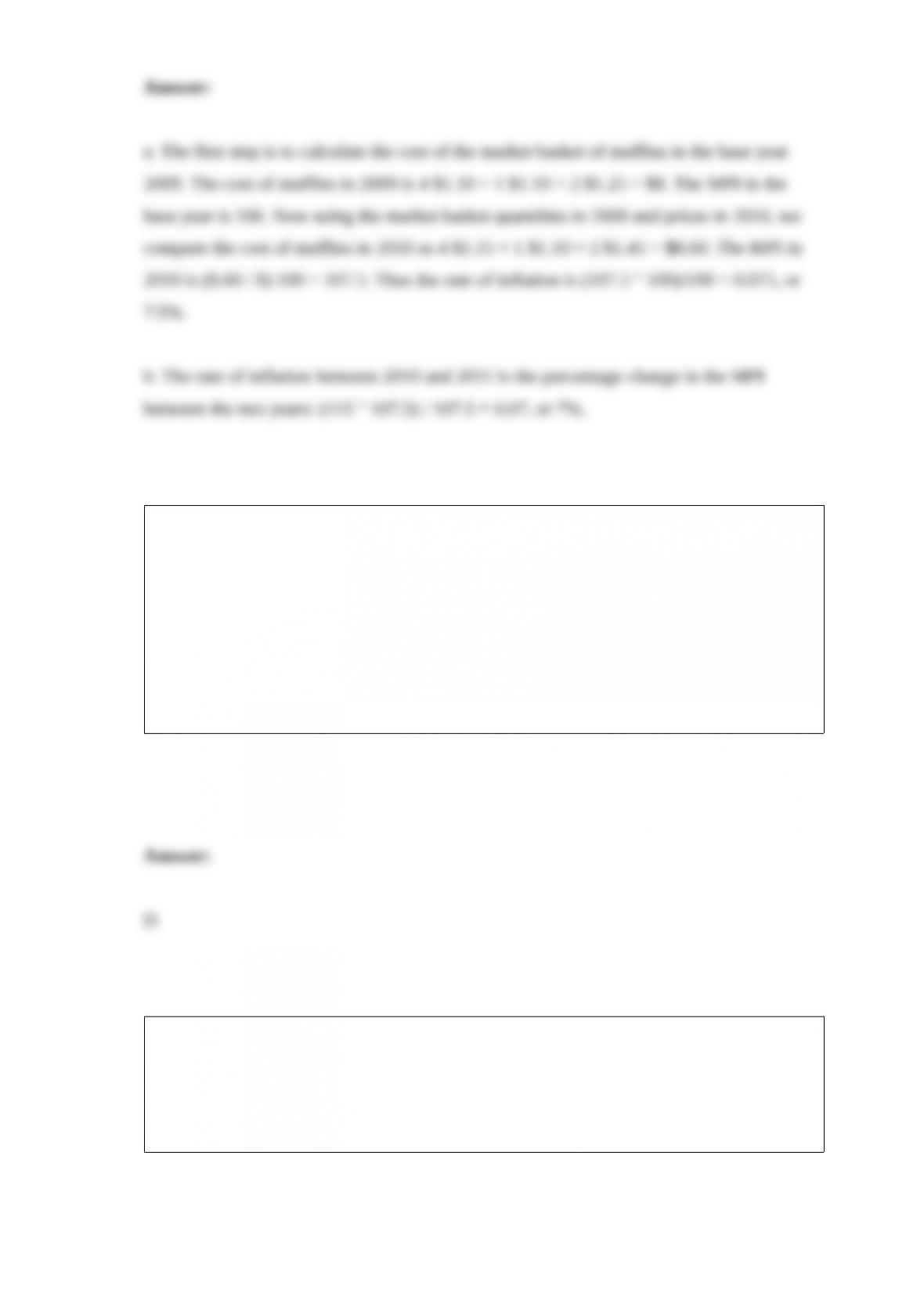
Look at the table Muffin Price Index. A college town has many small coffee shops, and
they all sell muffins. As an economics project you have been assigned to compile a
muffin price index (MPI). The base year is 2009. Use these data to compute the rate of
inflation in the MPI between:
a. 2009 and 2010.
b. 2008 and 2011.
The natural level of unemployment contains no_____ unemployment.
A) minority
B) structural
C) frictional
D) cyclical
In 2002, the French adopted the euro as their national currency.
A) True
B) False
Banks are financial intermediaries that use deposits of its customers, which are liquid
assets, to finance the illiquid investments of borrowers.
A) True
B) False
A business cycle is a:
A) very deep and prolonged economic downturn.
B) period in which output and employment are rising.
C) period in which output and employment are falling.
D) short-run alternation between economic upturns and downturns.
Which of the following factors is NOT necessary for convergence between two
countries?

A) equal access to education
B) equal access to infrastructure
C) a common language between the two countries
D) similar levels of political stability
To fight a recession, the Federal Reserve should conduct _____ monetary policy to
_____ interest rates, which will shift the aggregate demand curve to the _____.
A) expansionary; lower; left
B) contractionary; raise; left
C) contractionary; lower; right
D) expansionary; lower; right
From the 1930s until the 2008 financial crisis, banking regulation addressed all of the
following except:
A) deposit insurance.
B) capital requirements.
C) reserve requirements.
D) shadow banks.
One of the functions of the 12 regional Fed banks is to audit the books of private-sector
banks in their region to be sure that they are financially sound.
A) True
B) False