
Workers whose spells of unemployment are broken up by brief periods of employment
or withdrawal from the labor force are referred to as ______ workers
A. short-term unemployed
B. discouraged
C. long-term unemployed
D. chronically unemployed
In the base year, real GDP ______ nominal GDP.
A. is greater than
B. is less than
C. is equal to
D. could be greater than or less than
Espresso Yourself Coffee Shop hires workers in a competitive labor market to make
coffee. The ingredients required to make each cup of coffee cost 50 cents. The coffee
shop’s hourly output of coffee varies with the number of workers hired, as shown in the
table below. Each cup of coffee sells for $2.00.

The dollar value to the coffee shop of hiring the fifth worker is ______ per hour.
A. $1.50
B. $2.00
C. $5.00
D. $7.50
To increase total revenue, firms with ______ demand should lower price, and firms
with ______ demand should increase price.
A. elastic; unit
B. elastic; inelastic
C. inelastic; elastic
D. unit; inelastic

The demonstration effect suggests that people will save less when they
A. base their spending decisions (and consequently their saving decisions) on spending
decisions of others who spend more than they do.
B. base their saving decisions on their projections of income and spending needs over
their lifetime.
C. recognize that the real interest rate has increased.
D. control their spending in order to save more when the real interest rate increases.
Which of the following statements about explicit costs is true?
A. They are the only costs that matter to business owners.
B. They usually exceed implicit costs.
C. They are difficult to measure.
D. They appear on the firm’s balance sheet.
If Alex uses $800 from her checking account to pay her credit card balance, her wealth:
A. increases by $800.

B. decreases by $800.
C. increases by $1,600.
D. does not change.
If average labor productivity in two countries is the same, average living standards will
be lower in the country with:
A. the smaller population.
B. the larger population.
C. the higher share of population employed
D. the lower share of population employed.
Means-tested welfare benefits provide recipients with a strong incentive to:
A. leave welfare.
B. underreport their earnings.
C. work.
D. accurately disclose their earnings.

If a market is in equilibrium and demand increases while supply decreases, the change
in the equilibrium price is ________ and the change in the equilibrium quantity is
_________.
A. positive; positive
B. positive; negative
C. positive; indeterminate
D. indeterminate; positive
Refer to the figure below. If Laura and Chris are the only two consumers in this market
then at a price of $2.50 per pound, the market demand for hamburger is:
A. 1.5 pounds per week
B. 3 pounds per week
C. 4 pounds per week

D. 4.5 pounds per week
When private firms reduce investment because of the increase in interest rates brought
about by government borrowing it is termed:
A. logrolling.
B. crowding out.
C. monetary policy.
D. rent seeking.
Suppose that the short-run price elasticity of demand for electricity is 0.03, and the
long-run price elasticity of demand is 1.2. One would classify the short-run elasticity as
being ___________ and the long-run elasticity as being ____________.
A. elastic; elastic
B. elastic; inelastic
C. inelastic; unit elastic
D. inelastic; elastic

Refer to the figure below. If the Federal Reserve wants to set the nominal interest rate at
9%, it must conduct open market ______ to set the money supply at _____.
A. purchases; 100
B. sales; 100
C. purchases; 900
D. sales; 900
Inflation inertia is the result of the behavior of ____ and the existence of ______.
A. the central bank; automatic stabilizers
B. real and nominal interest rates; an output gap
C. autonomous aggregate demand; the Fed’s policy reaction function
D. inflation expectations; long-term wage and price contracts

A real quantity is a quantity measured:
A. in physical terms.
B. in terms of current dollar value.
C. by the average quantity.
D. using real prices.
Which of the following would not be included in the calculation of accounting profit?
A. The wages paid to the company’s workers.
B. The salary the owner could have earned working elsewhere.
C. The rent paid by the owner for the use of a building.
D. The medical insurance coverage for the company’s workers.

The saving of the government sector is called ______ saving.
A. private
B. public
C. national
D. aggregate
Leo is a welfare recipient who qualifies for two means-tested cash benefit programs. If
he does not earn any income, he receives $225 from each program. For each dollar he
earns (which his employer is required to report to the welfare agency), his benefit from
each program is reduced by 75 cents until the benefit equals zero.In the absence ofany
earnings, Leo will receive ______ in cash from each program, for a total of ______ in
benefits.
A. $225; $225
B. $225; $450
C. $225; $400
D. $200; $400

Alison decides to play the lottery. She has a 5% probability of winning $100 and a 95%
probability of winning zero. The expected value of playing the lottery is:
A. $100.
B. $5.
C. $10.
D. $50.
When the federal government borrows money, the resulting ______ in interest rates will
lead private investment to ______.
A. decrease; rise
B. decrease; fall
C. increase; rise
D. increase; fall
Someone who is committed to maintaining low inflation even at the short-run cost of
reduced output and employment is called a(n):
A. anchored central banker.

B. reactionary central banker.
C. inflation dove.
D. inflation hawk.
If the annual real rate on a 10-year inflation-protected bond equals 1.9 percent and the
annual nominal rate of return on a 10-year bond without inflation protection is 4.4
percent, what average rate of inflation over the ten years would make holders of
inflation-protected bonds and holders of bonds without inflation protection equally well
off?
A. 1.9%
B. 2.5%
C. 4.4%
D. 6.3%
The CPI in 1974 equaled 0.49. The CPI in 1975 equaled 0.54. The rate of inflation
between 1974 and 1975 was ______ percent.
A. 5.0
B. 5.4

C. 9.3
D. 10.2
Refer to the figure below. Long-run equilibrium in this economy:
A. will be impossible to achieve.
B. could occur if AD shifts downward to the left.
C. could occur if AS shifts downward and to the right.
D. will occur only if AD shifts upward to the right.
If all prices adjusted immediately to balance the quantities supplied and demanded for
all goods and services:
A. output gaps would not exist.
B. output gaps would be positive more often than they would be negative.
C. cyclical unemployment would be positive.
D. potential GDP would rise much more quickly.
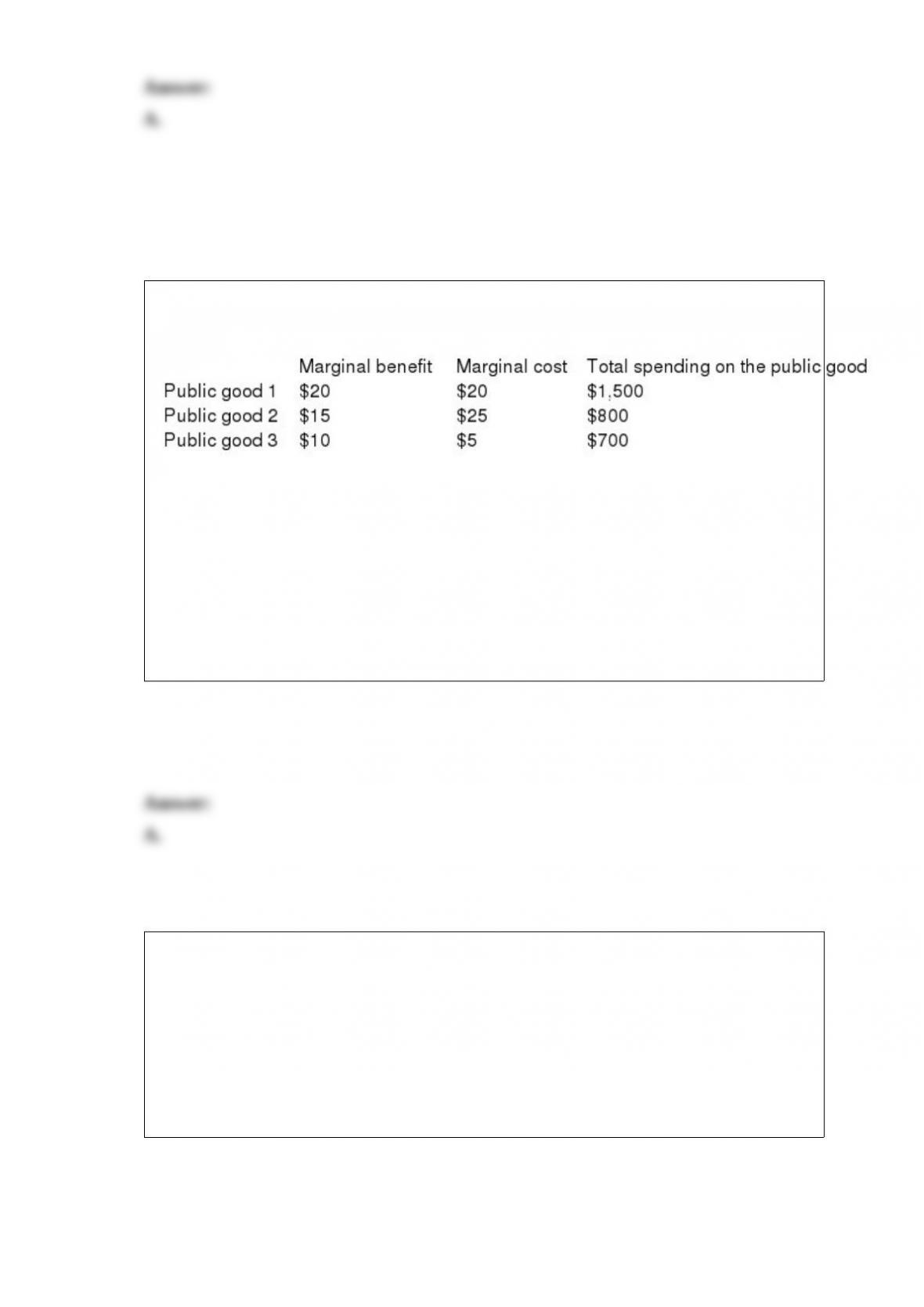
The table below shows the marginal benefit and marginal cost of purchasing an
additional unit of 3 different public goods.
The government is spending the socially optimal amount on:
A. public good 1
B. public good 2
C. public good 3
D. public good 1 and public good 2
In general, when the price of a variable factor of production increases:
A. total cost falls.
B. the profit maximizing level of output rises.
C. the profit-maximizing price falls.
D. marginal cost rises.

Suppose a small island nation imports sugar for its population at the world price of
$1,500 per ton. The domestic market for sugar is shown below.
With no subsidy, what is consumer surplus?
A. $1,000 per day
B. $4,000 per day
C. $8,000 per day
D. $9,000 per day
Professor Plum, who earns $100,000 per year, read in the paper today that the
university pays its basketball coach one million dollars per year in exchange for his
agreement to remain at the university for at least three more years. The coach earns
more than Professor Plum because:
A. the demand for sporting events exceeds the demand for college degrees.
B. universities value sports more than academics.
C. the coach is able to earn economic rent due to his unique talents.
D. the coach has more human capital than does Professor Plum.
Marginal cost is calculated as:
A. total revenue minus total costs.
B. the change in output divided by the change in total costs.
C. the percentage change in total costs divided by the percentage change in output.
D. the change in total costs divided by the change in output.
One reason that variable factors of production tend to show diminishing returns in the
short run is that:
A. capital equipment is often idle in the short run.
B. there is only so much that can be produced using additional variable inputs when
some factors of production are fixed.
C. large firms cannot effectively manage their resources.
D. the cost of employing additional resources increases as firms employ more of those
resources.
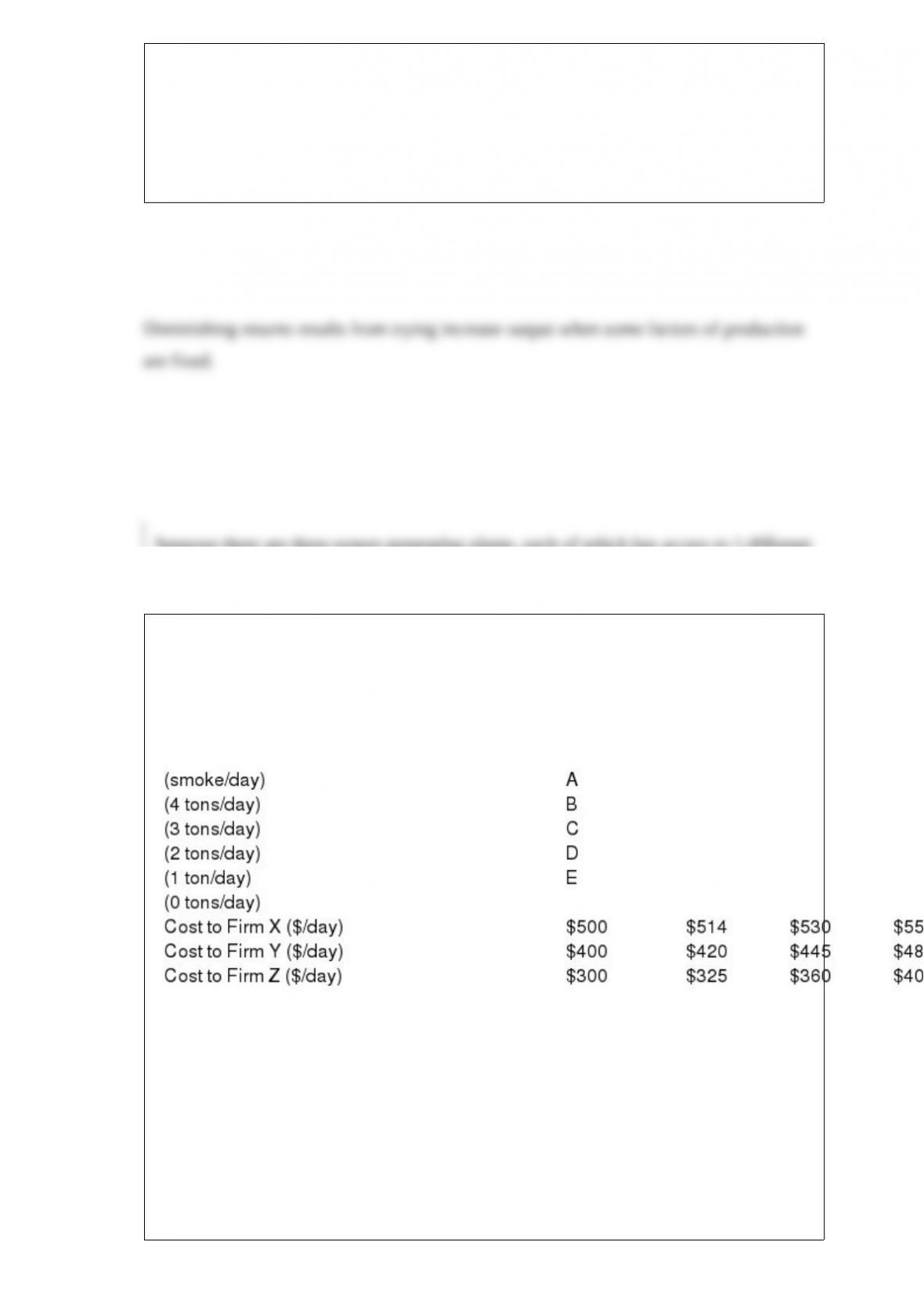
Suppose there are three power-generating plants, each of which has access to 5 different
production processes. The table below summarizes the cost of each production process
and the corresponding number of tons of smoke emitted each.
process
Suppose the government requires each firm to reduce pollution to 2 tons of smoke per
day, so that total daily smoke emission is 6 tons. The total cost to society of this policy
will be ______ per day.
A. $59
B. $42
C. $230

D. $135
Gasoline prices tend to be higher at stations that are just off the freeway than they are at
stations in the middle of town. The most likely reason for this is that:
A. freeway exit stations sell a higher quality product.
B. people who buy gas at freeway exit stations tend to have higher search costs.
C. freeway exit stations are more likely to have an attached convenience store.
D. demand for gas at freeway exits is lower than it is in the middle of town.
One problem with antitrust laws is that they:
A. are too recent to be understood by most lawyers.
B. encourage too many mergers.
C. blunt firms’ incentives to cut costs.
D. may prevent companies from achieving economies of scale.