
The key reason that the Laspeyres price index tends to overstate the impact of price
changes on consumers is that it:
A) only accounts for price increases and ignore price decreases.
B) measures prices two periods after the actual price changes occurred.
C) ignores the possibility that consumers alter their consumption as prices change.
D) All of the above are correct.
E) none of the above
Good A is a normal good. The demand curve for good A:
A) slopes downward.
B) usually slopes downward, but could slope upward.
C) slopes upward.
D) usually slopes upward, but could slope downward.
Recent research estimates that the short-run price elasticity of demand for gasoline in
the U.S. is -0.3, and the long-run price elasticity of demand is -1.4. What happens if the
govenment increases the federal gasoline tax?

A) Consumer expenditures on gasoline increase over the short run and long run
B) Consumer expenditures on gasoline decline over the short run and increase over the
long run
C) Consumer expenditures on gasoline increase over the short run and decline over the
long run
D) Consumer expenditures on gasoline decrease over the short run and long run
Use the following statements to answer this question:
I. A price-consumption curve is derived by varying the price of asparagus. If the
price-consumption curve is an upward sloping straight line, the demand curve for
asparagus must be downward sloping.
II. Fred consumes only food and clothing. Fred’s Engel curve traces out the utility
maximizing combinations of food and clothing associated with each and every income
level.
A) I and II are true.
B) I is true, and II is false.
C) I is false, and II is true.
D) I and II are false.

Scenario 4.5:
The demand curve for grilled cheese sandwiches has been estimated using statistical
techniques as follows:
log(Q) = -1.10 – 0.18 log(P) + 1.21 log(I) + 0.84 log(Ph)
where Q is the quantity of grilled cheese sandwiches
P is the price of grilled cheese sandwiches
I is income
Ph is the price of hamburgersSee Scenario 4.5. The Engel curve for grilled cheese
sandwiches is:
A) downward sloping.
B) horizontal.
C) upward sloping.
D) none of the above
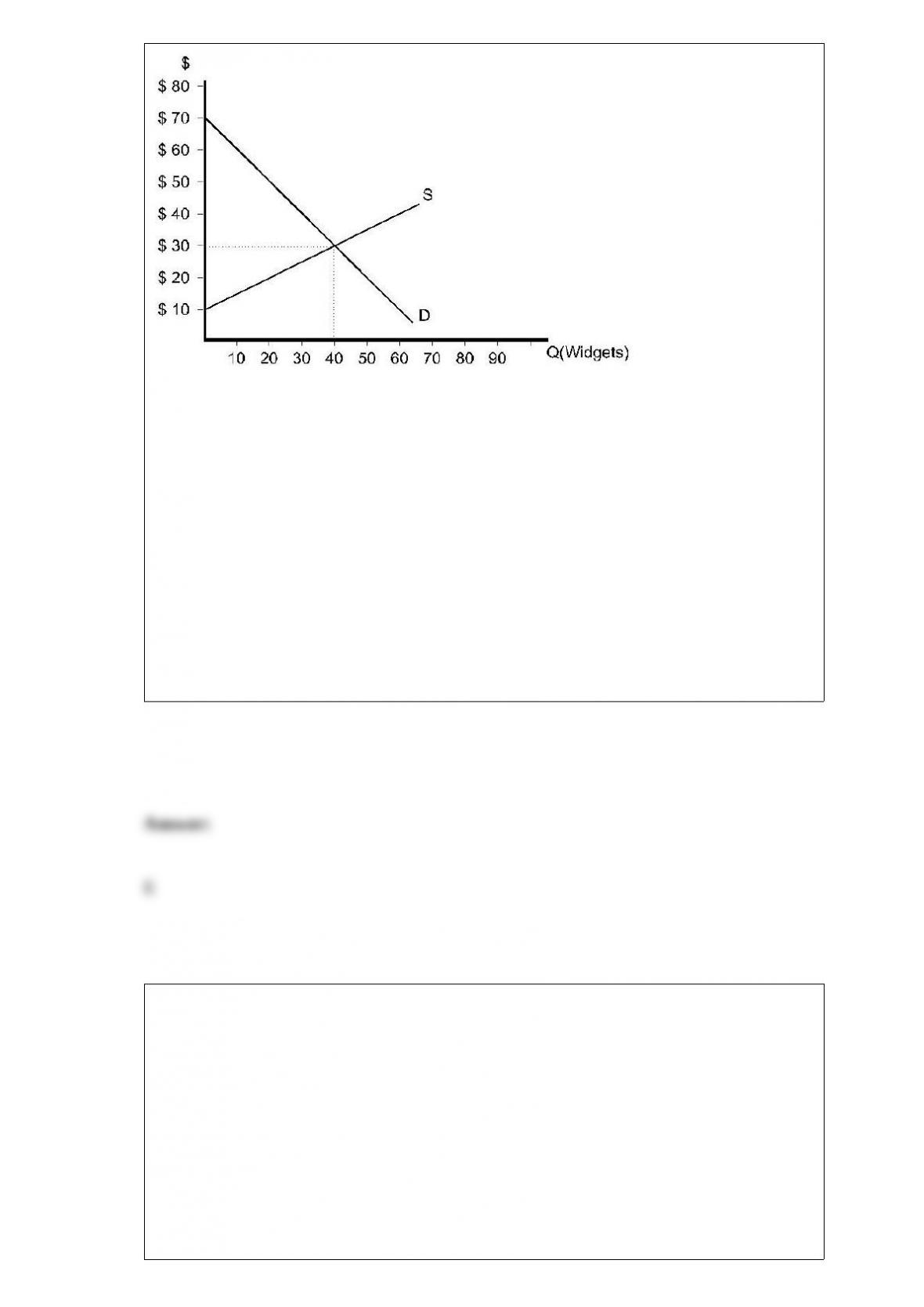
Figure 9.4
Refer to Figure 9.4. If the government establishes a price floor of $40 and purchases the
surplus, total consumer and producer surplus will be
A) $15.
B) 30 widgets.
C) $1,050.
D) $1,200.
E) $1,350
A production function defines the output that can be produced
A) at the lowest cost, given the inputs available.
B) for the average firm.
C) if the firm is technically efficient.
D) in a given time period if no additional inputs are hired.
E) as technology changes over time.

Over the past year price inflation has been 10%, but the price of a used Ford Escort has
fallen from $6,000 to $5,000. The real price of a Ford Escort has fallen by:
A) 12%.
B) 17%
C) 20%.
D) 24%
E) 32%.
Scenario 13.9
Consider the following game:
Two firms are situated next to a lake, and it costs each firm $1,500 per period to use
filters that avoid polluting the lake. However, each firm must use the lake’s water in
production, so it is also costly to have a polluted lake. The cost to each firm of dealing
with water from a polluted lake is $1,000 times the number of polluting firms.
Refer to Scenario 13.9. What kind of game is being played by Lago and Nessie?

A) Battle of the Sexes.
B) Prisoners’ Dilemma.
C) Beach Location.
D) Stackelberg Output Choice.
E) Cournot Output Choice.
Hart’s Pinefall Lodge provides guided hunts and fishing trips to their customers in
Ontario, Canada. The market price for high quality hunting and fishing trips is $1,250.
The market price for standard quality hunting and fishing trips is $750. The marginal
cost of providing high quality trips each season is: MC(Q) = 156.25Q. The marginal
cost of providing standard quality trips each season is: MC(Q) = 62.5Q. In order to be
able to sell their hunting and fishing trips at high quality prices, Hart’s Pinefall Lodge
must pay an advertising fee of $500 each season. Should the Lodge pay the fee and sell
high quality trips?

What is the advantage of the standard deviation over the average deviation?
A) Because the standard deviation requires squaring of deviations before further
computation, positive and negative deviations do not cancel out.
B) Because the standard deviation does not require squaring of deviations, it is easy to
tell whether deviations are positive or negative.
C) The standard deviation removes the units from the calculation, and delivers a pure
number.
D) The standard deviation expresses the average deviation in percentage terms, so that
different choices can be more easily compared.
E) The standard deviation transforms subjective probabilities into objective ones so that
calculations can be performed.
Due to the bandwagon effect, demand for some products is ________ elastic than it
would be without the positive network externality.
A) more
B) less
C) equally
D) more strongly unitary
Scenario 4.1:
Daniel derives utility from only two goods, cake (Qc) and donuts (Qd). The marginal
utility that Daniel receives from cake (MUc) and donuts (MUd) are given as follows:
MUc = Qd
MUd = Qc
Daniel has an income of $240 and the price of cake (Pc) and donuts (Pd) are both
$3.See Scenario 4.1. What is Daniel’s budget constraint?
A) 240 = 3Pc + 3Pd
B) 240 = 3Qc + 3Qd
C) 240 = (Pc)(Qc)
D) 240 = (Qc)(Qd)
E) none of the above

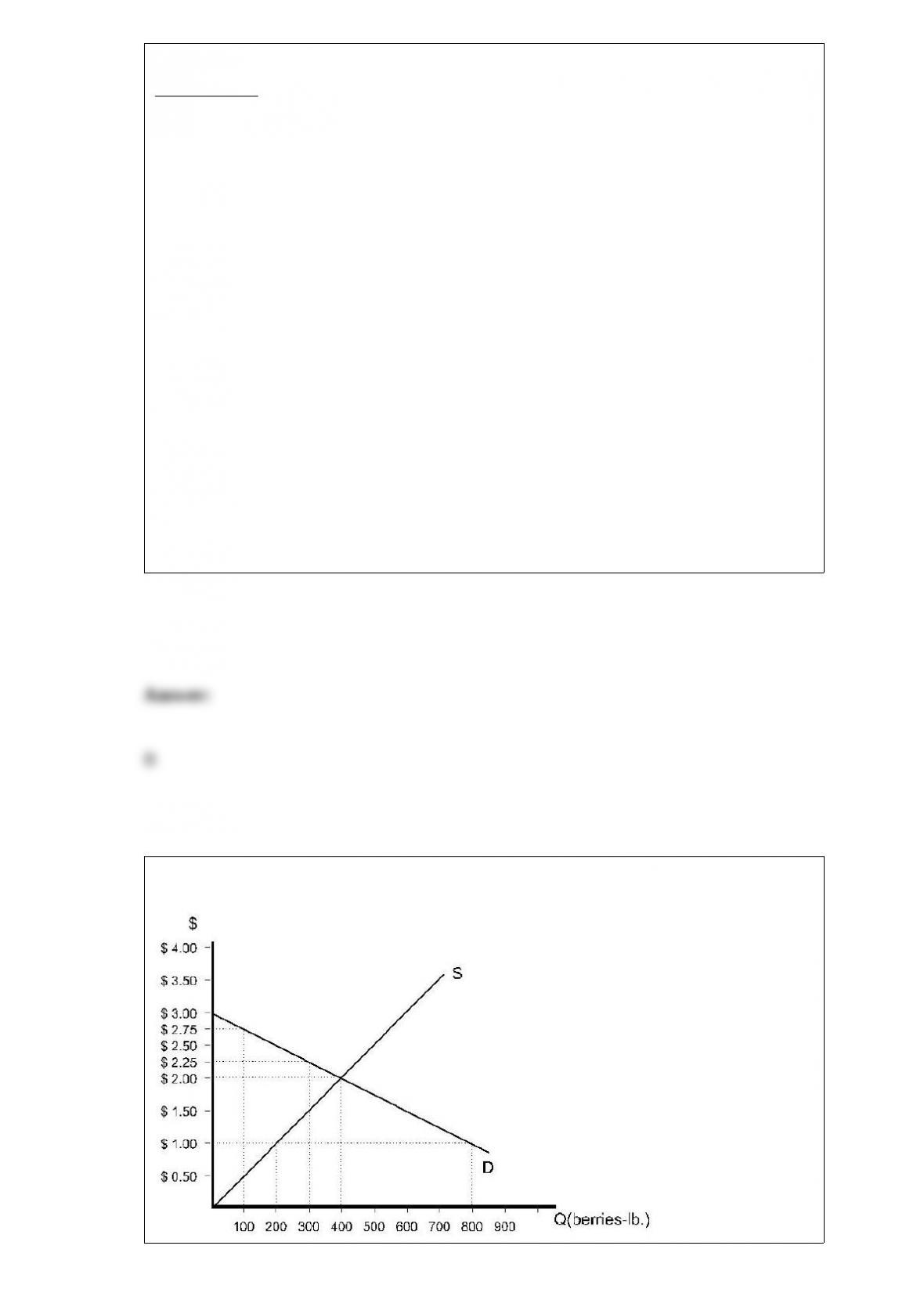
Figure 9.3
Refer to Figure 9.3. If the market is in equilibrium, total producer surplus is
A) $2.
B) $3.
C) $200.
D) $400.
E) $600.
At the profit-maximizing level of output, demand is
A) completely inelastic.
B) inelastic, but not completely inelastic.
C) unit elastic.
D) elastic, but not infinitely elastic.
E) infinitely elastic.
Amos Long’s marginal utility of income function is given as: MU(I) = I1.5, where I

represents income. From this you would say that he is
A) risk averse.
B) risk loving.
C) risk neutral.
D) none of the above
The demand for injections to immunize against a disease is given as:
P = 13 0.0005Q,
where P = price in dollars, and Q = quantity measured as number of shots per month.
The marginal social benefit function has the same vertical intercept as the demand
curve and one half the slope (one half in absolute value). The marginal cost of
injections is a constant $8.
a. With a competitive market, what price and quantity will prevail, assuming that there
is no government intervention?
b. Explain why the demand curve and marginal social benefit functions are different in
this case. What is the socially optimal quantity in the market?
c. What government policies could be used to bring about the optimal outcome?
The demand curve and marginal revenue curve for red rubber balls are given as follows:
Q = 16 – P MR = 16 – 2Q
What level of output maximizes profit?
A) 0
B) 4
C) 5.5
D) 6

E) B, C and D all maximize profit.
Firms that contain some divisions that produce parts and components to be used by
other divisions in order to generate finished goods are said to be:
A) horizontally integrated.
B) vertically integrated.
C) multinationals.
D) corporations.
The statement: “If everyone trades in the competitive marketplace, all mutually
beneficial trades will be completed, and the resulting equilibrium allocation of
resources will be economically efficient.” is formally known as:
A) the law of supply and demand.
B) the first theorem of supply and demand.
C) the first theorem of welfare economics.
D) the first theorem of efficiency in economics.

Governments may successfully intervene in competitive markets in order to achieve
economic efficiency
A) at no time; competitive markets are always efficient without government
intervention.
B) to increase the incidence of positive externalities.
C) in cases of positive externalities only.
D) in cases of negative externalities only.
E) in cases of both positive and negative externalities.
What is the problem with paying plant managers in multi-plant firms according to how
much each plant produces relative to its capacity?
A) Managers in low-cost or high-capacity plants could be penalized, in percentage
terms, for their overproduction.
B) The production problem in multi-plant firms is usually how to lower production to
increase market power, not how to increase production.
C) Managers in high-cost or low-capacity plants could be penalized for production
constraints over which they have no control.
D) Managers would have an incentive to understate the productive capacity of their
plants.
E) Managers would have an incentive to overstate the productive capacity of their

plants.
The authors explain that the international copper cartel (CIPEC) has been largely
ineffective in raising the price of copper in world markets, and the reason is mainly due
to the relatively elastic demand for copper. Suppose the cartel recognized that there are
multiple uses for copper, and some of the uses have few substitute products (e.g.,
copper electrical wire) while others have several close substitutes (e.g., copper water
pipes). If cartel attempted to raise the price of copper in one of these sub-markets,
which market should the cartel choose?
A) Market with several close substitutes because demand is more elastic.
B) Market with several close substitutes because demand is more inelastic.
C) Market with few close substitutes because demand is more elastic.
D) Market with few close substitutes because demand is more inelastic.
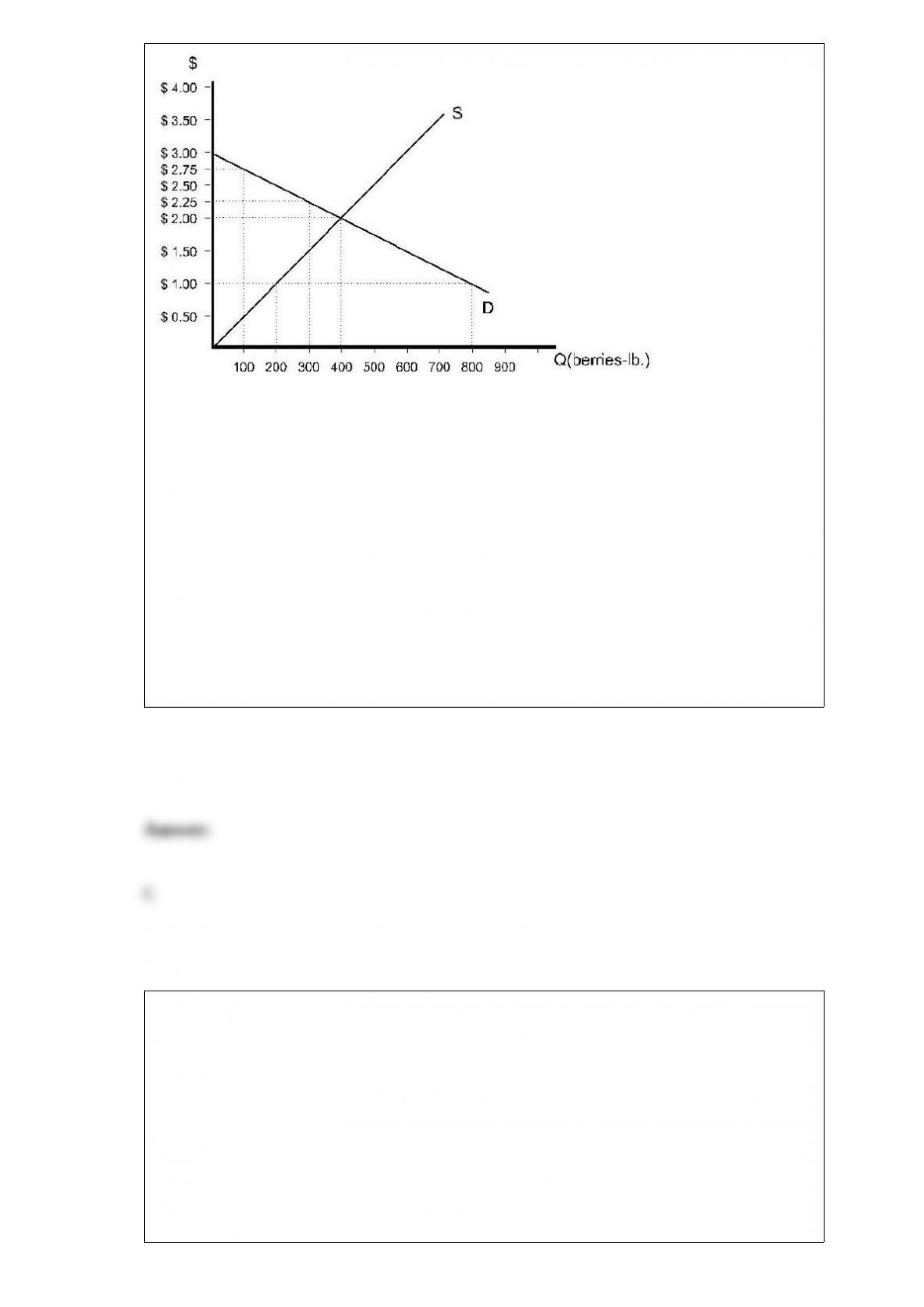
Figure 9.3
Refer to Figure 9.3. If the government establishes a price ceiling of $1.00, total
consumer and producer surplus will be
A) $1.50.
B) $300.
C) $450.
D) $500.
E) $600.
Which of the following would be LEAST likely to contribute to a moral hazard problem
among drivers?
A) Provide medical coverage to all drivers, their passengers, and any and all individuals
involved in the accident, no matter who was at fault.
B) Provide medical coverage and car repair/replacement coverage to drivers, their
passengers, and any and all individuals involved in the accident, no matter who was at
fault.

C) Modify all cars to remove the driver’s seatbelt and the steering wheel air bag.
D) Pass a law limiting the amount of damages that juries may award in accident cases.
E) Make automobile insurance mandatory for all drivers.
Consider the information below:
For Group A the cost of attaining an educational level y is
CA(y) = $6,000y
and for Group B the cost of attaining that level is
CB (y) = $10,000y.
Employees will be offered $50,000 if they have y < y*, where y* is an education
threshold determined by the employer. They will be offered $130,000 if they have y >
y*.
If the threshold educational level y* is set at 7,
A) only individuals in Group A will attain it.
B) only individuals in Group B will attain it.
C) individuals in both groups will attain it.
D) no individuals will attain it.
E) some fraction of individuals in each group will attain it.
Under a binding price ceiling, what does the change in producer surplus represent?
A) The gain in surplus for those sellers who are still willing to supply the product at the
lower price.
B) The loss in surplus associated with those units that used to be produced at the higher
price but are no longer produced at the lower price.
C) The gain in surplus associated with the excess demand created by the price ceiling
policy.
D) Both A and B are correct.
E) Both A and C are correct.
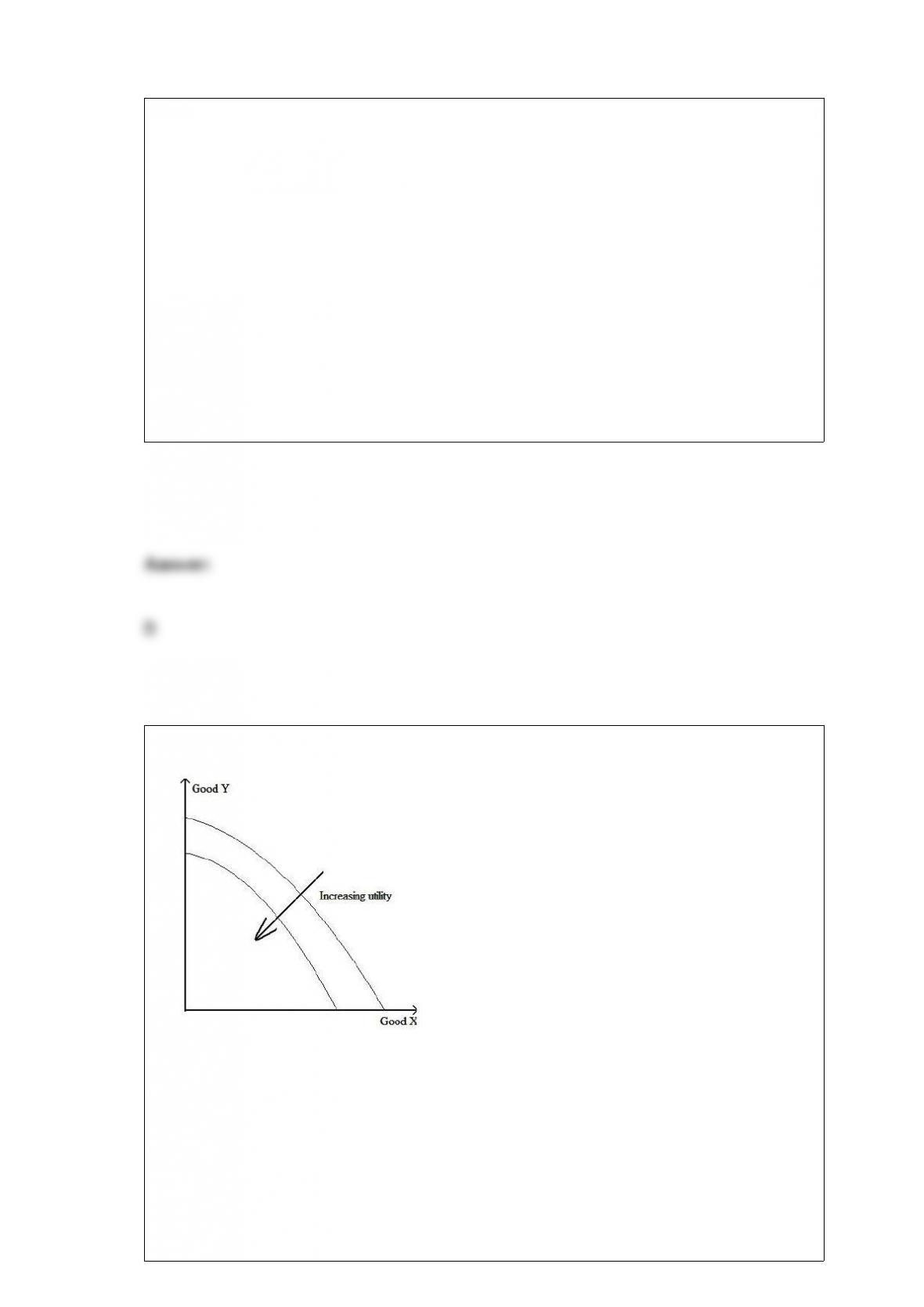
Consider the indifference map in the figure below:
Which of the four basic assumptions about consumer preferences are violated by this
indifference map?
A) More is better than less
B) Transitivity
C) Diminishing MRS

D) A and B are correct.
E) A and C are correct.
Consider the information below:
For Group A the cost of attaining an educational level y is
CA(y) = $6,000y
and for Group B the cost of attaining that level is
CB (y) = $10,000y.
Employees will be offered $50,000 if they have y < y*, where y* is an education
threshold determined by the employer. They will be offered $130,000 if they have y >
y*.
The lowest level of y* that can be set and still have only the high-productivity people
meet it is
A) 90.
B) 60.
C) 30.
D) 22.5.
E) 15.
What is the maximum value of the Lerner index?
A) Infinity
B) 100
C) Two
D) One
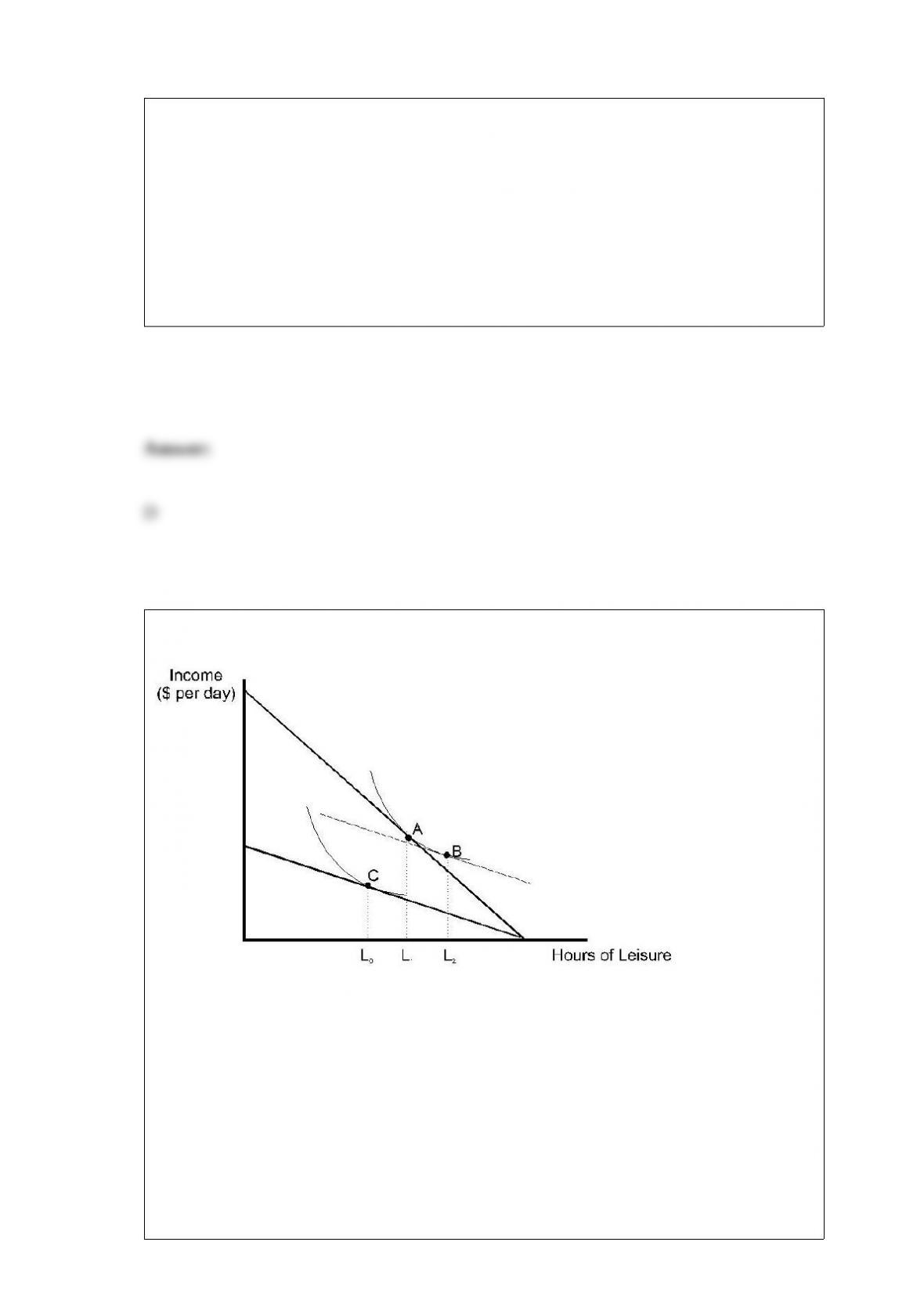
Figure 14.2
A consumer’s original utility maximizing combination of income and leisure is shown
in the diagram above as point A. After a wage decrease, the consumer’s utility
maximizing combination changes to point C.
Refer to Figure 14.2. The income effect of the wage decrease on the amount of hours of
leisure is:
A) L0 to L1.

B) L0 to L2.
C) L1 to L2.
D) L2 to L1.
E) none of the above
The following table contains information for a price taking competitive firm. Complete
the table and determine the profit maximizing level of output (round your answer to the
nearest whole number).
Total Marginal Fixed Average Total Average Marginal
Output Cost Cost Cost Cost Revenue Revenue Revenue
0 5 0
1 7 10
2 11 20
3 17 30
4 27 40
5 41 50
6 61 60
The demand for tickets to the Daytona 500 NASCAR event is given by the equation
QD = 350,000 – 800P. The supply of tickets to the event is given by the capacity of the
Daytona track, which is 150,000. What is the equilibrium price of tickets to the event?
What is the price elasticity of demand at the equilibrium price? What is the price
elasticity of supply at the equilibrium price?
Calculate the expected value of the following game. If you win the game, your wealth
will increase by 36 times your wager. If you lose, you lose your wager amount. The
probability of winning is 1/38 Calculate the variance of the game.
Suppose that a consumer’s increase in nominal income from the base year is exceeded
by the inflation level given by a Paasche cost of living index for their level of
purchases:
( < )
Show that this information implies that the consumer is strictly worse-off as compared
to the base year. (Hint: Use a revealed preference argument.)
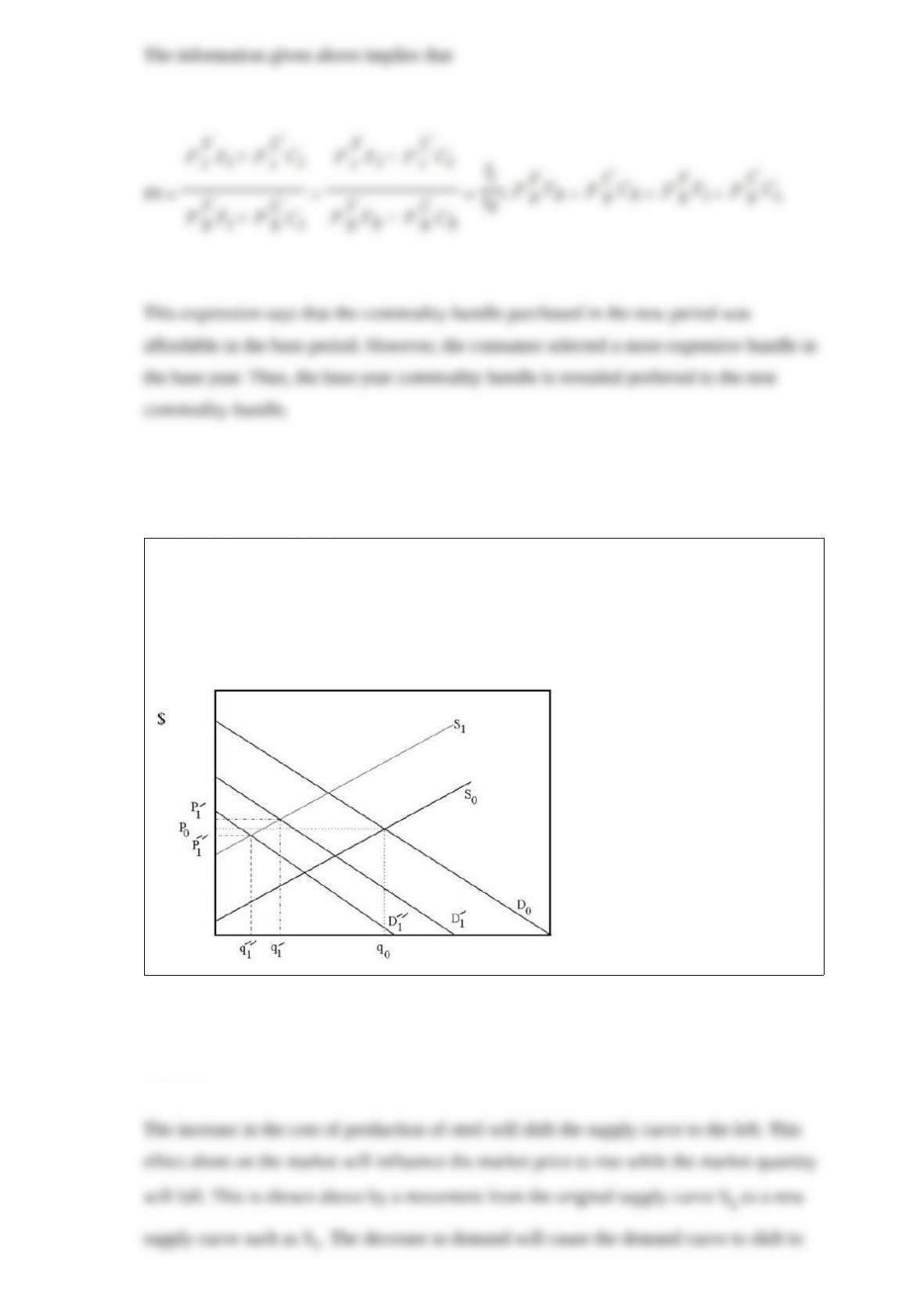
Suppose that due to more stringent environmental regulation it becomes more
expensive for steel production firms to operate. Also, recent technological advances in
plastics has reduced the demand for steel products. Use Supply and Demand analysis to
predict how these shocks will affect equilibrium price and quantity of steel. Can we say
with certainty that the market price for steel will fall? Why?
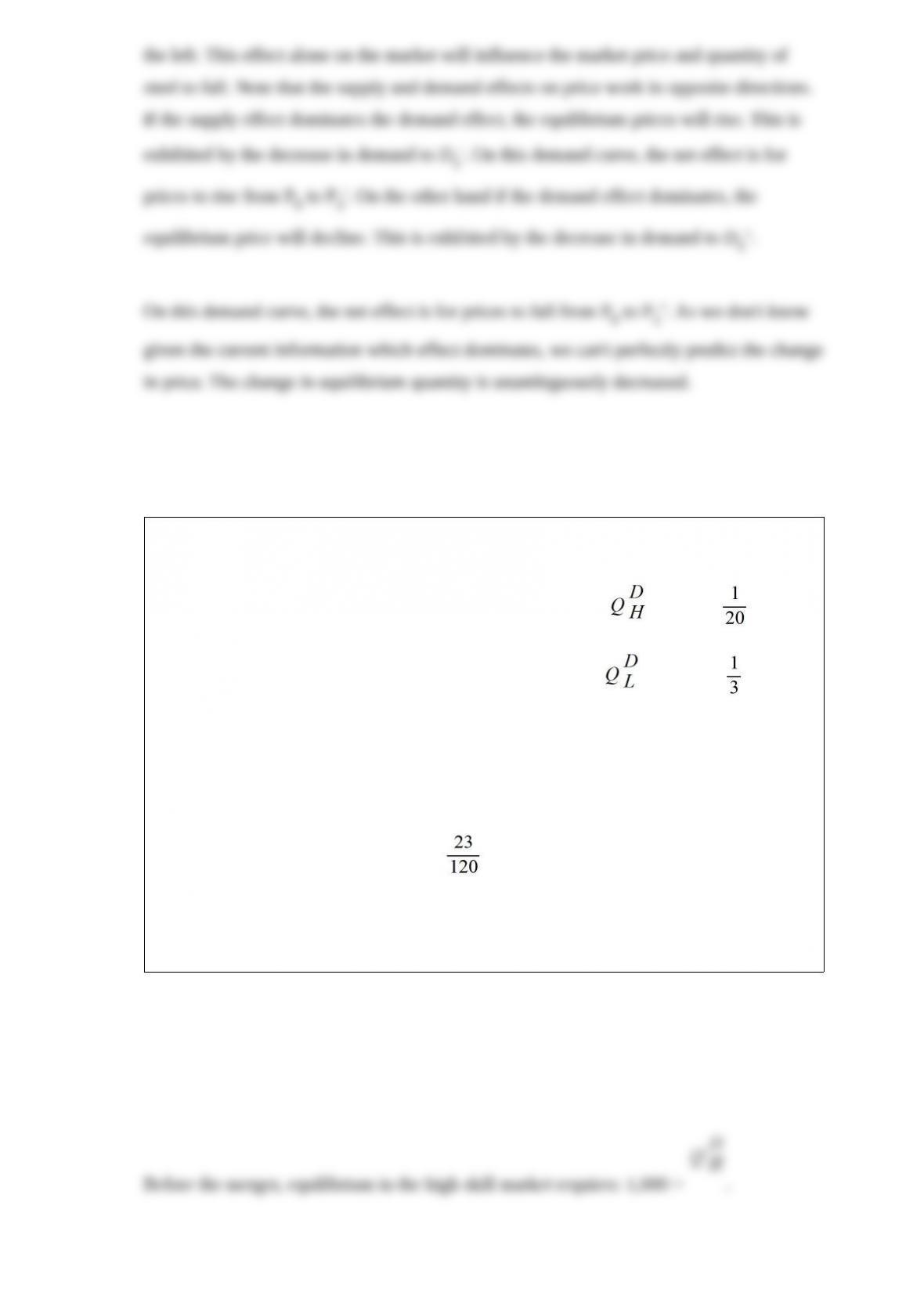
Prestige University grants degrees only to high skill students who perform well for their
eventual employers. Mediocre University grants degrees only to low skill students. The
market demand for newly graduated high skilled workers is: = 5,000 – pH. The
market demand for newly graduated low skilled workers is: = 15,000 – pL.
Currently, Prestige University graduates 1,000 students while Mediocre University
graduates 5,000. Determine the equilibrium prices for low and high skilled graduates.
Suppose that in an effort to cut costs, the State has merged Prestige University and
Mediocre University into State University. This merger has eliminated the signal that
employers use to rely on to discern graduate quality. As a result, the demand for State
University graduates is: QD = 10,000 – P. The number of graduates from State
University will be 6,000. Calculate the equilibrium price for State University graduates.
Before the merger, would students at both Universities be willing to pay higher tuition
in an effort to prevent the Universities from merging? Why or why not?
Adriana is in charge of setting the price on basketball tickets for the local team’s home
games. From previous experience, she has estimated demand to be
P = 50 – 0.00166Q,
where P represents price in dollars per seat, and Q represents seats that could be sold
per game. The seating capacity is 25,000 seats. Determine the number of tickets that
would be sold at a ticket price of $15 each. Also, determine the consumer surplus that
could be absorbed from these consumers if Adriana were able to set ticket prices so that
each customer (who values the ticket at least at $15) pays the entirety of his or her
actual valuation of the ticket.
The demand for telephone wire can be expressed as:
Q = 6000 – 1,500P,
where Q represents units, in pounds per day, and P represents price, in dollars per
pound. Determine the price elasticity of demand at P = $2.00 per pound.
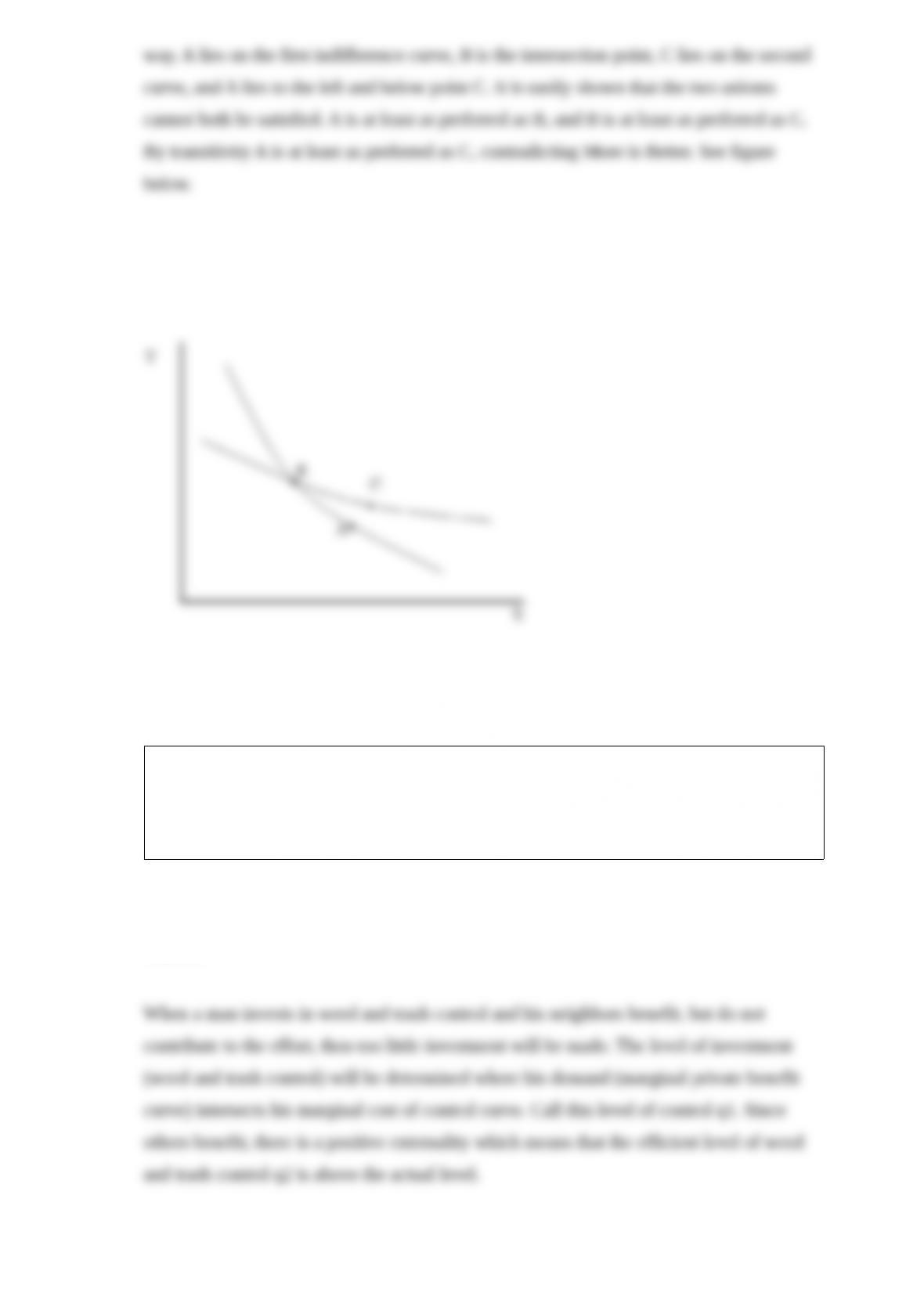
In the theory of consumer behavior, certain axioms about the nature of preferences
imply that indifference curves cannot cross. Which axioms imply this? Explain your
answer using a diagram and using words.
When a man invests in controlling weeds and trash that tend to accumulate in his yard,
both he and his neighbors benefit from his action. Is an externality associated with his
private decision? If so, explain its effect, and determine whether the efficient level of
weed control occurs when the individual invests in weed control.
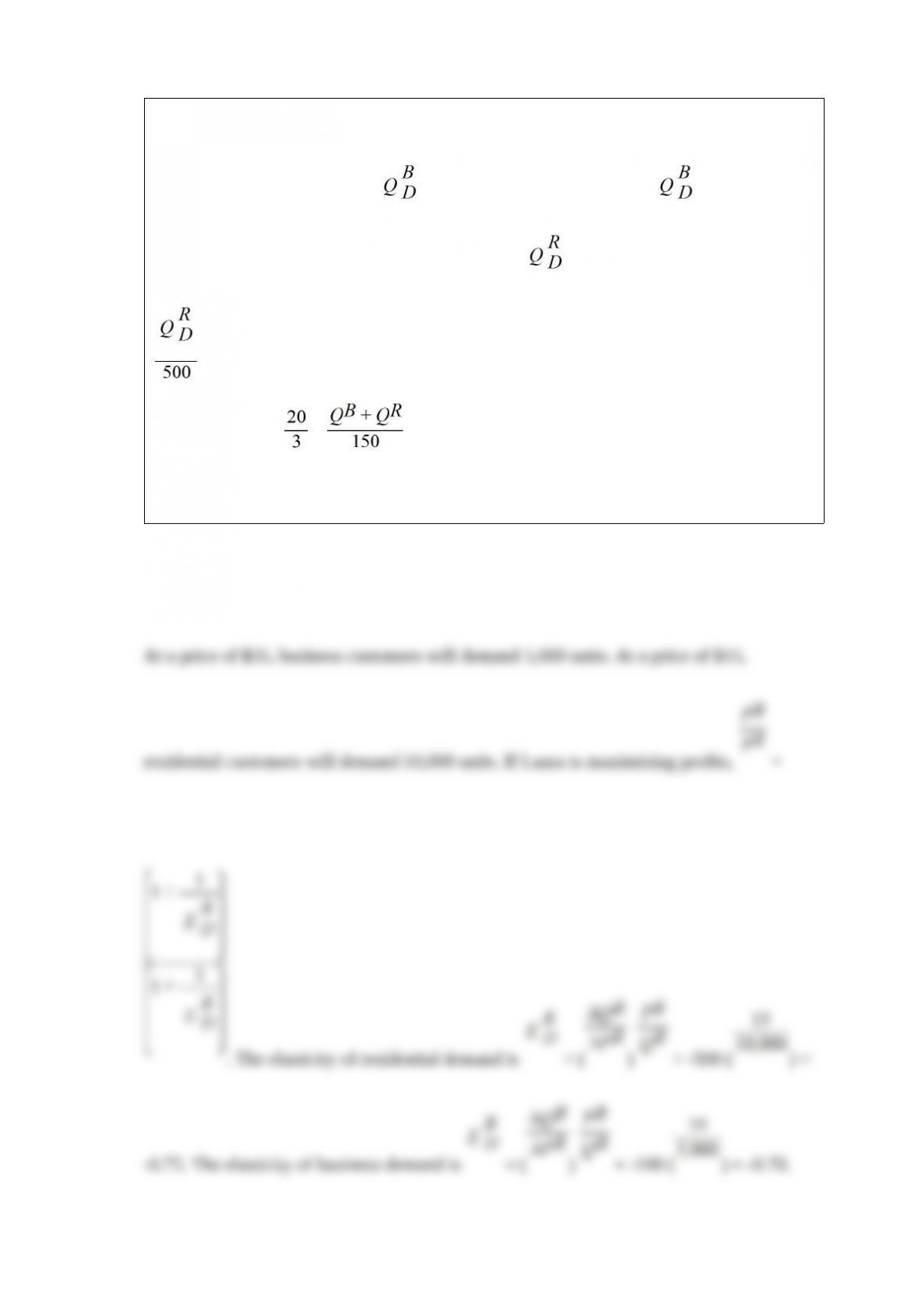
Internet service in the local market is supplied by Laura’s Internet Service. Laura has
two types of consumers. The first type of customers is local businesses, and their
demand for internet service is = 8,500 – 100P ⇔P = 85 – 0.01 . The second
type is residential customers, and their demand is = 12,500 – 500P ⇔P = 25 –
. Laura’s marginal cost function is
MC (QB + QR) = + . If Laura practices third-degree price discrimination
and charges business customers $35 and residential customers $15, is Laura
maximizing profits?
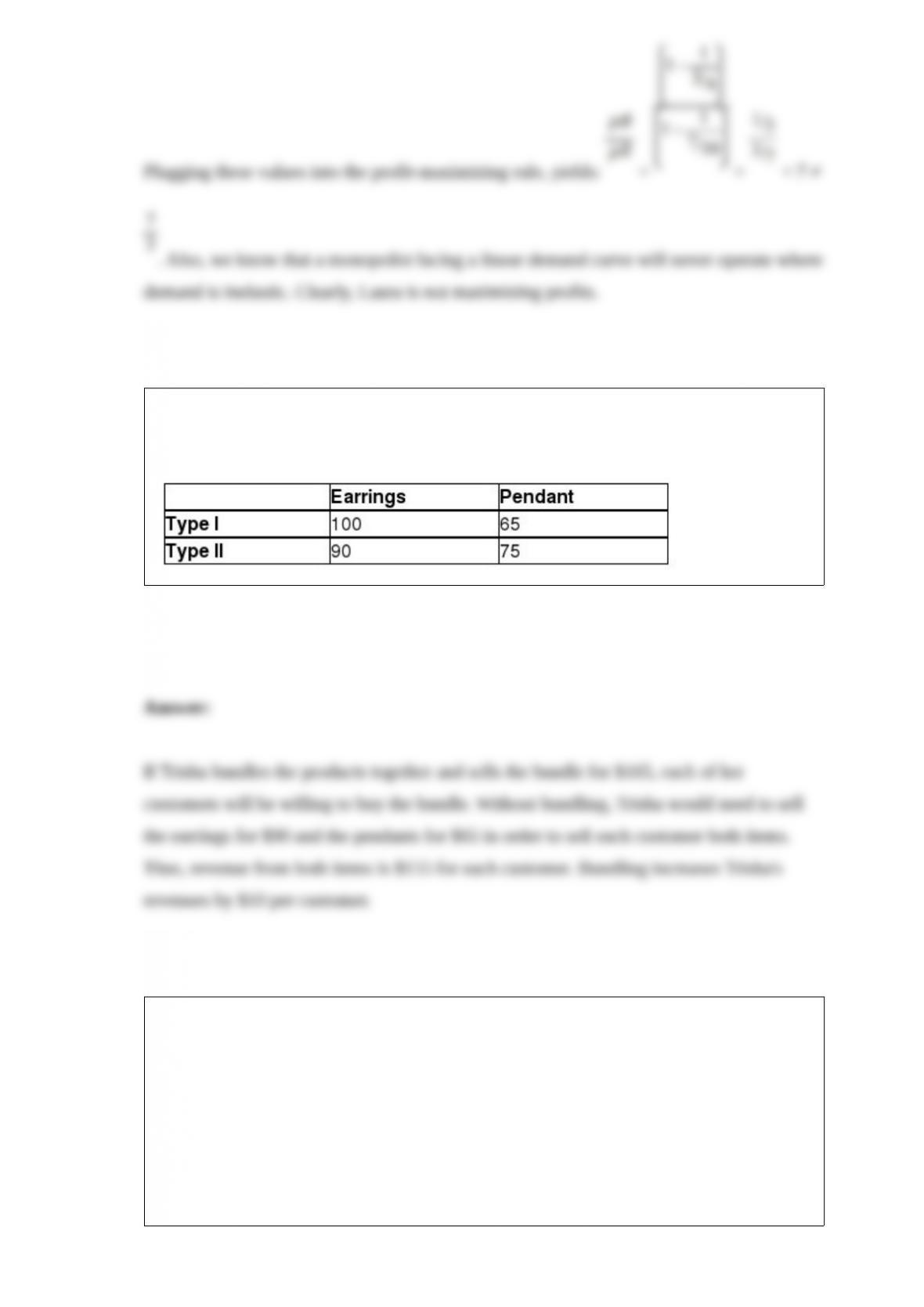
Trisha’s Fashion Boutique sells earrings and pendants. Trisha has two types of
customers. Their willingness-to-pay for earrings and pendants are given in the table
below. If Trisha bundles the earrings and pendants together, could she increase revenue?
Ms. Moneynickel has a monopoly in oil refinement in the local market. The demand for
Ms. Moneynickel’s oil is: P = 65 – q. The relevant marginal revenue function is: MR(q)
= 65 – 2q. Ms. Moneynickel’s marginal cost function is: MC(q) = In the refinement of
oil, Ms. Moneynickel emits pollution that has the marginal external cost function:
MEC(q) = What level of output will Ms. Moneynickel select to maximize profits? What
is the marginal social cost of Ms. Moneynickel’s profit maximizing output? What do
consumers pay for Ms. Moneynickel’s refined oil? Is this level of output efficient?
Should more or less oil be refined to reach the optimum output level? Should the local
government charge Ms. Moneynickel a pollution fee for each unit of oil she refines?
Suppose the minimum wage was $0.25 per hour in 1938 and the CPI in that year was
11.5. If the CPI in 1990 was 130.7, what is the real value of the 1938 minimum wage in
terms of 1990 dollars? The real value of the 1990 minimum wage in terms of 1990
dollars is $4.25. Has the real value of the minimum wage declined since 1938?
Explain what the principal-agent problem is, and explain evidence of its existence in
hospitals in the United States.