
Fred and Wilma just had a baby girl and want to make sure they save enough in the
future to send her to college. They begin to save in response to this ______ reason for
saving.
A. life-cycle
B. bequest
C. private
D. precautionary
Suppose that there are two types of houses for sale: those with solid foundations and
those with cracked foundations. In all other respects, the two types of houses are
identical. Houses with solid foundations are worth $200,000, while those with cracked
foundations are worth $200,000 minus the $20,000 to fix the crack, or $180,000. Sellers
know which type of house they have, but buyers cannot detect whether the foundation
has a crack. Suppose that 80 percent of the houses for sale have a solid foundation and
20 percent of the houses for sale have a cracked foundation. If buyers are risk-neutral
and know the that 80 percent of the houses for sale have a solid foundation while 20
percent have a cracked foundation, then how much will buyers be willing to pay for a
house.
A. $200,000.
B. $196,000.
C. $180,000.
D. $160,000.
The goal of utility maximization is to allocate your ______ in order to maximize your
______.
A. utility; spending
B. resources; satisfaction
C. time; work
D. resources; desires
The real rate of return on holding cash is equal to:
A. the nominal interest rate.
B. the real interest rate.
C. the expected inflation rate.
D. zero minus the inflation rate.

The benefit of holding money is _______, while the opportunity cost of holding money
is _______.
A. the nominal interest rate; the fees charged by banks
B. the nominal interest rate; its usefulness in carrying out transactions
C. increased income; lost purchasing power
D. its usefulness in carrying out transactions; the nominal interest rate
In the absence of laws requiring individuals to purchase insurance, insurance is most
attractive to:
A. the poor.
B. the wealthy.
C. those with lowest likelihood of filing a claim.
D. those with the highest likelihood of filing a claim.
According to the Principle of Increasing Opportunity Cost, in expanding the production
of any good, we should start by utilizing the resources that:
A. we have the most of.
B. we have the least of.
C. have the highest opportunity cost.
D. have the lowest opportunity cost.
As the quality of available resources becomes worse:
A. aggregate demand falls.
B. aggregate demand rises.
C. aggregate supply falls.
D. aggregate supply rises.
Bob’s Barber Shop cut 3,000 heads of hair in 2014 and 3,100 in 2015. The price of a
hair cut was $7 in 2014 and $8 in 2015. If 2014 is the base year, what was Bob’s
contribution to nominal GDP in 2015?
A. $21,000

B. $21,700
C. $24,000
D. $24,800
Suppose the following information describes the economy:
Private saving equals ____; public saving equals ______; national saving equals ____.
A. 100; 200; 100
B. 100; 100; 200
C. 200; 100; 300
D. 200; 100; 500
In Cuba, a bureaucratic committee makes the production decisions for the country’s
firms and factories. Therefore, Cuba is an example of a:
A. centralized economy.
B. capitalist economy.
C. mixed economy.

D. pure free-market economy.
Assume that all firms in this industry have identical cost curves, and that the market is
perfectly competitive.
If the market supply curve is given by S3, then what will happen to the market supply
curve in the long run?
A. It will stay at S3, but the quantity supplied will increase.
B. It will shift to S2.
C. It will shift to S1.
D. It will stay at S3, but the quantity supplied will decrease.

For the Fall semester, you had to pay a nonrefundable fee of $600 for your meal plan,
which gives you up to 150 meals. If you eat 100 meals, your marginal cost of the 100th
meal is:
A. $6.
B. $4.
C. $0.25.
D. $0.
The presence of an unregulated negative externality means that the unregulated market
equilibrium quantity is:
A. efficient.
B. smaller than is optimal.
C. larger than is optimal.
D. greater than demand.
If a perfectly competitive firm can sell each unit of output for $9, and the marginal cost
of the last unit produced is $8.50, then the:
A. extra benefit of the last unit produced is less than the extra cost.
B. firm should lower its output level in order to increase profits.
C. firm is earning an average profit of $0.50.
D. extra benefit of the last unit produced is greater than the extra cost.
The Incentive Principle states that a person:
A. is more likely to take an action if its cost increases.
B. is more likely to take an action if its benefit increases.
C. should take an action if its cost increases.
D. should take an action if its benefit increases.
Points that lie below the production possibilities curve are inefficient because:
A. more of one good could be produced without producing less of the other.
B. producing more of one good means producing less of the other.
C. producers face scarcity.
D. too many goods are being produced.
Capital income includes:
A. profits, rent, and interest.
B. wages and salaries.
C. earnings of the self-employed.
D. capital gains from stock sales.

The following payoff matrix shows the outcomes for the Unites States and Russia from
relying on conventional weapons versus atomic weapons in a military conflict. The
percentages refer to the fraction of the population that would die.
This situation above illustrates a positional externality because:
A. using atomic weapons is a dominated strategy.
B. using atomic weapons improves each country’s outcome but hurts the other country.
C. the game does not have a Nash equilibrium.
D. no matter what kind of weapons each country chooses, many people will die.
Assume that the average male wage rate is 20% higher than the average female wage
rate. One can infer that:
A. this is evidence of discrimination because females should be paid the same as males.
B. employers undervalue female employees, so they”re able to pay them less.
C. customers overvalue male employers, so employers pay males more.
D. this is evidence of discrimination only if all factors affecting productivity are equal.
Sharing the results of applied research conducted under government sponsorship with
the private sector, such as the development of the Global Positioning System (GPS), is

an example of a government policy to promote economic growth by:
A. increasing human capital.
B. increasing physical capital.
C. improving technology.
D. increasing the availability of natural resources.
For which of the following products is demand likely to be least elastic with respect to
price?
A. Food
B. Vegetables
C. Green vegetables
D. Green beans
If the demand curve is horizontal, then demand is:

A. perfectly inelastic.
B. unit elastic.
C. elastic.
D. perfectly elastic.
You paid $35 for a ticket (which is non-refundable) to see SPAM, a local rock band, in
concert on Saturday. Assume that $35 is the most you would have been willing to pay
for a ticket. Your boss called, and she is looking for someone to cover a shift on
Saturday at the same time as the concert. You would have to work 4 hours and she
would pay you $11/hr. The psychic cost to you of working is $2/hr. What is your
opportunity cost of going to work on Saturday?
A. $0
B. $9
C. $35
D. $36

Refer to the figure below. The total utility of consuming two pizzas a week is:
A. 25
B. 30
C. 55
D. 75
The figure below shows the supply and demand curves for oranges in Smallville.
When this market is in equilibrium, total economic surplus is ______ per day.
A. $0
B. $80
C. $160
D. $320

Matt has decided to purchase his textbooks for the semester. His options are to purchase
the books online with next day delivery at a cost of $175, or to drive to campus
tomorrow to buy the books at the university bookstore at a cost of $170. Last week he
drove to campus to buy a concert ticket because they offered 25 percent off the regular
price of $16. The benefit to Matt of driving to campus to buy the concert ticket last
week was:
A. $2
B. $4
C. $9
D. $16
Explicit costs:
A. measure the opportunity costs of the resources supplied by the firm’s owners.
B. are fixed in the short run.
C. measure the payments made to the firm’s factors of production.
D. are variable in the short run.

The Hatfields and the McCoys both earn $50,000 per year in real terms in the labor
market, and both families are able to earn a 25% real interest rate on their savings.
Assume that all interest is paid out as income in the following year. In the year 2010,
both families began to save. The Hatfields saved 8% of their income each year; the
McCoys saved 10%. In 2010, the Hatfields consumed ______ more than the McCoys;
in 2011, the Hatfields consumed ______ than the McCoys.
A. $1,000; about $800 more
B. $2,000; about $250 more
C. $1,000; about $800 less
D. $2,000; about $250 less
Suppose that the equilibrium price of T-shirts increases and the equilibrium quantity
falls. Which of the following best fits the observed data?
A. An increase in demand with supply constant.
B. A decrease in supply with demand constant.
C. An increase in demand coupled with an increase in supply.
D. A decrease in demand with supply constant.
If the price of textbooks increases by one percent and the quantity demanded falls by
one-half percent, then the price elasticity of demand is equal to:
A. 0.05.
B. 0.5.
C. 2.
D. 5.
Holding other factors constant, if a larger proportion of the population enters the labor
force as a result of a growing social acceptance of women working, then the real wages
of workers will ______ and employment of workers will _____.
A. increase; increase
B. increase; decrease
C. decrease; not change
D. decrease; increase
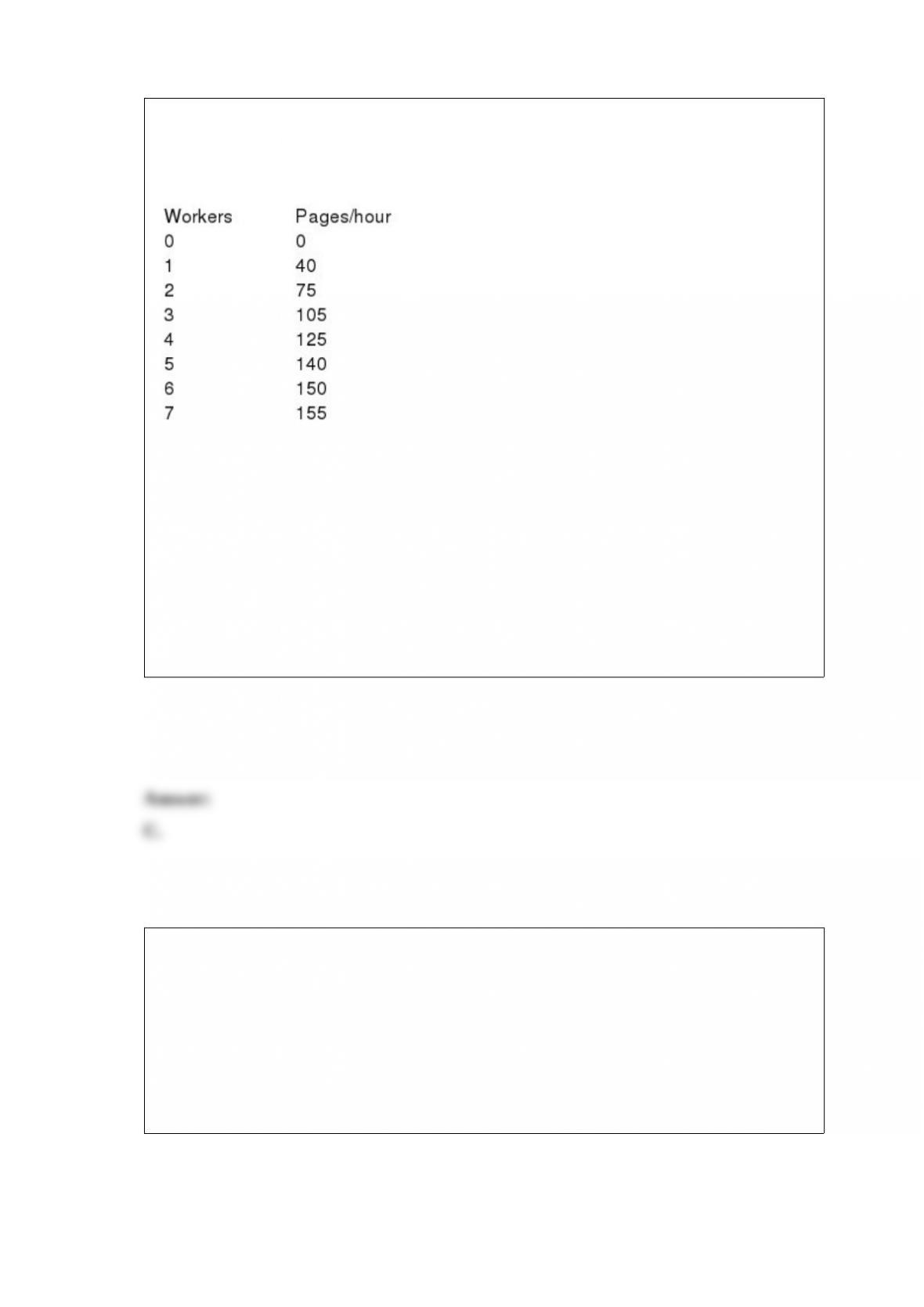
Paper Pushers Inc. hires workers in a competitive labor market. Apart from labor, the
company has no other variable inputs. The company’s hourly output varies with the
number of workers hired, as shown in the table below.
If the price of each page increases, then the demand for workers will
A. remain the same because changes in the output market will not affect the demand for
labor.
B. increase because the workers will be motivated to produce more.
C. increase because the value of the marginal product of labor will increase.
D. decrease because at a higher sales price the firm will not have to produce as much
output.
Empirical studies suggest that as real GDP per person increases the level of pollution:
A. increases.
B. decreases.
C. remains constant.
D. first increases then decreases.