
You borrow $10,000 from a bank for one year at a nominal interest rate of 5%. The CPI
over that year rises from 180 to 200. What is the real interest rate you are paying?
A) 15%
B) 5%
C) -1.1%
D) -6.1%
Which of the following statements is true?
A) Input prices are one of the success factors that firms can control.
B) Consumers will buy a product only if its price is below that of its competitors.
C) Consumers will buy a product only if it meets a need not met by competing
products.
D) Sheer chance can play a significant role in the success or failure of a business.
The quantity theory of money assumes that
A) the velocity of money is negative.
B) the velocity of money is constant.
C) the velocity of money is zero.
D) the velocity of money fluctuates unpredictably.
If average total cost is $50 and average fixed cost is $15 when output is 20 units, then
the firm’s total variable cost at that level of output is
A) $1,000.
B) $700.
C) $300.
D) impossible to determine without additional information.
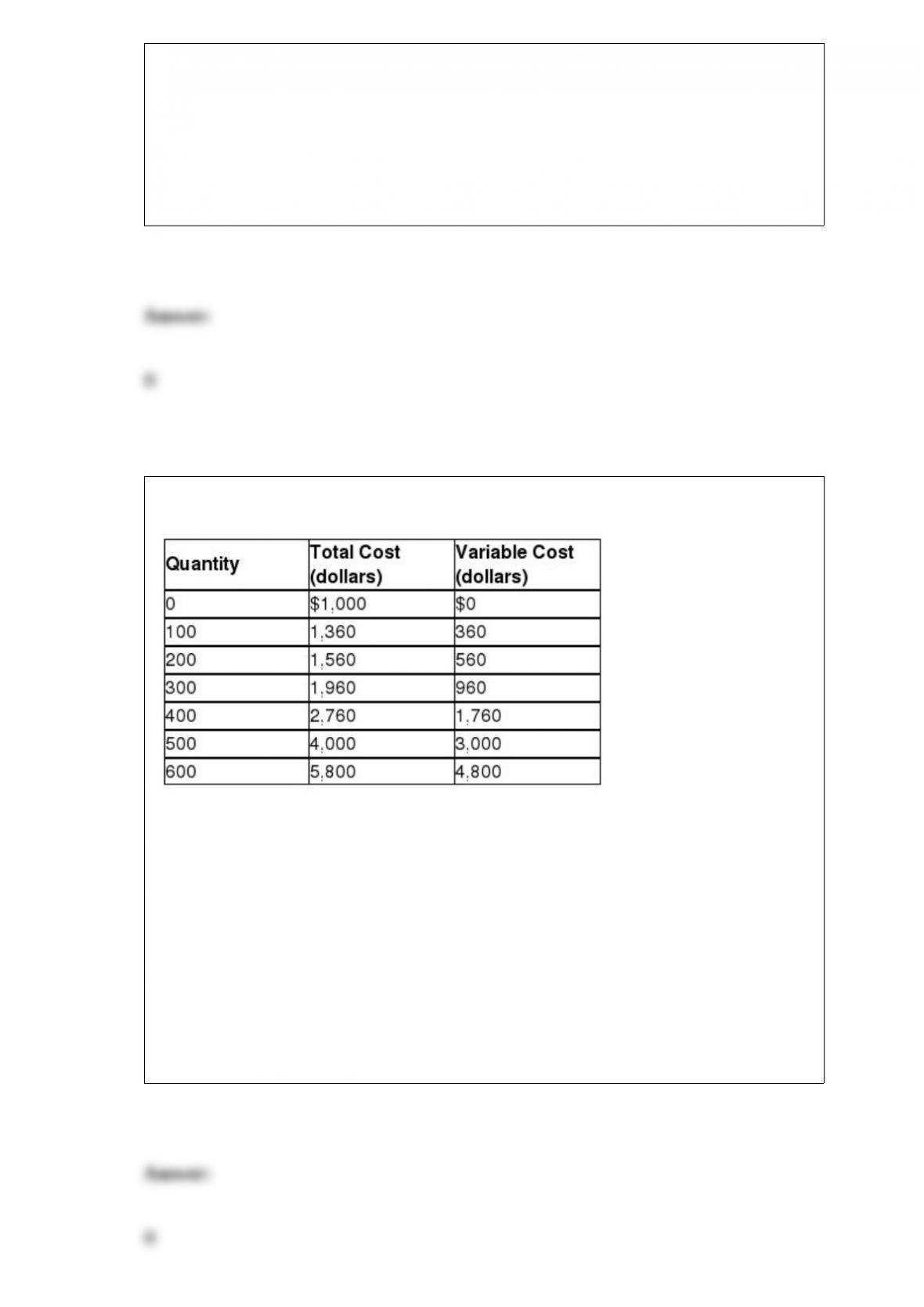
Figure 4-5 Figure 4-5 shows the
market for apartments in Bay City. Recently, the government imposed a rent ceiling at
R0. Suppose that instead of a price ceiling, the government imposed a price floor of R1.
What is the area representing the portion of consumer surplus transferred to producers
as a result of the price floor?
A) A
B) B
C) B + C
D) A + B
Table 12-1
Table 12-1 shows the short-run cost data of a perfectly competitive firm that produces
plastic camera cases. Assume that output can only be increased in batches of 100 units.
If the market price of each camera case is $8, what is the profit-maximizing quantity?
A) 300 units
B) 400 units
C) 500 units
D) 600 units

When a central bank works makes joint decisions with the government’s Treasury
department,
A) the central bank risks losing credibility.
B) the central bank is asserting its independence.
C) the government enhances its credibility.
D) the government loses its ability to conduct fiscal policy.
Which of the following would you expect to decrease both interest rates and exchange
rates? (Assume exchange rates are stated in terms of foreign currency per domestic
currency.)
A) contractionary monetary policy
B) expansionary monetary policy
C) contractionary fiscal policy
D) Both B and C will decrease both interest rates and exchange rates.
Which of the following is the best example of a quota?
A) a limit imposed on the number of sport utility vehicles that the United States can
import from Japan

B) a subsidy granted by the U.S. government to domestic garment manufacturers so
they can compete more effectively with foreign garment manufacturers
C) a tax placed on all sport utility vehicles sold in the domestic market
D) a $5,000 per-car fee imposed on all sport utility vehicles imported into the United
States
Ronald Coase was awarded the 1991 Nobel Prize in Economics primarily for
addressing problems related to externalities. Which of the following describes Coase’s
work?
A) Coase argued that government intervention is necessary to achieve economic
efficiency in markets that are affected by externalities.
B) Coase proved that economic efficiency cannot be achieved in a market that is
affected by positive or negative externalities.
C) Coase argued that under some circumstances private solutions to the problems of
externalities will occur.
D) Coase proved that a competitive market achieved a greater degree of economic
efficiency than a non-competitive market when externalities occur.
Equations for C, I, G, and NX are given below. If the equilibrium level of GDP is
$32,000, what will the new equilibrium level of GDP be if government spending
increases to 2,500? C = 5,000 + (MPC)Y
I = 1,500
G = 2,000
NX = -500 A) $32,500
B) $34,000
C) $38,000
D) $42,000
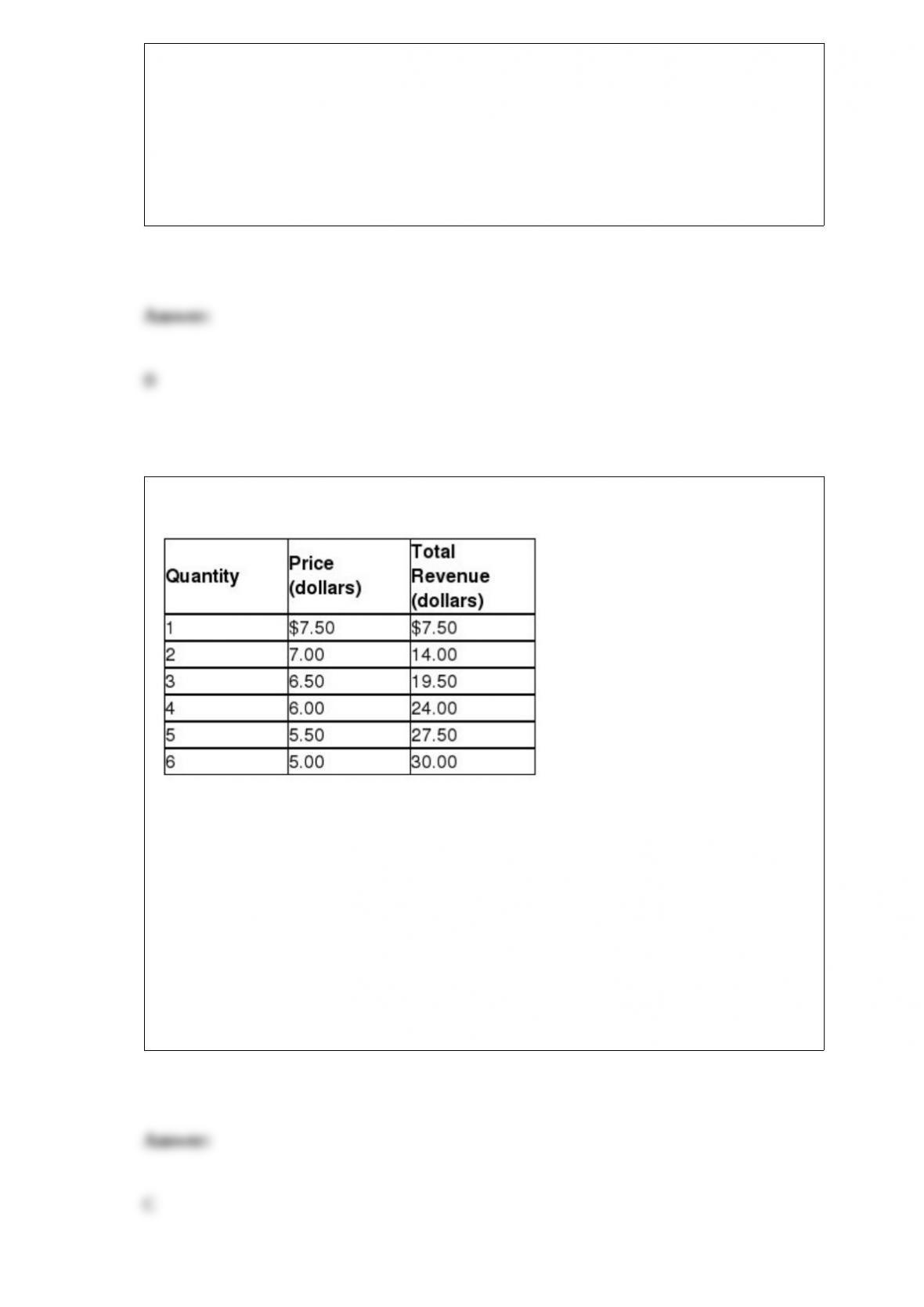
Table 13-1
What portion of the marginal revenue of the 5th unit is due to the output effect and what
portion is due to the price effect?
A) output effect = $3.00; price effect = $0.50
B) output effect = $1.50; price effect = $2.00
C) output effect = $5.50; price effect = -$2.00
D) output effect = $4.00; price effect = -$0.50